Introduction
Freight margins are tighter than they've been in years. U.S. business logistics costs reached $2.3 trillion in 2025, equal to 8.7% of GDP — and non-fuel trucking costs hit a record $1.779 per mile. Meanwhile, CBP issued over 53,000 liquidated damages cases in FY 2025 alone. The pressure on freight operations is relentless.
For shippers absorbing those costs, the practical question isn't whether to adopt freight forwarding software — it's which financial levers it actually moves, and by how much.
This article breaks down three specific mechanisms through which freight forwarding software drives measurable cost reduction — documentation automation, carrier rate optimization, and disruption prevention.
Key Takeaways
- Automating documentation can compress 6+ hours of per-shipment paper processing into minutes, cutting labor costs directly
- Over a third of TMS users achieve freight cost reductions greater than 12%, per ARC Advisory Group research
- Supply chain disruptions can erase 30–50% of annual EBITDA from a single 100-day event; early detection software significantly limits that exposure
- Manual processes scale poorly: inefficiencies compound as shipment volumes grow
- Software savings compound over time — they don't flatten after year one
What Is Freight Forwarding Software?
Freight forwarding software is a centralized digital platform that manages the coordination, documentation, tracking, and compliance of cargo movement from origin to destination. Instead of juggling spreadsheets, email chains, and phone calls across a dozen stakeholders, logistics teams work from a single system that connects all shipment data.
Freight forwarders, importers, exporters, and third-party logistics providers (3PLs) all rely on it to replace fragmented manual workflows. Gartner defines transportation management systems as software that supports multimodal sourcing, planning, and execution of physical transport. Core capabilities typically include:
- Carrier selection and rate comparison
- Load planning and multi-stop routing
- Real-time shipment tracking
- Delivery performance management
Beyond operations, freight forwarding software functions as a direct cost control tool. It reduces errors that generate penalties, captures rate data that prevents overpayment, and flags disruptions early enough to avoid the costliest last-minute fixes.
Key Benefits of Freight Forwarding Software for Cost Reduction
The benefits below map directly to cost categories freight operations actively track: labor, transportation spend, compliance penalties, and disruption losses. Each one is measurable.
Benefit 1: Documentation Automation Reduces Labor Costs Per Shipment
One of freight's most persistent hidden costs is staff time consumed by manual paperwork. According to McKinsey's research on trade documentation, a single shipment can involve up to 50 sheets of paper, 30 stakeholders, and six or more hours of processing time. Multiply that by weekly shipment volume and the labor cost becomes significant fast.
Freight forwarding software automates the most repetitive parts of this process:
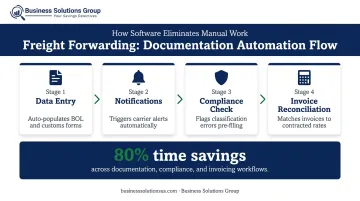
- Auto-populates bills of lading, customs declarations, and shipping forms from existing shipment data
- Triggers carrier notifications and status updates without manual input
- Flags classification inconsistencies before filings reach customs
- Reconciles freight invoices against contracted rates automatically
The financial impact runs in two directions. Labor cost per shipment drops first — staff spend less time on data entry and more time on work that generates revenue. A Forrester Consulting study found **80% time savings on manual freight management processes** for the modeled organization using a TMS platform.
Error costs fall second. A misclassified tariff code or incomplete customs declaration can trigger shipment holds, re-routing costs, and regulatory fines. CBP collected $46 million in trade enforcement actions in FY 2025 — most of those penalties stem from documentation errors that automation prevents.
KPIs this moves: labor cost per shipment, document processing time, customs filing error rate, compliance penalty frequency.
The ROI from documentation automation scales with volume. A company processing 50 shipments per week sees proportionally larger savings than one processing five — which is exactly when automation pays back fastest.
Benefit 2: Carrier Rate Optimization Controls Transportation Spend
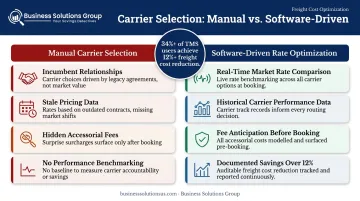
Carrier selection is one of the most controllable cost levers in freight forwarding. Most businesses without dedicated software manage it through incumbent relationships and manual quote comparisons — neither of which reflects current market conditions.
Freight forwarding software changes the input. Rate comparison tools pull current market data across carriers and lanes. Historical performance data shows which carriers consistently meet delivery windows. Cost estimation tools account for mode-specific fees, port surcharges, and accessorial charges before booking — not after.
Carrier decisions shift from habit to data — and the savings are documented. ARC Advisory Group's TMS ROI research found that more than one-third of surveyed users achieved freight cost reductions greater than 12%. A Forrester/Alpega study reported €164,000 in freight optimization benefits over three years from improved spot-rate utilization and container load optimization alone.
Beyond rate selection, software addresses a less visible problem: hidden fee accumulation. The FMC reported that nine major ocean carriers collected approximately **$15.4 billion in detention and demurrage charges** from 2020 to 2025 — fees that often result from poor visibility into container status and terminal free time. Route planning tools in freight software help teams anticipate these charges before they trigger.
What to measure: cost per shipment, transportation spend as a percentage of revenue, carrier contract compliance rate, quote-to-actual cost variance.
This benefit delivers the highest impact for businesses shipping across multiple carriers or lanes, where inconsistent pricing and fragmented rate data create the most exposure to overspend.
Benefit 3: Real-Time Visibility Prevents the High Cost of Disruptions
Disruptions are inevitable — but their financial impact isn't fixed. The cost scales with how late your team finds out, not just how severe the event is.
McKinsey's supply chain resilience research found that a single 100-day disruption can erase 30–50% of annual EBITDA across most industries. Companies can expect disruption losses equivalent to roughly 42% of one year's EBITDA every decade. Adding resilience to logistics decision-making can reduce that EBITDA exposure by up to 60%.
Freight forwarding software provides end-to-end visibility across all active shipments through a single dashboard, with automated alerts triggered by:
- Status changes and milestone delays
- Compliance flags or documentation gaps
- Port congestion or carrier schedule deviations
- Customs clearance holds
That early warning window is what changes the financial outcome. A team that learns about a customs delay two days out can reroute, adjust inventory orders, or communicate proactively with customers. A team that learns about it when a customer escalates is left choosing between expedited freight, emergency procurement, or issuing customer credits — all expensive options.
Context on why timing matters: global ocean schedule reliability dropped to 62.8% in December 2025, with late vessel arrivals averaging 5.04 days, per Sea-Intelligence data. Nearly 40% of ocean shipments arrive late. Real-time visibility doesn't prevent that — but it determines whether your team responds in hours or days.
Key metrics: on-time delivery rate, disruption response time, expedited freight spend, customer chargeback rate, inventory carrying cost.
What Happens Without Freight Forwarding Software
Running freight operations without dedicated software creates compounding cost exposure across multiple categories at once — and the damage is rarely visible until it's already significant.
Documentation errors accumulate silently. Manual data entry across 30 stakeholders and 50 documents per shipment creates systematic error risk. Fines, customs delays, and re-shipping costs follow — and they're hard to trace back to a single filing mistake.
Carrier overpayment becomes invisible. Without rate benchmarking data, businesses default to incumbent carriers and last-known pricing. The overpayment is real; it just doesn't show up until a benchmark comparison is run.
Disruption response is always reactive. Without real-time visibility, teams discover delays after customers escalate. By that point, expedited shipping and customer credits are the only options left.
McKinsey's 2023 digital logistics report found that 93% of shippers planned to maintain or grow technology investments, framing TMS as a minimum requirement to stay competitive — not a differentiator.
Businesses still running manual processes aren't just less efficient; they're structurally more expensive per shipment than digitally enabled competitors, and that gap widens as volumes grow.
How to Get the Most Value from Freight Forwarding Software
Freight forwarding software generates compounding returns when teams treat it as an operational discipline. Three principles determine how much value you actually capture:
- Use the data to drive decisions. Rate analytics and carrier performance reports only reduce costs when teams act on them — renegotiating contracts, switching underperforming carriers, adjusting routing by lane.
- Enforce consistent adoption across teams. Automation and visibility benefits erode when individuals manage shipments outside the system. Partial adoption produces partial results.
- Combine software data with market benchmarking. Freight software surfaces your cost data. Converting that data into negotiating leverage requires external market context — what comparable shippers are paying, where your rates are out of line, and how to structure the negotiation.
For companies that want that additional layer, supply chain advisory firms like Business Solutions Group provide carrier benchmarking, spend intelligence analysis, and contract negotiation support. BSG has helped over 1,200 companies reduce shipping costs, with freight advisory clients typically achieving 20–25% reductions on freight spend.
Conclusion
Freight forwarding software attacks costs from three directions: documentation automation cuts administrative labor, data-driven carrier management controls transportation spend, and real-time visibility prevents the expensive surprises that derail supply chains.
These savings compound over time. As shipment volumes increase, rate data accumulates, and teams build consistent habits around the tools, the financial returns grow. Businesses that treat freight forwarding software as a long-term financial investment (not just a tracking upgrade) consistently outpace competitors still managing logistics manually.
Frequently Asked Questions
What software do freight forwarders use?
Freight forwarders typically use purpose-built Transportation Management Systems (TMS) or freight forwarding platforms that handle shipment coordination, customs documentation, carrier management, and real-time tracking — ranging from enterprise-grade TMS solutions to cloud-based tools built specifically for forwarders and 3PLs.
How does freight forwarding software reduce operational costs?
It works through three mechanisms: automating labor-intensive documentation (cutting hours of manual work per shipment), optimizing carrier selection with current rate data (preventing systematic overpayment), and enabling early disruption detection that avoids costly reactive measures like expedited freight or customer credits.
Can freight forwarding software benefit small and mid-sized shippers, not just large enterprises?
Smaller shippers often see the strongest returns from documentation automation and carrier rate visibility, since they typically lack the negotiating leverage and dedicated logistics staffing that larger enterprises rely on to control costs manually. Per-shipment efficiency gains are proportionally significant even at lower volumes.
How does automation in freight software reduce compliance penalties?
Automated customs document generation reduces human error in tariff classifications and declaration filings — the leading causes of shipment holds and regulatory fines. CBP collected $46 million in trade enforcement actions in FY 2025, most of it tied to documentation errors that automated systems are designed to prevent.
What is the typical ROI timeline for freight forwarding software?
A Forrester Consulting study reported a 150% ROI and an 8-month payback period for one TMS implementation, with €221,000 in net present value over three years. ROI accelerates as shipment volumes grow, since automation and rate optimization savings scale with transaction count.
How does freight forwarding software help control hidden shipping costs?
Route planning and cost estimation tools help teams anticipate accessorial fees, port surcharges, and mode-specific charges before booking, closing the gap between quoted and actual costs. This matters: ocean carriers collected $15.4 billion in detention and demurrage charges over a recent five-year period, largely driven by poor visibility into container and terminal status.