Introduction
U.S. business logistics costs reached $2.58 trillion in 2024 — 8.8% of GDP, up 5.4% year-over-year. That's before factoring in the carrier rate increases hitting shippers from every direction: FedEx and UPS each announced 5.9% average increases for 2025, while USPS proposed increases of up to 7.6% on Parcel Select effective July 2025.
For companies that rely on parcel or freight shipping, rising transportation costs are a painful — and often hidden — drain on margins. External rate pressure is only part of the problem.
Most shipping overspend originates internally: poor carrier selection habits, manual workflows that scale poorly, errors that trigger surcharges, and no spend visibility to support contract negotiations.
Each of those is a correctable behavior — and shipping automation corrects them at the source.
This post walks through five specific ways shipping automation reduces cost — from carrier rate selection through to contract leverage — and how to prioritize them based on where your spending actually leaks.
Key Takeaways
- Carrier fees, labor, errors, and poor routing stack up — the true shipping cost is always larger than any single line item
- Automation eliminates entire categories of waste, not just speeds up tasks
- Real-time spend data is a negotiation asset — businesses without it consistently leave contract savings on the table
- Start with a spend audit before selecting any tool; the best ROI entry point is wherever cost leakage is greatest
- Each automation strategy in this guide targets a different cost driver — addressing more than one compounds the savings
Why Shipping Costs Keep Rising and Stay Hidden
Most shippers don't have a shipping cost problem — they have a shipping visibility problem. The spend is there; it's just scattered across enough operational layers that no single number captures it.
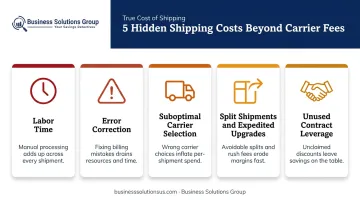
Carrier fees are the obvious line item. But the real cost of shipping accumulates across:
- Labor time for manual order import, label generation, and carrier assignment
- Error correction when wrong ZIP codes, incorrect weights, or missing customs documents trigger reshipments or surcharges
- Suboptimal carrier selection — often a default choice made once and never revisited
- Split shipments and expedited upgrades caused by disconnected inventory systems
- Unused contract leverage because there's no spend data to bring to negotiations
A 2024 Descartes benchmark survey of 630+ companies found that 37% still rely on spreadsheets and emails for shipping visibility. That's a cost measurement gap. Without accurate spend data, businesses estimate their shipping costs — and those estimates quietly erode margins.
A suboptimal carrier choice on a single shipment costs a few dollars. Repeated across thousands of shipments, that same habit compounds into a significant annual expense. No single decision looks catastrophic — which is exactly why the pattern goes unchallenged until someone measures it.
Top 5 Ways Shipping Automation Can Cut Costs
These five strategies span decisions, execution, and governance — meaning automation reduces cost at every stage of the shipping lifecycle, not just at the point of label generation.
Way 1: Automated Carrier Rate Shopping and Selection
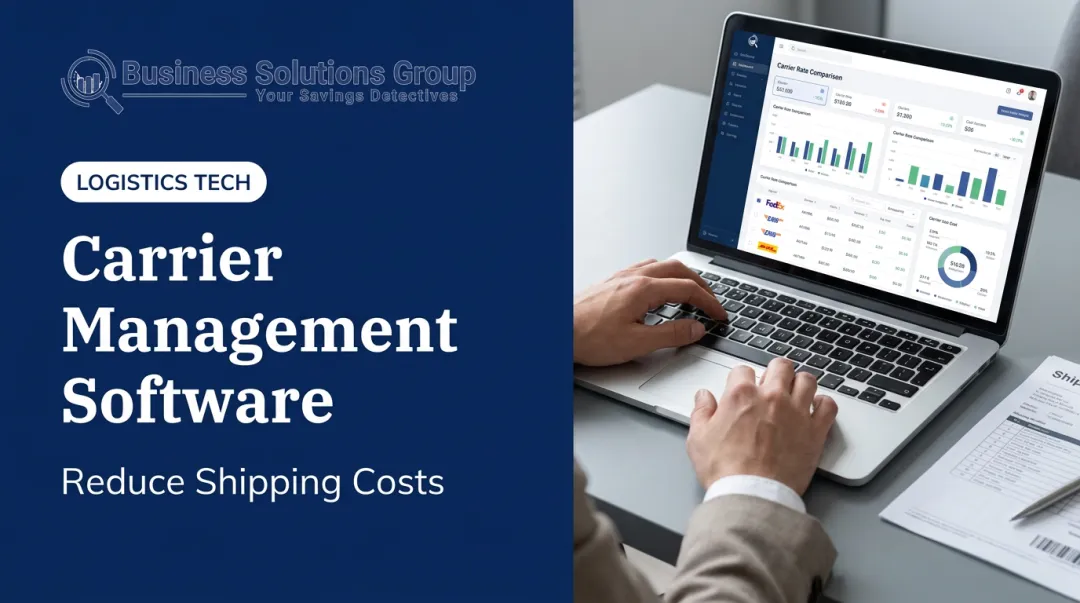
Most businesses default to one or two carriers. That default was probably a reasonable choice at some point, but it rarely gets re-evaluated. Automated rate shopping changes the math by comparing real-time pricing across USPS, UPS, FedEx, and regional carriers for every shipment before one is booked.
The variables that determine the lowest-cost option — package weight, delivery zone, required transit speed, dimensional weight — shift constantly. A regional carrier might be 20-30% cheaper for zone 5-8 ground shipments under five pounds. USPS might win on lightweight parcels going to residential addresses. No manual process catches these differences consistently at volume.
The Descartes 2024 survey found parcel shipping and label generation rose to 32% as a must-have transportation capability. Yet most small shippers still select carriers by habit rather than by rate. Automated rate shopping closes that gap by applying the same rate logic to every shipment, without manual intervention. Over thousands of orders, those per-shipment differences add up to real annual savings.
Way 2: Eliminating Labor Costs from Repetitive Shipping Tasks
Manual shipping workflows consume more labor than they appear to. Order import, carrier assignment, label generation, address validation, and tracking notification updates are individually quick tasks — but they stack fast across order volume, and they require correction when errors occur.
Automation displaces this work entirely for routine shipments. The same team processes higher volumes without adding headcount, which matters most during peak seasons when order velocity spikes and overtime becomes the default solution.
Labor is already a dominant cost in fulfillment operations. Data from a 2024 warehousing and fulfillment survey covering 600+ warehouses shows labor at 28-32% of total fulfillment revenue — and fulfillment experts note that more than 50% of cost per order is direct and indirect labor. Shipping workflow automation directly reduces the labor component without requiring operational restructuring.
Automated workflows also don't slow down, make transcription errors, or require re-training when staff turns over. That consistency holds regardless of order volume or seasonal pressure.
Way 3: Reducing Errors That Trigger Hidden Costs
Manual data entry introduces errors. That's not a criticism of operations teams — it's a structural reality of manual processes at scale. The problem is where those errors surface: downstream, as surcharges, reshipments, and customer service overhead that rarely get attributed back to the original mistake.
Address errors are the clearest example. UPS charges $23.50 per address correction on 2025 daily rates. FedEx's 2025 surcharge schedule lists comparable address correction fees for U.S. package services. A wrong ZIP code or apartment number — a single keystroke error — generates a $22-24 surcharge per package. Multiply that across even a small percentage of shipments and the annual cost is not trivial.
Beyond address corrections, manual shipping errors create:
- Carrier reshipment costs for misdirected packages
- Returns processing overhead when packages don't reach the right destination
- Customs delays and penalty fees for incomplete documentation on international shipments
- Customer service time handling delivery complaints and resolutions
Automation enforces standardized workflows for label creation, address validation, and freight classification. The system validates inputs before a label is generated, so a bad address never makes it onto a shipment. The surcharge simply doesn't happen.
Way 4: Improving Inventory and Fulfillment Coordination to Eliminate Waste
Disconnected inventory and shipping systems produce a predictable set of expensive outcomes: split shipments, last-minute expedited upgrades to meet delivery commitments, and fulfillment routed from the wrong location relative to the delivery destination.
Split shipments are particularly costly. When one order ships from two separate warehouses because inventory isn't visible across locations, the shipping cost effectively doubles — and the packaging and labor costs multiply as well. According to logistics expert Josh Bartel, CEO of Hydrian Inventory Optimization, added distance and duplicate packaging in split orders can increase shipping costs by 2x to 5x.
When inventory data connects to shipping systems in real time, several waste conditions are prevented:
- Routes orders to the nearest stocked fulfillment point, reducing shipping zones and transit costs
- Eliminates split shipments when full inventory visibility reveals which warehouse can fulfill the complete order
- Flags inventory shortfalls early enough to avoid last-minute expedited upgrades
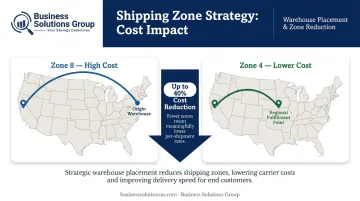
Zone reduction is particularly valuable for high-volume shippers. Shipping from an East Coast warehouse to a West Coast customer at zone 8 costs materially more than shipping from a regional fulfillment point at zone 4. For businesses with multiple locations, automated fulfillment routing captures that savings on every applicable order.
Way 5: Turning Shipping Data Into Carrier Contract Leverage
This is the most underutilized cost-reduction lever available to mid-market shippers, and it requires no operational change to begin capturing.
Carrier contracts are negotiable. Most shippers don't negotiate effectively because they lack the data to do so. A Shipware survey at the 2022 PARCEL Forum, covering shippers with approximately $3.5B in combined annual parcel spend, found that 75% believed their agreements could be improved — and less than 7% considered their pricing best-in-class.
Separately, 42.86% of small shippers under $10M in parcel spend didn't analyze the financial impact of carrier rate changes at all, and 11-15% of mid-to-large shippers relied entirely on carrier representatives to explain what contract modifications were worth.
Automated shipping systems generate the granular data that changes this dynamic. Carrier usage patterns, volume by service type, on-time performance by lane, dimensional weight charges, and accessorial fee patterns all become trackable. That data is the foundation for a credible negotiation. Specific terms worth targeting include:
- Volume discounts tied to documented shipping patterns
- Rate caps on high-frequency service types
- Minimum-charge reductions based on average package profiles
- Service level commitments with financial accountability clauses
Business Solutions Group's proprietary spend intelligence platform surfaces over 40 actionable cost insights — identifying where current contracts leave savings uncaptured and which specific contract terms to target in the next negotiation cycle.
How to Start Implementing Shipping Automation Without Overinvesting
Automation investment fails most often not because the technology doesn't work, but because businesses automate the wrong things first. The highest-ROI starting point is whichever area has the greatest current cost leakage — and identifying that requires a spend baseline before any tool selection.
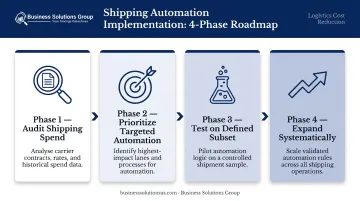
A practical phased approach:
- Audit current shipping spend by carrier, service type, cost category, and error-related surcharges — identify the single largest avoidable cost before selecting a tool
- Prioritize automation that targets that specific driver — rate shopping software if carrier selection is the issue, WMS integration if inventory disconnect is the problem, label automation if error-related surcharges are significant
- Test on a defined shipment subset before full rollout — measure actual cost impact against baseline before expanding
- Expand systematically to the next cost driver once the first is quantified
Most businesses that struggle with automation ROI skip the baseline step — they select tools based on what's popular rather than what their data actually shows. Business Solutions Group's supply chain cost analysis and benchmark services are designed to close that gap, helping businesses pinpoint their highest-cost leakage areas before committing to any automation investment.
Conclusion
Reducing shipping costs through automation means identifying where cost originates in your current operation and targeting automation at those specific points — not deploying every available tool at once.
The five strategies covered here — carrier rate shopping, labor reduction, error elimination, fulfillment coordination, and spend intelligence — are not a checklist to implement simultaneously. They're a framework, and your starting point depends on where your greatest cost pressure is right now.
Businesses that begin with a spend audit, identify their primary cost drivers, and automate in priority order consistently outperform those that automate broadly without one. Know your cost baseline first. Everything else follows from that.
Frequently Asked Questions
How does automation reduce shipping costs?
Automation removes labor from repetitive tasks, validates address data before surcharges are triggered, and enables real-time carrier rate comparison across multiple carriers simultaneously. The combined result: lower cost per shipment across labor, carrier fees, and error-related expenses.
What is the 80/20 rule for shipping automation?
The 80/20 rule means a small share of shipment types, carriers, or lanes typically drives the majority of avoidable cost. Target that high-impact subset first, rather than automating everything at once, and you'll see the fastest measurable ROI from your investment.
What types of shipping costs can automation directly reduce?
The main categories include:
- Carrier fees, through automated rate shopping
- Labor costs, through workflow automation
- Error surcharges like address corrections, through validation and standardized label generation
- Excess fulfillment costs, through inventory-shipping integration and smarter order routing
Is shipping automation cost-effective for small businesses?
Yes — rate shopping and label automation are scalable tools that deliver value at low shipment volumes. The key is starting with tools that address your specific cost driver rather than enterprise-grade systems designed for complexity you don't yet have.
How long does it take to see ROI from shipping automation?
ROI timelines vary by scope, but carrier rate optimization typically produces measurable savings within the first few months. Deeper savings from labor reduction and error elimination accumulate over the first year as the system processes higher volumes.
What should businesses prioritize when starting to automate their shipping?
Begin with a spend audit to identify your largest cost driver before selecting any tool. For most small parcel and freight shippers, automated carrier rate shopping delivers the most immediate, quantifiable savings and is the natural first investment.