Supply chain automation software addresses this directly. These platforms don't just accelerate existing workflows — they eliminate redundant spend, surface hidden cost drivers, and enable faster, data-backed decisions across every supply chain function.
The US supply chain management market was valued at $7.26 billion in 2024, growing at 8.4% annually through 2030. With adoption rising, the more urgent question isn't whether to automate — it's which platform will actually move the needle on cost.
This guide evaluates the top five supply chain automation platforms specifically through the lens of cost reduction, then covers how to choose the right fit for your business.
Key Takeaways
- Supply chain automation software uses AI, ERP integration, and real-time data to eliminate manual bottlenecks across procurement, inventory, and logistics
- The top platforms for cost reduction are SAP SCM, Oracle SCM Cloud, Blue Yonder, Kinaxis Maestro (formerly RapidResponse), and NetSuite SCM
- AI-driven forecasting can reduce supply chain forecast errors by 20–50%, directly cutting overstock and expediting costs
- Platform selection should be driven by integration depth, total cost of ownership, and your specific cost drivers — not brand recognition
- Spend intelligence analysis helps identify your highest-impact cost drivers before you select or implement any platform
What Is Supply Chain Automation Software and Why It Reduces Costs
Supply chain automation software is a category of digital platforms that integrate and automate core supply chain functions — procurement, inventory management, order processing, transportation, and supplier collaboration — with minimal manual intervention.
Unlike traditional ERP systems, which manage broad business operations across finance, HR, and manufacturing, supply chain automation platforms are built specifically for real-time execution and cross-functional coordination, with decision intelligence embedded throughout.
The Direct Connection to Cost
Manual supply chains generate cost in predictable ways:
- Excess inventory — poor demand visibility leads to overbuying; carrying costs typically run 15–25% of inventory value annually
- Premium freight — reactive planning triggers expedited shipping that planned operations would avoid
- Labor overhead — manual order processing, invoice reconciliation, and exception management consume headcount
- Rework from errors — data entry mistakes in purchasing, receiving, and fulfillment multiply downstream costs
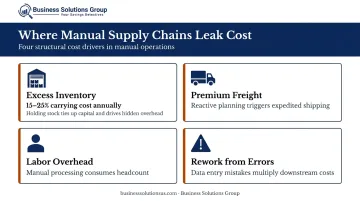
Automation addresses each of these directly. Better demand forecasting sharpens replenishment decisions, integrated transportation management replaces reactive freight booking, and automated procurement workflows cut manual processing overhead. The compounding effect is significant — McKinsey's benchmark suggests well-executed supply chain digitalization can deliver up to 30% lower operational costs.
Reaching that level of savings depends on choosing platforms that match your operational complexity — the tools below are evaluated on exactly that basis.
Top Supply Chain Automation Software for Cost Reduction
These platforms were selected based on demonstrated cost-reduction capability, AI and analytics depth, and integration quality — not simply market presence.
SAP Supply Chain Management
SAP SCM, part of SAP's broader enterprise suite, includes SAP Integrated Business Planning (IBP) for supply chain and SAP S/4HANA Supply Chain Management for planning, inventory optimization, logistics, and transportation. It's widely deployed among large manufacturers, distributors, and complex multi-tier operations.
The results speak for themselves. Microsoft implemented SAP IBP and reported avoiding more than $550M in inventory risk, reducing manual planning by 50%, cutting planning cycle time from five days to under one day, and increasing on-time planning by 75%.
| Feature Area | Detail |
|---|---|
| Key Features | AI-powered demand and supply planning, integrated transportation management, supplier collaboration portal, real-time supply chain visibility, ESG and compliance tracking |
| Pricing Model | SAP Supply Chain Base: $295/user/month (min. 15 users); Supply Chain Premium: $413/user/month; cloud or on-premise options available |
| Best For | Large enterprises and mid-market manufacturers seeking end-to-end supply chain cost control with deep ERP integration |
Oracle Fusion Cloud SCM
Oracle's platform — officially Oracle Fusion Cloud Supply Chain and Manufacturing — is a cloud-native solution built for global supply chain complexity. It connects planning, logistics, manufacturing, and order management into a unified architecture, with AI and machine learning embedded across modules including Demand Management, Replenishment Planning, Transportation Management, and Warehouse Management.
NTN Mexico implemented Oracle Fusion Cloud ERP and SCM and reduced obsolete inventory from 12% to 8%, improving working capital efficiency in the process. Oracle's Transportation Management module reduces logistics spend through load optimization and carrier management, while ML-driven demand forecasting minimizes both lost sales and overbuying.
| Feature Area | Detail |
|---|---|
| Key Features | AI/ML demand forecasting, inventory and supply planning, advanced transportation management, global trade compliance, warehouse management integration |
| Pricing Model | Cloud subscription per user/module; Oracle Fusion Demand Management Cloud Service starts at $550/month per hosted named user (min. 20 users); configuration-dependent pricing — contact Oracle for a quote |
| Best For | Enterprises managing complex, multi-node global supply chains seeking to reduce inventory and logistics costs at scale |
Blue Yonder
Blue Yonder is an AI-first supply chain platform and a Gartner Magic Quadrant Leader across supply chain planning (discrete industries), transportation management systems (19 consecutive years), and warehouse management systems (14 consecutive times). It serves retailers, manufacturers, and third-party logistics providers globally.
Its autonomous planning capability uses machine learning to continuously optimize inventory levels, reducing both overstock and stockout costs without constant planner intervention. On the logistics side, DHL implemented Blue Yonder's transportation management tools and achieved a 7% reduction in transportation costs through vehicle and stop optimization. Warehouse labor efficiency and space utilization savings add a further cost layer for distribution-heavy operations.
| Feature Area | Detail |
|---|---|
| Key Features | Autonomous AI-driven supply chain planning, warehouse management, transportation management, retail demand planning, supply chain command center for real-time visibility |
| Pricing Model | SaaS subscription; pricing varies by solution module and scale — contact Blue Yonder for custom pricing |
| Best For | Mid-to-large retailers, manufacturers, and 3PLs prioritizing AI-driven planning and logistics cost reduction |
Kinaxis Maestro (formerly RapidResponse)
Kinaxis rebranded its flagship platform as Kinaxis Maestro — an AI-powered supply chain planning and decisioning platform built on its patented concurrency technique. Concurrent planning means every change anywhere in the supply network is immediately visible across the entire plan, allowing teams to see the cost implications of any decision before acting on it.
That speed of response is the core cost-reduction mechanism. Nucleus Research reported that Kinaxis Maestro cut planning cycles by over 90%, with interviewed customers reporting planning time reductions of up to 99% and $50M in procurement cost avoidance. For operations facing frequent disruptions — component shortages, demand spikes, supplier failures — the ability to model cost trade-offs in real time prevents the expensive reactive decisions that often follow.
| Feature Area | Detail |
|---|---|
| Key Features | Concurrent supply chain planning, real-time scenario simulation, demand and supply planning, S&OP, inventory optimization, AI-powered predictive analytics |
| Pricing Model | SaaS subscription; customized pricing based on modules and organization size — contact Kinaxis for a quote |
| Best For | Mid-to-large enterprises in manufacturing and high-tech sectors that need rapid, cost-aware response to supply chain disruptions |
NetSuite Supply Chain Management
NetSuite SCM is an ERP-native supply chain platform designed for growing mid-market businesses. Rather than bolting on a separate SCM tool, NetSuite provides a single unified system connecting procurement, inventory, order management, demand planning, and financial data — which itself eliminates a significant cost: the reconciliation overhead of managing multiple disconnected systems.
Its demand-driven replenishment tools reduce carrying costs by automating reorder points based on real consumption data. Automated procurement workflows cut the manual labor and error costs tied to purchasing and vendor management. For businesses currently stitching together multiple point solutions, the consolidation alone often delivers measurable ROI before any optimization work begins.
| Feature Area | Detail |
|---|---|
| Key Features | ERP-integrated supply chain planning, demand-driven replenishment, real-time inventory tracking, automated procurement, mobile warehouse management |
| Pricing Model | Annual SaaS license based on core platform, optional modules, and user count; plus a one-time implementation fee — contact NetSuite for pricing tiers |
| Best For | Fast-growing small-to-mid-market businesses seeking a single, cost-effective platform that unifies supply chain and financial operations |
How to Choose the Right Supply Chain Automation Platform
The Evaluation Framework That Actually Works
Most software selection mistakes follow a recognizable pattern: buyers prioritize the most recognized brand, select a platform based on a single use case (say, warehouse management), or optimize for feature volume rather than cost-reduction fit. Gartner notes that supply chain planning projects frequently exceed budget, and tools often go underutilized — largely because they're scoped as IT projects rather than operational change initiatives.
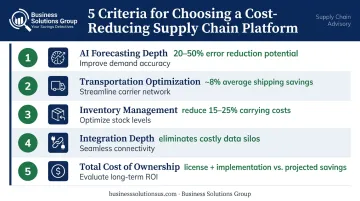
A cost-reduction lens changes what you evaluate. Five criteria matter most:
- AI forecasting depth: Does the platform reduce forecast error meaningfully? McKinsey benchmarks AI-driven forecasting at 20–50% error reduction, which directly translates to inventory and expediting savings.
- Transportation optimization: Companies using a TMS average roughly 8% in shipping savings. Evaluate how each platform's TMS module handles carrier selection, load optimization, and freight audit.
- Inventory management: Right-sizing, automated replenishment, and safety stock optimization reduce carrying costs that typically run 15–25% of inventory value.
- Integration depth: How cleanly does the platform connect with your existing ERP, WMS, and carrier systems? Poor integration creates the data silos that drive costs up in the first place.
- Total cost of ownership: Weigh implementation, licensing, training, and administration costs against projected savings — not just the license fee.
Where Automation Software Alone Falls Short
Even the most sophisticated automation platform has a blind spot: carrier contract pricing. For small parcel shippers and LTL shippers especially, planning intelligence doesn't replace the need for contract benchmarking and negotiation against current market rates.
Business Solutions Group addresses this gap directly. BSG's Parcel Spend Intelligence tool analyzes invoice history, carrier surcharges, accessorial fees, and routing logic to identify where contracts fall short of market benchmarks. That baseline is typically established within one week and becomes the measurement standard against which any automation platform's ROI is tracked.
For freight spend, BSG's Global RFP eProcurement solution places incumbent carriers into competitive bidding situations with pre-qualified alternatives across all transportation modes. This process typically delivers 15–30% savings in LTL without disrupting existing operations.
Conclusion
SAP SCM, Oracle SCM Cloud, Blue Yonder, Kinaxis Maestro, and NetSuite SCM each offer genuine cost-reduction capability — but they serve different operational profiles. SAP and Oracle fit large, complex enterprises with deep integration requirements. Blue Yonder and Kinaxis serve organizations where AI-driven planning and disruption response are the primary cost levers. NetSuite is the practical choice for mid-market businesses replacing a patchwork of disconnected systems.
Whichever platform you choose, benchmark your current supply chain spend before committing. Without a baseline, you have no way to measure what the software actually saves — and no leverage in negotiations with vendors or carriers.
If you're ready to pinpoint where your supply chain is leaking cost, Business Solutions Group provides end-to-end cost reduction advisory, proprietary spend intelligence software, and carrier contract optimization. Call +1 949-525-7677 to get started.
Frequently Asked Questions
How do you reduce supply chain costs?
The biggest gains come from automating order processing and replenishment, improving demand forecast accuracy to cut excess inventory, and optimizing carrier contracts. Add real-time visibility across those three areas and cost reductions compound — each improvement reinforces the next.
Which ERP is best for supply chain management?
SAP SCM and Oracle Fusion Cloud SCM lead for large enterprises with global operations. For mid-market businesses, NetSuite SCM is the strongest integrated option — lower implementation overhead and cost than enterprise-tier systems, without sacrificing core functionality.
Will supply chain management be replaced by AI?
AI changes how supply chain management works, not whether it's needed. It improves forecasting accuracy, speeds up scenario planning, and automates exception handling. Human oversight remains essential for strategic supplier relationships, network design, and situations that fall outside what predictive models can anticipate.
What is supply chain automation software?
Supply chain automation software uses AI, real-time data, and workflow automation to manage supply chain functions — procurement, inventory, logistics, and fulfillment — with minimal manual intervention. Unlike general ERP, these platforms focus on real-time execution and end-to-end coordination across functions rather than record-keeping alone.
What features matter most in supply chain automation software?
Prioritize demand forecasting accuracy, real-time inventory visibility, automated procurement, and transportation management with carrier optimization. Clean integration with your existing ERP or WMS is non-negotiable. The platforms worth investing in surface actionable cost insights through their analytics dashboards, not just raw reporting data.