The problem isn't a lack of data. It's that the data lives in too many places — carrier portals, spreadsheets, email threads, TMS systems that don't talk to each other. According to a FreightWaves and Tive survey of 500+ logistics professionals, only 20% of shippers are satisfied with their current shipment visibility, and just 4% describe themselves as "very satisfied."
This guide covers what a freight visibility platform actually is, the specific benefits it delivers, the features that matter most, and how to implement one without the typical pitfalls.
Key Takeaways
- A freight visibility platform aggregates real-time tracking data from all carriers and modes into one dashboard
- AI-powered ETAs are far more accurate than carrier-provided estimates — 91% accurate within a one-hour window vs. roughly 45% for traditional tools
- "Where is my shipment?" inquiries account for up to 50% of all customer service calls — real-time visibility eliminates most of them
- Manual check calls consume roughly 40% of a broker rep's workday; automation reclaims that time
- Poor data quality, incomplete carrier onboarding, and undefined exception workflows are the top reasons implementations fall short
What Is a Freight Visibility Platform?
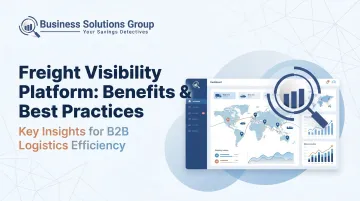
A freight visibility platform (FVP) is a system that pulls real-time tracking data from multiple sources — GPS, ELDs, IoT sensors, driver mobile apps, carrier APIs, and EDI feeds — into a single, centralized dashboard. Every supply chain stakeholder (shippers, carriers, 3PLs, and customers) sees the same live picture.
Beyond Simple Location Tracking
Modern FVPs go well beyond basic location tracking. They:
- Analyze aggregated data to detect exceptions automatically
- Generate predictive ETAs using machine learning
- Push configurable alerts when shipments deviate from expected parameters
- Replace scattered manual methods — container number lookups, phone check-calls, email status requests
Freight Visibility vs. Supply Chain Visibility
These terms overlap, but they cover different ground:
| Freight Visibility | Supply Chain Visibility | |
|---|---|---|
| Focus | Shipments in transit (all modes) | End-to-end operations |
| Covers | Location, ETAs, carrier status | Inventory, production, demand signals |
| Primary Tool | FVP | SCM platform |
An FVP solves the in-transit problem specifically. SCM platforms tackle the full ecosystem — which often includes an FVP as one component.
Why Real-Time Freight Visibility Matters More Than Ever
Traditional tracking surfaces data only at milestone events — pickup, departure, arrival. Between those checkpoints, you're operating blind. That means when a delay occurs, you typically learn about it at the same time your customer does.
The financial stakes are significant. According to the Economist Intelligence Unit, supply chain disruptions cost companies an average of 6–10% of annual revenues, with two-thirds of surveyed executives reporting revenue declines between 6% and 20% during disruption periods.
Customer Expectations Have Shifted the Bar
E-commerce has trained buyers to expect live tracking updates. That expectation now applies to B2B freight as well. Over 80% of shippers want proactive alerts about delays and exceptions — yet only 56% of those who track shipments do so in real time.
The consequence of falling short is concrete: 47% of customers will avoid ordering from a business again if they perceive inadequate delivery visibility.
From Reactive to Proactive Operations
Real-time visibility changes what you can actually do:
- Reroute shipments before delays compound
- Notify customers proactively instead of responding to complaints
- Adjust warehouse staffing based on accurate inbound ETAs
- Prevent detention and demurrage charges by preparing receiving docks ahead of arrival
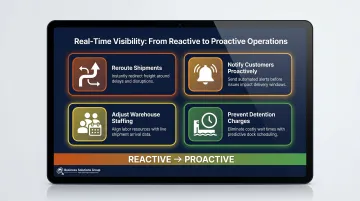
For freight shippers and logistics teams, that means fewer surprise calls from customers, less scrambling on the dock, and more decisions made on actual data rather than best guesses.
Key Benefits of a Freight Visibility Platform
Reduced Manual Work and Lower Operating Costs
Freight broker reps make 3–5 check calls per load while managing 15–20 loads per day. That volume means roughly 40% of their workday is consumed by manual status tracking — leaving voicemails, waiting for callbacks, and logging updates into TMS systems.
One documented case study from Descartes found that 10 logistics planning employees were spending 35% of their time on non-value-added order inquiry tasks, generating approximately $180,000 annually in wasted labor costs.
Automated status updates and exception alerts eliminate most check calls, freeing operations teams for work that actually generates revenue. Brokers using freight visibility platforms (FVPs) consistently report 40–50% reductions in manual check-call volume — a measurable shift in how their teams spend the day.
Business Solutions Group's TMS platform integrates real-time visibility across pre-shipment, in-transit, and post-delivery stages, with automated exception alerts built in — so operations teams don't need a separate tool layered on top.
Enhanced Customer Satisfaction and Transparency
"Where is my shipment?" (WISMO) inquiries account for up to 50% of all customer service calls, at an estimated cost of $4.50–$13 per inquiry. For an operation handling 200 WISMO calls daily, that's roughly $328,500 annually in pure support overhead.
FVPs eliminate most of these calls by giving customers direct access to accurate, live shipment status. Predictive ETA tools can generate reliable arrival windows days in advance — not just hours — giving customers and receiving teams time to plan.
93% of shoppers want to stay informed throughout the delivery process. For shippers competing on service, proactive status updates are no longer optional — they're what customers now plan around.
Proactive Exception Management and Risk Mitigation
Traditional tracking only surfaces problems after they happen. FVPs detect exceptions (port congestion, route deviations, weather delays, carrier-reported issues) as they develop, triggering automated alerts so logistics teams can respond before costs escalate.
Key exception types a modern FVP should detect:
- Tracking gaps or carrier silence beyond defined intervals
- Route deviations from planned paths
- Geofence breaches at pickup or delivery locations
- SOP violations (missed check-ins, unauthorized stops)
- Carrier-reported delays with downstream impact analysis
An exception caught in hour one is a quick reroute. The same exception discovered in hour twelve is a missed delivery window, a customer call, and a credit request.
Data-Driven Decision Making and Cost Savings
Historical transportation data captured by FVPs supports analysis that manual methods simply can't produce at scale:
- Carrier performance benchmarking — on-time rates by lane, carrier, and season
- Root-cause analysis — identifying whether delays stem from carriers, routes, or facilities
- Lane optimization — redirecting volume to better-performing carriers
- Contract negotiation leverage — performance data that supports rate discussions
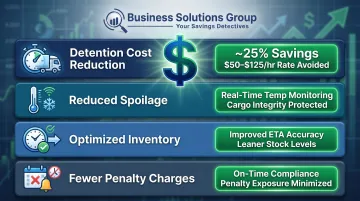
On the cost side, specific FVP-driven savings include:
- ~25% reduction in detention costs by alerting warehouses before free time expires (detention rates run $50–$125/hour depending on freight type)
- Reduced spoilage for temperature-sensitive freight through continuous condition monitoring
- Optimized inventory levels via accurate inbound ETAs
- Fewer penalty charges from missed delivery windows
Must-Have Features in a Modern Freight Visibility Platform
Multi-Modal, Multi-Source Real-Time Tracking
A platform that covers truckload but loses visibility for LTL or ocean has only partially solved the problem. A capable FVP must support:
- All relevant modes: Truckload, LTL, ocean, air, rail, parcel
- All data sources simultaneously: ELDs, telematics, GPS, mobile apps, API integrations, EDI
No shipment should fall into a blind spot because of carrier size or technology type. Smaller carriers without ELD mandates should still be trackable via driver mobile apps or manual check-in workflows within the platform.
Predictive ETA and AI-Powered Analytics
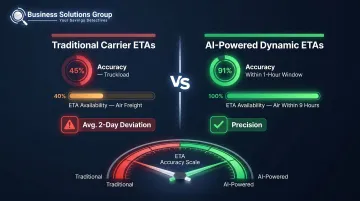
Carrier-provided ETAs are accurate roughly 45% of the time for day-of arrival predictions. AI-powered dynamic ETAs achieve 91% accuracy within a one-hour window by analyzing 150+ data points per load — traffic, weather, driver rest patterns, and historical carrier performance.
For air freight specifically, traditional tools provided ETAs only 40% of the time, with an average deviation of two days. AI-powered systems deliver ETAs 100% of the time, within nine hours of actual arrival.
This accuracy gap has direct operational consequences for dock scheduling, staffing, and customer commitments.
Automated Exception Detection and Alerting
The platform should surface exceptions without requiring someone to actively monitor a dashboard. Configurable alerting rules push notifications to the right stakeholders when defined thresholds are breached.
Good alerting systems are:
- Configurable by exception type and severity
- Routed to the right person (operations vs. customer service vs. carrier relations)
- Actionable — linked to context and recommended next steps, not just raw alerts
Seamless Integration With Existing Systems
Disconnected systems are one of the primary causes of visibility failure. An FVP that requires manual data export and import to feed your TMS or ERP creates a new set of problems while solving the old ones.
Integration requirements to evaluate:
| System | Integration Requirement |
|---|---|
| TMS | Bidirectional data sync — shipment status, ETA updates, exceptions |
| WMS | Inbound ETA feeds for dock scheduling and labor planning |
| ERP | Cost allocation, invoice matching, and financial reporting |
| Customer portals | Live tracking links and proactive notification triggers |
Reporting, Analytics, and Audit Trail
Built-in reporting turns operational data into business intelligence. At minimum, the platform should produce:
- Carrier performance scorecards with on-time delivery rates by lane
- Exception frequency reports identifying repeat problem patterns
- Detention and demurrage cost tracking
- Audit trails for regulatory compliance and claims documentation
Together, these reporting capabilities shift your team from reactive firefighting to proactive supply chain management — closing the loop between visibility data and measurable business outcomes.
Best Practices for Implementing a Freight Visibility Platform
Align Business Processes Before Going Live
Technology doesn't fix broken processes — it amplifies them. Before deployment, audit whether your current workflows are set up to act on exception data, or just observe it.
Key questions to answer before go-live:
- Who owns exception response, and what's the escalation path?
- Are inbound ETAs shared across TMS, WMS, and ERP in real time?
- Do receiving teams have visibility to adjust dock schedules based on arrival alerts?
- Is there a root-cause analysis protocol, or do exceptions just get resolved and forgotten?
Ensure Full Stakeholder Participation
An FVP is only as accurate as the data feeding it. If carriers aren't enrolled and contributing tracking data, the platform produces coverage gaps — the same blind spots you're paying to close.
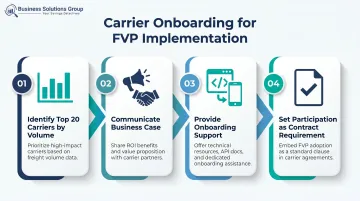
Steps to drive carrier and partner onboarding:
- Identify your top 20 carriers by shipment volume — prioritize onboarding these first
- Communicate the business case clearly — show carriers what's in it for them (fewer check calls, faster payment cycles)
- Provide onboarding support — simple API connections, EDI feeds, or mobile app enrollment for smaller carriers
- Set participation as a carrier requirement — include visibility compliance in carrier contracts
Prioritize Data Quality and Clean Integration
Inaccurate data produces unreliable ETAs and false exception alerts — and once teams stop trusting the platform, adoption stalls. Data quality issues need to be resolved before go-live, not after.
Start with these three steps:
- Audit all data sources feeding the platform for accuracy and completeness
- Identify legacy systems providing stale or incomplete location data
- Establish data validation rules to flag anomalies before they propagate downstream
Define Success Metrics and Monitor Early Results
Establish KPIs before go-live, not after. Recommended metrics for the first 90 days:
- Check-call volume reduction (target: 40%+ reduction)
- On-time delivery improvement rate
- Exception response time (from detection to action)
- WISMO inquiry volume reduction
- Customer satisfaction scores
Monitor closely throughout the first 90 days, then:
- Refine alert configurations based on actual exception patterns
- Gather user feedback before full-scale deployment
- Use early data to build the internal business case for continued investment
How to Choose the Right Freight Visibility Platform
When evaluating platforms, most buyers focus on the obvious criteria. Here's a complete evaluation framework:
Core criteria:
- Carrier network size and geographic coverage
- Integration capabilities with your TMS, WMS, and ERP
- Multi-modal tracking support across all your shipping modes
- Data security standards and regulatory compliance posture
- Quality of implementation support and ongoing customer success
Often overlooked:
- Industry specialization : platforms built for food and beverage or pharma include temperature monitoring that general platforms lack
- User experience — an unintuitive interface kills adoption, no matter the feature set
- Total cost of ownership — setup fees, licensing, integration development costs, and expected ROI timeline
For freight shippers comparing multiple platforms, working with a supply chain advisory partner can cut evaluation time by weeks. Business Solutions Group provides benchmark analysis that captures 6–12 months of shipment data to establish a financial baseline before any platform decision is made. The analysis covers tariff and rate analysis, freight invoice audit review, and supply chain process evaluation.
Most companies discover 10–30% in actionable savings opportunities through this process. The analysis is provided at no cost with no commitment required.
This baseline matters because it reveals whether a platform's promised ROI is realistic given your actual carrier mix, current rates, and operational structure — before you sign a multi-year contract.
Frequently Asked Questions
What is a freight visibility platform?
A freight visibility platform is a technology solution that aggregates real-time tracking data from GPS, ELDs, IoT sensors, and carrier systems into a single dashboard. It gives all supply chain stakeholders live shipment status, predictive ETAs, and automated exception alerts across all transportation modes.
What is real-time visibility in logistics?
Real-time visibility is the ability to continuously monitor shipment location, condition, and status as goods move through the supply chain. It enables proactive decision-making — including rerouting, customer notification, and dock scheduling — rather than reactive problem-solving after delays occur.
How does a freight visibility platform differ from a TMS, WMS, or SCM platform?
A freight visibility platform focuses specifically on live in-transit tracking and exception management. A TMS manages transportation planning and execution, while a WMS handles warehouse operations. SCM platforms take the broadest view, covering the full ecosystem including inventory and procurement. Modern FVPs integrate with all three rather than replacing them.
Which equipment can be monitored with real-time freight visibility?
FVPs can monitor trucks (via ELDs and GPS), ocean containers (via AIS and carrier APIs), rail cars, air cargo, and yard assets. IoT sensors extend monitoring to condition data — temperature, humidity, shock — for sensitive shipments like pharmaceuticals and perishables.
What are the biggest challenges in implementing a freight visibility platform?
The three most common barriers are poor data quality from legacy systems, low carrier and partner participation rates, and undefined business processes for acting on exception data. Addressing all three before go-live significantly improves platform effectiveness and how quickly the platform delivers results.
What is cloud-based logistics?
Cloud-based logistics refers to cloud-hosted software platforms — including freight visibility tools, TMS, and WMS — that manage and coordinate logistics operations. They enable real-time data sharing across supply chain partners from any location without requiring on-premise infrastructure.