Introduction
Most businesses treat freight as a fixed cost — something to budget for, not optimize. That assumption is expensive.
Transportation costs average roughly 6.36% of total sales for US shippers, and for companies not using best-in-class management, total logistics costs can reach 9% to 14% of revenue.
At that scale, even marginal inefficiencies — overpaid carrier contracts, redundant freight movements, unaudited invoices — add up to measurable margin loss.
The businesses that treat freight as a strategic function, not just a line item, consistently outperform on cost, delivery performance, and customer satisfaction. Those that don't tend to find out the hard way: chargebacks, stockouts, and carrier invoices nobody ever questioned.
This article covers what freight management actually does within a supply chain, how it drives cost control and delivery performance, and which specific strategies separate companies that optimize freight from those that simply absorb it.
Key Takeaways
- Freight management coordinates transportation, carrier relationships, routing, and compliance across the entire supply chain
- Poor freight management inflates shipping costs, delays deliveries, and forces excess inventory
- Technology tools like TMS, AI routing, and real-time tracking cut costs, reduce transit times, and improve shipment visibility
- Carrier contract benchmarking is one of the fastest ways to reduce freight spend
- KPI tracking — on-time delivery rate, cost per mile, freight invoice accuracy — drives continuous improvement and keeps freight spend in check
What Is Freight Management in Supply Chain Operations?
Freight management is the planning, execution, and optimization of how goods move physically through a supply chain. It's a subset of broader supply chain management — which also includes sourcing, manufacturing, and demand planning — and distinct from logistics, which adds warehousing and order fulfillment into the mix.
In practical terms, freight management is what bridges production and delivery. Even with solid inventory planning upstream, gaps in how freight moves translate directly into delays, cost overruns, and missed customer commitments.
Where Freight Management Fits
Freight management touches every stage of operations:
- Inbound procurement — raw materials sourced from suppliers and moved to manufacturing sites
- Inter-facility transfers — components and materials coordinated between internal locations
- Outbound distribution — finished goods shipped to distribution centers or directly to customers
Transportation Modes
Selecting the right mode for each lane is itself a strategic decision with direct cost and speed implications:
| Mode | Best For |
|---|---|
| Full Truckload (FTL) | High-volume, single-destination shipments |
| Less-Than-Truckload (LTL) | Smaller shipments sharing trailer space |
| Intermodal | Long-haul cost efficiency using rail + truck |
| Air Freight | Speed-sensitive or high-value cargo |
| Ocean Freight | International bulk shipments |
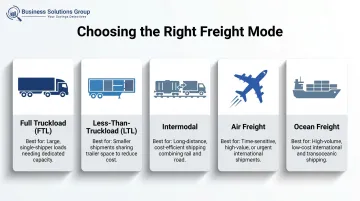
Mismatched mode selection on a given lane raises costs and creates bottlenecks that ripple across the entire supply chain.
Core Functions of Freight Management in the Supply Chain
Freight management is a set of interconnected functions that must operate together to keep goods moving efficiently and costs under control.
Carrier Selection and Relationship Management
Choosing the right carrier for each lane — based on transit time, reliability, capacity, and price — is the starting point for cost-effective freight. Long-term carrier partnerships typically unlock better service levels and pricing flexibility than transactional spot-market approaches. Businesses with fragmented carrier networks often pay above-market rates simply because they lack the volume and relationship leverage to negotiate effectively.
Route Optimization and Load Planning
Route optimization reduces transit times and fuel costs by identifying efficient delivery paths and consolidating shipments. Load planning — for example, combining multiple LTL shipments into a single FTL load — cuts per-unit costs and reduces handling risks.
The numbers support prioritizing this. A documented freight consolidation program for a major foot care manufacturer achieved a 12.4% reduction in freight costs, cutting cost per pound from $0.46 to $0.39 while improving average transit times by 1.2 days.
Freight Documentation and Compliance
Operational efficiency only holds if the administrative side keeps pace. Bills of lading, freight invoices, customs documentation, DOT compliance for domestic shipments, and import/export requirements form the administrative backbone of freight management. Documentation errors aren't just paperwork problems — they cause shipment delays, customs holds, and unexpected fees that erode delivery performance.
Freight Invoice Auditing
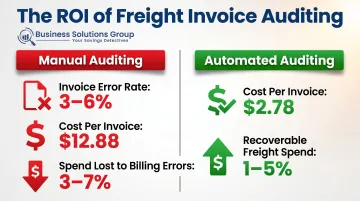
Freight invoice errors are common and costly. Between 3% and 6% of freight invoices contain errors, and billing mistakes typically drain 3% to 7% of a mid-market shipper's total annual freight spend. Systematic audit programs can recover 1% to 5% of total freight spend — recoveries most businesses never pursue because they lack the process to catch errors in the first place.
Automated auditing reduces invoice processing costs from roughly $12.88 per invoice to as low as $2.78, making it one of the higher-ROI operational improvements available.
Risk and Disruption Management
Freight management must account for disruptions: weather events, port congestion, capacity crunches, and tariff changes. Carrier diversification and contingency routing plans are the primary tools for minimizing downtime when the unexpected happens. Businesses that rely on single-carrier relationships or rigid routing structures absorb the full cost of disruptions rather than redirecting around them.
How Freight Management Drives Supply Chain Efficiency
On-time delivery rates, inventory accuracy, and customer satisfaction all depend on how reliably goods move through the network. When freight runs smoothly, the rest of the supply chain follows. When it doesn't, the ripple effects show up everywhere — from stockouts to chargebacks to strained customer relationships.
Inventory Alignment and Stockout Prevention
When freight is unpredictable, procurement teams compensate by holding excess safety stock — capital that earns nothing sitting in a warehouse. Reliable freight schedules make leaner inventory strategies viable, reducing carrying costs (which typically run 20% to 30% of total inventory value) while maintaining service levels.
Poor freight visibility compounds the problem on the other end. The global retail industry loses $1.73 trillion annually from inventory distortion — the combined cost of stockouts and overstocks — representing 6.5% of global retail sales. Predictable freight lead times let procurement teams plan replenishment more accurately, cutting both sides of that problem.
Supporting Customer Delivery Performance
Freight management determines whether customers receive orders on time and in full. The industry benchmark for on-time delivery sits at 95% or higher, with top performers targeting 97–99%. Late or inaccurate deliveries generate returns, chargebacks, and reputational damage that consistently exceed what better freight planning would have cost.
Cross-Functional Integration
Freight management works best when it's integrated with procurement, warehousing, and sales — not siloed in transportation alone. When freight planning is coordinated across functions, compounding delays are avoided rather than managed after the fact. Common breakdowns include:
- Late inbound shipments that stall production schedules
- Poorly timed deliveries that create warehouse bottlenecks
- Gaps between sales commitments and what freight can realistically deliver
Freight Cost Management: Strategies That Protect Your Bottom Line
Carrier Contract Negotiation and Benchmarking
Most businesses don't know whether their carrier rates are competitive. Carriers price based on what the market will bear — without benchmark intelligence, shippers simply accept whatever they're quoted.
The gap between what businesses pay and what they should pay is significant. Companies that haven't benchmarked their freight contracts in the last 2–3 years are typically overpaying by 15% to 30%. Accessing carrier pricing benchmarks — knowing the market rate for specific lanes, weight breaks, and service levels — gives shippers the leverage to negotiate from an informed position rather than guessing.
Business Solutions Group's spend intelligence software analyzes 6–12 months of shipment data to establish a financial baseline, then benchmarks that spend against current market rates at the lane and service level. The analysis spans parcel, LTL, FTL, air, and ocean freight, delivering results such as:
- Over 40 actionable insights, precise to one-tenth of a percent
- 20–25% reduction in freight and LTL spend for most clients
- $500 million in collective savings delivered through carrier contract renegotiation
Freight Consolidation and Mode Optimization
Three tactics consistently drive per-unit cost reductions in this area:
- Consolidating smaller shipments into full truckloads
- Shifting lanes between FTL, LTL, and intermodal based on cost/service tradeoffs
- Eliminating redundant freight movements
Mode optimization requires lane-level analysis. Blanket cost-cutting rarely identifies the specific lanes where structural savings are actually available.
Fuel Cost Management
Fuel costs represent 20–30% of total operating expenses for most US trucking carriers, making fuel surcharges a significant and variable component of freight pricing. Understanding how carriers structure surcharge tables — most use the DOE/EIA weekly diesel price report as a baseline, with LTL surcharge schedules ranging from roughly 16.5% to over 26% depending on diesel prices — allows shippers to negotiate more favorable surcharge terms. Route optimization reduces fuel consumption as well, cutting costs on top of what contract negotiation achieves.
Strategic Use of Spot vs. Contract Markets
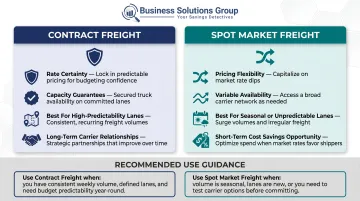
Once fuel and surcharge costs are under control, how you source capacity becomes the next lever. Contracted freight provides rate certainty and capacity guarantees. Spot market freight offers flexibility and potential savings when market capacity is loose.
A deliberate blend — sized based on volume predictability — outperforms relying exclusively on either. High-predictability lanes should typically be contracted; variable or seasonal lanes are better candidates for spot market sourcing.
Technology Tools Powering Modern Freight Management
Freight management has moved well past manual tracking and paper invoices. Real-time visibility, AI-driven routing, and automated audit systems now define what modern operations look like — and the gap between companies using these tools and those that aren't is widening.
Transportation Management Systems (TMS)
A TMS is the operational backbone of freight management: it centralizes carrier selection, rate comparison, load tendering, shipment tracking, and invoice processing in one platform. TMS users see average freight savings of approximately 8%, with the platform's value multiplying when integrated with ERP and WMS systems. Beyond direct cost savings, a TMS generates the historical data needed for benchmarking, KPI tracking, and continuous improvement.
Business Solutions Group's TMS integrates with WMS, ERP, and accounting software — eliminating data silos and allowing shipment data to flow from sales through shipping to billing without manual re-entry.
Real-Time Tracking and Visibility
GPS-enabled tracking and IoT sensors provide real-time shipment visibility — allowing businesses to proactively manage delays, communicate accurate ETAs to customers, and reroute when disruptions occur. The 2025 MHI/Deloitte Annual Industry Report found that 88% of supply chain leaders project adoption of sensors and automatic identification within five years, and 77% plan IoT investment — signaling that real-time visibility is becoming a baseline expectation, not a differentiator.
AI and Predictive Analytics
AI tools give freight teams the ability to act before problems surface rather than scrambling after they do. Key capabilities include:
- Route optimization: Adjusts delivery paths in real time based on traffic, weather, and fuel costs
- Demand forecasting: Predicts volume fluctuations so capacity is right-sized before shipments are tendered
- Disruption alerts: Flags carrier delays and risk signals early enough to reroute or swap providers
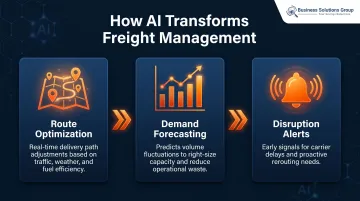
This shifts freight management from reactive firefighting to proactive planning — catching service risks before they become customer problems.
Key Performance Metrics for Measuring Freight Management Success
You can't improve what you don't measure. Businesses serious about freight performance need to track a defined KPI set consistently and benchmark those KPIs against industry standards, not just internal history.
Core freight management KPIs:
- On-time delivery rate: Target 95%+ industry-wide, with top performers reaching 97–99%; a single percentage point drop signals a lane or carrier problem worth investigating
- Freight cost as % of revenue: The US average sits around 6.36% of sales — knowing your number tells you whether you're competitive or leaving margin on the table
- Carrier performance score: Tracks reliability, damage rates, and service consistency so underperforming carriers are visible before they become customer service problems
- Freight invoice accuracy rate: Top performers hit 99.1% first-time-right processing; anything lower signals billing disputes and audit costs that compound quickly
- Transit time by lane: Measures route efficiency and surfaces underperforming lanes before they affect delivery commitments
Benchmarking against industry standards separates companies that optimize from those that merely monitor. Without external reference points, businesses often don't realize how far their freight performance lags the market until a competitor's service levels expose the gap.
Business Solutions Group's benchmark analysis compares freight performance and spending against proprietary market-rate intelligence. Clients see exactly where their costs and carrier metrics fall relative to comparable shippers — and which specific lanes, carriers, or billing practices are the fastest targets for improvement.
Frequently Asked Questions
What is freight in supply chain management?
Freight in supply chain management refers to the commercial transportation of goods between points in the supply chain — from supplier to manufacturer, manufacturer to distribution center, and distribution center to end customer. It encompasses the selection of carriers, modes, and routes that move inventory efficiently and cost-effectively.
What are the four types of supply chain management?
The four commonly referenced types are continuous flow (stable demand, like consumer staples), fast chain (short product lifecycles, like fashion), efficient chain (cost-optimized for commoditized goods), and agile/flexible chain (built for demand variability). Freight strategy varies considerably across each.
How does freight management affect supply chain costs?
Freight is one of the largest controllable cost categories in any supply chain. Inefficiencies in carrier selection, routing, and invoice auditing inflate costs fast — effective freight management can reduce transportation spend by 15–30% without compromising service levels.
What is the difference between freight management and logistics?
Logistics is the broader function covering transportation, warehousing, inventory management, and order fulfillment. Freight management specifically focuses on the planning, execution, and optimization of the transportation component — carrier selection, routing, freight costs, and shipment tracking.
What technologies are used in freight management?
Key technologies include Transportation Management Systems (TMS), GPS and IoT for real-time tracking, AI-driven route optimization tools, and freight audit and payment platforms. Each addresses a different gap — from carrier selection to invoice accuracy to live shipment visibility.
How can a business reduce its freight costs without sacrificing service?
Three main levers work consistently:
- Negotiate carrier contracts using market benchmark data
- Consolidate shipments and match transportation modes to each lane
- Audit freight invoices systematically to recover overcharges