The financial scale of these failures is staggering. U.S. hospital supply chains waste an estimated $25.4 billion annually, with the average hospital overspending by $12.1 million per year on avoidable supply chain costs. Drug shortages alone cost hospitals nearly $900 million in labor annually, according to a 2025 Vizient survey.
This guide covers what healthcare logistics management actually involves, the core challenges organizations consistently face, proven best practices, the technology tools making a measurable difference, and how to build a strategy that controls costs without compromising care.
TL;DR
- Healthcare logistics management covers the movement, storage, and delivery of medical supplies, equipment, and drugs — any breakdown has direct clinical and financial consequences
- Key operational challenges include cold chain integrity, regulatory compliance, inventory expiration, fragmented visibility, and rising costs
- Proactive management depends on real-time supply chain visibility, data-driven inventory control, and clear carrier accountability standards
- IoT sensors, AI-driven analytics, and spend intelligence platforms are now operational necessities
- Reducing costs starts with auditing current spend and benchmarking carrier contracts — then committing to continuous improvement, not one-time fixes
What Is Healthcare Logistics Management?
Healthcare logistics management is the coordinated planning, execution, and oversight of how medical supplies, pharmaceuticals, equipment, and specimens move from point of origin to point of care. It covers storage, transportation, and delivery — but unlike broader supply chain management (which spans the full product lifecycle from manufacturing to end use), logistics focuses specifically on the movement and storage component.
The Four Core Categories
Healthcare organizations must manage four distinct logistics flows:
- Inbound logistics — supplier-to-facility shipments of drugs, devices, and consumables
- Outbound logistics — facility-to-patient or facility-to-facility transfers
- Reverse logistics — product returns, equipment retrieval, and waste disposal
- Last-mile delivery — final delivery to patients, home health settings, or end-use locations
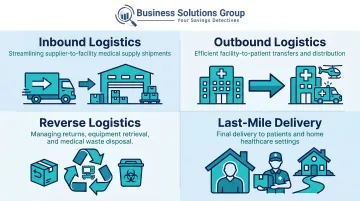
Each category comes with distinct handling requirements, carrier constraints, and compliance obligations — and failures in any one of them have direct consequences on care delivery.
Why the Stakes Are Different
In most industries, a late delivery is a service failure. In healthcare, it can mean a patient doesn't receive a scheduled infusion, a surgical procedure gets delayed, or a temperature-sensitive biologic arrives compromised.
That's why healthcare logistics isn't treated as a back-office function. The decisions made at the transportation and storage level carry real clinical weight.
Key Challenges in Healthcare Logistics
Cold Chain and Temperature Integrity
A growing share of the pharmaceutical pipeline requires strict temperature control. IQVIA reports that cold chain products now represent 38% of all pharmaceutical market share, up from 26% in 2017 — and 45% of the top-20 pharmaceutical companies' revenue comes from medicines requiring cold chain logistics.
The cost of getting this wrong is significant. The biopharma industry loses an estimated $35 billion annually from temperature-controlled logistics failures, according to IQVIA. The WHO estimates that up to 50% of vaccines are wasted globally each year, primarily from cold chain breakdowns.
Maintaining temperature integrity across multiple handoffs — warehouse, packaging, transit, and last-mile — is where most failures occur. Each transition point is a vulnerability.
Regulatory and Compliance Complexity
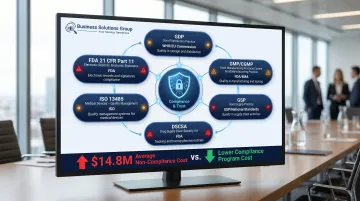
Healthcare logistics operates under a layered regulatory framework:
- GDP (Good Distribution Practices) — governing pharmaceutical distribution
- GMP/CGMP — covering drug manufacturing and processing (FDA 21 CFR Parts 210, 211)
- GSP (Good Storage Practices) — storage condition requirements
- DSCSA — U.S. drug supply chain traceability and serialization
- ISO 13485:2016 — quality management for medical devices
- FDA 21 CFR Part 11 — electronic records and signatures
These frameworks vary by jurisdiction and change regularly. The average cost of pharmaceutical non-compliance reaches $14.8 million per organization — nearly triple the cost of maintaining compliance programs — according to research cited by Systech. The FDA issued 159 Warning Letters to pharmaceutical companies in 2023 alone.
Inventory Management and Expiration Tracking
U.S. hospitals discard an estimated $3 billion in medications annually, with expired inventory representing a significant share of that loss. A mid-size hospital in Boston reported approximately $200,000 in annual losses from expired drugs alone; cardiac OR departments can generate over $70,000 per year in expiration costs.
Without automated tracking, FEFO (First Expired, First Out) protocols are prone to human error. RFID technology has helped health systems reduce medication expirations by up to 92%, and one hospital achieved a 41% reduction in drug waste after implementing automated inventory management.
Fragmented Visibility and Reactive Operations
Many healthcare organizations manage logistics through disconnected systems — separate platforms for supplier communications, carrier tracking, warehouse management, and inventory. The result is a reactive posture: teams learn about delays, stockouts, or temperature breaches after they've already occurred.
Without unified visibility, there's no way to identify patterns, catch problems early, or make data-driven decisions. It's a pattern Business Solutions Group encounters regularly with new clients: logistics spend treated as a black box, with no shipment-level detail to reveal what's actually happening across the network.
Rising Costs and Labor Pressure
Supply chain costs are the second-largest expense category for hospitals, trailing only staffing. Two compounding pressures define this challenge:
- Supply costs represent ~13% of total hospital expenses, and those expenses grew 5.1% in 2024 — nearly double the 2.9% general inflation rate
- Hospital employment has declined by nearly 93,000 jobs since 2020, leaving logistics teams stretched thin while managing increasingly complex operations manually
Best Practices for Healthcare Logistics Management
Establish End-to-End Shipment Visibility
Without a unified view of inbound and outbound shipments, organizations can't identify bottlenecks, catch delays early, or measure performance accurately. Visibility isn't a nice-to-have — it's what makes every other best practice actionable.
True end-to-end visibility includes:
- Real-time shipment status across all carriers and modes
- Exception alerts triggered by delays, route deviations, or temperature events
- Cost allocation by department, location, or shipment type
- Historical trend data to support pattern analysis and contract negotiations
Implement Data-Driven Demand Forecasting and Inventory Control
Manual inventory management (spreadsheets, periodic counts, intuition-based reordering) creates two predictable failure modes: stockouts that delay care, and overstock that generates expiration waste.
Data-driven demand forecasting uses historical consumption data and predictive analytics to maintain optimal inventory levels. Automated reorder triggers close the gap between consumption and restocking. The result is a supply chain that responds to real demand signals rather than estimates.
Key capabilities to prioritize:
- Consumption-based forecasting tied to historical usage data
- Automated reorder thresholds that remove manual intervention
- Real-time inventory visibility across locations and SKUs
Standardize Carrier Compliance and Contract Management
Not every carrier meets the handling standards that healthcare shipments require. Unmanaged carrier relationships create inconsistency in delivery performance, temperature compliance, and cost.
Effective carrier management involves:
- Documented qualification criteria before onboarding any carrier
- Formal SLA agreements with defined performance thresholds
- Regular performance scorecards reviewing on-time delivery, claim rates, and compliance incidents
- Mechanisms to escalate or replace underperforming partners
Apply Expiration-First Inventory Rotation Protocols
FEFO rotation — combined with digital tracking through barcodes, RFID, or BLE tags — ensures products closest to expiration move first. Manual rotation checks are too slow and error-prone for high-volume environments.
Automated expiration alerts notify staff when products are approaching their shelf-life window, allowing time to redeploy or return inventory before it becomes waste. Early action on near-expiry inventory reduces write-offs and keeps compliant products in circulation longer.
Develop Proactive Risk and Contingency Protocols
Reactive logistics is expensive. By the time a disruption surfaces, the cost — in expediting fees, care delays, or wasted product — has already been incurred. Proactive protocols shift that curve.
Practical protocols include:
- Secondary supplier relationships maintained for high-criticality products
- Weather and route contingency plans reviewed seasonally
- Automated delay alerts that trigger rerouting decisions before shipments miss delivery windows
- Supplier diversification to reduce single-source dependency
Benchmark Performance with KPIs and Industry Comparisons
Measuring performance against your own history tells you whether you're improving. Measuring against industry benchmarks tells you whether you're competitive.
Key logistics KPIs to track:
- On-time delivery rate
- Order cycle time
- Inventory accuracy
- Cost-per-shipment
- Stockout frequency
- Expiration waste rate
Without external benchmarks, organizations set goals in a vacuum. Business Solutions Group's benchmark analysis measures performance down to 1/10th of a percent, giving healthcare logistics teams the granularity needed to set meaningful targets and track real progress against industry standards.
Technology Enhancing Healthcare Logistics Operations
IoT Sensors and Real-Time Monitoring
IoT-enabled devices attached to containers, vehicles, or packages provide continuous data on location, temperature, humidity, and other shipment conditions throughout transit. Modern sensors can detect temperature variations as small as 0.1°C, transmitting data via Bluetooth, LoRaWAN, or cellular networks.
Effective IoT cold chain monitoring can reduce temperature-related product losses by up to 90%, with implementation costs typically recovered within the first year. Across logistics more broadly, IoT adoption has driven a 23% decrease in lost shipments.
For high-value biologics and specialty drugs, real-time monitoring is operationally essential — a failed shipment means a write-off, not just a delay.
AI and Machine Learning for Supply Chain Optimization
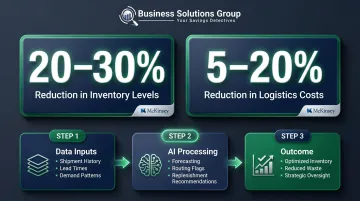
McKinsey reports that AI-powered demand forecasting reduces inventory levels by 20–30% and logistics costs by 5–20% in distribution operations. For healthcare, where inventory carrying costs and expiration waste are major budget items, those reductions translate directly to margin improvement.
AI tools process shipment history, supplier lead times, and demand patterns to recommend optimal reorder quantities, flag routing inefficiencies, and automate replenishment decisions. Mayo Clinic and Cleveland Clinic are among the health systems actively using AI to optimize supply chain strategy — moving logistics teams from manual firefighting toward strategic oversight.
Quality Management Systems for Compliance Automation
Electronic QMS (eQMS) platforms replace manual documentation and compliance tracking with automated workflows. Key capabilities include:
- Regulatory change tracking and documentation updates
- Supplier audit scheduling and record management
- Automated routing and approval for quality events
- Audit trail generation for FDA 21 CFR Part 11 and EU Annex 11 compliance
Unified data platforms connecting MES, LIMS, and QMS can compress audit preparation from days to minutes by creating a single, tamper-proof source of truth across manufacturing and quality data.
Spend Intelligence Platforms for Cost Visibility
Tracking shipments is necessary. Tracking spend is what enables strategic decision-making.
Spend intelligence platforms provide financial visibility across carriers, routes, shipment modes, and supplier relationships — uncovering hidden cost leakage that manual invoice review consistently misses. Business Solutions Group's proprietary spend intelligence software manages over $3 billion in parcel spend and has helped clients achieve more than $350 million in annual savings. Core capabilities include:
- Carrier rate analysis down to precise percentage points
- Automated invoice auditing across all transportation modes
- Surcharge and accessorial fee identification
- Real-time cost allocation by department or location
For healthcare organizations managing complex, multi-modal logistics across regulated supply chains, this level of financial visibility is what enables negotiation leverage and ongoing cost control.
How to Build a Cost-Optimized Healthcare Logistics Strategy
Audit Current Logistics Spend First
Before changing anything, organizations need to understand where money is actually going. A logistics spend audit captures 6–12 months of shipment-level detail to establish a financial baseline — then examines that data for:
- Redundant vendor relationships and duplicated shipping lanes
- Uncontrolled use of expedited shipping modes (shipments that could have moved standard)
- Invoice errors and billing discrepancies (22% of all freight invoices contain exceptions requiring manual intervention, costing $53.50 each to resolve)
- Accessorial charges that add 8–20% to base transportation rates
- Carrier rate misapplications and missing contract discounts
Most organizations that haven't benchmarked their carrier contracts in the past two to three years are overpaying by 15–30% without knowing it.
Negotiate Carrier Contracts Using Benchmark Data
Without benchmark data, most healthcare organizations have no way to know whether their carrier pricing is competitive. They're comparing rates against their own history, not the market — which means they're negotiating blind.
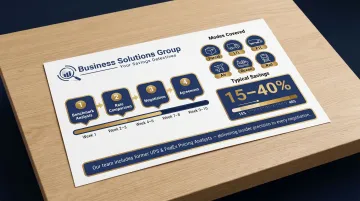
Business Solutions Group's contract negotiation process starts with a full benchmark analysis of current tariffs and shipment patterns against proprietary market-rate intelligence. This surfaces the actual savings opportunity before any negotiation conversation begins.
Key details on the process:
- Timeline: 6–10 weeks depending on shipment mode
- Modes covered: Parcel, LTL, FTL, air, ocean, and rail
- Typical savings: 15–40% in carrier cost reductions
- Team background: Former UPS and FedEx senior-level pricing analysts who know precisely how carriers structure their agreements
Build a Continuous Improvement Cycle
Cost optimization isn't a project with an end date. Carriers adjust rates, surcharges creep in, shipment patterns shift, and new inefficiencies emerge over time.
Sustaining savings requires:
- Monthly or quarterly performance reviews — tracking KPIs against benchmarks, not just prior periods
- Ongoing invoice auditing — catching billing errors before they compound
- Regular re-benchmarking — ensuring carrier agreements remain competitive as market rates evolve
- Proactive identification of new opportunities — not waiting for a budget crisis to prompt a review
This ongoing discipline is what separates organizations that hold their savings from those that watch them erode within 12–18 months. Business Solutions Group's Client Success Team handles this continuous monitoring, keeping initial gains intact and building on them over time.
Frequently Asked Questions
What does healthcare logistics management do?
Healthcare logistics management coordinates the planning, movement, storage, and delivery of medical supplies, pharmaceuticals, and equipment from point of origin to point of care. The goal is getting the right products to the right place, in usable condition, when patient care demands it.
What is a logistics management system?
A logistics management system (LMS) is a software platform that helps organizations plan, execute, and monitor the flow of goods across their supply chain. Core features typically include shipment tracking, inventory management, carrier coordination, and performance reporting — giving teams end-to-end visibility across the supply chain.
What are the 5 types of logistics management?
The five types are: procurement (inbound), production, distribution (outbound), reverse, and last-mile logistics. In healthcare, each has a direct application — from sourcing pharmaceuticals and managing production flow to returning expired inventory and delivering medications to patients.
What are the biggest challenges in healthcare logistics?
Cold chain integrity, regulatory compliance, inventory expiration management, fragmented visibility across disconnected systems, and rising operational costs are the most persistent and impactful challenges healthcare logistics teams face.
What is the difference between healthcare logistics and supply chain management?
Supply chain management covers the full product lifecycle from manufacturing through end use. Logistics specifically focuses on the efficient movement and storage of goods — making it one critical component within the broader supply chain, not a synonym for it.