The margin impact is real. When freight costs are uncontrolled, they erode already-thin operating margins, delay supply availability, and make department-level budgeting nearly impossible. Finance teams struggle to forecast accurately when freight charges are buried inside supplier invoices or swept into a single general ledger line.
What makes this frustrating is that most of these costs aren't inevitable. They accumulate because of specific, correctable failures: supplier contracts that hand freight control to vendors, ordering patterns that drive emergency shipments, and organizations that have never separated freight spend into measurable categories. This article addresses all three dimensions — and what healthcare organizations can do about them.
TL;DR
- Inbound freight can account for up to one-third of total logistics costs — and most healthcare organizations don't track it
- Charges stay invisible when freight is bundled into supplier invoices or buried in a single GL account
- The biggest controllable cost drivers: supplier contract terms, expedited ordering habits, and fragmented purchasing
- Cutting costs requires action at three levels — contracting, in-transit management, and organizational structure
- Healthcare organizations with structured freight programs achieve measurable, sustained savings
How Inbound Freight Costs Build Up in Healthcare
Inbound freight rarely appears as a single, visible budget line. Instead, it builds up across hundreds of supplier invoices, emergency orders, and distribution fees — swept into a catch-all freight GL account that prevents accurate cost isolation.
As the Journal of Healthcare Contracting notes, many hospital organizations lump mail, same-day deliveries, trunk stock, and inbound freight costs into one account. Suppliers — who choose their own carriers under standard contract terms — may apply markups on those charges without any transparency to the buyer. The healthcare organization sees a combined invoice and pays it.
Why the Build-Up Goes Undetected
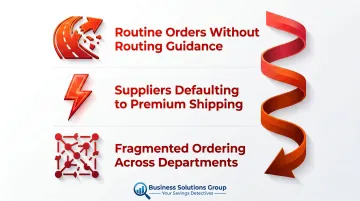
The accumulation is gradual — and that's exactly why it persists. Three compounding patterns drive it:
- Routine orders placed without routing guidance — departments order from preferred vendors without specifying mode, leaving carrier selection entirely to the supplier
- Suppliers defaulting to premium shipping — without contract restrictions, vendors may choose expedited options that inflate per-shipment costs while the buyer absorbs the difference
- Fragmented ordering across departments — multiple facilities or departments ordering independently from different vendors eliminates volume consolidation and makes freight spend impossible to view in aggregate
Healthcare organizations frequently don't discover the full scale of these costs until a formal audit occurs. At that point, they often find marked-up freight rates, accessorial charges they never questioned, and invoice errors paid without review.
Research from APQC suggests freight invoice error rates run 12–15%, with billing errors costing organizations 3–7% of total freight spend when invoices go unaudited.
Key Cost Drivers for Inbound Freight in Healthcare
Most healthcare organizations are overpaying on inbound freight — not because of carrier rates, but because of structural problems in how shipping is contracted and managed. Three drivers account for the majority of that excess spend.
Supplier Contract Terms
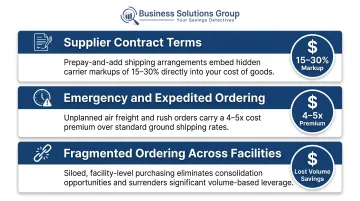
The most structurally significant driver is contract language that gives vendors control of freight decisions. Under "prepay and add" arrangements, the supplier selects the carrier, ships the product, and adds freight charges to the buyer's invoice — often with a markup of 15–30% built in. Because the healthcare organization never sees the carrier invoice directly, it has no basis for questioning the charge.
Switching to FOB Destination, Freight Bill Third Party terms addresses this directly:
- Redirects billing to the buyer's own carrier account
- Eliminates supplier markups on freight
- Gives the healthcare organization direct visibility into actual shipping costs
Emergency and Expedited Ordering
Poor inventory forecasting and last-minute clinical requests force reliance on expedited shipping that is disproportionately expensive. Air freight costs 4–5x more than road transport for the same shipment — and in healthcare, where supply criticality can feel like justification for overnight shipping on nearly any item, this premium adds up fast.
When emergency ordering becomes a habit rather than an exception, costs spiral. Without usage data and predictive visibility, stockouts recur and expedited freight stays the default — an expensive pattern that better demand planning can break.
Fragmented Ordering Across Facilities
Multi-facility health systems often operate with siloed supply chains — each department or location maintains its own vendor relationships, order cycles, and carrier arrangements. According to research from Triose/Cencora, this fragmentation prevents volume consolidation and eliminates carrier negotiating leverage. It also makes a system-wide view of freight spend effectively impossible to achieve.
Each of these three drivers is solvable — but only once the organization has visibility into where money is actually going. That's where the practical fixes begin.
Cost-Reduction Strategies for Inbound Freight in Healthcare
Strategies for reducing inbound freight costs fall into three categories: changing the decisions made before freight moves, changing how freight is managed once it's in motion, and changing the organizational structure that surrounds freight decisions.
Strategies That Change Upstream Decisions
These are the highest-leverage interventions because they set the cost baseline for every shipment before a carrier is ever contacted.
Audit current spend and establish benchmarks. Without a starting point, savings can't be tracked or validated. Freight costs typically represent approximately 1–3% of a hospital's total supply budget, per the Journal of Healthcare Contracting — though that range shifts significantly based on product mix, geography, and how actively freight is managed. An audit that separates inbound freight from distribution fees, emergency orders, and mail costs creates the foundation for everything that follows.
Renegotiate supplier contracts. Replace "prepay and add" language with FOB Destination, Freight Bill Third Party terms. This single contract change eliminates supplier markups and redirects freight billing to the healthcare organization's own carrier account, where charges can be reviewed, contested, and benchmarked.
Build a preferred carrier program. Consolidating inbound shipments through fewer, pre-vetted carriers allows healthcare organizations to:
- Negotiate volume-based discounts across the full system
- Set enforceable performance standards for transit times and reliability
- Eliminate rate unpredictability across hundreds of vendor relationships
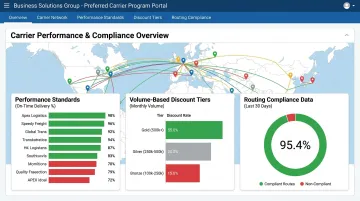
Business Solutions Group builds preferred carrier programs through a formalized RFP process, with all carrier agreements negotiated in the client's name — preserving full transparency and ownership over carrier relationships.
Set clear mode classification thresholds. Establish criteria for when standard ground, second-day, or overnight shipping is justified, and embed those thresholds in a routing guide. Without enforcement, suppliers and internal requestors default to premium modes for non-urgent supplies, and costs compound without anyone making an explicit decision to spend more.
Strategies That Improve In-Motion Management
Even well-structured contracts lose value when day-to-day management is weak. These approaches reduce costs by tightening control once freight is in motion.
Implement a Transportation Management System. Organizations still managing inbound freight through email and spreadsheets can't detect exceptions — a vendor choosing the wrong carrier, a routing guide violation — until after costs are already incurred. A TMS changes that dynamic.
Real-time visibility into carrier selection, transit status, and routing compliance converts reactive cost recovery into proactive cost prevention.
Business Solutions Group's TMS platform supports all modes — LTL, FTL, air, ocean, parcel, and rail — with automated least-cost routing, exception alerts, and post-shipment audit capability. For qualifying engagements, the platform is available at no additional cost.
Create vendor compliance programs with chargeback mechanisms. Routing guides are only effective when vendors follow them. Compliance programs that pair routing requirements with formal chargeback policies shift the cost of non-compliance back to the vendor, creating a financial incentive for consistent adherence rather than relying on goodwill.
Separate freight costs in your GL. Lumping inbound freight, distribution fees, emergency orders, and mail into a single account makes it impossible to identify which categories are growing or where savings have been achieved. Separating these into distinct GL categories is a prerequisite for any measurable freight management program — and it's often the first thing that reveals where spending is actually concentrated.
Strategies That Change the Organizational Context
In many health systems, the surrounding structure — siloed departments, misaligned goals, lack of shared data — is the primary cost driver, not any individual vendor or shipment.
Centralize freight management across facilities. When each facility negotiates its own vendor relationships and places orders independently, the system loses the volume aggregation needed to secure favorable carrier terms. Centralizing freight management under a single function creates unified spend visibility and restores negotiating leverage. EY documented one leading US health system projecting $80 million in supply chain savings through centralization and process improvement.
Align clinical and supply chain stakeholders. Freight savings goals set within supply chain alone, without clinical input, miss opportunities created by over-ordering, item preferences, or unpredictable requisition patterns. Cross-functional alignment turns freight cost reduction into a shared operational priority rather than a supply chain problem that clinicians don't feel responsible for.
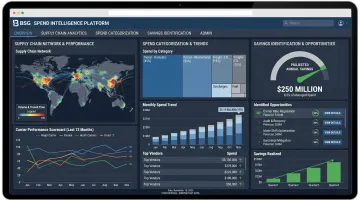
Use spend intelligence to reduce emergency freight dependency. Predictive analytics and usage data let healthcare organizations identify stock-at-risk before shortages occur, optimize order cycles, and pinpoint which facilities or item categories drive the most expedited freight costs.
Business Solutions Group's proprietary spend intelligence platform manages over $3 billion in parcel spend and has helped clients achieve more than $350 million in annual savings. It's built to surface these hidden patterns and translate them into specific cost reduction opportunities across the supply chain.
Conclusion
Reducing inbound freight costs in healthcare isn't about blanket spending cuts. It requires identifying where cost actually originates — in supplier contract terms, ordering behavior, management gaps, or organizational silos — and addressing each source with a targeted response.
That targeted approach has a pattern in organizations that make sustained progress: they establish baselines, track freight costs in categories that can actually be measured, and align clinical and supply chain teams around shared savings targets. When freight is treated as a fixed expense, it behaves like one. When it's managed as a cost category — with visibility, accountability, and supplier terms that reflect actual shipping behavior — it becomes a consistent source of recoverable spend.
Frequently Asked Questions
How can I reduce inbound freight costs in healthcare?
The three core levers are renegotiating supplier freight terms to eliminate "prepay and add" markups, implementing a preferred carrier program with enforceable routing guides, and centralizing freight visibility across facilities to prevent siloed ordering from undermining volume leverage.
What is inbound logistics?
Inbound logistics refers to the movement of goods, materials, and supplies from suppliers into a facility. In healthcare, this includes medical supplies, pharmaceuticals, devices, and lab materials — all of which carry compliance and handling requirements that add cost complexity beyond standard commercial freight.
What are the 5 R's of logistics?
The 5 R's are the Right product, Right quantity, Right condition, Right place, and Right time. In healthcare inbound freight, failure on any of these dimensions typically triggers emergency reorders or expedited shipping that erase any savings gained elsewhere.
What percentage of a healthcare organization's logistics costs come from inbound freight?
Inbound transportation can represent as much as one-third of a healthcare organization's total logistics costs, and freight costs typically account for approximately 1–3% of a hospital's total supply budget. Organizations without managed freight programs have been found to overspend by at least 20% compared to those with structured programs in place.
Should healthcare organizations manage inbound freight in-house or outsource to a 3PL?
In-house programs offer control but require dedicated staff, systems, and carrier relationships. External partnerships bring immediate volume leverage and established carrier networks. Business Solutions Group takes a third approach: embedding directly into client operations, keeping all carrier agreements in the client's name, and delivering savings without adding headcount or cost.