Introduction
Healthcare supply chains are under pressure from every direction. Reimbursements from Medicare and Medicaid fell $130 billion short of actual hospital costs in 2023, while total hospital expenses grew 7.5% in 2025, outpacing most inflation benchmarks.
Medical supplies now account for 10.5% of the average hospital's operating budget, totaling $146.9 billion annually, according to the AHA's 2024 Costs of Caring report.
What makes this especially costly: most health systems still can't see what they have. Black Book Research's 2026 State of Healthcare Supply Chain Technology study found that 81% of provider organizations lack near-real-time visibility across critical supply domains and care sites.
That visibility gap has a direct cost: emergency purchases at premium prices, expired stock written off, and redundant orders that no one catches until the invoice arrives.
This article walks through four concrete strategies health systems can use to move from reactive supply management to disciplined, data-driven cost control.
TLDR: Key Takeaways
- Medical supplies consume ~10.5% of the average hospital budget, yet most systems still rely on fragmented, manual inventory processes
- Poor visibility triggers a cascade: overstocking, stockouts, expired products, and emergency buys at premium prices
- Smarter procurement — driven by spend analytics and benchmark pricing — produces measurable, repeatable savings
- Advanced analytics shifts supply chain teams from firefighting to forecasting
- Combining GPOs, technology partners, and consolidated logistics cuts costs and builds the redundancy needed to handle supply disruptions
Why Healthcare Supply Chains Are Under Exceptional Financial Pressure
The Numbers Behind the Squeeze
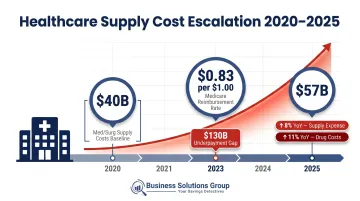
The financial math is unforgiving. Medicare paid just $0.83 per $1.00 of actual cost in 2023, contributing to a $130 billion underpayment gap that hospitals absorbed with no offsetting revenue. At the same time, med/surg supply costs climbed from $40 billion in 2020 to $57 billion in 2025 — roughly 8.2% compound annual growth — according to Definitive Healthcare's analysis of annual hospital supply cost changes.
Supply expense per calendar day rose 8% year-over-year through September 2025, with drug costs climbing even faster at 11%. These aren't temporary disruptions — they're structural trends that require structural responses.
The Visibility Problem
When 81% of health systems can't see their supply chain in real time, the operational fallout is predictable:
- Emergency purchases at above-contract prices fill gaps that shouldn't exist
- Overstocked departments hoard supplies out of fear, while others run short
- Expired inventory gets written off — a direct hit to margin
- Equipment is purchased again because nobody knows where the existing units are
These visibility gaps have a direct behavioral consequence — one that rarely surfaces in ERP dashboards.
The "Emotional Buying" Problem
There's a procurement pattern that doesn't show up in system reports: ordering driven by fear rather than data. When clinical staff or department managers anticipate a shortage, they order more than needed. Multiplied across dozens of facilities and thousands of SKUs, this behavior inflates inventories and creates the very waste it was meant to prevent.
A typical regional health system manages between 6,000 and 35,000 unique SKUs, sourced from global suppliers navigating their own pressures:
- Tariff exposure on imported materials
- Logistics bottlenecks that extend lead times unpredictably
- Raw material constraints that shift without warning
Without a shared data foundation, ordering decisions become guesswork at scale — and guesswork compounds across every department that places an order. Addressing these patterns requires more than tightening a few contracts; it calls for systematic visibility into where inventory is, what it costs, and when it's actually needed.
Strategy 1: Achieving Real-Time Inventory Visibility Across the Enterprise
What Enterprise Visibility Actually Means
Enterprise inventory visibility isn't a dashboard showing stock levels in one warehouse. It's a unified, real-time view across every PAR closet, department, storage room, warehouse, and facility in the health system — including patient-chargeable supplies, ancillary items, and high-value equipment.
Without that unified view, procurement teams are essentially managing dozens of separate inventories rather than one system. The result is predictable: duplicate purchases, expired products, and misallocated equipment that gets bought again rather than retrieved.
The cost of expired and unused high-value medical devices alone is estimated at $5 billion annually — a benchmark that major distributors and health system analysts continue to reference across supply chain research.
How Real-Time Systems Work in Practice
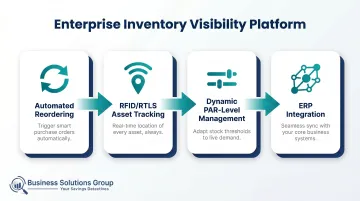
Modern inventory visibility platforms combine several components:
- Automated reordering triggered by actual consumption, not scheduled counts
- RFID/RTLS asset tracking for high-value equipment and surgical supplies
- Dynamic PAR-level management that adjusts thresholds based on patient volume, seasonal demand, and scheduled procedures
- ERP integration that connects inventory data to financial reporting and procurement workflows
Dynamic PAR management is where these systems earn their keep. Static reorder points ignore flu season surges and elective surgery schedules. These systems adjust automatically — preventing both stockouts and the panic-buying that follows them.
The Multi-Facility Advantage
For health systems operating across multiple hospitals or ambulatory sites, centralized visibility changes the procurement calculus entirely. When one facility is overstocked and another is running low, a consolidated view makes redistribution obvious. Without it, both facilities order independently, and the system pays twice.
That same unified view supports compliance readiness. Traceable transaction histories and SKU-level documentation satisfy regulatory and audit requirements without manual reconciliation — eliminating a time-consuming step that typically falls on already-stretched supply chain staff.
Strategy 2: Cost Control Through Smarter Procurement and Spend Management
The Fragmentation Problem
Most healthcare procurement environments weren't designed for scale. They grew through mergers, acquisitions, and departmental autonomy — leaving behind disconnected systems, paper-based workflows, and purchasing decisions that happen in isolation. The result: no single view of total spend, pricing inconsistencies across facilities, and limited leverage in supplier negotiations.
That fragmentation has a measurable cost. 72% of healthcare organizations report that at least half of their critical supply chain exception workflows remain primarily manual, according to Black Book's 2026 research — a sign that most organizations need a fundamentally different procurement approach, not just better software.
Spend Analytics as the Foundation
Before any negotiation or consolidation effort, health systems need to understand where money is actually going. Spend analytics platforms reveal:
- Pricing inconsistencies across facilities buying the same item from the same supplier at different rates
- Off-contract purchasing that bypasses negotiated terms and pays list price
- Supplier concentration risks where over-reliance on single sources creates vulnerability
- Consolidation opportunities where SKU rationalization can reduce complexity and cost
Business Solutions Group's proprietary spend intelligence software is built specifically to identify these gaps — benchmarking supplier pricing, flagging savings opportunities, and supporting more informed contract negotiations. The platform is designed to be self-funded through the savings it uncovers.
Contract Compliance and Procurement Auditing
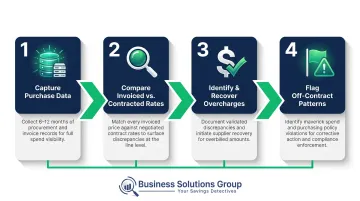
Negotiating a good contract is only half the work. Revenue leakage happens when invoiced prices don't match contracted rates, or when "maverick spending" routes purchases through unapproved vendors. Contract compliance auditing closes this gap by:
- Capturing 6–12 months of purchase data to establish a spending baseline
- Comparing invoiced prices against contracted rates at the line-item level
- Identifying and recovering billing discrepancies
- Flagging patterns of off-contract purchasing for policy intervention
Business Solutions Group's audit process includes ongoing KPI tracking and re-benchmarking, turning compliance from a periodic check into a continuous operational discipline.
The GPO Advantage
Group Purchasing Organizations give health systems access to pre-negotiated pricing that would take months to secure independently. Hospitals that actively leverage GPO contracts realize 10–18% average savings versus independent negotiations, and 96–98% of U.S. hospitals already participate in at least one GPO. For most health systems, the real opportunity isn't finding a GPO to join — it's ensuring full compliance with the contracts already in place.
Strategy 3: Using Data Analytics to Eliminate Waste and Drive Smarter Decisions
The Analytics Gap
Health system supply chain teams are aware their tools aren't keeping pace with their challenges. 71% of healthcare organizations expect to replace or significantly upgrade at least one major supply chain application within 24 months, per Black Book 2026 — a signal that the sector is approaching a technology inflection point.
The gap is a capability problem, not just a software age problem. Most organizations underuse — or don't have access to — the following:
- Demand forecasting tied to patient volume and seasonal trends
- Cost-per-case analysis linked to clinical outcomes
- Expiry prediction for high-cost consumables
- Slow-moving inventory identification before write-off
What Advanced Analytics Actually Enables
When analytics are applied well, supply chain decisions shift from opinion-based to evidence-based:
- Demand forecasting uses historical usage data and admission patterns to predict what will be needed — and when — rather than relying on gut instinct or last year's budget
- Surgical kit standardization identifies supply variation across surgeons performing the same procedure, creating standardization opportunities that reduce per-case cost without affecting clinical quality
- Value analysis applied systematically has helped health systems reduce supply costs by 5–10%, with some organizations citing approximately $15 million in annual savings through improved processes, according to Vizient's value analysis research
AI and Predictive Modeling
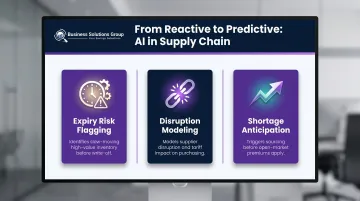
Predictive models move beyond reporting past behavior — they anticipate problems before those problems become emergencies. Applied to healthcare supply chains, this means:
- Flagging expiry risks on slow-moving, high-value inventory before write-off
- Modeling the impact of a supplier disruption or tariff change on downstream purchasing
- Anticipating shortage patterns and triggering proactive sourcing before open-market premiums apply
Business Solutions Group's analytics platform is built around these predictive capabilities. It uses historical data to forecast cost spikes, capacity constraints, and demand shifts — giving supply chain teams the lead time to act strategically rather than scramble reactively.
Strategy 4: Building Resilience Through Strategic Partnerships and Consolidation
The Case for Consolidation
Running independent inventory operations across multiple facilities multiplies cost at every layer — logistics, capital tied up in redundant stock, administrative overhead, and waste from facility-level ordering inefficiencies. Consolidated Service Centers (CSCs) address this by centralizing pharmacy, surgical supply, and equipment distribution across the health system.
One inventory managed intelligently beats ten inventories managed independently. Centralization reduces per-unit cost through scale, cuts redundant purchasing through shared visibility, and lowers carrier costs through consolidated volume.
Strategic Partnerships That Build Resilience
No health system builds resilience alone. The partnerships that matter most include:
- Logistics carriers with reliable performance for both routine replenishment and urgent needs — especially critical for rural or specialty facilities
- Technology vendors providing tracking, analytics, and ERP integration that ties the system together
- Cold-chain storage partners for temperature-sensitive biologics, vaccines, and pharmaceuticals
- Supply chain advisory firms that bring benchmark data, category expertise, and independent perspective to cost-reduction strategy — Business Solutions Group, for example, runs a structured seven-phase engagement covering savings analysis, implementation, and ongoing reporting while keeping the burden on internal teams minimal
Shortage Mitigation at the Enterprise Level
Drug shortages alone cost hospitals approximately $360 million annually in management costs, with gray-market premiums running 300–500% above contract pricing during acute shortfalls. Facility-by-facility shortage responses compound this cost. Each site hoards independently, and the system as a whole pays for the redundancy.
An enterprise-level shortage strategy changes the dynamic:
- Proactive shortage programs through wholesalers provide early warning and priority access
- Virtual warehousing and consignment models add inventory buffer without carrying cost
- Centralized shortage governance ensures consistent response across facilities rather than panic-buying at the edges
Frequently Asked Questions
What percentage of a hospital's budget is typically spent on medical supplies?
Medical supplies account for approximately 10.5% of the average hospital's operating budget, totaling $146.9 billion across the U.S. in 2023. That share makes supply chain one of the largest non-labor cost categories and one of the highest-impact areas for margin improvement.
What is the biggest barrier to improving healthcare supply chain visibility?
Fragmented systems, siloed department data, and manual processes are the primary culprits. Most health systems have accumulated incompatible platforms through years of growth and acquisitions, making unified real-time visibility difficult to achieve without deliberate integration work.
How can healthcare organizations reduce medical supply waste?
Enterprise-wide inventory visibility, dynamic PAR-level management, and expiry tracking address the root causes. Moving away from "emotional buying" (stocking based on fear rather than data) toward demand-driven procurement eliminates the overstocking that leads to write-offs.
What role does data analytics play in healthcare supply chain management?
Analytics enables demand forecasting, spend benchmarking, cost-per-case analysis, and proactive shortage mitigation. The practical effect is moving supply chain teams from reactive firefighting to strategic planning so problems get resolved before they become expensive emergencies.
How do GPOs help with healthcare procurement cost control?
GPOs provide access to pre-negotiated pricing and preferred vendor terms, eliminating the time and resources required for individual supplier negotiations. For scarce products during shortages, GPO relationships also improve access and pricing versus open-market alternatives.
What is the difference between inventory management and inventory optimization in healthcare?
Inventory management handles basic tracking and reordering: knowing what's on hand and triggering replenishment when levels drop. Optimization goes further, using predictive analytics and demand planning to balance supply availability against cost, cutting both stockouts and excess inventory carrying costs.