Introduction
Healthcare logistics management — the coordination of medical supplies, pharmaceuticals, equipment, and patient-critical goods across the supply chain — is under more pressure than ever. According to the American Hospital Association, hospitals saw total expenses grow 5.1% in 2024, far outpacing the 2.9% inflation rate, while supply costs alone consumed 13% of hospital budgets.
The pipeline of precision therapies, the shift to home-based care, and escalating cyber threats are forcing logistics functions to evolve at an uncomfortable pace.
2026 is the year many of these pressures converge. Organizations that built digital foundations over the past two years are now extracting measurable returns — while laggards contend with widening cost gaps and operational blind spots.
This article breaks down the five trends reshaping healthcare logistics right now, what's driving them, and what the next 1–3 years will demand from supply chain leaders.
TL;DR
- AI has moved from pilot programs to full-scale supply chain deployment — reducing stockouts and automating exception management at scale
- Cold chain logistics is now mission-critical as cell, gene, and mRNA therapies require cryogenic-grade handling end-to-end
- Supply chain resilience is a board-level priority, driven by multi-source procurement, regional hubs, and real-time visibility
- Direct-to-patient and last-mile delivery models are expanding rapidly beyond hospital walls
- Cybersecurity and regulatory compliance are core logistics functions, not IT afterthoughts
AI and Predictive Analytics: From Experimentation to Execution
The Shift to Full-Scale Deployment
According to Menlo Ventures' 2025 State of AI in Healthcare report, 22% of healthcare organizations have implemented domain-specific AI tools — a 7x increase over 2024. Health systems lead at 27% adoption, and healthcare AI spending reached $1.4 billion in 2025, nearly tripling the prior year.
That's not pilot territory anymore. That's operational infrastructure.
In logistics specifically, AI is being deployed for:
- Demand forecasting — integrating EHR usage data to generate smarter reorder triggers
- Exception management — flagging delayed shipments or mismatched purchase orders in real time
- Disruption prediction — identifying supplier risk signals before shortages materialize
- Inventory optimization — reducing both stockouts and excess inventory simultaneously
The ROI Case Is No Longer Theoretical
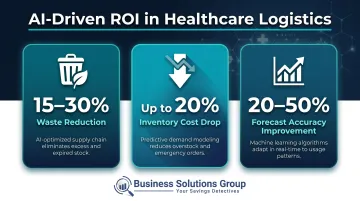
- AI-driven inventory management reduces hospital waste by 15–30%, based on health system deployments
- Overall inventory costs can drop by up to 20% with AI implementation across procurement workflows
- Demand forecasting accuracy improves by 20–50% using machine learning models trained on EHR data
Those gains don't happen in isolation. The organizations achieving them share one trait: cloud ERP foundations that feed AI tools clean, integrated data. Without that base layer, even well-designed algorithms return unreliable outputs.
For healthcare shippers looking to reduce freight spend alongside supply costs, Business Solutions Group pairs spend intelligence software with advisory services to benchmark carrier costs, surface inefficiencies, and build the data foundation that makes AI-driven decisions reliable.
Advanced Cold Chain Logistics for Precision and Biologic Medicines
Why Cold Chain Has Become Infrastructure-Level Critical
The FDA has approved 49 cellular and gene therapy products as of April 2026 — including CAR-T therapies like YESCARTA, KYMRIAH, and CARVYKTI (each requiring cryogenic storage and transport conditions). These aren't off-the-shelf medications. A single temperature excursion can destroy an irreplaceable, patient-specific therapy with no substitute available.
The pharmaceutical industry loses an estimated $20–$35 billion annually from cold chain failures, with up to 50% of vaccines discarded globally due to temperature deviations — a number that rises with every new biologic that clears FDA approval.
What Advanced Cold Chain Looks Like in 2026
Cold chain logistics is growing at a 9.8% CAGR — faster than the broader pharmaceutical logistics market — with the global cold chain market projected to reach $510.1 billion by 2029.
Organizations are investing in:
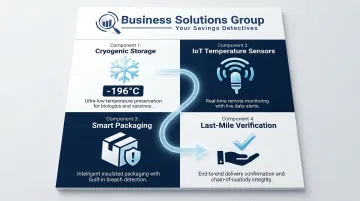
- Cryogenic storage capable of maintaining -196°C for cell and gene therapies
- IoT-enabled temperature sensors providing continuous, real-time monitoring throughout transit
- Smart packaging with embedded condition alerts for direct-to-patient shipments
- Last-mile verification protocols confirming cold chain integrity at patient handoff in clinical trials and home delivery scenarios
Closing that gap requires more than equipment upgrades. Organizations need integrated monitoring systems, carrier contracts with cold chain compliance clauses, and audit-ready documentation — capabilities that directly affect both patient outcomes and liability exposure.
Supply Chain Resilience Through Diversification and End-to-End Visibility
The Post-Pandemic Structural Shift
Approximately 80% of active pharmaceutical ingredients are sourced from outside the United States, predominantly from China and India. When that supply geography faces disruption — from tariffs, geopolitical events, or public health crises — health systems without alternative sourcing strategies absorb the full impact.
The response in 2026 is structural diversification:
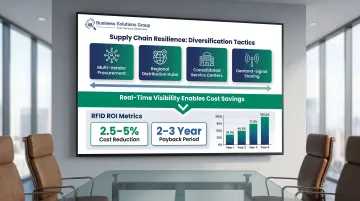
- Multi-vendor procurement strategies that reduce dependency on any single supplier
- Regional distribution hubs that shorten supply lines and reduce single-point-of-failure risk
- Consolidated service centers (CSCs) providing centralized control over medical/surgical and pharmacy inventory across facilities
- Demand-signal sharing between providers and distributors to reduce the lag between usage and replenishment
Visibility Technology Is Closing the Data Gap
The global RFID in healthcare market is projected to grow from $3.8 billion in 2024 to $8.6 billion by 2030 at a 15.3% CAGR — reflecting sustained investment in real-time asset tracking across health systems.
RFID-enabled systems deliver measurable financial returns:
- 2.5–5% cost reductions in annual supply expenses
- 2–3 year payback period on implementation
- Near-real-time inventory visibility when integrated with cloud ERP platforms
What this visibility often exposes is a persistent pricing gap: different health systems can pay up to 100% more for identical items from the same manufacturer. Spend benchmarking and procurement intelligence tools target this gap directly — turning data access into measurable cost reduction.
Last-Mile and Direct-to-Patient Delivery Innovation
The US home healthcare market sits at $222.61 billion in 2025 and is projected to reach $692.30 billion by 2035 at a 12.01% CAGR. That trajectory is pulling healthcare logistics well beyond hospital distribution centers.
What's Driving Last-Mile Complexity
Several converging forces are pushing last-mile innovation:
- Home-based care expansion — infusion therapies, specialty medications, and post-surgical care moving to the home setting
- Ambulatory surgery centers — a market growing at 6.3% annually, requiring dedicated supply chains distinct from inpatient models
- Decentralized clinical trials — a $8.6 billion market growing to $29.7 billion by 2034, demanding direct-to-patient investigational product delivery
What Sophisticated Last-Mile Looks Like
Logistics providers are building direct-to-patient capabilities that include:
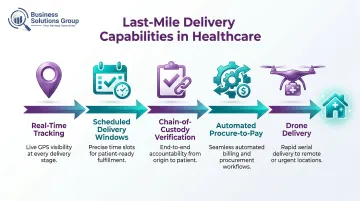
- Real-time shipment tracking with patient-facing notifications
- Same-day and scheduled delivery windows for specialty medications
- Documented patient handoff protocols with chain-of-custody verification, particularly for temperature-sensitive therapies
- Automated procure-to-pay workflows for implantable devices in non-acute settings
- Drone delivery — Mayo Clinic, Cleveland Clinic, and Intermountain Health have partnered with Zipline for autonomous medication delivery to hospital-at-home patients
The scale driving these capabilities is hard to ignore. Specialty drug spending jumped from $92.5 billion in 2023 to $129.2 billion in 2024, heading toward nearly $965.5 billion by 2030. Most of that growth involves temperature-sensitive, patient-specific products — biologics, gene therapies, infusion agents — that require dedicated cold-chain handling, real-time monitoring, and patient-level delivery confirmation that standard parcel networks aren't built to provide.
Cybersecurity and Regulatory Compliance as Core Logistics Functions
The Threat Landscape in Numbers
Healthcare remains the highest-cost target for cyberattacks. The average healthcare data breach costs $10.93 million per incident — more than double the cross-industry average of $4.45 million. In 2025 alone, 710 large breaches were reported, affecting approximately 62 million individuals.
The Change Healthcare ransomware attack in 2024 compromised 192.7 million records and cascaded across the entire pharmaceutical supply chain, disrupting claims processing and medication dispensing nationwide. The fallout forced logistics teams — not just IT departments — to own vendor access controls, data sharing protocols, and business continuity planning.
How Organizations Are Responding
With breach costs and incident frequency both climbing, healthcare logistics operations are responding with structural security changes, not just policy updates:
- Zero-trust security architectures for all supply chain platforms and vendor connections
- Third-party vendor vetting as a prerequisite for logistics partnerships
- AI-based anomaly detection to flag unusual patterns in supply chain data and transactions
- DSCSA serialization compliance — wholesale distributors faced mandatory compliance by August 2025; dispensers with 25 or fewer pharmacists/technicians have until November 2026
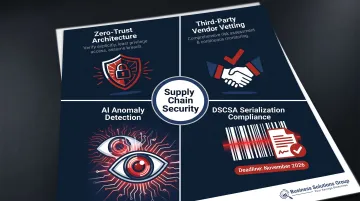
Compliance isn't just a regulatory checkbox. Organizations with a strong security track record secure better vendor partnerships and lower cyber insurance premiums — which means compliance gaps now carry a direct line-item cost, not just regulatory risk.
What's Driving These Healthcare Logistics Trends
These trends don't exist in isolation. Five underlying forces are converging to reshape the sector simultaneously.
Technology maturation: AI, IoT, robotics, and cloud ERP have crossed the threshold from experimental to operationally reliable. The infrastructure that makes real-time visibility and predictive analytics possible now exists at scale.
Patient expectations: Consumers who receive same-day delivery for retail orders expect comparable service for their medications and medical equipment. That expectation is reshaping logistics networks that were built around hospital convenience, not patient convenience.
Cost pressure: Supply, pharmacy, and purchased services represent 30–40% of a typical health system's cost base, and McKinsey projects 5–15% savings achievable through spend optimization. For organizations operating on narrow margins, that opportunity is impossible to ignore. Freight benchmarking and contract renegotiation are increasingly the first place health systems look to capture those savings without operational disruption.
Regulatory evolution: DSCSA serialization mandates, FDA traceability requirements, and HIPAA digital data rules are forcing logistics providers to build compliance into operations from day one, not retrofit it later.
Workforce constraints: HRSA projects a 58% physician shortage in nonmetro areas by 2038. Supply chain automation — from robotic dispensing to drone delivery — is part of the strategic response. Delivering care with constrained staffing means logistics infrastructure has to work harder and smarter.
Together, these five forces explain why the trends below aren't incremental upgrades — they're structural shifts in how healthcare supply chains are built and managed.
How These Trends Are Impacting Healthcare Logistics Operations
Operational Impact
Automation is eliminating manual touchpoints across procure-to-pay workflows, reducing error rates and shifting supply chain teams from reactive problem-solving to proactive planning.
Cold chain and direct-to-patient logistics are adding new process layers. Temperature monitoring protocols, patient verification requirements, and reverse logistics for returns each demand dedicated investment in technology and training.
Spend intelligence platforms give healthcare shippers measurable control over freight costs and carrier performance, turning fragmented shipping data into actionable benchmarks. Business Solutions Group's advisory tools are built specifically for this kind of visibility.
Business Impact
Health systems are making deliberate investments in:
- Consolidated service centers for inventory centralization
- AI platforms for demand forecasting and exception management
- Cybersecurity infrastructure and DSCSA compliance systems
- Carrier contract renegotiation and freight benchmarking to offset rising costs
The business case is supported by data: RFID-enabled systems return 2.5–5% annual supply expense savings within 2–3 years, and comprehensive spend optimization programs yield 5–15% reductions from external spend baselines.
Workforce Impact
Roles are shifting, not disappearing. Demand for manual data entry and order processing is declining, while skilled positions in data analytics, AI tool management, and compliance work are growing. Healthcare organizations are responding with targeted upskilling programs, though projected workforce shortages mean automation will carry significant operational weight well into the 2030s.
Future Signals for Healthcare Logistics in 2026 and Beyond
Several developments are already visible on the horizon:
Near-term signals (next 1–2 years):
- Autonomous drone delivery scaling beyond pilot programs at major health systems
- Blockchain-based drug traceability moving from pilots to operational deployment as DSCSA compliance demands increase
- 4PL models gaining traction as health systems outsource full supply chain orchestration — the global 4PL market is projected to reach $152.37 billion by 2035
Technologies entering operational use:
- Generative AI for real-time logistics decision support and scenario planning
- Digital twin simulations enabling supply chain stress-testing before disruptions occur
- Ambient IoT sensors embedded in packaging for continuous cold chain condition monitoring
These near-term shifts set the stage for more structural changes in the years that follow. By 2027–2028, the competitive gap between prepared and unprepared organizations will widen significantly.
Scenarios for 2027–2028:
- AI-driven logistics networks that self-optimize routing and inventory without human intervention
- Full supply chain traceability mandates becoming standard regulatory requirements in the US
- Market consolidation around logistics providers with integrated visibility, compliance, and cost management capabilities
Organizations that invest in visibility, compliance infrastructure, and AI-ready systems now will be better positioned to absorb regulatory mandates and market shifts — without scrambling to catch up when timelines compress.
Conclusion
Healthcare logistics in 2026 is defined by five converging demands: AI at operational scale, cold chain precision for next-generation therapies, structural supply chain resilience, direct-to-patient delivery sophistication, and cybersecurity integration throughout. Each one rewards early movers — organizations that build capability before a disruption forces their hand, not after.
Organizations that treat these trends as strategic priorities are building supply chains capable of absorbing future disruptions without compromising patient care. The right advisory and technology partnerships shorten that path significantly — compressing years of trial-and-error into targeted, measurable improvements in cost, speed, and reliability.
Frequently Asked Questions
What are the healthcare supply chain trends for 2025?
2025 trends centered on AI adoption, supply chain resilience, cold chain expansion, last-mile delivery growth, and cybersecurity investment. 2026 marks the maturation of these trends from experimentation into full operational deployment across health systems of all sizes.
What is the future of logistics in 2025?
2025 accelerated the shift toward digital transformation, real-time visibility, and AI-driven decision-making. By 2026, these capabilities have become standard operational requirements. Organizations without them face measurable cost and service disadvantages.
What software do supply chain analysts use?
Common tools include ERP systems (SAP, Oracle), warehouse management systems (WMS), transportation management systems (TMS), predictive analytics platforms, and spend intelligence software for cost benchmarking and carrier analysis.
What are the 4 types of SCM?
The four types are: supply chain planning (demand and inventory), supply chain execution (procurement and fulfillment), supply chain visibility (tracking and monitoring), and supply chain optimization (cost and efficiency improvement). Each addresses a distinct phase of the end-to-end supply chain.
How does AI improve healthcare logistics management?
AI enables predictive demand forecasting, automated exception management, disruption risk detection, and real-time inventory optimization, reducing inventory costs by up to 20% and improving forecast accuracy by 20–50%.
What is cold chain logistics in healthcare?
Cold chain logistics is the temperature-controlled supply chain required to safely transport vaccines, biologics, and specialty medications. In 2026, it extends to cell and gene therapies requiring cryogenic handling at temperatures as low as -196°C. At these extremes, a single temperature excursion can permanently destroy a patient-specific therapy with no possibility of replacement.