The costs rarely announce themselves. They accumulate through small, compounding inefficiencies: an extra 30 seconds per pick, a slow-moving SKU occupying prime shelf space, a replenishment order placed without demand data. None of it looks like a problem in isolation. Collectively, it erodes profitability quarter after quarter before anyone runs the numbers.
This guide covers where warehouse costs actually originate, which drivers carry the most weight, and what types of interventions — from layout decisions to supply chain benchmarking — produce durable reductions rather than one-time fixes.
Key Takeaways
- Warehouse costs accumulate through dozens of small inefficiencies that go untracked until margin is already eroded
- Labor, inventory holding, and facility overhead are the three largest controllable cost categories — each requires different interventions
- Effective cost reduction spans three levers: smarter decisions, tighter operations, and supply chain-level improvements
- Technology and process discipline drive sustainable savings — one-time audits rarely hold without ongoing measurement
- Spend intelligence and benchmarking tools can surface cost patterns that internal data alone won't reveal
How Warehouse Operation Costs Typically Build Up
Most warehouse cost problems aren't sudden — they're accumulated. A few extra steps in a picking route, inventory that hasn't moved in six months still occupying a primary slot, a staffing model that doesn't flex with volume. Each issue is minor on its own. Together, they compound into significant annual losses.
What makes this hard to manage is the lag between cause and visibility. By the time excess costs show up clearly in financial reporting, the inefficiency has often been running for months and has become embedded in how the warehouse operates. Managers inherit the process, optimize around it, and the original inefficiency never gets reviewed.
The Visible Costs vs. the Hidden Ones
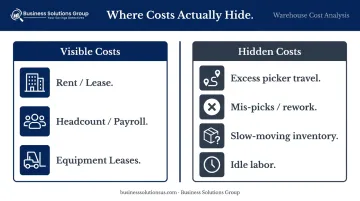
Businesses tend to monitor the obvious expenses well:
- Rent and lease commitments
- Headcount and payroll
- Equipment leases and maintenance contracts
The harder-to-see costs live elsewhere:
- Excess picker travel time from poor slotting
- Mis-picks requiring correction and reshipment
- Slow-moving inventory consuming prime storage and tying up working capital
- Idle labor during volume dips that a flexible staffing model would absorb
Those hidden costs are typically where the largest reduction opportunity sits — because they never appear as a discrete line item, they rarely get challenged.
Key Cost Drivers in Warehouse Operations
Four cost drivers account for the majority of controllable warehouse spend — and each one has a direct path to reduction once it's clearly understood.
Labor
Labor productivity can represent up to 50% of warehouse operating costs, making it the single largest controllable expense in most operations. Excessive labor spend typically traces back to efficiency losses built into how work is organized: suboptimal pick routes, poor slotting, manual processes that automation could handle, and high turnover that requires constant retraining.
Replacing a warehouse employee carries a real cost. SHRM estimates employee replacement can run 50–200% of annual salary — a figure that escalates quickly in high-turnover environments.
Inventory Holding Costs
Overstocking creates a cascade of secondary costs. Excess inventory:
- Consumes storage space that could hold faster-moving product
- Ties up working capital that could be deployed elsewhere
- Increases the risk of damage, obsolescence, or markdown
- Forces businesses into larger or more expensive facilities than they need
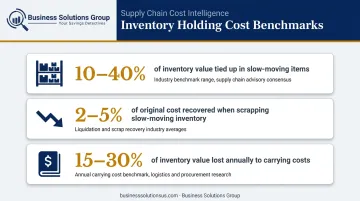
According to McKinsey, slow-moving items often represent 10–40% of total inventory in industrial-services organizations — and scrapping those items typically returns only 2–5% of original cost. Inventory holding cost estimates vary, but most industry benchmarks place carrying costs at 15–30% of inventory value annually.
Space and Facility Overhead
Facility costs feel fixed, but they're heavily influenced by space utilization decisions. U.S. industrial asking rents reached $10.20 per square foot in Q1 2026, up 2.1% year-over-year — which means utilization gaps are increasingly expensive to ignore.
Every square foot of underutilized space — unused vertical height, inefficient aisle configurations, oversized safety stock footprints — translates directly into overpayment for square footage that isn't generating value.
Process Errors and Rework
Each of these error types carries a labor and cost penalty that rarely appears as a tracked line item:
- Mis-picks requiring re-pulls and re-packing
- Misplaced inventory triggering search time and cycle count variances
- Damaged goods generating credits and replacement shipments
- Returns driving reverse logistics labor with little recovery value
Because these costs get absorbed across labor hours, shipping credits, and customer service time, operations managers often underestimate their cumulative impact. WERC-derived DC metrics benchmarks indicate best-in-class order picking accuracy at 99.68% or above — a meaningful gap from average operations that represents real rework cost.
Cost-Reduction Strategies for Warehouse Operations
No single strategy applies universally. The right starting point depends on where costs are originating in a specific operation. The strategies below are organized by the type of change required.
Strategies That Reduce Costs by Changing Decisions
These strategies address how warehouse operations are configured before daily work begins.
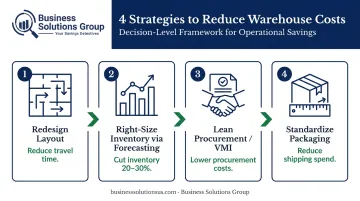
Redesign layout and space utilization. Most warehouses leave vertical space underutilized. Implementing narrow-aisle racking, relocating fast-moving SKUs closer to packing and shipping stations, and auditing layout against current order patterns can reduce both footprint requirements and pick travel time without capital expansion. McKinsey documented a pre-labeling redesign that reduced pallet picking time by 50%, saving 530 seconds per pallet.
Right-size inventory through demand forecasting. Decisions about how much stock to hold are the direct cause of holding cost overruns. AI-driven demand forecasting, using historical sales data and seasonal patterns, can reduce inventory levels by 20–30% through dynamic segmentation , freeing up space and working capital at the same time.
Shift to leaner procurement models. Just-In-Time procurement and Vendor Managed Inventory (VMI) are structural decisions that reduce how much stock sits in the warehouse at any given time. These models require tighter supplier relationships and reliable demand signals, but they meaningfully reduce storage costs and working capital requirements for operations with predictable order patterns.
Standardize packaging specifications. Non-standardized packaging leads to wasted materials, inconsistent carton sizes that increase dimensional weight charges, and slower packing throughput. Establishing packaging standards at the process design stage reduces material costs and lowers outbound shipping costs , a factor particularly relevant for small parcel shippers.
Strategies That Reduce Costs by Changing How Operations Are Managed
These strategies address visibility, consistency, and control during daily operations.
Deploy a Warehouse Management System (WMS). A WMS provides real-time inventory tracking, automated task assignment, and pick path optimization. According to Gartner, the primary operational impact includes more efficient workflows, improved inventory accuracy, and fewer manual errors. Without this visibility layer, managers rely on lagged data and informal observations, so bottlenecks persist longer than necessary.
Optimize picking through slotting and route efficiency. Order picking accounts for a disproportionate share of total warehouse labor cost. Slotting optimization (placing highest-velocity items in the most accessible "golden zone" positions) combined with batch picking for high-volume SKUs and regular re-slotting as order patterns shift, directly reduces picker travel time and labor hours per order.
Track KPIs and benchmark against industry standards. Cost reduction requires measuring the right things consistently:
- Cost per order
- Picks per labor hour
- Order accuracy rate
- Dock-to-stock cycle time
Internal data tells you whether performance is improving or declining. Benchmarking against industry standards tells you whether your current performance is acceptable or significantly below what's achievable. Operations that track only internal trends often miss the second question entirely, which is where the larger improvement opportunities tend to live.
Cross-train staff and manage labor planning proactively. Rigid staffing models that don't flex with volume are a reliable source of labor overspend. Cross-training employees across multiple roles allows operations to absorb demand peaks without overtime, reduces idle time during slow periods, and decreases dependency on temporary fill-ins that erode cost control.
Strategies That Reduce Costs by Changing the Context Around Operations
Some cost drivers aren't visible from inside the warehouse. They sit in facility conditions, technology infrastructure, and supply chain relationships.
Automate high-frequency repetitive tasks. Barcode and RFID scanning, voice-directed picking, and conveyor systems reduce the labor proportion of total operating cost while improving accuracy and throughput. Automation ROI is volume-dependent . An Aberdeen survey of 250+ executives found average payback just under 26 months. The evaluation should start with your actual error rates and labor costs, not industry averages.
Reduce energy consumption through infrastructure upgrades. Energy costs typically represent 15% of a warehouse operating budget. LED lighting replacements, motion-sensor controls in low-traffic zones, and programmable HVAC systems reduce energy spend without disrupting operations. The U.S. Department of Energy notes LEDs use at least 75% less energy than incandescent alternatives , a meaningful reduction at warehouse scale where lighting runs continuously.
Use spend intelligence and benchmarking to surface systemic cost leakage. Some warehouse cost overruns aren't visible from inside the four walls. They live in carrier pricing inefficiencies, procurement patterns, and supply chain contracts that haven't been renegotiated as volumes or market conditions changed. Comprehensive spend analysis tools and benchmark assessments can expose these hidden cost structures and create leverage for renegotiation at the supply chain level, not just the warehouse floor.
Business Solutions Group's Parcel Spend Intelligence platform provides over 40 actionable insights for cost savings and recovery opportunities, including Parcel Cost Variance and Parcel Margin Analysis.
For businesses where outbound shipping costs are a significant component of total logistics spend, this type of external spend analysis surfaces savings that internal teams typically aren't positioned to see — particularly in fuel surcharge structures, accessorial charges, and carrier contract terms that have drifted out of alignment with current market rates.
Conclusion
Reducing warehouse operation costs starts with a diagnostic question: where are costs actually originating? Cutting headcount or renegotiating a single contract without answering that question produces short-term relief that rarely holds.
Operations that sustain cost improvements over time treat warehousing as a measurable, manageable function — not a fixed overhead category. Three principles tend to hold across every warehouse type and size:
- Track the right KPIs, not just the most visible ones (labor hours, not just headcount)
- Benchmark against external standards, not just last quarter's numbers
- Treat each improvement cycle as a baseline for the next — not a finish line
That discipline — measuring, adjusting, repeating — is what keeps cost reductions from eroding within 12 months. For businesses that want outside perspective on where to start, a supply chain advisor can compress the diagnostic phase significantly and surface benchmarks that internal teams rarely have access to.
Frequently Asked Questions
How do you reduce warehousing costs?
Start with the three highest-impact areas: right-sizing inventory through better demand forecasting, improving space utilization through layout and slotting optimization, and tightening labor efficiency through better pick processes and task direction. Technology visibility tools like a WMS accelerate progress across all three.
What are the biggest cost drivers in warehouse operations?
Labor, inventory holding costs, and facility overhead are the three dominant categories. Process errors and rework (mis-picks, damaged goods, returns handling) represent a significant hidden cost that most operations don't track as a standalone category, so they persist unchecked.
How does poor inventory management increase warehouse costs?
Overstocking ties up working capital and consumes space, while understocking triggers expedited replenishment and lost sales. Both are symptoms of inadequate demand forecasting and reactive replenishment habits instead of a structured inventory policy.
What is the ROI of warehouse automation and technology?
ROI depends on volume, current error rates, and labor costs. WMS implementations typically show measurable accuracy and throughput gains within months. Physical automation like AGVs and conveyor systems requires higher volume thresholds to justify capital outlay before the capital outlay makes financial sense.
How can smaller businesses reduce warehouse costs without large capital investment?
Focus on layout optimization, slotting reorganization, demand forecasting improvements, cross-training staff, and energy efficiency upgrades. These strategies require process discipline and planning rather than significant spending, and several deliver results within weeks of implementation.
What role does benchmarking play in reducing warehouse operation costs?
Benchmarking identifies performance gaps that internal data alone can't reveal , including metrics like cost per order, pick accuracy, and labor productivity. It gives operations managers a realistic target and a defensible baseline for sustained improvement.