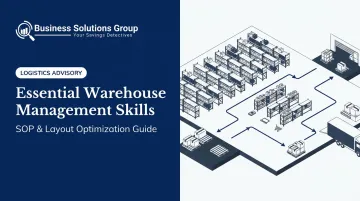
The challenges are predictable: workers on different shifts executing tasks differently, floor space that isn't pulling its weight, pickers traveling excess distances because slotting was set up years ago and never revisited, and inbound errors that quietly corrupt inventory records downstream.
This guide covers the warehouse management skills that drive operational results, how to build SOPs that workers actually follow, and layout optimization strategies with real performance data behind them. Each section connects back to measurable outcomes — because that's what separates a well-run warehouse from an expensive one.
Key Takeaways
- Order picking accounts for 55% of warehouse operating costs — making picking strategy and slotting the highest-leverage skills to develop
- Effective SOPs require five core components: purpose, scope, procedure steps, roles, and a review schedule
- Layout optimization through slotting and zone design can reduce travel distances by 22% and cut cycle times by 36%
- SOPs and layout changes must be co-developed; mismatches between the two drive the most persistent floor-level inefficiencies
- Top-performing warehouses hit ≥99.68% order picking accuracy — track your operation against this benchmark monthly
Core Warehouse Management Skills That Drive Operational Excellence
Inventory Control and Order Fulfillment Proficiency
Accurate, real-time inventory data is what keeps a warehouse functional. Without it, picking errors multiply, stockouts appear unexpectedly, and fulfillment timelines slip. Managers need to build proficiency across the full inventory cycle: receiving, putaway, active storage, and cycle counting.
According to a 2021 peer-reviewed survey, order picking accounts for 60% of productive warehouse activities and 55% of warehouse operating costs. That concentration of cost makes picking strategy selection a core management skill — not a default software setting.
The four primary picking methods each suit different conditions:
- Wave picking — best for high-volume operations with multiple carriers and defined ship windows
- Batch picking — effective when one picker handles multiple orders simultaneously; reduces travel per order
- Zone picking — assigns workers to fixed areas; reduces congestion in large facilities
- Cluster picking — combines batch and zone approaches; works well for mid-sized SKU counts with mixed order sizes
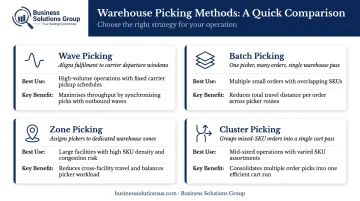
Selecting the right method for your order volume, SKU count, and facility size directly determines whether labor costs stay predictable or spiral during peak periods.
Inbound accuracy deserves equal attention. Receiving errors — miscounted quantities, wrong putaway locations, unverified supplier discrepancies — ripple through the entire inventory system. By the time an error surfaces at pick time, it's already multiplied.
Inspecting incoming goods against purchase orders is the first line of defense. Assigning putaway locations based on product velocity, not just available space, is the second — and it's the discipline that prevents downstream chaos.
SOP Creation, Process Documentation, and Change Management
Most warehouses run on informal knowledge — "how we've always done it" passed verbally between shifts. That works until someone calls in sick, a new hire starts, or order volume spikes.
Converting floor-level knowledge into documented, repeatable procedures is what makes operations scalable.
Effective documentation requires observation first. Managers who write SOPs from memory or theory produce procedures that don't match what workers actually do. Walk the floor, watch the task, identify where variation creeps in, then write instructions specific enough to close the gap.
Change management is equally important. Introducing a new SOP or reconfiguring a zone doesn't automatically change behavior. Resistance to new procedures is normal — especially when staff have built efficient personal shortcuts around an old layout. Three practices that drive adoption:
- Assign an internal champion — a shift lead or experienced picker who believes in the change and models the new behavior
- Run brief training sessions before going live, not after problems emerge
- Build in a feedback channel so workers can flag when a procedure doesn't work as written
Cross-training staff across receiving, picking, packing, and shipping is the operational flexibility payoff that comes from having clear SOPs. When procedures are documented and accessible, getting a receiving associate productive in packing takes hours, not days.
How to Build Effective Warehouse SOPs
The Five Core Components of a Strong Warehouse SOP
Every warehouse SOP that actually gets followed shares the same structural foundation:
- Purpose — why this procedure exists and what operational risk it controls
- Scope — which roles, areas, zones, or product types it applies to
- Step-by-step procedure — instructions specific enough to eliminate guesswork; if a worker can interpret a step two different ways, rewrite it
- Roles and responsibilities — who owns each step and who verifies completion
- Documentation and review schedule — how compliance is tracked and when the SOP is revisited
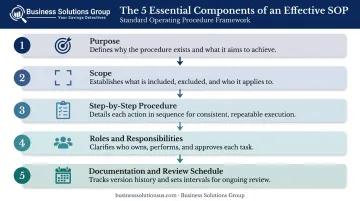
Visual formatting matters enormously on the warehouse floor. Flowcharts, annotated layout diagrams, and checklist formats outperform dense paragraphs — especially in environments with shift workers who need to act quickly. Build SOPs around how workers physically move through the space, not how a process looks on a whiteboard.
Well-formatted SOPs also need to stay current. ISO 9001-oriented guidance recommends reviewing procedures at least annually when processes are stable, and every six months or less when change is frequent. Any layout change, new product category, technology upgrade, or significant shift in order volume should trigger an immediate review — don't wait for the calendar.
SOPs for the Five Essential Warehouse Processes
Each of the five core warehouse processes needs its own dedicated SOP. Here's what each one must cover:
- Receiving — The highest-risk process and the most commonly under-documented. Cover PO verification, quality inspection, discrepancy documentation, and putaway logic by product type and storage zone. Errors here corrupt inventory records that won't surface until pick time.
- Picking — Specify the approved picking method, verification steps before items leave the pick face, and product-specific handling requirements. Pick accuracy is the metric customers feel directly.
- Packing — Define standards by product category (fragile, oversized, temperature-sensitive), dimensional weight considerations, and label accuracy requirements. Inconsistent packing drives returns.
- Shipping and outbound — Cover carrier coordination, loading sequence for dock efficiency, required documentation (bill of lading, packing slips, customs forms where applicable), and final order verification before departure.
- Replenishment — Often missing from SOP libraries entirely. Define trigger points for replenishing active pick locations, assign responsibility, and establish prioritization rules during peak periods to prevent pick face stockouts mid-shift.
Warehouse Layout Optimization Strategies
Zone Design and Strategic Slotting
Zone design is the foundational layout decision. Dividing the floor into distinct functional areas — receiving dock, bulk storage, active pick locations, packing stations, staging, and shipping dock — creates structure. The sequencing of these zones should mirror the natural flow of goods: products move from receiving toward shipping in one general direction, without backtracking or crossing high-traffic lanes.
Slotting is where layout strategy gets granular. It means assigning specific SKUs to specific storage locations based on velocity, weight, dimensions, and how often SKUs appear in the same order. The principle is simple:
- A-items (high velocity) — closest to packing stations, at ergonomic pick heights (waist to shoulder)
- B-items (moderate velocity) — secondary positions, still accessible without excessive travel
- C-items (slow movers) — outer locations, upper or lower shelves, less prime real estate
A 2021 slotting optimization model documented a 5% reduction in total travel distance, 5% reduction in preparation time, and 4% lower monthly movement costs through optimized storage assignment. A separate Lean Warehouse Management case study reported a 22% reduction in travel distances and a 36% reduction in warehouse management cycle time after implementing systematic layout planning — along with a drop in late order rate from 14.69% to 3.71%.
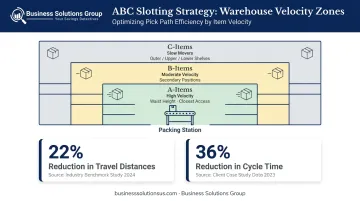
Those gains only hold if slotting is maintained. As product demand shifts seasonally, during promotions, or with new launches, velocity profiles change. WMS data reports — specifically pick frequency by SKU — are the primary input for re-slotting decisions. Reviewing slotting quarterly prevents A-items from drifting into C-item locations while no one is watching.
Vertical Space, Traffic Flow, and Dock Positioning
Most warehouses underuse their cubic footage. Facilities that optimize floor space but ignore vertical height are effectively paying rent on air. ISM benchmarking data identifies 85–90% capacity utilization as the high-performing range; WERC's best-in-class threshold is ≥90%.
Racking investments — selective pallet rack, push-back systems (which can store pallets up to five deep), or mezzanine levels — increase storage density without expanding the facility footprint.
Traffic flow design affects both safety and throughput. One-directional forklift lanes, clearly marked pedestrian paths, and defined cross-traffic points reduce near-miss incidents and eliminate the time lost when vehicles and workers navigate the same aisle in opposite directions. Keeping that structure intact as the operation evolves requires a system — which is where the 5S methodology (Sort, Set in Order, Shine, Standardize, Sustain) becomes practical.
Dock positioning is a throughput variable that most operations evaluate once and then ignore. The placement and ratio of inbound versus outbound dock doors directly affects peak-hour capacity. When inbound and outbound workflows share dock space without clear separation, congestion compounds during high-volume periods.
Reviewing shipment volume patterns against dock door allocation — particularly at peak hours — can surface whether the current configuration is the bottleneck. For operations without clear external benchmarks, Business Solutions Group provides benchmark analysis that shows where a warehouse's configuration stands relative to industry norms — a reference point internal teams rarely have on hand.
Aligning SOPs with Layout for Maximum Efficiency
One of the most overlooked causes of warehouse inefficiency is a mismatch between documented SOPs and the physical layout. A layout redesign without corresponding SOP updates means workers are following instructions written for a different floor plan. Workers end up navigating around equipment or backtracking simply because the documentation hasn't caught up to the floor.
SOPs and layout changes must be co-developed. The sequence matters:
- Finalize the new layout design — zones, racking, travel paths, dock assignments
- Walk the floor with workers who execute the relevant SOPs — have them trace the physical path against the written steps
- Update all location references, storage codes, and travel sequences in the documentation before the new layout goes live
- Brief all affected shifts on both the layout change and the SOP update simultaneously
Integrating WMS data into both SOP maintenance and layout evaluation closes the feedback loop. Actual pick times, error rates, and replenishment frequencies tell you whether current procedures and spatial organization are working — or whether a problem is quietly driving up labor costs before anyone notices.
Operations that review this data regularly can distinguish between three distinct root causes:
- People issue — a training gap affecting how workers execute the SOP
- Process issue — the SOP itself needs revision to reflect current conditions
- Space issue — slotting or zone design is creating unnecessary travel or congestion
Tracking KPIs and Building a Culture of Continuous Improvement
WERC's 2026 DC Measures report tracks 36 operational metrics across warehouse and distribution center operations. The five most actionable KPIs for evaluating SOP and layout performance:
| KPI | Best-in-Class Benchmark |
|---|---|
| Order picking accuracy | ≥99.68% |
| Total order cycle time | <6 hours |
| Inventory count accuracy by location | ≥99.88% |
| Labor productivity (lines picked/shipped per hour) | ≥92.8 |
| Average warehouse capacity utilized | ≥90% |
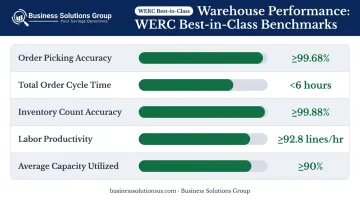
The numbers only matter when they drive decisions. The cadence that works in practice:
- Weekly — operational metrics reviewed against SOP compliance and current pick accuracy
- Monthly — trend analysis across all five KPIs, root cause investigation for any metric moving in the wrong direction
- Quarterly — SOP review cycle, slotting re-evaluation based on SKU velocity data, layout assessment
When a metric deviates, root cause analysis should answer three questions: Is this a people issue (training, staffing)? A process issue (SOP needs revision)? Or a space issue (layout, slotting, dock configuration)? Different causes require different fixes — and diagnosing incorrectly wastes both time and resources.
One challenge internal teams often face is knowing whether their numbers are actually good — or just better than last quarter. That's where external benchmarking adds value. Business Solutions Group's supply chain analytics and spend intelligence services help operations compare performance against industry peers, surface logistics cost reduction opportunities, and prioritize which SOP or layout changes will move the needle most.
Frequently Asked Questions
What are the most important skills for a warehouse manager?
Strong warehouse managers blend technical skills — inventory control, WMS usage, picking strategy — with operational ones: SOP development, staff training, and data interpretation. Translating floor-level observations into documented process improvements is what separates managers who scale operations from those who constantly firefight.
How do you create an effective warehouse SOP?
Start by observing actual workflows, not theorizing about them. Then build the SOP around five components: purpose, scope, step-by-step procedure, roles and responsibilities, and a documented review schedule. Visual formats — checklists, flowcharts, annotated diagrams — are more effective than text-heavy paragraphs on the warehouse floor.
What is the best warehouse layout for maximizing efficiency?
High-performing layouts share three features: zone sequencing that mirrors product flow from receiving to shipping, A-item SKUs positioned closest to packing stations at ergonomic heights, and one-directional traffic lanes that minimize congestion. The right configuration depends on your SKU count, building footprint, and order profile.
What is warehouse slotting and why does it matter?
Slotting is the strategic assignment of SKUs to specific storage locations based on velocity, weight, dimensions, and order co-occurrence. Optimized slotting reduces the distance pickers travel per order, lowers labor costs, and decreases physical fatigue — with documented travel distance reductions of 5–22% in published studies.
How often should warehouse SOPs be reviewed and updated?
At minimum, quarterly — but the real trigger is operational. Any layout change, new product category, technology upgrade, or significant volume shift warrants immediate review. If something changes on the floor, the SOP needs to catch up before the next shift.
How does warehouse layout affect order fulfillment speed?
Layout determines how far pickers travel per order, how smoothly goods flow from receiving to shipping, and how fast dock congestion builds during peak hours. Travel time alone accounts for roughly 50% of total picking time — making layout one of the highest-leverage variables in fulfillment labor costs.