Introduction
Telecom invoices pile up across dozens of carriers. Mobile plans get activated and forgotten. Contracts auto-renew at rates no one has reviewed in years. For IT and finance leaders managing distributed organizations, this is a familiar frustration — and an expensive one.
According to Tangoe, telecom invoice auditing identifies an average of 5–10% in cost savings during the first year, based on the company's management of $15 billion in IT spend. For a mid-size enterprise spending $2 million annually on telecom, that's $100,000–$200,000 sitting in overlooked invoices and unreviewed contracts.
Telecom Expense Management (TEM) exists to close that gap. This guide covers what TEM is, what unmanaged telecom spend actually costs, and how IT and finance teams can evaluate the right approach for their organization.
Key Takeaways
- TEM is the structured process of tracking, auditing, and optimizing all telecom and technology-related expenses across an organization
- Without TEM, most businesses overpay due to billing errors, unused services, and unmonitored contracts
- Both IT and finance benefit from TEM — it delivers inventory visibility for technical teams and cost allocation accuracy for budget owners
- The right TEM model (software-only, hybrid, or fully managed) depends on your team's capacity and environment complexity
What Is Telecom Expense Management (TEM)?
TEM is the ongoing process of monitoring, controlling, and optimizing costs associated with telecommunications services. That includes phone lines, mobile devices, data plans, internet connections, and cloud communication tools. It operates as both a management strategy and a technology discipline — one that runs continuously, not just at billing time.
What Falls Under the TEM Umbrella
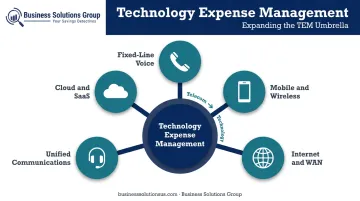
Modern TEM programs cover a broad range of services:
- Fixed-line voice and local circuits
- Mobile and wireless plans, devices, and SIM cards
- Internet access and WAN circuits
- Unified communications platforms
- Cloud and SaaS communication services
That last category reflects a significant shift in the market. What was once called "Telecom Expense Management" has expanded into Technology Expense Management — a broader discipline that encompasses cloud infrastructure, SaaS subscriptions, and IoT connectivity alongside traditional telecom. Gartner's 2024 Market Guide identifies cost optimization, asset inventory, and workflow automation as the core capabilities TEM services must deliver.
A Brief History
Understanding how TEM evolved helps explain why it's grown into such a complex discipline. TEM originated as manual bill auditing in the 1980s following the AT&T divestiture, which fragmented the US telecom market and made carrier billing significantly more complex. The 1996 Telecommunications Act accelerated competition further, multiplying the number of invoices organizations had to manage.
By the 2000s, software platforms automated much of the invoice processing that had previously required dedicated staff. Today, AI-assisted TEM programs handle real-time usage monitoring across distributed workforces, multi-carrier environments, and hybrid cloud infrastructures.
Who It Serves
Gartner defines TEM as enabling enterprise IT, procurement, and finance departments to order, provision, support, and manage costs of corporate telecommunications and associated IT services. That dual ownership matters:
- IT teams use TEM for asset inventory, usage monitoring, and vendor management
- Finance teams use it for cost allocation, budget forecasting, and billing compliance
When both teams draw from the same data, cost decisions get made faster and with less back-and-forth between departments.
The Hidden Costs of Unmanaged Telecom Spend
Billing Errors
Telecom invoices are structurally complex. A single carrier invoice for a multi-location organization can span hundreds of line items across different rate plans, service types, and locations. Errors — incorrect rates, duplicate charges, credits that were promised but never applied — are routine rather than exceptional.
The difficulty isn't just catching errors after the fact. Without automated invoice validation, most discrepancies go unnoticed entirely, becoming permanent overpayments rather than recoverable credits.
Zombie Services
Zombie services are lines, circuits, and mobile plans that continue generating charges after the employee, office, or device they supported no longer exists.
Common examples:
- An employee leaves, but their mobile plan stays active
- An office closes, but the internet circuit keeps billing
- A device gets swapped, but the old data plan never gets canceled
These charges are difficult to catch without centralized inventory management because no single person has visibility across all services, locations, and carriers simultaneously. They accumulate month after month, until someone runs a full audit — which, without TEM, rarely happens on a consistent schedule.
Contract Mismanagement
Carrier contracts typically span multiple years and contain rate structures that can be benchmarked against current market pricing. Without usage data at hand during renegotiation and without awareness of when renewals are approaching, organizations often auto-renew at rates that no longer reflect competitive pricing.
This is where advisory services that specialize in carrier contract benchmarking add direct value alongside a TEM program. Business Solutions Group's benchmark analysis and carrier contract advisory work helps organizations enter vendor negotiations with market rate intelligence, identifying where contracted rates have drifted above market and where renegotiation leverage exists.
Compliance and Audit Risk
Organizations without structured telecom records face predictable problems during financial audits, internal chargebacks, and regulatory reviews:
- Inaccurate cost allocation leads to departmental budget disputes
- Undocumented service inventories create reconciliation gaps that finance teams struggle to explain
- Missing audit trails erode confidence in both IT and finance reporting
These aren't catastrophic failures — they're steady friction that compounds over time.
Core Components of a TEM Program
Inventory and Asset Management
Every TEM program starts with a complete record of all active telecom services — circuits, phone lines, mobile devices, SIM cards, data plans, and communication licenses — mapped to locations, users, and cost centers. Without that record, invoice validation, usage monitoring, and cost allocation are all guesswork.
Invoice Processing and Validation
TEM platforms automatically ingest invoices from multiple carriers, extract charge data, and validate each line item against contracted rates and active services. Discrepancies — overbilling, unauthorized charges, missed credits — are flagged before payment.
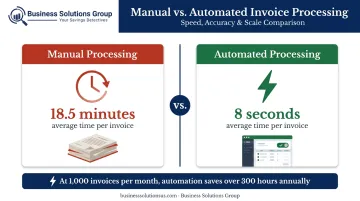
That validation step is where manual processes fall apart. Tangoe reports that manual invoice processing takes 18.5 minutes per invoice, compared to 8 seconds using automated systems. For organizations processing hundreds of invoices monthly, that gap translates directly to staff hours.
Usage Monitoring and Right-Sizing
Actual utilization rarely matches contracted commitments — and TEM makes that gap visible. Common optimization actions that follow:
- Disconnecting underutilized circuits or lines
- Downsizing data plans to match actual consumption
- Consolidating redundant services across locations
- Realigning mobile plans to current usage rather than legacy assumptions
Cost Allocation and Reporting
Contract terms, renewal dates, SLA compliance, and negotiated discounts across all carriers are tracked in one place. This prevents auto-renewals at stale rates, surfaces renegotiation windows, and documents vendor performance over time — so procurement teams walk into any contract conversation with full context.
TEM Benefits: IT and Finance Perspectives
For IT Teams
- Eliminates manual invoice reconciliation — automated processing frees staff from repetitive, error-prone work
- Accurate asset visibility — tracks every service across moves, adds, changes, and disconnects (MACD) so nothing falls through the cracks
- Usage intelligence — surfaces consumption patterns that inform network planning and technology decisions
- Faster dispute resolution — documented records and automated flagging reduce the time spent tracing billing discrepancies
For Finance Teams
- Predictable spend — telecom costs become attributable and forecastable rather than a catch-all line item
- Accurate chargebacks — department-level cost allocation enables precise internal billing
- Audit-ready documentation — every transaction, contract, and service change is recorded and retrievable
- Reduced financial leakage — errors caught pre-payment rather than after the fact
For the Business
When IT and Finance operate from the same telecom data, the business stops reacting to costs and starts managing them. TEM converts telecom from a catch-all expense into a controlled spend category.
Organizations that implement TEM programs commonly report recovering 5–10% of annual telecom spend in the first year through billing corrections and service right-sizing, with around 2% in ongoing savings each subsequent year as the largest inefficiencies are resolved and programs mature.
A Tangoe case study involving an automotive retailer with 5,000 stores reported a 66% reduction in telecom costs and 50 hours saved per week — with 63% of savings tied to productivity gains, not rate reductions. Results at that scale aren't the norm, but the underlying dynamic is: the larger and more distributed the environment, the more unmanaged telecom costs compound quietly across every location.
5 Signs Your Business Needs TEM
Not every organization needs a full TEM program immediately. But certain conditions make the cost of inaction higher than the cost of implementation:
- No one can answer "what are we paying for and who's using it?" across multiple locations, carriers, or service types without significant manual effort
- Your team spends meaningful hours each month on telecom billing — and still discovers errors after payment rather than before
- Contract renewals happen on auto-pilot: no usage review, no rate benchmarking, no renegotiation
- Telecom shows up as a real budget line item, but you can't confidently attribute spend to specific departments or locations when finance asks
- You're approaching 50 locations or 700–800 invoices per month — the threshold where manual management typically breaks down, according to Tellennium
How to Choose the Right TEM Approach
The Three Delivery Models
| Model | How It Works | Best For |
|---|---|---|
| Software-Only | Your team operates a TEM platform independently | Organizations with dedicated IT/telecom staff and manageable invoice volumes |
| Hybrid | TEM software plus targeted managed services (audits, disputes, contract reviews) | Teams that want expert support without full outsourcing |
| Fully Managed | A TEM partner handles day-to-day operations including invoice processing, auditing, and optimization | Organizations with high invoice volumes, limited internal capacity, or complex multi-carrier environments |
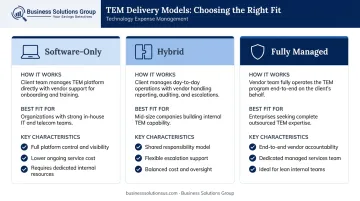
There's no universally correct model. A 10-location company with one telecom vendor and a capable IT team may do fine with software only. A 200-location enterprise managing wireline, wireless, and cloud services across a dozen carriers almost certainly needs managed support.
Key Evaluation Criteria
When assessing TEM platforms or providers, look for:
- Integration capability with existing ERP and accounting systems
- Inventory management depth: confirm it handles your full range of service types
- Reporting granularity — department-level and cost-center-level data finance teams actually need
- Scalability across locations, carriers, and service categories
- Data security practices, since telecom data touches sensitive organizational information
- Documented results from organizations of similar size and complexity
The Contract Strategy Layer
Identifying savings through TEM is only half the work — the other half happens at the contract level. Business Solutions Group supports TEM programs through carrier contract benchmarking and advisory services, applying market rate intelligence and negotiation expertise so that visibility translates into better pricing terms, not just better documentation.
The TEM market itself reflects this growing need. Mordor Intelligence values the market at $5.64 billion in 2026 and projects growth to $10.85 billion by 2031 — a 13.98% CAGR driven by enterprise demand for unified visibility across telecom, cloud, and SaaS spend.
Frequently Asked Questions
What is telecom expense management (TEM)?
TEM is the structured process of tracking, auditing, and optimizing an organization's telecom and technology-related expenses — covering invoices, contracts, usage, and inventory across all services and locations.
What is a TEM platform?
A TEM platform is a software system that centralizes telecom invoice processing, asset inventory, usage monitoring, cost allocation, and contract management in a single interface. It enables IT and finance teams to manage and optimize telecom spend without relying on spreadsheets or manual reconciliation.
What types of businesses benefit most from TEM?
Any organization managing multiple carriers, locations, or service types can benefit. The impact is greatest at mid-to-large enterprises where high invoice volumes and manual processes have created visibility gaps or recurring billing errors.
How does TEM help reduce billing errors?
TEM platforms validate each invoice against contracted rates and active services before payment, automatically flagging discrepancies such as duplicate charges, incorrect rates, or billing for disconnected lines. These errors would otherwise go unnoticed until a manual audit.
What is the difference between TEM software and a managed TEM service?
TEM software is a tool your team operates independently. A managed TEM service means a provider handles day-to-day operations including audits, disputes, and optimization on your behalf. Hybrid models offer a middle ground — software plus targeted expert support — for organizations that want both.
How quickly can a business expect ROI from TEM?
Most organizations begin identifying billing errors and disconnecting unused services within the first few billing cycles. Full program ROI typically develops over 6–12 months as inventory is cleaned up, contracts are renegotiated, and usage is right-sized to current needs.