Introduction
Telecom costs — mobile voice, data, network circuits, and cloud-adjacent services — rank among the fastest-growing and least-audited line items in enterprise budgets. Studies consistently show that 7–12% of telecom invoices contain billing errors, yet most finance and IT teams lack the bandwidth to catch them. Contracts auto-renew without scrutiny. Unused services stay on the books for years.
The result: telecom spend grows faster than headcount or revenue, with no one owning the full picture.
Telecom expense management (TEM) is the management discipline that fixes this. This article unpacks the specific, repeatable use cases where TEM produces measurable financial and operational results — from recovering overcharges to renegotiating carrier contracts to automating invoice workflows.
TL;DR
- TEM is the systematic process of tracking, auditing, and optimizing telecom spend across voice, data, mobile, and network services
- Its highest-impact use cases include billing error recovery, carrier contract renegotiation, and invoice process automation
- Organizations that implement TEM consistently reduce spend by catching errors, eliminating unused services, and right-sizing plans
- Without TEM, billing errors go unchallenged and contracts renew at above-market rates by default
- Sustained TEM programs generate compounding returns over time, outperforming any single audit by a wide margin
What Is Telecom Expense Management?
Gartner defines TEM services as enabling enterprise IT, procurement, and finance teams to "order, provision, support and manage costs" of corporate telecommunications, associated IT services, and inventories.
In practice, TEM covers wireline, wireless, data, internet, and mobile services — any telecom expense a business pays carriers to maintain connectivity and communications. Modern TEM programs increasingly extend into cloud services, SaaS subscriptions, and IT licensing under the broader "Technology Expense Management" umbrella, as enterprise technology costs increasingly overlap and consolidate.
TEM is most relevant for mid-to-large organizations managing multiple carriers, locations, or device pools — environments where manual oversight breaks down quickly. Companies with 500+ employees and $500,000+ in annual telecom spend consistently see the strongest ROI from structured TEM programs.
Regardless of which platform or vendor delivers it, TEM drives three specific business outcomes:
- Cost control — catching errors and eliminating waste before they compound
- Budget predictability — replacing reactive invoice surprises with structured visibility
- Carrier accountability — ensuring what you're billed matches what you agreed to pay
Key Benefits and Use Cases of Telecom Expense Management
Each benefit below ties to a specific TEM workflow — invoice auditing, contract management, inventory tracking, or automation. These aren't theoretical efficiency gains. Each one maps to a measurable financial or operational outcome.
Benefit 1: Spend Visibility and Invoice Accuracy
Most organizations review telecom invoices the same way they always have: manually, incompletely, and after payment. TEM replaces that with a consolidated, automated view of all invoices across carriers, locations, and service types.
The mechanics: automated invoice ingestion, line-item matching against contracted rates, and systematic flagging of discrepancies give finance and IT teams a precise picture of what they're actually paying versus what they agreed to pay.
Why this matters:
Billing errors in telecom environments are not edge cases. According to Tangoe's invoice audit data, telecom and data center invoices contain errors approximately 9% of the time on average. Common error types include:
- Duplicate charges
- Rate misapplications (billed above contracted rates)
- Charges for services that were cancelled
- Missing credits or discounts
In a large multi-carrier environment, a 9% error rate across hundreds of monthly invoices represents a significant ongoing financial leak. These errors compound until someone catches them.
Visibility also changes how decisions get made. When leaders can see spend at the cost-center level, they can attribute telecom costs accurately, dispute charges with carrier documentation in hand, and identify overcharges before payment rather than after.
KPIs this affects:
- Invoice processing accuracy rate
- Billing dispute recovery rate
- Telecom spend as a percentage of revenue
- Cost allocation accuracy by department
When it matters most: Organizations with decentralized procurement, multiple regional carriers, or rapid headcount growth — where no single team has a complete picture of what's being billed — get the highest immediate return from spend visibility.
Business Solutions Group's spend intelligence platform is designed specifically for this visibility gap, providing unified access to telecom and IT spend data across an organization's carrier relationships and service types.
Benefit 2: Contract Optimization and Vendor Management
Most enterprises negotiate a carrier contract, then don't revisit it for years. Rates set under different market conditions persist. Volume discounts go unrealized. Auto-renewal clauses lock organizations into terms that no longer reflect their scale or usage.
TEM changes the negotiation dynamic by creating a comprehensive inventory of contracted services, usage levels, and rate terms. That data becomes the foundation for renegotiating from a position of knowledge rather than assumption.
A Tangoe case study of an energy company post-divestiture puts the stakes in concrete terms: $5.3M in total annual telecom waste eliminated — a 26% reduction — including:
- $2.9M from unnecessary legacy services
- Nearly $900K/year from disconnecting 178 unused POTS lines
- $428K from contractual savings after renegotiation
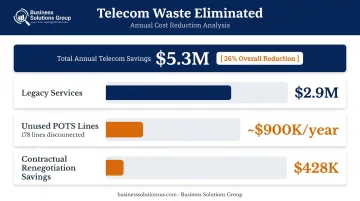
That breakdown reveals a consistent pattern: unused services and unreviewed contracts are typically the largest contributors to telecom waste, and neither surfaces without systematic inventory and contract review.
With benchmark data in hand, procurement teams can approach carrier negotiations with leverage — identifying above-market rates, consolidating redundant vendor relationships, and pursuing volume discounts across service categories.
KPIs this affects:
- Contract compliance rate
- Carrier spend per unit vs. market benchmark
- Percentage of services under active optimization review
- Vendor consolidation ratio
When it matters most: Contract optimization delivers the highest ROI when contracts are approaching renewal, after a merger or acquisition that created duplicate carrier relationships, or when telecom spend has grown significantly since the last renegotiation cycle.
Business Solutions Group's carrier advisory team maintains a database of comparable contract benchmarks, enabling clients to assess whether current rates reflect actual market conditions before entering negotiations — reducing the time from contract review to realized savings.
Benefit 3: Operational Efficiency Through Process Automation and Mobility Management
Beyond cost recovery, TEM creates ongoing operational efficiency by automating the workflows that otherwise demand significant manual effort: invoice processing, approval routing, usage tracking, and mobile device lifecycle management.
Every invoice that flows through a manual review process carries a cost. APQC benchmarks show a $6.00 median cost per invoice processed in accounts payable. In telecom environments with hundreds of monthly carrier invoices, that burden adds up quickly.
Manual workflows also introduce payment delays, approval bottlenecks, and late fees that compound over time.
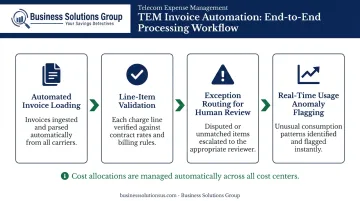
TEM platforms address this by:
- Automating invoice loading and line-item validation
- Routing exceptions for human review (rather than routing everything)
- Managing cost allocations across cost centers without manual intervention
- Flagging usage anomalies in real time
Remote and hybrid work has expanded enterprise mobile fleets, making rate plan optimization both a cost and a productivity issue. Employees on the wrong-sized plans — over-provisioned or under-provisioned for their actual usage — generate waste across hundreds or thousands of devices.
A Tangoe survey found that 100% of companies surveyed report struggles with mobile device management. TEM addresses this by tracking device assignments, plan changes, and usage patterns, ensuring each user's plan aligns with actual consumption rather than historical assumptions.
KPIs this affects:
- Invoice processing cycle time
- Late payment fee incidence
- Mobile rate plan optimization rate
- Help desk ticket volume related to telecom
- Employee productivity hours recovered
When it matters most: Automation delivers the greatest returns in organizations with 500+ mobile endpoints, multiple invoice sources, or geographically distributed operations where a centralized finance team cannot manage billing at scale manually.
What Happens When TEM Is Missing
Without a structured TEM program, telecom costs grow by default — not through deliberate decisions, but through accumulated inaction.
The reactive management trap:
IT and finance teams end up responding to individual billing complaints rather than running proactive audits. Most major carriers strictly limit retroactive credit windows — and the deadlines come faster than most teams expect.
T-Mobile's terms require written dispute notification within 60 days of receiving the disputed bill. Verizon Wireless allows disputes only within 90 days. Miss those windows, and overcharges become permanent losses.
The compounding scale problem:
As headcount, locations, and device counts grow, an unmanaged telecom environment doesn't stay manageable — it becomes progressively harder to control:
- Unused services accumulate without anyone tracking them
- Cost attribution becomes inaccurate as services span departments
- Telecom spend grows as a percentage of operating costs rather than shrinking with scale
The negotiation gap:
Without usage data and market benchmarks, organizations negotiate carrier contracts from a position of weakness. Carriers know their own rate structures significantly better than most procurement teams. Without comparable data, procurement teams accept the terms presented rather than the terms they could have secured.
How to Get the Most Value from TEM
Start with a Full Telecom Audit
TEM delivers the strongest early returns when it begins with a baseline inventory: all services, all contracts, all invoices — across every carrier and location. This audit phase typically surfaces immediate savings from billing errors and unused services, generating enough recovery to fund the broader program.
Business Solutions Group's TEM engagement follows this structure, beginning with a complimentary benchmark savings analysis that identifies where current spend deviates from market-appropriate rates before any optimization work begins.
Treat TEM as Always-On, Not One-Time
A single audit captures what's already gone wrong. Ongoing TEM catches errors before payment clears and flags misaligned rate plans before they compound.
The compounding returns come from:
- Continuous invoice auditing — errors caught before payment, not after
- Quarterly usage reviews — rate plan alignment kept current as headcount and usage patterns change
- Contract renegotiation at renewal windows — not on auto-pilot
- Ongoing vendor benchmarking — market rates shift; contracts should shift with them
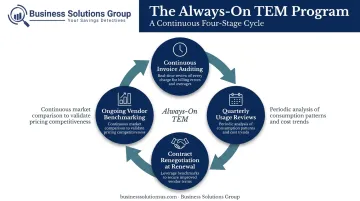
Organizations that audit once and walk away tend to recover yesterday's losses. Those running continuous TEM prevent tomorrow's.
Pair TEM with Expert Advisory Support
Data alone doesn't close savings — carrier negotiations require market rate intelligence, benchmark documentation, and firsthand knowledge of what terms carriers will actually move on. Advisory support bridges that gap, ensuring TEM data translates into contracted reductions rather than unanswered proposals.
Business Solutions Group combines spend intelligence software with carrier advisory services to cover both sides of that equation: surfacing where overpayment exists and negotiating the terms that correct it.
Conclusion
TEM's real value lies in what it does to a spend category most organizations have managed reactively by default: it makes telecom costs visible, controllable, and accountable. Invoice auditing, contract optimization, and process automation each deliver measurable returns. The compounding effect kicks in when all three operate together as a continuous program rather than isolated fixes.
Organizations that treat TEM as an ongoing discipline — not a one-time project — will find their telecom spend shifting from an uncontrolled cost center into a predictable, managed expense. One that scales with the business instead of quietly outpacing it.
Frequently Asked Questions
What are the different types of telecom expense management?
TEM covers four primary categories: asset and inventory management, expense and invoice management, mobility management (devices and rate plans), and procurement and order management. Modern TEM programs also extend to cloud services and IT licensing under the broader Technology Expense Management umbrella, reflecting how enterprise technology costs now overlap with traditional telecom.
What is the difference between cost analysis and spend analysis?
Cost analysis is backward-looking : it examines what costs were incurred and why. Spend analysis goes further by categorizing, benchmarking, and analyzing spend data to uncover savings opportunities, vendor performance gaps, and optimization actions.
How much can a company save with telecom expense management?
Industry providers commonly cite savings of 10–30% on telecom and mobility spend through TEM programs, with some vendors reporting up to 20% in the first year from audit findings alone. Actual savings depend on the size of the telecom environment, contract management maturity, and how long spend has gone unaudited — organizations with longer gaps typically recover more in early audit phases.
What is included in a telecom expense management audit?
A TEM audit typically covers: device and service inventory assessment, invoice review for billing errors and contract compliance, usage analysis to identify over- and under-utilized services, and vendor management review to surface renegotiation opportunities. The output is a baseline picture of actual spend versus contracted terms across all carriers and service types.
How does TEM help with contract negotiation?
TEM provides the usage data and market benchmark intelligence needed to negotiate with specific evidence, identifying where current rates exceed market, where services are underused, and where consolidation could unlock volume discounts. That shifts the conversation from the carrier's standard terms to a discussion grounded in your actual consumption.
When should a company implement telecom expense management?
TEM is most urgently needed when an organization manages multiple carriers, locations, or mobile device pools it cannot easily audit manually. The highest-leverage timing is before a major contract renewal, after an acquisition that created duplicate carrier relationships, or whenever telecom spend has grown faster than headcount or revenue — starting before renewal windows preserves negotiation leverage.