The downstream effects are real. Zylo also found that 61% of IT leaders cut projects because of unplanned SaaS cost increases — meaning wasted spend doesn't just drain budgets, it kills strategic initiatives.
The uncomfortable truth: IT expenses aren't inherently expensive. They become expensive through poor visibility, fragmented governance, and reactive decision-making. Most organizations don't have a spending problem — they have a tracking and accountability problem.
This article examines IT expense management across three dimensions: how costs accumulate, what drives them, and how businesses can reduce them through smarter procurement decisions, stronger governance, and structural changes.
Key Takeaways
- IT costs compound gradually: unused licenses roll over, cloud resources stay provisioned, and contracts auto-renew unchecked
- The biggest waste drivers are unmanaged SaaS licenses, shadow IT, fragmented vendor relationships, and no real-time spend visibility
- Cost reduction works across procurement decisions, spend governance, and breaking down the siloed team structures that let waste go unnoticed
- Effective IT expense management targets waste specifically — not budgets broadly — so operational value stays intact
- Organizations with continuous cost visibility consistently outperform those relying on periodic audits
How IT Expenses Typically Build Up
IT costs rarely arrive as a single large invoice. They accumulate in layers: one subscription here, one auto-renewed contract there — until a budget review or a scaling effort forces a full accounting.
The Compounding Nature of IT Spend
The average organization now manages between 106 and 305 SaaS applications, depending on company size and industry. With an average of 211 SaaS renewals per year — nearly one every business day — the renewal calendar alone creates constant exposure to unchecked costs.
The compounding effect works like this:
- Unused licenses roll over into the next contract term without review
- Cloud resources stay provisioned beyond project completion, accumulating hourly charges
- Vendor contracts auto-renew under original terms, forfeiting renegotiation leverage
- New tools get purchased by departments without IT or finance awareness
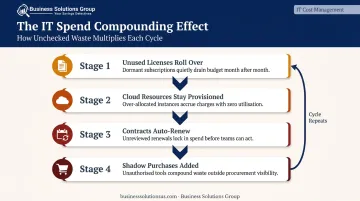
Each layer adds cost that is difficult to unwind retroactively. Because no single team owns the complete view, the problem compounds across departments without triggering any internal alarm.
When the Waste Becomes Visible
Most of these costs stay invisible until a budget audit, a leadership transition, or a period of growth forces someone to reconcile IT spend against actual value. By that point, the waste is already entrenched.
Flexera's 2024 State of ITAM Report found that 22% of global IT leaders paid more than $5 million in software audit costs over three years. That figure is a direct consequence of licenses accumulating without proper tracking.
Key Cost Drivers in IT Expense Management
No single driver explains every organization's IT cost problem. The profile depends on company size, procurement maturity, and how IT resources are governed. That said, several patterns surface repeatedly across industries.
Unmanaged Software Licenses
This is the largest single source of documented IT waste. Productiv's 2023 analysis found that 53% of SaaS licenses go unused over any 90-day window — a staggering share of recurring spend generating zero return.
Overpurchasing is rarely the root cause. More commonly, unused licenses stem from:
- Headcount changes that leave licenses attached to departed employees
- Duplicate tools purchased by different departments solving the same problem
- License tiers provisioned for peak usage that never materializes
- Shelfware: tools purchased for a project that ended but were never cancelled
Shadow IT and Fragmented Ownership
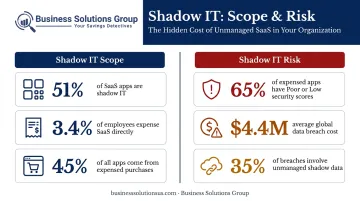
Unmanaged licenses are only part of the problem. According to Productiv, 51% of SaaS applications in most organizations are shadow IT — owned and operated outside of IT oversight. Zylo adds a telling detail: 3.4% of employees expense SaaS directly, and those expensed apps represent 45% of all applications by volume.
The financial and security implications overlap. Zylo found that 65% of employee-expensed apps had a "Poor" or "Low" security risk score, and IBM's 2025 data shows the average data breach now costs $4.4 million globally — with 35% of breaches involving unmanaged shadow data.
Cloud Waste and Over-Provisioning
Shadow IT creates fragmented ownership over software. Cloud infrastructure introduces a parallel problem: uncontrolled spend at the infrastructure layer. Flexera's 2026 State of the Cloud Report estimates 29% of IaaS and PaaS spend is wasted, and 84% of organizations report struggling to manage cloud costs effectively. Cloud budgets are being exceeded by an average of 17%.
Contract Value Leakage
Cloud overspend compounds a broader contract management failure. World Commerce & Contracting reports that organizations lose an average of 11% of contract value through poor contract management — and most of that loss occurs after signature, not during negotiation.
Cost-Reduction Strategies for IT Expense Management
Effective IT cost reduction works on three levels: changing the procurement decisions that create costs, improving the governance that controls them, and addressing the structural conditions that enable waste in the first place.
Procurement-Level Cost Reduction
These approaches reduce IT expense by altering what gets purchased, from whom, and under what terms.
Conduct a full vendor and contract audit. Map every active vendor relationship, subscription, and renewal date. For each contract, benchmark current pricing against market rates. McKinsey found that one major video-streaming company achieved 15–20% cloud savings by forecasting consumption accurately and negotiating from that position — a result that started with understanding their own spend data.
Rationalize software licenses. Run utilization analysis across all SaaS tools. With 51% of licenses sitting unused monthly, most organizations can recover significant spend by:
- Deprovisioning licenses tied to inactive users
- Identifying duplicate tools across departments
- Downgrading license tiers where full-feature access isn't needed
- Eliminating shelfware from the portfolio entirely
Consolidate vendors strategically. Fragmented vendor relationships mean fragmented leverage. Moving spend from many small suppliers to fewer preferred vendors increases aggregate purchase volume, strengthens negotiating position, and reduces the administrative burden of managing dozens of separate contracts and invoices.
Implement eProcurement processes. Unstructured purchasing — where employees or departments can acquire IT tools outside approved channels — is how maverick spend accumulates. eProcurement tools enforce preferred vendor policies, create structured approval workflows, and give finance and IT leaders visibility into purchasing activity before costs are committed. Business Solutions Group's eProcurement solutions apply this purchasing governance across business operations, helping organizations close the gap between what gets bought and what gets approved.
Governance and Visibility Controls
These approaches reduce cost by improving visibility, governance, and accountability while IT services are active.
Establish centralized spend visibility. Without a single source of truth, spend anomalies go undetected and renewals get missed. Nearly 50% of business leaders lack full visibility into company spending data, according to Coupa — a gap that makes timely intervention impossible. Unified dashboards or IT financial management (ITFM) tools close this gap by surfacing the complete cost picture across vendors, departments, and contract types.
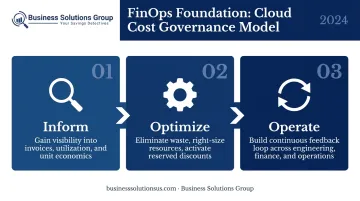
Adopt a FinOps framework for cloud. The FinOps Foundation's three-phase model provides a structured path for cloud cost governance:
- Inform — Gain granular visibility into cloud invoices, utilization rates, and unit economics
- Optimize — Eliminate waste, right-size resources, and activate reserved capacity discounts
- Operate — Build a continuous feedback loop between engineering, finance, and operations
Introduce showback and chargeback models. When business units see how their technology consumption drives IT spend, behavior changes. Departments that understand the cost of what they use provision more carefully and challenge unnecessary resources. Even a showback model — where cost allocation is visible but not directly charged — creates accountability that reduces waste over time.
Track the right KPIs. Cost optimization stays aspirational without measurable indicators. Key metrics to monitor include:
- License utilization rate — percentage of provisioned licenses actively used
- Off-policy spend percentage — share of purchases made outside approved procurement workflows
- Cloud unit cost trends — cost per workload, application, or business unit over time
- Procurement cycle time — APQC benchmarks the median at just 1.0 day for services, giving a reference point for efficiency
Structural Conditions That Drive IT Waste
These approaches address the structural conditions that enable IT waste — often with more lasting impact than any single tool or process change.
Address shadow IT through approved vendor catalogs. When employees bypass official procurement channels, organizations accumulate duplicate tools, lose spend visibility, and inherit security risk. Guided buying experiences and preferred vendor catalogs redirect that behavior without creating friction. Employees get access to approved tools on their own terms, and the organization retains spend control.
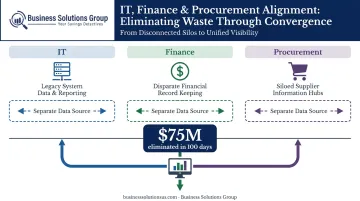
Align IT, Finance, and Procurement around shared data. When these three functions operate with separate data sources and separate priorities, purchases happen without financial context, budgets get validated after the fact, and savings opportunities disappear. Shared dashboards and common KPIs allow all three teams to act on the same real-time picture.
TBM Council documented a case where MassMutual eliminated $75 million in direct and stranded costs within 100 days during a divestiture by applying unified cost management standards — a result that required IT and finance to operate from the same data.
Apply benchmark analysis to vendor negotiations. Internal spend data alone is insufficient for effective negotiation. Organizations need external market context to know whether their rates are above, at, or below what comparable businesses pay. Business Solutions Group's spend intelligence capabilities give procurement teams that external market context — so negotiations are grounded in what comparable organizations actually pay, not internal estimates.
Conclusion
Reducing IT expenses starts with understanding precisely where costs originate — in procurement decisions, governance gaps, or structural factors — rather than applying blanket cuts that compromise operational quality.
The organizations that control IT spend don't do it through annual audits or reactive budget reductions. They build real-time visibility, enforce purchasing governance, and ensure IT, finance, and procurement teams work from the same data. That alignment is what separates organizations that manage IT costs reactively from those that use spend data to make faster, better-informed decisions.
Frequently Asked Questions
What are effective IT cost reduction strategies?
Smarter procurement (vendor consolidation, license rightsizing, contract audits), stronger spend governance through ITFM tools and FinOps frameworks, and fixing structural issues like shadow IT all play a role. Most organizations need these working in parallel — tackling just one rarely produces sustained results.
What is IT expense management and why does it matter?
IT expense management is the practice of tracking, controlling, and optimizing all technology-related costs across software, cloud, hardware, and vendor contracts. Without it, businesses consistently overpay through unchecked renewals, unused licenses, and fragmented vendor relationships that eliminate negotiating leverage.
What is the difference between IT cost cutting and IT cost optimization?
Cost cutting reduces spend without regard for operational impact — it's fast but often damages service quality or team capability. Cost optimization strategically eliminates waste while preserving or improving the value delivered, targeting the inefficiencies rather than the functions they support.
How do I identify hidden IT costs in my organization?
Start with a full vendor and subscription audit, then run utilization analysis to identify inactive user seats. Centralized spend dashboards surface anomalies — duplicate tools, auto-renewals, over-provisioned resources — that manual tracking consistently misses.
How does vendor consolidation reduce IT expenses?
Consolidating vendors increases aggregate purchase volume with fewer suppliers, which strengthens negotiating leverage and creates opportunities for volume-based pricing. It also reduces the administrative overhead of managing multiple contracts, invoices, and renewal calendars simultaneously.
What role does eProcurement play in managing IT costs?
eProcurement tools enforce approved purchasing workflows that prevent maverick and duplicate spend. They give IT and finance leaders real-time visibility into procurement activity — meaning costs are visible and controllable at the point of commitment, not discovered after the fact.