Introduction
Global IT spending is forecast to hit $5.61 trillion in 2025, according to Gartner's latest IT spending report. The scale isn't the issue — how much of it gets wasted is.
Flexera's research shows that 32–36% of software licenses go unused or underutilized across desktop, data center, and SaaS categories. At scale, that translates into real margin pressure, stalled digital initiatives, and budget overruns that compound year over year.
Those compounding overruns rarely stem from technology being inherently expensive. They stem from poorly governed procurement, mismanaged resources, and no accountability for consumption. Addressing that requires a targeted approach, not across-the-board cuts.
This article covers nine strategies organized across three dimensions: changing what gets purchased, improving how IT is managed day-to-day, and addressing the structural conditions that allow waste to persist.
Key Takeaways
- IT waste accumulates through licensing bloat, vendor sprawl, and cloud over-provisioning — rarely traceable to a single line item
- The biggest cost drivers are poor procurement governance, duplicate tools, and a reactive support model
- Quick wins like license audits and shadow IT cleanup can show results in weeks
- Structural fixes — vendor consolidation, cloud rightsizing, and ITFM dashboards — typically show measurable impact within one to two quarters
- Lasting savings come from addressing where costs originate, not just trimming line items
How IT Costs Typically Build Up
IT overspending rarely arrives as one large, visible invoice. It builds incrementally, one overlooked decision at a time.
A team adds a SaaS tool. Then another department buys a competing one. Auto-renewals fire every year without a usage check. Cloud environments provisioned for peak demand stay running at 10% CPU utilization. Each individual decision seems minor — the aggregate is where costs become unmanageable.
The pattern shows up clearly in the data:
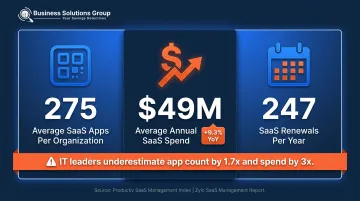
- The average company manages 275 SaaS applications, with annual SaaS spend averaging $49 million — up 9.3% year over year, per Zylo's 2025 SaaS Management Index
- IT leaders underestimate their actual app count by 1.7x and their SaaS spend by 3x
- The average organization faces 247 SaaS renewals per year — missing those windows often results in paying 20–30% more
Those numbers reflect two overlapping patterns. The first is gradual: subscription creep, shelfware sitting unused, licenses auto-renewing without a review. The second is episodic — triggered by team expansions, compliance mandates, or migrations that add new tooling without retiring what came before.
Most organizations only discover the full picture when they try to consolidate, audit, or benchmark against peers. At that point, the question shifts from "how did this happen?" to "what do we cut first?" — which is exactly where the strategies below come in.
IT Cost Reduction Strategies
Sustainable cost reduction starts with identifying where excess spend actually comes from — procurement decisions, day-to-day management behaviors, or underlying structural problems. The nine strategies below are organized around each of those drivers.
Strategies That Reduce Costs by Changing Decisions
These approaches target what gets purchased, how it's sourced, and who governs approval. Correcting poor upfront decisions yields the highest long-term savings — stopping unnecessary spend before it enters the budget.
1. Consolidate Vendors and Rationalize Your IT Supplier Portfolio
Maintaining too many vendors across hardware, software, and services creates contract fragmentation. Fragmented contracts mean weaker negotiating leverage, redundant renewal cycles, and procurement overhead that compounds quickly.
Consolidating to a smaller set of preferred suppliers delivers measurable gains:
- Unlocks volume-based discounts across hardware, software, and services
- Simplifies renewal cycles by reducing the number of active contracts
- Cuts the administrative cost of managing dozens of separate relationships
- Gives procurement teams a cleaner view of total spend by category
Business Solutions Group's IT lifecycle management platform supports this transition by centralizing vendor contracts, renewals, and lifecycle data into a single view. Their engagement model includes vendor performance benchmarking and total cost of ownership (TCO) analysis to identify which suppliers merit preferred status.
2. Right-Size Software Licensing Before Purchase
Most organizations over-license because purchasing decisions are based on projected headcount, not actual usage patterns. The result is shelfware — licenses that are paid for and never opened.
Zylo's research puts this in sharp focus: 38–53% of SaaS licenses go unused, and the average organization wastes $21 million annually on unused SaaS alone.
Conducting a usage audit before renewing or expanding any software agreement allows teams to:
- Right-size license tiers to reflect actual consumption
- Eliminate shelfware before auto-renewal fires
- Negotiate contracts against real usage data, not worst-case projections
- Avoid the 20–30% premium that comes from missing renewal windows unprepared
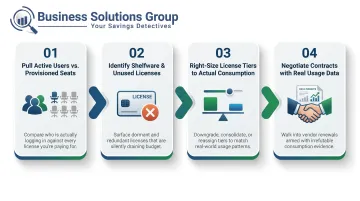
The audit doesn't need to be complex. Even a basic pull of active users versus provisioned seats will surface significant savings opportunities.
3. Enforce Buying Decisions at the Source with Spend Intelligence and eProcurement Tools
Uncontrolled purchasing — employees or departments buying outside approved channels — is one of the fastest routes to cost leakage. Only 26% of SaaS spend is managed by IT, and 33.6% of apps are acquired entirely outside IT oversight, according to Zylo's 2025 data.
eProcurement workflows and spend intelligence platforms close this gap by:
- Enforcing preferred vendor selection at the point of purchase
- Flagging non-compliant or off-contract spending in real time
- Creating an auditable procurement trail that supports contract renegotiation
- Providing visibility into pricing agreements to benchmark what discounts are achievable
Business Solutions Group's proprietary spend intelligence software surfaces these patterns in practice — identifying pricing inefficiencies and creating data-backed leverage for contract negotiations with existing suppliers.
Strategies That Reduce Costs by Changing How IT Is Managed
These strategies target what happens after a purchase is made — how tools are consumed, how support is delivered, and whether spend is tracked in real time.
4. Automate Repetitive IT Support Tasks and User Lifecycle Management
Manual Level 1 support — password resets, access requests, basic troubleshooting — is expensive. At $13.50 per assisted contact versus $1.84 for self-service (per Gartner benchmarks), the cost gap compounds across thousands of monthly tickets.
Slow offboarding creates a second, less visible cost: 31% of former employees still have active SaaS access after departure, meaning organizations are paying for licenses being used by people no longer on the payroll.
Automating these workflows through AI-assisted service management delivers on two fronts:
- Reduces cost-per-ticket through self-service deflection
- Eliminates the security and financial risk of delayed deprovisioning
Each of these gains compounds: fewer manual touchpoints lower support costs, while faster deprovisioning stops budget from leaking into inactive accounts.
5. Eliminate Shadow IT and Manage Duplicate SaaS Licenses
Decentralized software purchasing and weak offboarding processes create a predictable outcome: organizations paying for tools that are either duplicated across departments or no longer used at all.
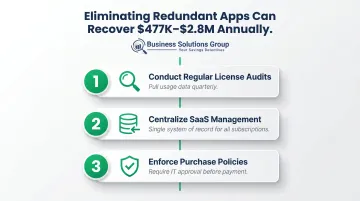
The cost of inaction is concrete. Zylo estimates that eliminating redundant applications can recover $477K to $2.8 million annually depending on company size and category. At the enterprise level, $21 million in annual SaaS waste is the average.
Three practical steps to reclaim this budget:
- Conduct regular license audits — pull usage data at least quarterly, not just at renewal
- Centralize SaaS management — create a single system of record for all software subscriptions
- Enforce purchase policies — require IT approval for new software before payment is authorized
6. Implement ITFM Dashboards for Real-Time Spend Visibility
Organizations cannot manage what they cannot see. Without centralized dashboards connecting IT spend to business units, cost centers, and application usage, both finance and IT teams are making decisions on stale data.
IT Financial Management (ITFM) tools close that gap by:
- Surfacing budget anomalies before they become overruns
- Linking IT expenditure to measurable business outcomes
- Enabling cost allocation by department, application, and project
The results from ITFM adoption are concrete. Micron reduced CapEx budget variance from 20–30% down to within 1% after implementing Technology Business Management practices. Jabil reported a 25% productivity gain with faster budgeting and improved forecasting accuracy.
Business Solutions Group's Telecom Expense Management platform provides this kind of centralized spend visibility — integrating data across vendors, locations, and service types into dashboards that support real-time financial governance for CIOs and CFOs.
Strategies That Reduce Costs by Changing the Context Around IT
These three strategies target the structural conditions that drive IT waste: cloud architecture, accountability models, and operational posture. Each one reduces costs not by switching tools, but by changing how IT resources get consumed in the first place.
7. Optimize Cloud Infrastructure and Eliminate Idle Resources
Cloud sprawl is one of the fastest-growing sources of IT waste. Virtual machines, storage volumes, and development environments provisioned for peak capacity rarely get scaled back down.
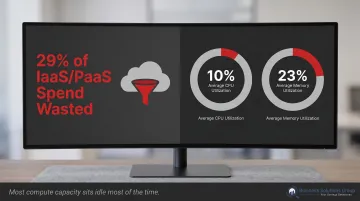
The numbers are significant: 29% of IaaS/PaaS cloud spend is estimated to be wasted, according to Flexera's State of the Cloud report. Kubernetes clusters average just 10% CPU utilization and 23% memory utilization — meaning most compute capacity is idle most of the time.
Practical steps to address this:
- Implement auto-scaling policies so resources flex with actual demand
- Schedule idle resource shutdowns for dev and test environments
- Use cloud cost monitoring tools to track consumption by application and department
- Run Spot Instances for non-critical workloads — they can reduce compute costs by 59–77%
Treat cloud cost optimization as an ongoing discipline. Workloads shift, teams spin up new environments, and waste accumulates quietly — monthly reviews catch what annual audits miss.
8. Align IT Cost Accountability with Business Unit Consumption
When business units don't see the cost consequences of their IT consumption, there's no natural incentive to use resources efficiently. The result is low-value demand that no one is motivated to question.
Showback and chargeback models create that incentive:
- Showback — informational reports showing each unit what it consumes, without internal billing
- Chargeback — internal billing for IT services, where departments see actual costs on their P&L
Showback alone — without any internal billing — consistently reduces demand for low-priority IT resources. Departments that see their consumption data start asking harder questions about what they actually need.
The key to making this work is simplicity — overly complex allocation models create administrative overhead that undermines the purpose. Start with high-cost categories like cloud and SaaS, where consumption data is easiest to pull.
9. Invest in Predictive IT Analytics to Shift from Reactive to Proactive
Reactive IT — addressing outages and performance degradation after they occur — is significantly more expensive than proactive maintenance. For SMBs, downtime costs range from $8,000 to $74,000 per hour. At enterprise scale, the financial and operational impact is higher still.
Predictive analytics tools that monitor system health, ticket volume trends, and mean time to resolution (MTTR) allow IT teams to:
- Identify risk signals before they escalate into incidents
- Reduce emergency labor costs associated with unplanned outages
- Shift IT from a cost-reactive function to a value-generating one
Getting there requires consistent data collection and defined escalation thresholds — but the payoff compounds. Teams that act on signals early spend less time firefighting and more time on improvements that actually move the business forward.
Conclusion
Reducing IT costs effectively requires identifying where cost actually originates — whether in procurement decisions, management behaviors, or systemic conditions — rather than cutting budgets across the board. Blanket cuts shift costs. Targeted strategies eliminate them.
The nine strategies here are not independent fixes. They work best in combination: procurement governance reduces what enters the system, operational controls improve what's already in use, and structural changes address the environment that amplifies cost. Organizations that treat IT cost optimization as a continuous, cross-functional discipline consistently outperform those that address it reactively, one budget cycle at a time.
Business Solutions Group works with businesses to put these strategies into practice — through spend intelligence software, eProcurement advisory, and supply chain analytics that make cost visibility actionable. For organizations ready to move beyond reactive budget cuts, that kind of structured support is where sustainable savings begin.
Frequently Asked Questions
What are examples of cost-saving initiatives in IT?
Practical examples include software license audits to eliminate shelfware, vendor consolidation to strengthen contract terms, cloud resource rightsizing, automation of Level 1 support tasks, and eProcurement policies that block unauthorized spending before it occurs.
How does technology help with cost savings?
Spend intelligence platforms, ITFM dashboards, AI-powered automation, and cloud monitoring tools give organizations real-time visibility into where money is going. That visibility enables data-driven decisions that reduce waste without sacrificing service quality.
What are the 4 cost principles?
The four core cost management principles are:
- Cost transparency: knowing where money is spent
- Cost accountability: assigning ownership to consumption
- Cost optimization: spending efficiently for maximum value
- Cost governance: enforcing policies and controls consistently
What is the difference between IT cost reduction and IT cost optimization?
Cost reduction focuses on cutting specific expenditures, typically as a short-term measure. Cost optimization is broader: it's an ongoing strategy to get more business value from every dollar of IT spend while maintaining or improving service quality.
How do you identify hidden IT costs?
Conduct a full spend audit across software licenses, cloud usage, vendor contracts, and shadow IT purchases. Centralize the data using spend visibility tools or ITFM dashboards, then benchmark against industry peers — anomalies that internal data alone won't catch often surface through that comparison.
How quickly can IT cost reduction strategies show results?
Quick wins like license audits and shadow IT cleanup can deliver results within weeks. Structural changes — vendor consolidation, cloud rightsizing, and ITFM implementation — typically show measurable impact within one to two quarters.