Introduction
LTL freight costs are rarely driven by rates alone. According to an AFS Logistics audit of nearly 250,000 LTL invoices, approximately 4.5% contained billing errors, with inaccurate accessorial charges accounting for nearly half of all mistakes. At that scale, the dollars add up fast.
The real problem is compounding. Misclassified freight triggers reclassification fees. Poor packaging inflates dimensional weight. Unchallenged accessorials pile onto invoices nobody reviews.
Business Solutions Group's advisory work confirms this pattern: clients who haven't benchmarked their LTL contracts in two to three years are typically overpaying by 15–30%, often without realizing it.
This article covers 7 tricks organized around where costs actually originate: decisions made before a shipment leaves your dock, how shipments are managed in transit, and the carrier relationships and systems surrounding your freight program.
Key Takeaways
- LTL overpayments hide in freight class errors, accessorial fees, packaging waste, and unaudited invoices
- Businesses commonly overpay 10–15% on accessorials alone, often without auditing a single invoice
- A TMS with multi-carrier rate shopping cuts per-shipment cost and processing time faster than any other single change
- Multi-carrier strategies protect against embargoes and give you competitive pricing leverage
- Spend data and benchmark analysis reveal negotiation opportunities that gut instinct routinely misses
How LTL Freight Costs Accumulate Over Time
Most shippers treat LTL as a fixed cost. It isn't. Costs build across multiple touchpoints — base rates, fuel surcharges, accessorial charges, reweigh fees, and damage claims — each adding to the final invoice in ways that aren't always obvious.
The compounding problem is that many of these costs are invisible until you audit. A liftgate fee charged incorrectly on 200 shipments per year looks like a small line item — until you calculate the annual total.
Fuel surcharge escalations go unchallenged. Reclassification fees accumulate because nobody is verifying freight class at the point of shipment creation.
Where the leakage typically hides:
- Outdated carrier contracts with rates no longer competitive against the market
- Unverified freight class assignments that carriers correct after delivery
- Unchallenged accessorial charges that appear as minor line items
- Billing errors that compound monthly without a systematic audit process
Business Solutions Group's benchmark analysis captures 6–12 months of shipment-level data to establish a financial baseline. In practice, shippers who haven't had an outside contract review in the past two years tend to show the largest gaps between what they're paying and what the market supports.
The Key Cost Drivers Behind LTL Freight Expenses
LTL pricing is shaped by four primary variables: freight class (NMFC code), shipment weight and dimensions, lane density, and accessorial requirements. Errors in any one of these inflate your bill.
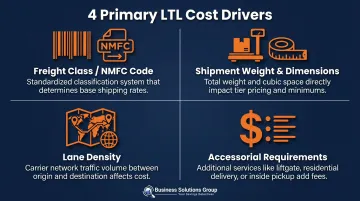
Accessorial charges deserve particular attention. Industry analysis shows they can add 15% to over 50% to base freight rates — and FedEx Freight's published tariff puts liftgate service alone at a $163 minimum charge per shipment. These aren't edge cases. They're routine fees that stack up quickly for shippers without proactive controls.
Those cost drivers share one thing in common: timing. Decisions made before the shipment — freight spec, packaging, classification, mode selection — have more cost impact than rate negotiations that happen after the fact. Most of the 7 tricks below intervene at that pre-shipment stage.
7 Tricks to Save Time and Money on LTL Freight Management
These tricks are grouped by where they intervene in the cost cycle: pre-shipment decisions, in-transit management, and the external relationships and systems shaping your overall freight spend.
Pre-Shipment Decisions That Cut Costs
Trick 1 — Evaluate consolidation before defaulting to LTL
If multiple LTL shipments are heading to the same destination in the same window, consolidation into a single truckload or multi-stop TL move often reduces per-unit cost and damage exposure simultaneously. LTL freight changes hands multiple times across carrier terminals. Each terminal touchpoint is a damage risk that disappears with a direct truckload move.
This requires shipment timing flexibility and volume awareness, but the math frequently favors consolidation. A TMS with mode comparison capability can flag consolidation opportunities automatically, based on actual shipment data rather than guesswork.
Trick 2 — Verify NMFC freight class before every booking
Freight class errors are expensive on both ends. When a carrier determines the class on your Bill of Lading is wrong, the result is a reclassification fee ($25–$150 per shipment), a reweigh fee ($20–$50), and a rate adjustment, all stacking on the same invoice.
The NMFC system assigns one of 18 classes based on density, handling, stowability, and liability. The denser and easier to handle the freight, the lower the class and the lower the rate. Assigning a lower class than the carrier will verify doesn't save money; it just shifts the cost downstream with added fees on top.
A TMS that calculates pounds per cubic foot when weight and dimensions are entered, and retrieves the correct freight class automatically, eliminates the manual entry errors that trigger reclassification.
Trick 3 — Optimize packaging to control density and reduce claims
Oversized packaging increases cubic footage without adding weight. That reduces freight density, which can push a shipment into a higher NMFC class and a higher rate. The fix is straightforward: use the smallest packaging that adequately protects the freight.
There's a second payoff. LTL shipments average a 1.24% damage claim rate, with an average claim value of $1,796 per incident. Better packaging reduces both the classification risk and the damage probability in a single decision. Dimensional weight and packaging optimization are often overlooked levers — shippers focused on carrier rates frequently miss the savings sitting in their own packing decisions.
Managing LTL More Effectively
Trick 4 — Use a TMS to compare real-time rates across multiple carriers
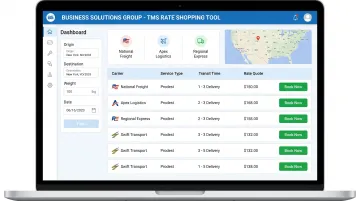
Without a Transportation Management System, shippers either call a single carrier or manually query multiple sites. Neither approach ensures competitive pricing. A TMS consolidates rate shopping, mode comparison, and booking into one interface, reducing time per shipment while capturing the best available rate automatically.
Business Solutions Group's TMS Rate Shopping Tool connects to over 100 national, regional, and local carriers, including UPS, FedEx, USPS, LTL, FTL, and courier options, all in a single dashboard. The platform supports real-time quoting and booking, integrated multi-carrier tracking, automated invoice auditing, and ERP/WMS integration. For companies spending $500,000 or less annually on freight, it's available at minimal to no cost.
The TMS market is growing fast: projected to reach $37 billion by 2030 at a 14.9% CAGR, driven by shippers discovering what manual rate shopping costs them. One managed transportation client achieved 22% total savings, with 13% captured in the first month of implementation.
Trick 5 — Audit freight invoices and dispute accessorial charges systematically
Accessorial charges: liftgate fees, detention, address corrections, limited access delivery. These are the most common source of LTL billing errors. AFS Logistics audit data puts it precisely: 42.8% of all LTL invoice errors relate to inaccurate accessorial charges, out of nearly 4.5% of all invoices containing some form of error.
Most shippers don't dispute these charges because they appear as small line items. Left unchallenged, they compound quietly across hundreds of invoices. A systematic audit, whether manual or automated through a TMS, catches errors before they become sunk costs.
Business Solutions Group's freight invoice audit and recovery program covers all modes and reviews every invoice line for duplicate charges, rate errors, incorrect accessorials, and misapplied credits. Most clients see returns within the first billing cycle. The service runs on a performance-based model: no recovery, no fee.
Changing the Context Around LTL
Trick 6 — Build a multi-carrier strategy to eliminate single-carrier dependency
The U.S. LTL market has roughly 200 active carriers, with the top 5 controlling 50% of total revenue. That concentration creates real risk: when a carrier imposes an embargo due to capacity crunches, driver shortages, or terminal overload, shippers with no alternative carriers face delays, premium pricing, and no negotiating leverage.
A targeted mix of national and regional carriers solves this. Regional carriers frequently offer lower minimum charges ($60–$80) versus national carriers ($100–$130) for comparable shipments, making lane-level carrier selection a consistent cost lever, not just an emergency fallback.
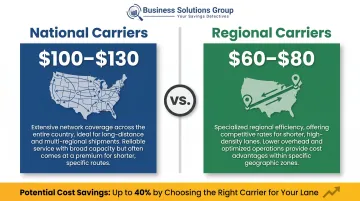
Building this mix requires mapping lanes to carrier strengths, running competitive bidding across both national and regional options, and tracking ongoing performance with scorecards. Without that structure, shippers default back to single-carrier dependency over time.
Trick 7 — Use spend data and benchmarks to negotiate carrier contracts
Most shippers negotiate carrier contracts without knowing how their rates compare to market. Carriers negotiate these contracts daily; most shippers do it every few years, typically without lane-level data, freight profile analysis, or benchmark comparisons.
Effective negotiation requires:
- Shipment volume and weight history by lane
- Carrier performance data (transit time, claims ratio, service failures)
- Market benchmarks showing what comparable shippers pay
- Accessorial fee analysis, not just headline discount percentages
- Projected freight profile for contract term modeling
Business Solutions Group's proprietary spend intelligence software ingests data from ERP and WMS systems and generates consolidated dashboards with lane-level visibility, defining optimal rate structures down to one-tenth of a percent. Their advisory team includes former UPS and FedEx senior pricing analysts who use this data to negotiate on behalf of clients, typically achieving 20–25% reductions in LTL freight costs. The benchmark analysis is delivered at no cost, with no commitment required.
Conclusion
LTL freight costs don't come from a single source. They build up across a chain of decisions — freight class assumptions that go unverified, packaging that inflates dimensional weight, accessorial fees that never get disputed, and carrier contracts that haven't been benchmarked in years. Finding the savings requires identifying where cost originates first.
The most durable improvements come from treating LTL freight management as an ongoing discipline. Businesses that pair operational rigor — accurate classification, packaging optimization, invoice auditing — with spend intelligence and multi-carrier strategies consistently outperform those relying on a single carrier relationship and manual processes.
The 7 tricks above are a starting point. Applied together, they create a compounding effect that recovers margin across every lane, shipment, and invoice cycle. If you want to accelerate that process, Business Solutions Group's freight advisory and spend intelligence services help identify exactly where your LTL dollars are leaking — and close those gaps fast.
Frequently Asked Questions
What is the going rate for LTL freight?
According to the TD Cowen/AFS Freight Index, LTL contract rates currently average $46.40 per hundredweight (CWT) — a 14.3% year-over-year increase. Typical cost ranges from $0.22–$0.42 per pound, but freight class, lane, distance, and accessorials all shift that number significantly. Benchmark comparisons matter more than averages for planning purposes.
How can I reduce my freight costs?
The fastest levers are accurate NMFC classification, multi-carrier rate shopping through a TMS, systematic invoice auditing, and contract renegotiation backed by spend data. Pre-shipment decisions — classification and packaging — typically carry the highest impact.
How do I negotiate LTL freight rates?
Effective negotiation requires lane-level volume data, historical freight class distribution, and market benchmarks showing what comparable shippers pay. Carriers respond to shippers who demonstrate consistent volume and accurate freight profiles — incomplete or inaccurate data weakens your position at the table.
How do I choose an LTL freight carrier?
Evaluate lane coverage, transit time performance, claims ratio, accessorial fee structure, and embargo history. No single carrier is optimal across all lanes and shipment types — which is why comparing national and regional options through a TMS, rather than defaulting to one relationship, consistently surfaces lower rates and better service fits.
What tools are used to manage LTL shipments?
Core tools include a TMS (for rate shopping, booking, and tracking), freight invoice auditing software, ERP/WMS integrations, and spend analytics platforms. Business Solutions Group offers all of these — including TMS access at minimal to no cost for qualifying shippers — as part of its LTL advisory and managed services engagements.
What is freight rate management?
Freight rate management is the ongoing process of monitoring, negotiating, and optimizing carrier rates — extending well beyond the initial contract to include invoice auditing, lane benchmarking, accessorial controls, and performance tracking across your network.