Introduction
Cash flow pressure is real right now. Rising interest rates, tariff volatility, and tighter credit conditions have pushed CFOs and supply chain leaders to find liquidity within their own operations—and most are sitting on more than they realize.
The hidden reservoir is working capital. PwC's 2025/26 Working Capital Study identified €1.84 trillion in excess working capital trapped across 17,000+ companies in Europe and globally. In the U.S. alone, The Hackett Group's 2025 survey pegged the figure at $1.7 trillion among the 1,000 largest public companies.
Supply chain planning platforms are where most of that capital gets unlocked. When deployed properly, they reduce inventory excess, sharpen forecast accuracy, align payment flows, and surface hidden cash—translating operational data directly into liquidity.
This article covers how supply chains trap working capital, how planning platforms free it, and what to look for when evaluating one.
Key Takeaways
- Working capital is tied up in three places: excess inventory, poor forecasting, and misaligned payment terms
- AI-driven forecasting can reduce supply chain forecast errors by 20–50%, per McKinsey
- The Cash Conversion Cycle (CCC = DIO + DSO – DPO) is the primary metric to track
- Platform-driven visibility prevents costly inventory imbalances across locations
- Combining advisory expertise with planning technology drives larger, longer-lasting working capital improvements than software alone
How Supply Chains Trap Working Capital
Working capital, in practical supply chain terms, equals current assets (inventory + receivables) minus current liabilities (payables). The wider that gap, the more cash is locked in operations rather than available for investment or growth.
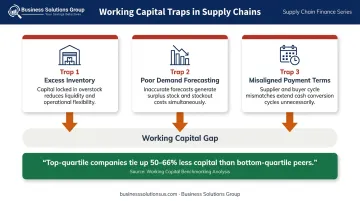
Three structural traps consistently inflate that gap:
- Excess or misallocated inventory — Stock ordered against forecasts that didn't materialize sits idle, consuming cash with no return
- Poor demand forecasting — Overforecasting creates surplus; underforecasting triggers expensive emergency purchasing. Both drain cash
- Misaligned payment terms — Paying suppliers faster than customers pay you creates a timing mismatch that silently erodes liquidity
The scale of this problem is significant. U.S. manufacturers held inventories equal to 30% of total current assets in Q1 2026, according to Federal Reserve QFR data. For wholesale distributors, that figure was 38% in Q4 2025. These aren't edge cases—they represent the structural baseline most companies are managing against.
Meanwhile, the performance gap between companies that manage working capital well and those that don't is striking. Top-quartile Nordic performers tie up 50–66% less capital in operations than their bottom-quartile peers, according to McKinsey research covering 250 large companies.
The difference almost always traces back to planning quality: how accurately demand is forecast, how tightly inventory is positioned, and how well payment cycles align with cash flow realities. Supply chain planning platforms target all three levers simultaneously.
How Supply Chain Planning Platforms Reduce Inventory-Tied Capital
Inventory is typically the single largest driver of working capital consumption. Overstocking locks cash in slow-moving goods. Understocking forces expensive emergency replenishment. Planning platforms tackle both problems at once—by making replenishment decisions smarter, not just faster.
From Static Reorder Points to Dynamic Replenishment
Traditional inventory management relies on fixed reorder points—a set threshold triggers a purchase order, regardless of what's actually happening with demand or lead times. Planning platforms replace this with demand-driven replenishment logic that adjusts dynamically based on:
- Actual consumption rates (not just historical averages)
- Current supplier lead times and variability
- Downstream fulfillment demand signals
The result is leaner average stock without sacrificing service levels. McKinsey case evidence shows an automotive supplier reduced total inventory by 15% in 12 months through aligned forecasting and S&OP discipline—without increasing stockouts.
SKU Rationalization and Inventory Segmentation
Not all inventory deserves equal attention or capital allocation. Planning platforms identify low-velocity SKUs that absorb disproportionate working capital, enabling businesses to:
- Cull products that haven't earned their shelf space
- Consolidate variants where customer demand doesn't justify the complexity
- Shift to postponement strategies that defer inventory commitment until demand is confirmed
For businesses carrying hundreds or thousands of SKUs with uneven demand profiles, this rationalization alone can free up substantial working capital.
Cross-Location Visibility Prevents Costly Imbalances
One of the most common—and expensive—inventory problems is imbalance: excess stock at one warehouse node while another faces a stockout. Without cross-location visibility, companies respond reactively through emergency transfers or markdowns, both of which erode margin.
Planning platforms surface these imbalances in real time, enabling proactive redistribution before the situation becomes a crisis.
Reducing Safety Stock Through Better Forecasting Accuracy
Cross-location visibility addresses where stock sits; better forecasting accuracy addresses how much stock you need in the first place. Safety stock exists to buffer against uncertainty—demand variability, lead time fluctuations, and supplier unreliability. When platforms reduce that uncertainty, the justification for large safety buffers shrinks. Businesses can systematically reduce buffer inventory without increasing stockout risk, converting idle insurance stock into freed working capital.
Demand Forecasting: The Engine Behind Smarter Cash Decisions
Poor forecasting drives most inventory-related working capital waste. AI-powered, multi-variable forecasting models replace manual projections with demand signals drawn from real data — and the financial difference is measurable.
According to McKinsey, AI-driven forecasting can reduce supply chain forecast errors by 20–50% and cut product unavailability by up to 65%. At that scale, businesses can fundamentally reassess how much inventory they actually need to hold.
What Modern Platforms Actually Forecast Against
Modern planning platforms incorporate a much broader signal set than internal historical data alone:
- Seasonal demand patterns and promotional calendars
- Macroeconomic indicators and consumer spending trends
- Tariff changes and trade policy shifts
- Supplier lead time variability and capacity constraints
When these signals feed a unified demand plan, purchasing decisions align to real need rather than worst-case assumptions. The result: less over-procurement, lower idle stock costs, and a direct impact on the P&L and balance sheet.
The Financial Cascade Effect
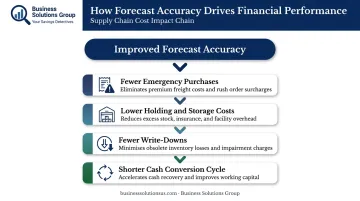
Improved forecast accuracy produces a chain reaction across the P&L and balance sheet:
- Fewer emergency purchases — unplanned procurement typically carries premium costs that compress margin
- Lower holding and storage costs — less inventory means less warehouse space required
- Fewer write-downs — obsolescence drops when stock is purchased closer to actual demand
- Shorter cash conversion cycle — all of the above compress the time between cash out and cash in
Scenario Modeling Before Capital Is Committed
Advanced platforms add a layer that most businesses lack entirely: what-if scenario modeling. Supply chain teams can model the working capital impact of a demand spike, a supplier delay, or a sudden tariff change before committing capital. For businesses operating in volatile conditions, that capability translates directly into fewer capital allocation mistakes and tighter control over cash at risk.
Payment Terms, Supplier Coordination, and Working Capital Finance
Working capital optimization doesn't stop at inventory. The other half of the equation is the timing of cash flows—specifically, the gap between when you pay suppliers and when customers pay you.
The Cash Conversion Cycle formula makes the mechanics clear:
CCC = Days Inventory Outstanding (DIO) + Days Sales Outstanding (DSO) – Days Payable Outstanding (DPO)
A lower CCC means less time cash is tied up in the operating cycle. The most powerful lever: extend DPO while reducing DIO simultaneously. Planning platforms create the data foundation to do both.
Better Supplier Data Creates Negotiating Leverage
When a planning platform gives suppliers visibility into forward demand signals—accurate forecasts, real-time inventory levels, lead time data—procurement teams gain something valuable in return: a credible case for extending payment terms. Suppliers who can see reliable demand are more willing to offer concessions because their own planning uncertainty drops.
The financial math is straightforward. A McKinsey analysis found that avoiding payments just five days early on $1 billion in annual spend frees approximately $14 million in cash—no renegotiation required, just payment timing discipline.
Supply Chain Finance as a Complementary Tool
For companies that have extended DPO but want to protect supplier health, supply chain finance (SCF) programs like reverse factoring offer a practical solution:
- Buyers preserve extended payment terms without straining supplier relationships
- Suppliers receive early cash through a third-party financier
- Planners provide the real-time transaction data these programs need to run efficiently
The 2025 World Supply Chain Finance Report estimates global SCF volume reached $2.46 trillion in 2024—a scale that reflects how broadly businesses have adopted this model to balance DPO extension with supplier stability.
For businesses looking to act on these opportunities, Business Solutions Group pairs spend intelligence software and eProcurement tools with hands-on advisory support—helping clients benchmark payment terms, identify gaps, and put cost reduction strategies into practice.
Key Metrics to Track Working Capital Performance
Real-time dashboards in planning platforms replace quarterly snapshots with live visibility—giving teams the data they need to act before small drifts turn into real cash problems. Three metrics, tracked together, tell most of the story.
The Primary Metric: Cash Conversion Cycle
The Cash Conversion Cycle (CCC = DIO + DSO – DPO) is the single most useful measure of working capital efficiency in supply chains. A lower number means less time cash is tied up in the operating cycle. A negative CCC—where customers pay before you pay suppliers—means the supply chain is effectively self-financing.
Benchmark context: U.S. large-company CCC averaged 37 days in 2024, per The Hackett Group. EU cash-intensive sectors averaged 90.2 days DIO in 2024—illustrating how much sector and geography matter when interpreting these numbers.
Two Supporting Metrics Worth Tracking
| Metric | What It Measures | Why It Matters |
|---|---|---|
| Inventory Turnover Ratio | COGS ÷ Average Inventory | Higher turnover = less capital tied up in stock |
| Current Ratio | Current Assets ÷ Current Liabilities | Signals whether the business can meet short-term obligations |
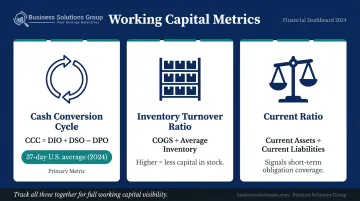
Neither metric tells the full story alone. Inventory turnover without CCC context can mask payables problems. Current ratio without turnover data can mask slow-moving stock. When these three metrics diverge—say, turnover improves while CCC worsens—it's usually a signal that payables terms or receivables collections deserve a closer look.
What to Look for in a Supply Chain Planning Platform
Not all platforms deliver meaningful working capital impact. The following capabilities determine whether a platform will actually move the needle:
- Demand forecasting built on multi-variable models that incorporate external market signals alongside internal history
- Replenishment logic that adjusts in real time based on actual consumption, replacing static reorder points
- Network-wide inventory visibility that enables redistribution before imbalances become crises
- Supplier collaboration tools that give procurement teams shared data access and leverage in payment term negotiations
- Direct integration with financial or eProcurement systems, connecting planning decisions to cash flow outcomes
Technology Alone Isn't Enough
A platform surfaces opportunities. Capturing them requires process change, supplier negotiation, and often a structural rethink of how the supply chain is managed. Companies that achieve the deepest working capital improvements pair planning software with advisory expertise: professionals who audit current cost structures, identify benchmark gaps, and build a custom optimization roadmap.
For businesses seeking that combination, Business Solutions Group offers custom-built supply chain optimization and spend intelligence tools alongside the advisory expertise to ensure the technology produces measurable cash flow improvements—not just visibility into where problems exist, but a clear path to resolving them.
Frequently Asked Questions
How do you reduce working capital in supply chain?
Reduce supply chain working capital by optimizing inventory through accurate demand forecasting, extending supplier payment terms, and accelerating customer collections. Planning platforms automate and coordinate all three levers simultaneously, making the gains faster and more sustainable.
How do supply chains impact working capital consumption?
Supply chains consume working capital through inventory holding, the timing gap between paying suppliers and collecting from customers, and inefficiencies like excess safety stock and fragmented purchasing. Each layer adds cost and delays the return of cash to the business.
What is the Cash Conversion Cycle and why does it matter?
CCC = DIO + DSO – DPO. A shorter or negative CCC means the business collects from customers before it must pay suppliers, making the supply chain self-financing and freeing capital for growth rather than operations.
How does demand forecasting help reduce inventory working capital?
Accurate forecasting prevents both overstocking (which locks cash in slow-moving goods) and understocking (which triggers costly emergency purchases). The result is a lower average inventory investment required to support the same service level.
What features should a supply chain planning platform have to improve cash flow?
Look for AI-driven demand forecasting, dynamic replenishment, real-time multi-location inventory visibility, supplier collaboration tools, and integration with financial or eProcurement systems. These capabilities connect planning decisions directly to working capital outcomes.
Can small and mid-sized businesses benefit from supply chain planning platforms?
Yes, often more than large enterprises. SMBs typically carry larger inventory buffers and have less supplier negotiating leverage, making platform-driven forecast accuracy and spend intelligence especially impactful for freeing cash. A 2022 Software Advice survey found 9 in 10 SMB supply chain managers felt larger companies held a procurement advantage — the right platform narrows that gap.