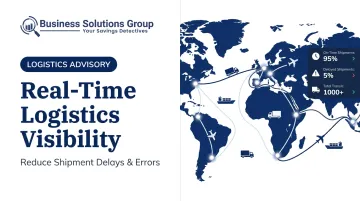
Real-time logistics visibility is talked about constantly in supply chain circles. But its actual value isn't in the dashboard — it's in the outcomes. Fewer delayed shipments. Fewer billing disputes. Faster responses when something goes wrong. Better leverage in carrier negotiations.
This article breaks down exactly what real-time logistics visibility delivers in practice — three core operational advantages, what happens when it's absent, and how to extract compounding value from it over time.
Key Takeaways
- Real-time visibility tracks shipment location, status, and condition across every carrier and every leg of the journey.
- Early delay detection prevents the most expensive reactive costs: expediting fees, air freight upgrades, and SLA penalties.
- Automated data flows replace manual check-ins, eliminating the transcription errors and documentation gaps behind billing disputes.
- Continuous carrier performance data lets shippers hold partners accountable and negotiate contracts from a position of strength.
- Visibility data only creates value when it's acted on — not just collected.
What Is Real-Time Logistics Visibility?
Real-time logistics visibility means knowing where every shipment is, what condition it's in, and what its current status is — at any moment, across every stage of transit. That means before a delay surfaces, before the carrier calls, and before a problem reaches your customer.
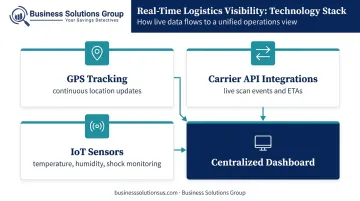
In practice, it combines several data sources into a single operational view:
- GPS tracking for continuous location updates on trucks, containers, and parcels
- Carrier API integrations that pull scan events, status changes, and ETAs directly from carrier systems
- IoT sensors for condition monitoring — temperature, humidity, shock — on sensitive freight
- Centralized dashboards that aggregate all of this into one view across all carriers and lanes
Adoption of these tools has accelerated sharply. IoT device use for real-time shipment tracking nearly doubled from 25% in 2023 to 53% in 2024, per Tive's State of Visibility 2024 survey — and another 25% of respondents planned to adopt real-time tracking within 12 months.
Visibility is a decision-support tool, not a passive log. It gives operations teams enough lead time to respond before a developing problem becomes a missed delivery, a failed compliance check, or an angry customer.
Three Operational Advantages of Real-Time Logistics Visibility
Each of the advantages below maps to metrics logistics managers and supply chain leaders actually track — not theoretical benefits, but measurable operational outcomes.
Advantage 1: Proactive Delay Detection Before Disruptions Compound
Most logistics costs tied to delays aren't caused by the delay itself — they're caused by finding out too late. By the time a team learns a shipment missed a customs hold or a carrier rerouted around weather, the downstream impact has already multiplied: an expedited air freight booking, a customer credit, a scrambled receiving schedule.
Real-time visibility changes that equation. Live alerts flag transit exceptions — a missed scan, a route deviation, a customs hold — hours before they become missed deliveries. That window is the difference between a quick operational adjustment and a reactive, expensive fix.
According to Gartner's 2025 logistics resilience research, logistics leaders who proactively plan for disruptions are nearly 3.5x more likely to be high performers than those who respond reactively. The gap between those two postures is a visibility gap.
KPIs this moves:
- On-time delivery rate
- Exception resolution time
- Expediting cost per shipment
- SLA compliance rate
When it matters most: High shipment volumes, time-sensitive freight (perishables, just-in-time manufacturing inputs, seasonal goods), or multi-carrier supply chains where manual tracking can't keep pace.
Advantage 2: Error Reduction Through Automated, Verified Data Flows
Manual status updates, phone check-calls, and paper-based records have a shared failure mode: humans mistype, mishear, and misfile things. The result shows up as billing disputes, mis-shipments, compliance gaps, and hours of administrative rework.
Real-time visibility replaces that manual layer with automated, system-generated data. Scan events, electronic proof of delivery, and digital handoff records create an auditable trail that all parties — shippers, carriers, receivers — can reference in real time.
That trail eliminates the "he said/she said" dynamic that drives most invoice disputes. When the data is timestamped, system-generated, and accessible to everyone involved, there's no ambiguity about what happened.
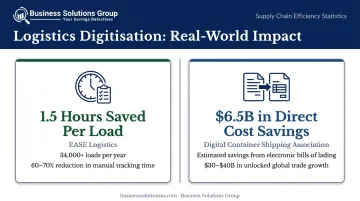
The productivity impact is concrete. Descartes documented that EASE Logistics — managing more than 34,000 loads annually — saved an estimated 1.5 hours per load by replacing manual tracking check-calls with automated visibility, achieving a 60–70% reduction in manual tracking time.
At scale, the documentation benefits extend further. The Digital Container Shipping Association estimated that switching from paper bills of lading to electronic bills of lading could save $6.5B in direct costs and unlock $30–$40B in annual global trade growth — a figure that underscores how much friction lives in paper-based logistics documentation.
KPIs this moves:
- Shipment accuracy rate
- Invoice dispute rate
- Claims frequency
- Manual touchpoints per shipment
When it matters most: High-volume operations, complex multi-stop routes, and regulated industries where documentation accuracy directly affects compliance.
Advantage 3: Carrier Performance Accountability and Cost Control
Without data, carrier contract negotiations default to gut feel or the carrier's own metrics. That's a weak position. Real-time visibility generates a continuous, objective record of how each carrier actually performs — across every lane and shipment.
That record delivers two practical outcomes. Shippers can identify which carriers are consistently underperforming against contract commitments before the next renewal — not after years of absorbing the cost. And when it's time to negotiate, they bring evidence instead of estimates: showing a carrier that on-time performance on a specific lane ran 8 points below contracted commitment over 18 months is a fundamentally different conversation than asking for a rate reduction based on general market conditions.
This is where advisory support amplifies the data. Business Solutions Group uses visibility and spend intelligence data to help clients benchmark their carrier spend against market rates, identify where cost leakage is occurring, and structure contracts around actual performance — converting performance data into direct, recurring cost reductions.
KPIs this moves:
- Cost per shipment by carrier
- On-time performance rate by carrier
- Claims rate by carrier
- Total freight spend vs. benchmark
- Contract compliance rate
When it matters most: Businesses with significant freight budgets, multiple carriers across lanes, or those approaching contract renewals without historical performance data to anchor negotiations.
What Happens When Real-Time Visibility Is Missing
Operating without visibility doesn't eliminate problems — it just delays them. By the time an issue surfaces, the cost to fix it is already higher than it needed to be. The consequences tend to compound in familiar ways:
- Customers learn about delays before your team does, triggering SLA penalties that proactive alerting would have prevented
- Billing discrepancies, failed deliveries, and compliance findings cost more to resolve after the fact than to catch in transit
- Carrier performance problems build up unnoticed — with no data trail, there's no basis for accountability or contract renegotiation
- Expediting fees, rework labor, and preventable claims accumulate gradually, making root causes difficult to pinpoint
- Adding volume or new lanes without systematic visibility multiplies errors and delays rather than absorbing them
The scale of exposure is significant: according to a Tive industry survey, 47% of respondents experienced monthly cargo losses exceeding $5,000 — and that covers just one category of cost from incomplete visibility.
How to Get the Most Value from Real-Time Visibility
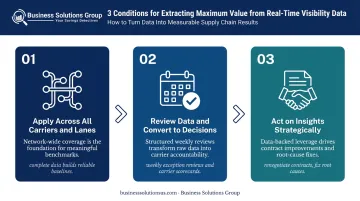
The data is only as useful as what gets done with it. Real-time visibility tools generate their highest return when paired with consistent operating discipline across three conditions:
1. Apply it across all carriers and lanes. Performance baselines and benchmarks only mean something when they're built from complete data. Cherry-picking which shipments to track creates blind spots that undermine carrier accountability.
2. Review data regularly and convert it into decisions. Weekly or monthly exception reviews, carrier scorecards, and variance reports don't generate value sitting in a dashboard. Organizations that benefit most treat visibility data as an operational input, not a reporting artifact.
3. Act on insights at a strategic level. Carrier performance trends should inform contract renegotiations. Recurring delay patterns should trigger process changes. Error data should drive root-cause corrections.
When businesses lack the internal bandwidth to do this reliably, a supply chain advisory partner like Business Solutions Group can step in — translating raw visibility data into structured cost reductions through benchmarking analysis, spend intelligence review, and contract restructuring.
Conclusion
Real-time logistics visibility delivers value because it changes how decisions get made — not because of the technology itself. Fewer delays reach customers. Fewer errors become disputes. Carrier performance becomes measurable and, therefore, manageable.
Its advantages also compound. The longer visibility data is consistently captured and acted upon, the stronger the performance baseline, the better the contract terms, and the lower the error rate. A business that spent 12 months building carrier scorecards enters its next contract negotiation in a considerably stronger position than one starting from scratch.
Treat real-time visibility as a continuous operational practice — not a one-time implementation — and the data becomes a strategic asset. The businesses that get the most out of it are the ones that act on what it reveals, consistently and deliberately.
Frequently Asked Questions
What is real-time logistics visibility?
Real-time logistics visibility is the continuous, live tracking of shipment location, status, and condition across every stage of the supply chain. It differs from periodic or manual check-in tracking by providing uninterrupted data, so teams can act on developing issues rather than discovering them after delivery.
How does real-time visibility reduce shipment delays?
Live alerts flag transit exceptions (missed scans, route deviations, customs holds) early enough for teams to reroute, notify customers, or adjust receiving schedules before downstream impact compounds. The key is lead time: catching a problem 12 hours early eliminates costs that catching it post-delivery would require.
What technologies power real-time shipment tracking?
The core stack includes GPS tracking, RFID tags, IoT sensors, carrier API integrations, and centralized visibility platforms that aggregate data from multiple sources into a single dashboard. Most modern implementations combine carrier-provided data feeds with independent tracking devices for comprehensive coverage.
How does real-time visibility help reduce shipping errors?
Automated data capture replaces manual status updates and paper records, cutting out the transcription errors, documentation gaps, and miscommunications behind billing disputes, mis-shipments, and compliance failures. System-generated, timestamped records give all parties a shared, auditable reference.
What is the ROI of investing in real-time logistics visibility?
ROI comes from reduced reactive costs (expediting fees, claims, rework), lower freight spend through carrier accountability and data-backed negotiations, and improved customer retention from reliable delivery performance. The Descartes/EASE Logistics case documented 1.5 hours saved per load, a productivity gain that scales directly with shipment volume.
How can small and mid-sized shippers benefit from real-time visibility?
Smaller shippers often lack the volume leverage to negotiate strong carrier contracts. Visibility data changes that dynamic — performance evidence replaces gut feel, letting shippers hold carriers accountable and benchmark spend against market rates regardless of volume.