Introduction
Shipping costs rarely spike overnight. They accumulate through fragmented shipments, missed grouping opportunities, and batching decisions made without visibility into the full order picture. FedEx announced average rate increases of 5.9% for Express, Ground, and Home Delivery services effective January 2024, while U.S. business logistics costs climbed 5.4% to $2.58 trillion — equal to 8.8% of GDP. For businesses that ship at volume, those numbers translate directly into margin compression and budget unpredictability.
What many shippers don't realize: a significant share of those costs aren't carrier-driven. They're self-inflicted through poor order grouping, inconsistent batching, and software that's either absent or misconfigured.
This article examines where consolidation-related shipping costs actually originate, which specific factors drive them up, and how order consolidation software — when chosen and configured deliberately — can cut them across fulfillment, freight, and parcel spend.
Key Takeaways
- Shipping costs build through fragmented shipments and missed groupings, not as a single line item
- LTL penalties, dimensional weight surcharges, and per-shipment base fees compound quickly at scale
- Software selection, internal governance, and carrier relationships each require their own cost-reduction approach
- Carrier contract negotiations produce the strongest results when backed by twelve months of consolidation data
- Benchmarking against industry peers confirms whether your software is cutting costs against a meaningful standard — not just an internal one
How Shipping Costs Build Up Without Effective Order Consolidation Software
Consolidation-related costs don't appear on a single invoice line. They accumulate across hundreds of small charges — per-shipment handling fees, dimensional weight surcharges, LTL minimums — that compound until a quarterly audit makes them visible.
The Mechanics of Cost Accumulation
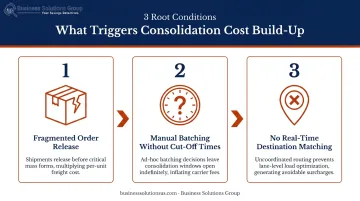
Three operational conditions trigger most of this cost build-up:
- Fragmented order release — orders dispatched individually as they arrive rather than held for grouping
- Manual batching without enforced cut-off times — planners making inconsistent grouping decisions based on workload rather than system rules
- No real-time destination matching — inability to identify which open orders share geographic proximity before releasing them to carriers
The capacity utilization data tells the story clearly. According to ISM, 43% of truckloads moved at less than capacity in 2023, and ATRI reported 16.3% deadhead mileage across non-tank operations that same year. Every underloaded truck represents freight spend that could have been avoided — or at least shared across multiple shippers.
Why These Costs Stay Hidden
Split shipments are particularly expensive. SupplyChainBrain reports that the added distance and packaging involved in split orders can raise shipping costs by 2x to 5x compared to consolidated moves. Yet most businesses don't quantify this exposure until they're shipping enough volume that the pattern appears in aggregate spend data.
Without consolidation software enforcing grouping decisions, each planner essentially applies their own batching logic — or none at all. That inconsistency is exactly what order consolidation software is designed to eliminate.
Key Cost Drivers for Order Consolidation Software
What you actually pay for order consolidation comes down to software configuration, operational habits, and external factors like carrier relationships and shipment volumes. Getting a handle on which of these is bleeding money — and why — is the first step toward fixing it.
Primary Cost Drivers by Category
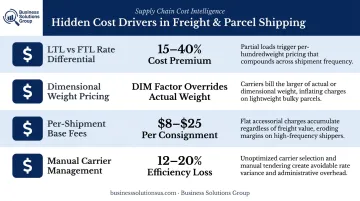
| Driver | What It Costs You |
|---|---|
| LTL vs. FTL rate differential | Q4 2024 LTL rates indexed at 65% above 2018 baseline vs. 4.9% for truckload — the gap is substantial when loads consistently fall short of full |
| Dimensional weight pricing | UPS additional handling charges run $43.50–$52.75 per package by zone for weight, and $28.00–$36.00 for dimension — per package, not per shipment |
| Per-shipment base fees | Every unnecessary carrier transaction adds a base charge; unconsolidated orders multiply these across your invoice |
| Manual carrier management | Administrative overhead from managing multiple carrier relationships without system support adds labor cost that rarely appears in freight spend analysis |
How Cost Drivers Vary by Shipper Profile
Cost drivers shift depending on who's shipping:
- High-volume shippers lose leverage when consolidated volume data isn't available to support carrier rate negotiations
- Mid-market businesses typically see grouping opportunities but lack automated rules to capture them consistently
- Smaller shippers pay retail-tier rates when consolidation — including 3PL-enabled pooling — could unlock volume-based pricing
Identifying your dominant cost driver narrows the field quickly — most shippers have one primary leak, not five.
Cost-Reduction Strategies for Order Consolidation Software
Strategies for reducing shipping costs through order consolidation software fall into three categories: decisions made before and during software adoption, how the software is governed once active, and the broader operational context surrounding it. Each category requires a different approach.
Strategies That Reduce Costs by Changing Decisions
These strategies address the ceiling on achievable savings — the decisions that determine what the software is even capable of delivering before a single shipment is processed.
Select software with native multi-carrier rate comparison. Software without live rate shopping forces businesses to default to contracted rates even when spot or alternative carrier options are cheaper on a specific lane. That gap compounds across every shipment processed on that lane throughout the year.
Define consolidation rules before go-live, not after. This means documenting:
- Ship-to matching criteria (geographic radius, zip code grouping)
- Product compatibility exclusions (hazmat, temperature-sensitive, oversize)
- Cut-off time windows for each shipping origin
Businesses that deploy consolidation software without these rules end up with informal batching that produces no measurable improvement over manual processes. The software runs, but nothing changes.
Match software selection to your actual shipment mode. LTL-heavy operations need consolidation logic built around load optimization, BOL management, and pallet configuration. Parcel-dominant shippers need different capabilities entirely. Using a tool mismatched to your freight profile creates configuration gaps that prevent full cost capture regardless of how well the software is configured.
Configure dimensional weight optimization at deployment. Leaving cartonization settings at defaults means consolidation reduces your shipment count but not the dimensional weight charges carriers apply to inefficient packaging. Fewer shipments with the same DIM charges is a partial win at best.
Strategies That Reduce Costs by Changing How the Software Is Managed
Once software is active, the gap between what it's capable of and what it's actually doing becomes the primary cost variable.
Enforce automated consolidation cut-offs rather than manual release. Software configured to hold orders until a defined window closes consistently produces larger, more cost-efficient loads without requiring planner involvement on every shipment. Academic modeling of middle-mile consolidation has shown up to 22% average improvement over baseline policies when dynamic assignment replaces manual dispatching.
Use consolidation analytics as a negotiation input. Most businesses let consolidation dashboards sit unused between contract renewals. That's a missed opportunity. Lane concentration data, shipment frequency by origin-destination pair, and volume trends are exactly what carriers evaluate when deciding how aggressively to price a contract. Bringing twelve months of that data to a negotiation is a fundamentally different conversation than projecting forward from forecasts.
Integrate with WMS and ERP systems. Consolidation programs break down when the software can't see live inventory data. Orders get merged that can't be fulfilled from a single location, triggering the split shipments the software was deployed to prevent. Real-time available-to-promise visibility isn't an optional integration; it's a prerequisite for reliable consolidation.
Review exception logs regularly. Recurring exceptions — stockouts, service level conflicts, carrier rejects — that are never resolved in the system rules force manual workarounds that erode the automation gains the software was deployed to create. Exception patterns are diagnostic data. Treating them as one-off problems rather than system improvement inputs is how consolidation programs consistently fall short of their potential.
Strategies That Reduce Costs by Changing the Operational Context
In many cases, the environment around the software, not the software itself, is the real cost driver.
Extend consolidation logic to inbound shipments. Most businesses only apply consolidation software to outbound fulfillment. The inbound side — multiple supplier POs arriving on the same dock day — is frequently unmanaged. Pre-planning these as a single consolidated delivery reduces receiving costs and carrier fees without requiring new technology, just a broader application of existing consolidation logic.
Evaluate 3PL partnerships for access to pooled rate tiers. The 2024 Third-Party Logistics Study found that 80% of shippers reported 3PLs contribute to reducing overall logistics costs. 3PLs aggregating multiple clients' freight can offer rate tiers based on combined volume that a mid-market shipper wouldn't qualify for independently.
Software compatibility determines whether consolidation decisions can flow across that partnership without manual reconciliation. Evaluating integration fit before committing to a 3PL relationship avoids reconciliation gaps that offset the rate savings.
Benchmark your carrier spend against market rates. Software-generated savings look compelling in isolation. They can also mask above-market rates if they're never compared to what comparable shippers are paying. Periodic benchmarking against industry peers — using data sources like the Cass Freight Index (aggregating 35 million commercial invoices and $37 billion in annual spend) or DAT RateView ($1 trillion in transaction data) — is how businesses determine whether the software is optimizing against the right baseline. Carrier spend benchmarking and analysis is a core service that supply chain optimization advisors like Business Solutions Group provide as part of their cost-reduction engagements.
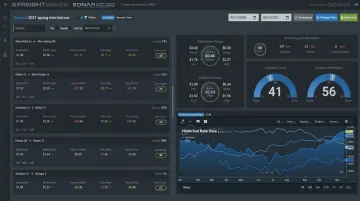
Treat software performance data as a continuous input to contract renewals. Freight contracts typically renew annually. Businesses that bring lane concentration metrics, volume data, and on-time performance records into those conversations consistently secure better terms than those negotiating on forecast alone. The data already exists inside the software; acting on it is a governance decision, not a technology problem.
Conclusion
Reducing shipping costs through order consolidation software requires knowing where cost actually originates. Part of it lives in initial software selection and configuration. Part is embedded in day-to-day governance — how the system is actually managed. The largest portion often reflects the commercial and operational context around the software: carrier relationships, integration quality, and whether spend is benchmarked against anything meaningful.
Each of those three areas requires deliberate decisions — not just a software deployment. The tool creates the capability; what happens before, during, and around its use determines whether that capability translates into real margin improvement or simply automates an existing cost problem more efficiently.
Frequently Asked Questions
How do you decrease the cost of shipping?
Consolidate multiple orders into fewer shipments to cut per-shipment base fees and handling charges. Use software to enforce consolidation rules consistently, and bring volume data to carrier contract negotiations to secure rate concessions beyond published discounts.
How does consolidated shipping work?
Consolidated shipping groups multiple individual orders heading to the same or nearby destinations into a single shipment. This reduces the total number of carrier transactions, maximizes truck or container utilization, and qualifies the shipper for volume-based rate discounts.
What features should I look for in order consolidation software?
Prioritize these core capabilities:
- Multi-carrier rate comparison
- Automated cut-off window enforcement
- WMS and ERP integration for real-time inventory visibility
- Cartonization and dimensional weight optimization
- Analytics for tracking consolidation rate and cost per shipment
Is order consolidation software worth it for smaller shippers?
Yes. Mid-market and smaller shippers benefit from reduced manual batching errors, access to volume-based rate tiers through 3PL partnerships, and better data for carrier contract negotiations — all without needing high absolute shipment volume.
Does order consolidation delay delivery times?
Consolidation can introduce a short hold period while orders are grouped within a cut-off window. Well-configured software limits delays by excluding expedited orders from consolidation queues and notifying customers of combined ship dates upfront.
What is the difference between LTL and consolidated shipping?
LTL (Less Than Truckload) is a carrier pricing model for shipments that don't fill a full truck. Order consolidation is the practice of grouping multiple orders together — consolidation is often used to convert multiple LTL moves into a single fuller load, reducing per-unit freight costs.