Meanwhile, UPS and FedEx have raised rates by 5.9–6.9% every year since 2022. Small businesses absorb those increases silently while larger competitors with negotiated volume discounts barely notice them.
The problem isn't just carrier pricing. It's packaging decisions, carrier defaults, structural choices, and contracts that haven't been reviewed in years. This article covers four concrete strategies — each targeting a distinct source of excess shipping spend.
Key Takeaways
- Surcharges (fuel, residential, delivery area) now make up nearly a third of the average package cost — auditing them regularly uncovers immediate savings
- Most small businesses pay retail rates when commercial and negotiated pricing is readily available
- Right-sizing packaging can cut per-shipment costs by 15–20% with no carrier change required
- Comparing rates across carriers saves 15–30% — no single carrier wins on every shipment
- Free shipping thresholds, fulfillment location, and order consolidation often drive bigger savings than negotiating a single label price
How Shipping Costs Build Up — and Why They're Hard to See
Shipping costs rarely show up as one clean number. They accumulate across:
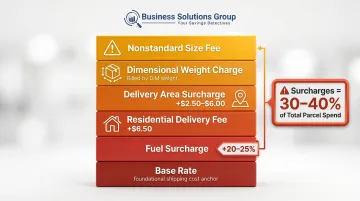
- Base rates — the published rate for the service level and zone
- Fuel surcharges — adjusted quarterly, currently adding 20–25% on top per label
- Residential delivery fees — UPS charges $6.50 per package; FedEx $6.45
- Delivery area surcharges (DAS) — $2.50–$6.00 per package for rural destinations
- Dimensional weight charges — triggered when package volume exceeds actual weight billing
- Nonstandard size fees — USPS charges $4.50–$21.00 for packages exceeding size thresholds
The compounding effect is what catches most businesses off guard. A company shipping at retail rates, using oversized boxes, and defaulting to a single carrier isn't making one bad decision — it's stacking four or five of them simultaneously. Each layer adds cost that stays invisible until someone actually audits the invoices.
Most businesses never run that audit. Shipping gets treated as a fixed operational line item — predictable, unchangeable, not worth scrutinizing. In practice, the surcharges alone can push actual per-package costs 30–40% above the base rate. That's the gap the following strategies are designed to close.
Key Cost Drivers That Make Shipping Expensive
Actual Weight vs. Dimensional Weight
Carriers charge based on whichever is greater: the actual package weight or the dimensional (DIM) weight, calculated as:
DIM weight = (Length × Width × Height) ÷ DIM divisor
| Carrier | DIM Divisor | When Applied |
|---|---|---|
| UPS | 139 | All domestic packages |
| FedEx | 139 | All domestic packages |
| USPS | 166 | Packages over 1 cubic foot only |
A real example: ship a 5 lb item in a 20×15×10 inch box via UPS, and you're billed at 22 lbs — not 5. That's a $30–$50 swing on a single label, just from box choice.
USPS's higher divisor (166 vs. 139) and its 1 cubic foot threshold mean it's often more forgiving on bulky, lightweight items — a real advantage for products like pillows, foam packaging, or large-but-light retail goods.
Carrier Defaults and Service Mismatches
DIM weight is just one piece of the cost puzzle. The carrier you're using — and whether it's the right one for each shipment — is often where even more money leaks out. Most small businesses pick one carrier and stick with it out of habit, and that single default usually drives the largest share of avoidable shipping costs. The right carrier changes based on:
- Package weight and dimensions
- Destination zone
- Required delivery speed
- Whether the recipient address is residential or commercial
A shipment that's cheapest via USPS on Monday might be better routed through UPS Ground on Friday. The savings come from treating each shipment as its own decision, not a habit.
4 Ways to Reduce Shipping Costs for Small Business
Shipping costs don't come from one place — they come from several. Each strategy below targets a different source of excess spend. Applied together, they produce results that individually they can't.
Way 1: Negotiate or Access Discounted Carrier Rates
Retail counter rates are the starting point for consumers, not businesses. Commercial pricing, business accounts, and aggregated discount programs offer substantially lower rates for identical services.
Three routes to discounted rates:
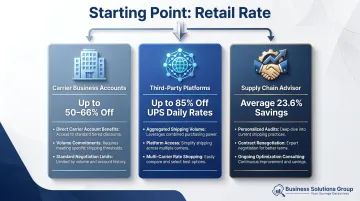
Open free carrier business accounts directly. UPS offers up to 50% off Ground and 66% off Air services through free, commitment-free enrollment. FedEx offers comparable programs through its small business account structure.
Use third-party shipping platforms. Platforms like Pirateship and Shippo pool volume across thousands of businesses to negotiate rates no individual small shipper could reach alone. Pirateship advertises up to 85% off UPS Daily Rates with no monthly fees. Shippo's customers saved $216 million on USPS rates in 2024 alone.
Work with a supply chain advisor. Business Solutions Group's carrier contract benchmarking and negotiation services help businesses identify exactly where their current contracts fall short of market rates — and then negotiate directly on their behalf. The process starts with a no-cost benchmark analysis of 6–12 months of shipment data. Their team — which includes former senior-level pricing analysts from UPS and FedEx — averages 23.6% savings for small parcel clients, with a typical range of 15–40%.
Rate negotiations aren't a one-time event. Carriers issue annual rate increases, rotate incentive programs, and introduce new surcharge structures on a regular cycle. Business Solutions Group recommends re-benchmarking every 18 months or whenever shipping volume changes materially.
Way 2: Optimize Packaging to Reduce Dimensional Weight Charges
Packaging is a direct cost driver. Every inch of unused space in a box is a potential DIM weight overcharge waiting to appear on your invoice.
Practical packaging changes that reduce cost immediately:
- Right-size your box selection. Standardize 3–5 box sizes matched to your most common SKU dimensions. Right-sizing packaging can reduce annual shipping costs by 15–20%, according to AnchorBox's 2025 e-commerce packaging analysis.
- Switch to poly mailers for non-fragile items. Soft goods, apparel, and similar products ship far cheaper in poly mailers than boxes — no DIM weight calculation applies.
- Eliminate unnecessary void fill. Excess dunnage adds both dimensional bulk and package weight.
- Stay under key weight thresholds. USPS Ground Advantage has tiered pricing at 4 oz, 8 oz, 12 oz, and 15.999 oz. Keeping packages under those thresholds can drop you into a cheaper pricing tier.
When USPS flat-rate packaging makes sense:
USPS Priority Mail flat-rate boxes hold up to 70 lbs at a fixed commercial price (starting around $12.10 for a small flat-rate box), regardless of destination zone. Flat rate is the right choice when your package is heavy enough that standard Priority Mail pricing would exceed the flat-rate price — typically heavier items heading to distant zones. For lightweight packages under a pound, standard Ground Advantage is almost always cheaper.
Way 3: Compare Rates Across Carriers for Every Shipment
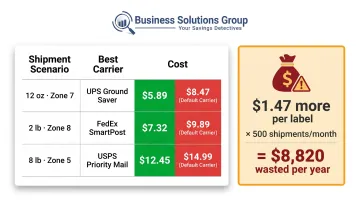
No carrier is cheapest for all shipments. The best option shifts based on weight, zone, and speed — and Shippo's 2026 carrier comparison makes that clear:
| Scenario | Cheapest Option | Cost |
|---|---|---|
| 12 oz, Zone 7 (ground) | USPS Ground Advantage | $5.89 |
| 2 lb, Zone 8 (ground) | UPS Ground Saver | $9.44 |
| 8 lb, Zone 5 (3-day) | USPS Priority Mail | $10.85 |
A business defaulting to UPS for that 12 oz Zone 7 package pays $7.36 — $1.47 more per label. At 500 shipments per month, that's $8,820 per year from one avoidable default.
How to automate rate comparison:
Multi-carrier shipping platforms like ShipStation, Shippo, and EasyPost compare rates across carriers at the moment of label creation. You can also set automation rules — "any order under 1 lb ships USPS Ground Advantage" — that eliminate manual decisions while locking in optimal routing.
Rate comparison also applies within a single carrier's service lineup. Choosing between USPS Ground Advantage and Priority Mail for the same package, or between UPS Ground and Ground Saver, can produce meaningful savings per label.
Those intra-carrier comparisons also expose a reliability gap. Shippo tracked 153 carrier outages in 2024 — and businesses locked into a single carrier have no fallback when that carrier goes down.
Way 4: Align Shipping Structure with Business Context
Individual label prices matter — but the structural decisions surrounding those labels often matter more.
Key structural levers to adjust:
Set a free shipping threshold strategically. Calculate the order value at which your margins can absorb carrier cost, then set your threshold just above it. Done correctly, this increases average order value while making shipping economics sustainable — rather than offering free shipping that quietly erodes margin.
Consolidate shipments. Shipping two items in one box instead of two separate packages eliminates one label, one residential surcharge, and one fuel surcharge. For businesses with repeat customers or subscription components, consolidation policies compound quickly.
Reduce zone-based costs through fulfillment placement. Every zone increment adds cost. If a significant portion of your customers are in a specific region and you're fulfilling from the opposite coast, the zone cost penalty accumulates across every order. Evaluating whether a secondary fulfillment point — or a 3PL with distributed inventory — makes economic sense is worth the analysis.
For businesses with meaningful shipping volume, the most reliable way to find structural savings is a formal spend analysis. Business Solutions Group's Parcel Spend Intelligence (PSI) platform manages over $3 billion in parcel spend and produces more than 25 actionable insights per engagement — including surcharge pattern identification and cost versus projected spend comparisons.
Proactive alerts flag when per-shipment costs drift above expected ranges, surfacing cost sources that standard carrier reporting never shows. Clients have achieved over $350 million in annual savings through the platform.
Conclusion
Shipping costs are controllable — but only if you know where to look. Rates, packaging decisions, carrier defaults, and structural choices each contribute to what you pay, and each can be addressed directly without sacrificing speed or reliability.
Businesses that consistently control shipping costs share one trait: they treat it as an active cost center, not a fixed expense. Carrier rates change annually — major carriers like UPS and FedEx publish General Rate Increases (GRIs) every January. Shipping volumes shift. The companies that audit regularly, re-benchmark contracts, and match the right carrier to each shipment will consistently outperform those that set their shipping process once and never revisit it.
Frequently Asked Questions
How do you reduce shipping costs for businesses?
Four levers move the needle most reliably:
- Negotiate or access discounted carrier rates through business accounts or advisory services
- Right-size packaging to eliminate dimensional weight overcharges
- Compare rates across carriers for every shipment rather than defaulting to one
- Align your shipping structure with your actual order patterns (thresholds, fulfillment points, consolidation policies)
What is the average shipping cost for a small business?
The Pitney Bowes Parcel Shipping Index reports an average of $9.09 per parcel across the US market in 2024, but this includes large shippers with negotiated rates. Small businesses on retail or unoptimized commercial pricing typically pay more, so treat it as a floor, not a target.
How much should I charge for shipping for my small business?
Three models are common: pass-through (charge actual carrier cost), free shipping above a threshold (absorbed into margins), or a flat rate regardless of order specifics. The right choice depends on your average order value, product margins, and customer expectations.
Do small businesses get shipping discounts?
Yes. Commercial pricing through carrier business accounts, third-party platforms that pool volume across thousands of shippers, and supply chain advisors who benchmark and negotiate contracts all provide access to rates below retail. Most small businesses paying retail rates simply haven't explored these options yet.
What's the cheapest way to ship something quickly?
For fast domestic shipping, USPS Priority Mail (1–3 days) is often competitive for lighter packages, while UPS and FedEx express options suit heavier time-sensitive parcels. The most reliable approach is running a rate comparison across carriers before purchasing each label — the cheapest option shifts based on weight, destination zone, and required delivery window.