Introduction
U.S. business logistics costs hit $2.6 trillion in 2024, equivalent to 8.7% of GDP according to CSCMP's State of Logistics Report. For individual businesses, that translates directly into compressed margins and eroding profitability, especially for small parcel and freight shippers competing on both price and speed.
The problem isn't that shipping is inherently uncontrollable. Most excessive shipping costs trace back to specific, fixable decisions: packaging choices made without considering dimensional weight, carrier contracts accepted without benchmarking, invoices approved without scrutiny. Unapproved rate increases and billing errors left unchecked do far more damage than market conditions alone.
That's exactly what this guide addresses. The 10 strategies ahead are organized around three areas: pre-shipment decisions, day-to-day execution, and the operational environment supporting your logistics. Whether you ship 500 packages a month or 50,000, there are concrete savings available in each.
Key Takeaways
- Carrier selection, packaging, and order policies drive costs before a package ever ships
- Dimensional weight, shipping zones, accessorial fees, and return rates are the top avoidable cost drivers
- Billing errors alone cost shippers 3–5% of total freight spend, and 9 in 10 businesses overpay on carrier contracts
- Savings come from upstream decisions, active management, and structural logistics changes — often all three at once
- Applied consistently, these 10 strategies can meaningfully reduce freight spend regardless of your shipping volume
How Shipping Costs Build Up
Shipping costs rarely appear as one large line item. They accumulate through per-shipment charges, annual carrier rate increases, seasonal surcharges, and billing errors that stack up month over month.
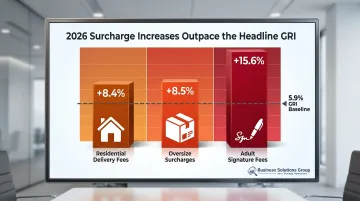
FedEx and UPS have announced a 5.9% General Rate Increase (GRI) for 2026 — the third consecutive year at that headline figure. But the actual effective increase for most shippers runs higher. Surcharge-specific hikes fall outside the GRI average:
- Residential delivery fees rose 8.4%
- Oversize surcharges jumped 8.5%
- Adult signature fees increased 15.6%
Cost build-up isn't always gradual, either. A spike in return volume, a shift in customer geography, or scaling order volumes that outpace negotiated rate tiers can all trigger sudden cost pressure.
Without formal invoice review or spend visibility, most businesses only discover how much they're overpaying once margin pressure forces the conversation — by which point, overcharges may have run unchallenged for a year or more.
Key Cost Drivers
Shipping cost drivers fall into three categories:
- Measurement and rating: Dimensional weight pricing, zone classification, and package characteristics determine the base rate on every shipment
- Carrier selection and contracting: Single-carrier dependency and unchallenged published rates lock in avoidable overpayment
- Operational structure: Warehouse location, return rates, and average order value all influence what you pay per shipment
Accessorial fees are where budgets quietly bleed. Residential delivery fees, fuel surcharges, address correction charges, and oversize fees typically account for 20–35% of total parcel spend — reaching 40% during peak season — yet they're among the least-monitored cost categories. Ground fuel surcharges typically run 8–10% of base rate, while Express surcharges can hit 14–18%.
That exposure isn't uniform across all shippers, though. Small parcel operations are hit hardest by dimensional weight pricing and zone sprawl. Freight shippers, by contrast, face greater exposure to fuel surcharges, LTL inefficiencies, and unfavorable contract terms.
10 Cost-Reduction Strategies
Effective shipping cost reduction requires matching the right strategy to the right driver. These 10 strategies are organized by where in the shipping lifecycle they create the most leverage.
Strategies That Reduce Costs by Changing Decisions
These approaches cut cost through better choices made before a shipment is ever created.
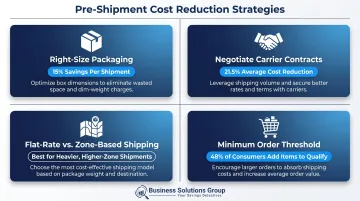
Strategy 1 — Right-Size Packaging to Eliminate Dimensional Weight Penalties. Carriers charge based on whichever is greater: actual weight or dimensional weight (calculated using a DIM divisor of 139 for FedEx and UPS, 166 for USPS). The average shipping box contains 40% empty space, meaning most businesses are literally paying to ship air. One documented example from STACI Americas shows a box right-sized from 18x14x6 to 14x10x4 inches reduced DIM weight from 11 lbs to 5 lbs — a 15% savings per shipment. Conducting a packaging audit across your top SKUs is low-cost and produces immediate results.
Strategy 2 — Negotiate Carrier Contracts Using Benchmark Data. Most businesses accept published carrier rates without challenge. Shipware reports 9 out of 10 shippers overpay by 20–30% because carriers hold a data advantage on zones, weights, and accessorial patterns. Professional contract optimization yields an average 21.5% cost reduction, with high-volume shippers reaching up to 30%. Carrier contracts contain more than 250 negotiable terms beyond base rates, including DIM divisors, fuel surcharge caps, and accessorial fee waivers. Business Solutions Group's benchmark analysis identifies where current spend diverges from market rates before any negotiation begins, typically surfacing 15–40% in savings opportunities at no cost.
Strategy 3 — Use Flat-Rate and Zone-Based Shipping Strategically. Flat-rate options like USPS Priority Mail Flat Rate and FedEx One Rate work best for heavier items shipped to higher zones, where zone-based pricing escalates significantly. For lightweight or short-zone shipments, standard zone-based pricing usually wins. Neither approach alone is sufficient — the combination eliminates avoidable overpayment on both ends of the shipping profile.
Strategy 4 — Set a Minimum Order Threshold for Free Shipping. Absorbing shipping costs unconditionally on every order erodes margin. A well-calibrated free shipping threshold, typically set 10–15% above your current median order value, offsets per-shipment cost while incentivizing larger carts. 48% of consumers add items specifically to qualify for free shipping, and thresholds increase average order value by 10–30%. The average threshold across ecommerce is $64, though the right number depends on your category and per-shipment cost.
Strategies That Reduce Costs by Changing How Shipping Is Managed
These approaches reduce cost through better control, visibility, and consistency while shipping operations are running.
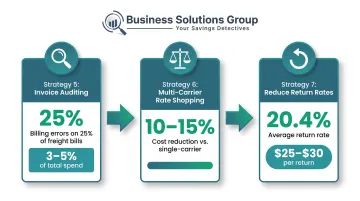
Strategy 5 — Audit Carrier Invoices and Track Accessorial Fees. Billing errors appear on up to 25% of all freight bills, costing shippers 3–5% of total annual freight spend. On a $10M shipping budget, that's up to $500,000 left on the table. Common errors include duplicate billings, incorrect DIM weight application, late delivery credits not applied, and misapplied accessorials. The dispute window is typically 30 days, so real-time detection matters. Business Solutions Group's Parcel Spend Intelligence (PSI) platform automates this process across more than $3 billion in managed parcel spend. It flags billing anomalies and surcharge inaccuracies, generates alerts when costs exceed expected thresholds, and returns 100% of recovered credits directly to clients.
Strategy 6 — Implement Multi-Carrier Rate Shopping at the Order Level. Relying on a single carrier for all shipments removes the competitive pressure that keeps pricing in check and exposes the business to that carrier's full surcharge structure with no fallback. Multi-carrier rate shopping delivers a 10–15% reduction in shipping costs versus single-carrier baselines, with case studies showing up to 30% savings when regional carrier advantages are applied. Business Solutions Group's TMS Rate Shopping Tool supports real-time rate comparison across UPS, FedEx, USPS, LTL, and FTL, with setup available at minimal to no cost for businesses spending $500,000 or less annually on parcel and freight.
Strategy 7 — Reduce Return Rates Through Better Product Presentation and Packout Practices. Returns are a double cost: the business absorbs both outbound and return shipping. The average U.S. ecommerce return rate hit 20.4% in 2024, and each return costs $25–$30 when accounting for shipping, processing, and customer service. Apparel return rates run 30–40%. Reducing returns through accurate product descriptions, high-quality imagery, and careful packout practices directly cuts shipping spend — and improves customer satisfaction as a side effect.
Strategies That Reduce Costs by Changing the Context Around Shipping
These approaches address the structural environment in which shipping occurs.
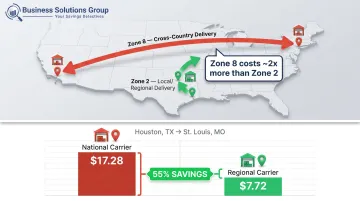
Strategy 8 — Optimize Fulfillment Center Location to Reduce Zone Distance. Shipping zones are the most predictable cost driver in domestic parcel shipping. Shipping to Zone 8 (cross-country) can cost roughly twice as much as Zone 2 (local) for the same package weight. Positioning inventory closer to your highest-density customer markets reduces both cost and transit time. Strategic warehouse placement can cut shipping costs by 15–25% through zone reduction alone. Businesses without the volume to justify multiple locations can access this benefit through 3PL partners with distributed warehouse networks.
Strategy 9 — Partner with 3PL or 4PL Providers to Access Volume Discounts and Network Scale. 3PLs aggregate volume across multiple clients, unlocking carrier discounts that individual businesses cannot negotiate independently. 3PL partnerships deliver overall logistics cost savings of 15–30%. Beyond pricing, outsourcing fulfillment reduces labor costs and warehousing overhead, which is particularly valuable for businesses in growth mode. Business Solutions Group's 4PL managed logistics model covers carrier selection, TMS integration, shipment execution, invoice audit, and claims management, with carrier agreements negotiated directly in the client's name for full transparency.
Strategy 10 — Use Hybrid Shipping Services and Regional Carriers for Last-Mile Delivery. Major carriers aren't always the most cost-effective for last-mile. Hybrid services like FedEx Ground Economy use national carrier infrastructure for linehaul with USPS handling final delivery on non-urgent residential shipments. Regional carriers go further: they can save 10–40% compared to national carriers on specific lanes. One documented example: shipping a 10-lb package from Houston to St. Louis costs $17.28 with a national carrier versus $7.72 through a regional network, a 55% savings on that lane. Regional carriers are most effective for businesses with concentrated geographic markets.
Conclusion
Shipping costs aren't fixed. They reflect decisions made across the entire shipping lifecycle — from packaging choices and carrier contracts to warehouse placement and returns management. Cutting them requires identifying where cost originates, not applying blanket reductions.
Businesses that build ongoing audit processes, use benchmark intelligence before contract negotiations, and revisit their operational structure regularly turn shipping from a recurring margin drain into a measurable profit lever. Start with invoice auditing and packaging optimization — both deliver measurable results quickly and with minimal complexity. The cost and volume data they surface then positions you to negotiate stronger carrier contracts and benchmark rates with real leverage behind the ask.
Frequently Asked Questions
Frequently Asked Questions
What are the most effective shipping cost reduction strategies?
The most impactful approach combines pre-shipment decisions (packaging, carrier contracts, order thresholds) with active management practices (invoice audits, multi-carrier rate shopping) and structural changes (warehouse location, 3PL partnerships). Sustained savings come from the compounding effect across all three levers, not any single tactic.
How do you identify and implement cost-saving measures in logistics?
Start with a shipping spend audit covering carrier invoices, accessorial fees, zone distribution, and return rates — then benchmark against market rates to identify the largest gaps. Prioritize strategies by ROI and switching cost; packaging optimization and invoice auditing typically deliver results fastest.
What is the cheapest shipping method for a small business?
The optimal carrier depends on package weight, dimensions, destination zone, and delivery speed. USPS is often the lowest-cost option for parcels under one pound; hybrid services like FedEx Ground Economy or UPS SurePost reduce costs on non-urgent residential deliveries across longer zones.
Do small businesses qualify for shipping discounts?
Yes. Small businesses can access discounted rates through direct carrier negotiations, multi-carrier platforms that pool volume across shippers, 3PL partnerships that pass through pre-negotiated rates, or USPS commercial pricing available via approved platforms regardless of size.
Can a small business write off shipping costs?
Shipping costs are generally tax-deductible as an ordinary business expense, typically reported on Schedule C under Line 18 (office expenses) or Line 27a (other expenses). Consult a tax professional to confirm proper categorization for your situation.
Which location strategy is best for minimizing shipping costs?
Place fulfillment inventory as close as possible to your highest customer concentration, using carrier zone maps to identify optimal warehouse locations. Businesses with widely distributed customers typically benefit from multi-node fulfillment through owned facilities or a 3PL network.