That quiet inattention is expensive. Worldwide telecom services spending reached $1.51 trillion in 2024, according to IDC — and a meaningful portion of that spend is wasted on billing errors, inactive services, and contracts that auto-renewed at rates no one negotiated.
Telecom Expense Management (TEM) exists to fix that. This article defines what TEM actually is, explains where unmanaged telecom spend leaks money, and outlines what a well-structured TEM program looks like in practice — whether you're evaluating a standalone solution or considering how telecom oversight fits into a broader cost management strategy.
Key Takeaways
- TEM centralizes tracking, auditing, and optimization of all telecom-related expenses (mobile, voice, data, and internet) into one systematic process.
- Telecom invoices are error-prone — Gartner estimates up to 20% contain billing mistakes, per the UK Crown Commercial Service.
- TEM delivers visibility, operational efficiency, and contract leverage — not just one-time cost cuts.
- Any business managing multiple carriers or locations can benefit from TEM — not only large enterprises.
What Is Telecom Expense Management (TEM)?
TEM is a strategic discipline that combines technology, process, and expertise to centralize how an organization manages its telecommunications spend. That includes mobile plans, internet services, voice networks, and cloud-based communications — essentially anything billed by a carrier or telecom provider.
The ETMA defines TEM programs as programs created to "proactively reduce expenses, introduce efficiencies, increase visibility, and provide better control for IT and telecom services." In practice, that maps to ten discrete functional areas:
- Inventory management and sourcing
- Procurement and invoice management
- Expense validation and usage management
- Bill payment and reporting
- Business intelligence and enterprise mobility management
Unlike a one-time audit, TEM is an ongoing management framework — one that surfaces problems continuously rather than discovering them months after the fact.
TEM vs. Technology Expense Management
The terms are often used interchangeably, but the distinction still matters when evaluating solutions.
- Telecom Expense Management focuses on carrier services — mobile plans, wireline voice, data circuits, and internet connectivity.
- Technology Expense Management extends further, covering cloud subscriptions, SaaS licenses, hardware, and broader IT infrastructure.
ETMA itself rebranded from the Telecom Expense Management Industry Association to the Enterprise Technology Management Association in 2018, reflecting how thoroughly the two disciplines have converged. For organizations with heavy carrier and mobile complexity, dedicated TEM depth remains valuable. Those managing significant cloud and SaaS spend alongside telecom may benefit from a broader technology expense management approach.
From Bill Auditing to Intelligent Management
TEM's origins trace to manual bill auditing that emerged after the AT&T divestiture in 1984, when telecom deregulation suddenly gave businesses multiple carrier relationships to manage. Automated software platforms followed in the 1990s and 2000s. Today, AOTMP notes the industry is moving toward AI-driven TEM with flexible modular platforms and strategic advisory partnerships — a significant evolution from reviewing paper invoices line by line.
Why Unmanaged Telecom Spend Costs More Than You Think
The scale of the problem starts with the numbers. The global enterprise telecom services market was estimated at $724.52 billion in 2022 and is projected to reach nearly $1.2 trillion by 2030. For any individual business, telecom represents a substantial, recurring cost — and one that rarely gets the scrutiny it deserves.
Where the Money Leaks
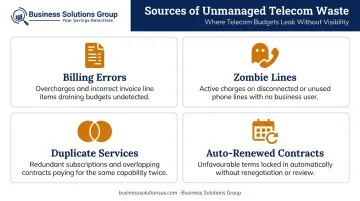
Without TEM, several categories of waste accumulate invisibly:
- Billing errors — complex invoices contain mistakes that go uncontested simply because no one reviews them against contracted rates.
- Zombie lines — disconnected services that keep generating charges because the cancellation was never confirmed or reflected in billing.
- Duplicate services — the same connectivity or voice service provisioned at multiple locations without anyone noticing the overlap.
- Auto-renewed contracts — agreements that roll over at outdated rates because no one tracked the renewal date or had grounds to renegotiate.
The Crown Commercial Service white paper lists these patterns explicitly as common telecom invoice error categories, including "unprocessed disconnected services" and "zero-use devices" — both of which drain budget predictably.
The Visibility Problem
Without centralized tracking, finance and IT teams often can't answer basic operational questions: How many circuits does the company have? Which locations are overspending? Are contracted rates actually appearing on invoices?
That visibility gap makes everything harder. Budgets get built on assumptions, audits require manual reconstruction, and decisions about consolidating or expanding services rest on incomplete data.
Why Complexity Makes It Worse
What works at modest scale breaks down quickly as organizations grow. Three carriers across two locations can be tracked in a spreadsheet. Ten carriers across fifty locations — each with distinct contracts, rate schedules, and usage patterns — cannot. Add remote workers, mobile device fleets, and cloud communications, and the exposure compounds fast.
At that scale, unmanaged telecom spend isn't just a line item problem — it's a structural one. Business Solutions Group applies the same spend intelligence and benchmark analysis it uses across supply chain and logistics to telecom costs, giving organizations the visibility to treat telecom as a managed investment rather than a recurring unknown.
Core Components of a TEM Program
A well-designed TEM program covers five interconnected functions. Each one builds on the others, and a gap in any single area constrains what the program can deliver overall.
Inventory and Asset Management
Effective TEM starts with a complete, living inventory of every telecom asset — circuits, phone lines, mobile devices, data connections — mapped to locations and contracts. Without this foundation, invoice validation is unreliable and usage analysis is impossible. You can't optimize what you haven't catalogued.
Invoice Processing and Validation
This is where most programs find immediate, measurable savings. TEM automates invoice capture, review, and approval — checking each charge against contracted rates and active services before payment is released. Overbilling, duplicate charges, and rate discrepancies get caught before they clear accounts payable, not months later during a manual reconciliation.
Usage Monitoring and Right-Sizing
TEM tracks actual usage patterns against what's being paid for. The gaps that surface are consistent across organizations:
- Eliminate plans with zero or near-zero usage
- Downsize over-provisioned data services
- Realign mobile plans with actual consumption patterns
- Remove services that no longer match current operational needs
Right-sizing is distinct from cost-cutting — it's about ensuring spend reflects reality rather than legacy assumptions made during a procurement cycle two or three years ago.
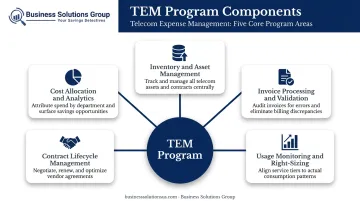
Contract Lifecycle Management
TEM maintains visibility into contract terms, renewal dates, and negotiated discounts across all carriers. Two outcomes follow directly: auto-renewals at unfavorable rates get caught before they lock in, and carrier negotiations shift in your favor. Accurate consumption data and contract benchmarks give you a specific, defensible position — one that typically yields better rates and terms than negotiating from memory or outdated estimates.
Cost Allocation, Reporting, and Analytics
Gartner describes TEM services as supporting "effective commercial management of technology services through robust cost optimization, asset inventory, and workflow automation."
The reporting layer converts raw invoice data into business intelligence. Cost allocation by location, department, or cost center gives leadership the granular data needed for accurate budgeting, chargeback, and strategic decisions.
Warning Signs Your Business Is Ready for TEM
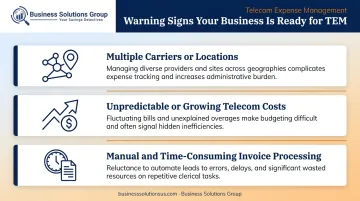
Not every organization needs a full TEM program immediately, but several patterns indicate that passive management is already costing money.
You manage multiple carriers, contracts, or locations. If your team reconciles invoices from several providers across multiple sites using spreadsheets or manual processes, billing discrepancies and missed savings are already accumulating.
Telecom costs are unpredictable or growing without explanation. Budget overruns, surprise charges, and an inability to forecast next quarter's telecom spend reliably are symptoms of uncontrolled spend — not isolated billing errors.
Invoice processing is manual and time-consuming. When staff spend significant time each month entering telecom data, chasing approvals, or reconciling discrepancies, the labor cost alone often justifies TEM. Errors in data entry also delay dispute resolution and obscure your true cost picture.
How to Choose a TEM Partner That Delivers Real Results
The TEM market includes a range of platforms and managed service providers. Choosing well requires evaluating more than software features.
Look Beyond the Platform
A TEM tool without experienced analysts and defined workflows delivers limited value. The technology handles volume and automation; human expertise handles disputes, contract interpretation, carrier negotiations, and the judgment calls that software can't make.
AOTMP's 2025 industry analysis identified "post-sale service-quality decline" and "low confidence in asset/service inventory accuracy" as the leading frustrations among TEM buyers — both of which reflect gaps in expertise and process, not technology.
Evaluate Reporting and Integration Depth
The right partner connects TEM data with existing ERP, finance, or procurement systems and delivers reporting at a level of granularity that supports chargeback, budgeting, and executive decision-making. High-level dashboards that show total spend by carrier don't enable the departmental cost allocation or contract compliance analysis that makes TEM genuinely useful.
That gap is where advisory depth matters most. Business Solutions Group's spend intelligence approach — applied across supply chain, logistics, and telecom — goes further: benchmark analysis against market rates, identification of billing discrepancies, and actionable recommendations rather than generic summaries.
Ask the Right Questions Before Committing
Before selecting a TEM partner, get clear answers to these:
- How have you delivered measurable savings for organizations similar to ours in size and complexity?
- How do you handle carrier disputes and credit recovery, and what is the typical timeline?
- How transparent are your fees, and how are savings calculated and reported?
- Can your platform integrate with our existing finance or ERP systems?
- What does ongoing account management look like after initial implementation?
Hold any advisory partner to full transparency on process, pricing, and results — and a demonstrated track record, not just projected savings estimates.
Frequently Asked Questions
What is a telecom expense management platform?
A TEM platform is software that centralizes invoice management, asset inventory, usage tracking, contract data, and reporting in one system. It automates oversight across all telecom spend, enabling businesses to catch billing errors, track usage, and manage contracts without relying on manual spreadsheet reconciliation.
How much do telecom expense managers charge?
Pricing varies by model — common structures include a percentage of aggregate spend, gain-share on recovered savings, flat fees, or managed service retainers. Fees depend on environment complexity and scope. Most programs are structured so that net savings exceed program costs.
What is MMS in the context of TEM?
In TEM and enterprise IT, MMS stands for Managed Mobility Services. It covers the full lifecycle of mobile devices — procurement, provisioning, activation, support, and decommissioning. MMS is frequently paired with TEM to provide full oversight of both mobile costs and device management.
What is the difference between TEM and technology expense management?
TEM focuses on carrier services — mobile plans, voice, data circuits, and internet connectivity. Technology expense management extends to cloud subscriptions, SaaS, hardware, and broader IT spend. The two terms are increasingly used interchangeably as telecom and IT infrastructure converge.
How quickly can businesses see savings from TEM?
Many organizations identify quick wins within the first few billing cycles — primarily through billing error corrections and disconnection of unused services. Deeper savings from contract renegotiation and systematic right-sizing typically compound over the following months as the program matures.
Do smaller businesses benefit from TEM?
Yes, though large multi-location enterprises see the most dramatic savings. Any business managing multiple carriers, growing mobile fleets, or unpredictable telecom costs can benefit. Smaller organizations often discover billing errors and unused services the first time they audit their spend — savings that had gone unnoticed for years.