What makes this particularly costly: return shipping consistently runs higher per package than outbound shipping. Residential pickup fees, unpredictable packaging, and the absence of volume consolidation all compound the base rate. Worse, most of that excess cost isn't inherent to returns — it's the result of routing defaults that were never designed for the return journey.
This article examines smart routing as the primary lever for reducing return shipping costs: where cost builds up, what drives it, and which specific strategies eliminate it.
Key Takeaways
- Return costs accumulate through compounding routing defaults: mismatched carriers, wrong destinations, and flawed disposition paths
- Carrier selection inertia (applying outbound carriers to all returns) is the single largest controllable cost driver
- Disposition-based routing — directing items to refurbishment, liquidation, or restock at label generation — cuts redundant transportation legs
- Return eligibility thresholds and keep-it resolutions can remove routing costs entirely for low-value items
- Carrier contract renegotiation focused specifically on return rates is underused but high-impact
How Return Shipping Costs Build Up
Return shipping costs don't arrive as one consolidated charge. They accumulate through a sequence of individually small decisions: label generation, carrier assignment, destination selection, and secondary routing after inspection. By the time a returned item is fully processed, transportation costs alone can represent roughly 30% of the product's original value, according to CBRE research.
A single suboptimal routing decision barely registers. Across thousands of returns per month, that same default compounds into a measurable margin issue.
Most businesses don't catch this early because return shipping spend is rarely isolated as its own cost category. Outbound shipping shows up clearly on carrier invoices. Return shipping gets buried in operational overhead — the expense accumulates quietly until a financial review or a tightening margin finally forces the question.
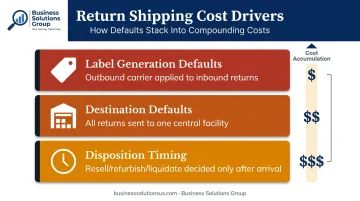
Three compounding factors make this worse:
- Label generation defaults — return labels often mirror outbound carrier agreements, regardless of whether that carrier is cost-effective for inbound residential pickups
- Destination defaults — all returns routed to one central facility regardless of item type, origin, or what will ultimately happen to the item
- Disposition timing — decisions about resell, refurbish, or liquidate happen after the item arrives, meaning routing decisions were made without that information
Key Cost Drivers for Return Shipping
Carrier Selection Inertia
The most common return shipping cost driver is also the most invisible: using the same carrier for returns that you use for outbound. Return shipments have fundamentally different characteristics — residential pickup, unpredictable timing, variable packaging — that make them a poor match for contracts structured around outbound volume economics.
UPS, for example, stacks multiple surcharges onto return shipments that outbound contracts weren't built for:
- Residential Surcharge on any home address pickup
- Additional Handling fees for non-standard packaging
- Separate charges per pickup attempt
These fees accumulate on top of base rates negotiated for a completely different shipment profile. Regional and hybrid carriers often price short-haul return lanes more competitively — but most businesses never compare them because the outbound carrier is simply the default.
Destination Routing Inefficiency
Routing every return to one central fulfillment center creates two problems: longer average transit distances (and higher zone counts) and secondary transportation moves after items are received and sorted.
An item returned from a customer in Dallas doesn't need to travel to a central warehouse in New Jersey before anyone decides what to do with it. But without routing logic that accounts for geography and disposition intent, that's exactly what happens. The item travels past qualified regional facilities on its way to the default destination.
Disconnected Disposition Decisions
According to Gartner, returns processing is highly manual and time-consuming for most organizations. The core problem: most teams make disposition decisions — resell, refurbish, liquidate, discard — only after a return arrives, which means no upstream routing logic could account for them.
This disconnect creates redundant transportation. An item that should go directly to a refurbishment center instead travels to a central warehouse first, gets assessed, and then ships again. That's a second transportation leg that serves no operational purpose and adds direct cost.
Smart Routing Strategies to Reduce Return Shipping Costs
Smart routing addresses cost at three distinct points: the decisions made when a return is initiated, how routing is managed while returns are in motion, and the network and contract context within which all routing operates.
Strategies That Change Routing Decisions at Initiation
These are the highest-leverage decisions because they lock in a cost trajectory before the package enters the carrier network.
Disposition-Based Routing at Label Generation
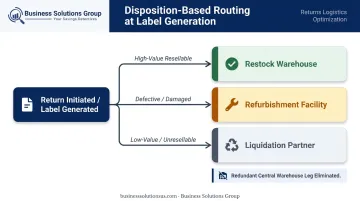
Rather than defaulting every return to the original fulfillment center, assign the destination based on what will happen to the item:
- High-value resellable items → nearest restock-capable warehouse
- Defective or damaged items → directly to a refurbishment facility
- Low-value or unresellable items → liquidation or disposal partner
Eliminating the central-warehouse-first step removes one or more transportation legs per return — and those legs add up across volume.
Carrier Selection at the Shipment Level
At label generation, select the return carrier based on the package's weight class, origin ZIP, and destination — not by automatic assignment to the outbound carrier. National carriers are often not the most cost-effective option for zone-1 and zone-2 return shipments. Regional carriers frequently offer lower rates and comparable transit times within their geographic footprint.
Return Eligibility Thresholds
Not every item warrants a physical return. According to Reuters, 59% of U.S. retailers now offer returnless or keep-it policies — issuing refunds without requiring the item back when the cost to return and process it exceeds the item's recovery value. For low-value items, this eliminates the routing cost entirely.
Conditional Label Issuance
Pre-including return labels in every outbound shipment generates label costs for returns that will never happen. Shifting to on-demand digital labels — issued only when a customer initiates a return — eliminates that waste. USPS charges $1.65 per physical label for its Label Delivery Service; multiplied across shipment volume, unused labels represent real spend.
Strategies That Change How Return Routing Is Managed
Once a return is initiated, these strategies control how — and where — it moves through the network.
Automated Destination Assignment
Automate routing at the point of return initiation so each item is pre-routed to the nearest qualified facility — not just the nearest warehouse. Routing rules that factor in facility type, current capacity, and geographic proximity reduce average transit distance and zone count per shipment without requiring manual intervention on each return.
Return Reason Data as Pre-Routing Input
When customers identify the reason for a return, that information should trigger routing logic before the package ships. A customer flagging a defect routes to a refurbishment center. A sizing issue routes to a restock facility. This eliminates post-receipt routing decisions and the secondary transportation moves they generate.
Invoice Monitoring and Billing Error Tracking
Carrier invoices for return shipments should be audited, not trusted by default. Surcharge inflation, misapplied service levels, and accessorial errors are common across parcel invoicing.
Tracking return shipping costs by carrier, lane, and destination reveals which routing paths are generating excess cost — and where substitution or renegotiation would have the most impact. Without active invoice review, cost problems accumulate undetected.
Zone-Reduction Through Regional Consolidation
Instead of routing individual returns from geographic clusters as independent national-carrier shipments to a central hub, group them by region and route to a regional destination. Zone count is a direct cost multiplier. Reducing average zones per return shipment cuts cost per unit without any carrier renegotiation required.
Strategies That Change the Context Around Return Routing
The routing decisions above only perform as well as the network and contracts surrounding them. These structural strategies set the ceiling on what's achievable.
Return-Specific Carrier Contract Terms
Most carrier contracts are structured around outbound shipment economics. Return shipments — particularly residential ground pickups — often fall under unfavorable default rates because they were never explicitly negotiated.
Renegotiating to include return-specific rate structures is a low-visibility but high-value lever. Key terms worth targeting in any renegotiation include:
- Residential pickup rates for inbound return shipments
- Zone-based pricing for short-haul return lanes
- Volume thresholds tied specifically to return shipment counts
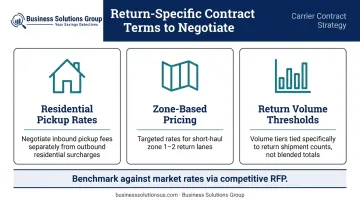
Any business running significant return volume should negotiate these terms separately from outbound rates. Benchmarking against market rates — through competitive RFP management and side-by-side proposal analysis — helps surface the gaps that default contracts obscure. Business Solutions Group's parcel advisory work covers return shipping terms directly, not just outbound agreements.
Regional and Hybrid Carrier Integration
For return shipments traveling zone 1 or zone 2, national carriers are often not the right tool. Regional carriers typically offer lower rates for short-haul lanes within their geographic footprint. Introducing regional carrier options specifically for the return leg — rather than defaulting to national carrier agreements — reduces per-shipment cost without degrading transit time or customer experience.
Distributed Return Processing Infrastructure
Facility placement is the structural variable that determines average shipping zone count. A single central returns facility means every return travels the full distance from customer to hub.
Two or three strategically placed regional processing centers reduce average transit zones across the return network. That reduction in zone count cuts per-shipment cost at scale — without changing carrier rates or routing logic. Mapping return spend by lane, carrier, and facility destination identifies which routing patterns generate disproportionate cost and where network restructuring will have the greatest impact.
Conclusion
Most return shipping costs are built into the routing path before a single label prints. The decisions, defaults, and structural conditions embedded in that path are where cost originates — and where it can be removed.
Smart routing operates at multiple points simultaneously — label generation, in-transit management, and the underlying carrier network and contract structure. Each layer has its own levers. Addressing only one while ignoring the others leaves money on the table.
Return shipping cost reduction is also continuous. Carrier rates change. Return volumes shift. New regional carrier options emerge. Businesses that treat routing as a fixed default will consistently overpay. Making routing decisions visible, measurable, and actively managed is what turns return shipping from a cost you absorb into one you control.
Frequently Asked Questions
Do you get shipping costs back on returns?
Businesses generally do not recover return shipping costs from carriers. The expense is absorbed by the retailer or the customer depending on policy, and return shipments typically carry fewer service guarantees than outbound shipments.
What is smart routing for returns, and how is it different from standard return shipping?
Smart routing uses item-level data, geographic logic, and disposition intent to dynamically assign the optimal carrier, route, and destination for each return. Standard return shipping defaults all returns to the same carrier and destination regardless of item type, origin, or what will happen to the item after it arrives.
How much more does return shipping cost compared to outbound shipping?
Return shipping consistently costs more per package than outbound due to residential pickup fees, unpredictable packaging, lack of volume consolidation, and fewer service guarantees. Industry reporting indicates reverse logistics can cost 3 to 5 times more than forward logistics when total processing costs are included.
What factors should determine how a return shipment is routed?
Key routing inputs include:
- Item value and resellability
- Return origin ZIP and proximity to processing facilities
- Intended disposition (restock, refurbish, liquidate)
- Carrier cost by weight and zone
- Whether the item meets the threshold for a physical return at all
How can businesses reduce return shipping costs without eliminating free returns?
Reducing return costs and maintaining free returns can happen simultaneously. Optimizing carrier selection, routing to closer facilities, consolidating return volumes for better negotiated rates, and using keep-it resolutions for low-value items all lower costs without changing the customer-facing policy.
What is disposition-based routing?
Disposition-based routing directs returned items to the facility best suited for their next use — restock warehouse, refurbishment center, liquidation partner — at the time of label generation rather than routing everything to a central facility first. This eliminates redundant transportation moves and the cost that comes with them.