Introduction
Parcel shipping costs have climbed steadily for years — and the increases compound. UPS and FedEx applied General Rate Increases of 5.9% in both 2024 and 2025, stacking on top of similar increases in prior years. For high-volume shippers, that trajectory alone is a significant budget problem.
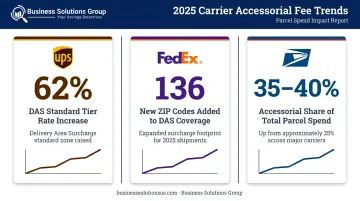
Base rate increases tell only part of the story. Accessorial fees now represent 35–40% of total parcel spend for many shippers — up from roughly 25% a decade ago.
Billing errors that most teams never catch, suboptimal carrier mix decisions, and contract terms that haven't been benchmarked against the market add further drag. The total cost gap between what shippers pay and what they could pay is rarely visible without the right data.
Data visibility helps — but only if it connects to decisions. A dashboard that shows where spend is going won't recover a billing overcharge or flag that your dimensional weight calculations are inflating costs across an entire service tier.
This post covers five platforms designed to move beyond reporting, what to look for when evaluating them, and how to match the right tool to your highest-leverage cost problem.
Key Takeaways
- Parcel analytics platforms reduce costs through spend visibility, invoice auditing, carrier benchmarking, and real-time routing decisions, going well beyond passive reporting.
- The five platforms covered here each solve a distinct cost problem: spend monitoring, billing recovery, scenario modeling, SLA refund automation, and AI-driven carrier selection.
- Start platform selection by identifying your biggest cost gap, then match it to the right tool.
- High-volume shippers with complex carrier contracts gain the most from platforms that support benchmarking and anomaly detection.
- Pairing any platform with an advisory layer accelerates results, especially when interpreting data against contract terms and market benchmarks.
What Is a Parcel Analytics Platform?
Parcel analytics platforms aggregate shipment and carrier data to identify cost drivers, delivery performance gaps, and optimization opportunities. They're distinct from shipping execution tools — label generators, basic rate shoppers, TMS systems — which handle operational tasks but don't provide the analytical depth needed to systematically reduce costs.
The most useful platforms operate across four types of analytics:
- Descriptive — what happened (spend by carrier, zone, service level)
- Diagnostic — why it happened (surcharge spikes, accessorial patterns, routing inefficiencies)
- Predictive — what's likely to happen (cost forecasting, volume trend analysis)
- Prescriptive — what action to take (carrier recommendations, contract adjustment triggers)
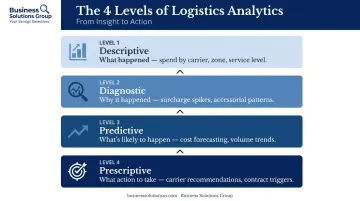
Platforms that stop at descriptive reporting require manual interpretation to drive any action. The best tools for cost control push toward prescriptive outputs — telling you what to do, not just what occurred.
Why Carrier Complexity Matters
For U.S. commercial shippers, UPS, FedEx, and USPS remain the core national carrier programs for parcel analytics purposes. Each has distinct rate structures, surcharge models, and accessorial frameworks that change annually. In 2025 alone, FedEx added 136 ZIP codes to Delivery Area Surcharge coverage, and UPS raised its DAS standard tier by 62% — changes that quietly erode margins for shippers who aren't tracking surcharge shifts across all three carriers in real time.
Top Parcel Analytics Platforms for Cost Control
These platforms were selected based on their ability to directly reduce parcel costs — through spend visibility, contract leverage, billing accuracy, or carrier decision intelligence.
Sifted
Sifted is a logistics intelligence platform built around continuous parcel spend monitoring, carrier benchmarking, and contract negotiation support. It functions as an always-on analytics layer for U.S. shippers managing multi-carrier programs, particularly useful for teams that need ongoing visibility without building manual reporting workflows.
Key differentiators:
- Proactive anomaly alerts when shipping profiles shift unexpectedly (cost spikes, service mix changes, surcharge pattern changes)
- Peer benchmarking that provides real market context during carrier contract renegotiations
- Built-in invoice audit that flags and recovers billing overcharges automatically
Sifted reports clients achieve an average 17% reduction in cost-per-pack. A published case study for Beddy's/Moxie Logistics showed projected annual savings exceeding $493,000 after service adjustments.
| Feature Area | Details |
|---|---|
| Key Features | Continuous spend monitoring, carrier cost benchmarking, proactive anomaly alerts, invoice audit and recovery |
| Best For | Teams preparing for carrier contract renegotiations or seeking ongoing spend visibility without manual reporting |
| Pricing | Flat platform fee based on shipping volume and product needs; no gain-share, no per-seat pricing, unlimited users. Specific pricing requires a demo request at sifted.com |
Enveyo
Enveyo is a multi-module parcel analytics and optimization platform serving both shippers and 3PLs. Its suite covers spend management, logistics modeling, carrier rate shopping, invoice audit, and delivery experience management — one of the few platforms covering all of those capabilities in a single interface.
The standout capability is logistics simulation: teams can model carrier mix scenarios against real shipment data before executing any operational changes. That removes the guesswork from decisions like consolidating carriers or shifting service levels.
Its automated audit module catches billing errors before invoicing rather than after — a meaningful distinction for finance teams managing cash flow. CooperVision used Enveyo's platform to save more than $4.7M in contracted shipping costs while growing volume 31%, per Enveyo.
| Feature Area | Details |
|---|---|
| Key Features | Parcel spend management, logistics modeling/simulation, multi-carrier optimization, automated invoice audit, delivery alerting |
| Best For | Shippers and 3PLs who want end-to-end analytics with scenario modeling before committing to operational changes |
| Pricing | Not publicly listed; platform emphasizes unlimited carriers, data, transactions, and users. Contact Enveyo for current pricing |
Intelligent Audit
Founded in 1996, Intelligent Audit has audited 2.1 billion+ shipments in a single year and counts 20% of Fortune 50 companies among its customers. Its AI engine, DeepDetectAI, scans shipment records at scale to identify billing anomalies, contract non-compliance, and accessorial overcharges that manual review consistently misses.
The platform goes beyond invoice checking. Capabilities include:
- SLA compliance validation
- Contract renegotiation data preparation
- Operational adjustment recommendations
This makes it relevant to both enterprise finance and procurement teams, not just logistics operations.
In one published case study, DeepDetectAI identified three major operational anomalies in a single quarter and produced $2.8M in annual savings for a high-end fashion brand.
| Feature Area | Details |
|---|---|
| Key Features | AI-powered invoice auditing (DeepDetectAI), SLA compliance tracking, contract non-compliance detection, accessorial overcharge recovery |
| Best For | Enterprise shippers with complex multi-carrier contracts who need full audit trails and billing accuracy across finance and procurement |
| Pricing | Not publicly listed. Contact Intelligent Audit directly for pricing; expect customized quotes for high-volume enterprise accounts |
LateShipment.com
LateShipment.com focuses specifically on SLA refund automation. The platform monitors shipments for carrier errors across 50+ error types — late deliveries, lost packages, damaged goods — and files refund claims automatically, without requiring shippers to manually track carrier SLA performance.
Setup takes under four hours according to the company's published FAQ, and the platform has tracked 1.2 billion+ packages in real time across its customer base. For teams not currently claiming carrier SLA refunds, the ROI is near-immediate with minimal integration work.
| Feature Area | Details |
|---|---|
| Key Features | Automated SLA refund claims (50+ error types), branded tracking pages, delivery notifications, performance-based pricing option |
| Best For | Shippers who want fast, low-effort cost recovery from carrier errors without overhauling their existing tech stack |
| Pricing | Pay-as-you-go with automatic volume discounts; performance-based option available where payment is tied to recovered refunds (no upfront subscription fee for OneAudit). Verify current success-fee percentage directly with vendor |
EasyPost (Luma AI)
EasyPost connects parcel analytics directly to shipping execution through its Luma AI layer — closing the loop between insight and action within a single platform. With 100+ carrier integrations, it gives multi-carrier operations a unified view of spend and performance without requiring separate analytics tooling.
Luma AI operates across three functions:
- Luma AI Insights runs scenario modeling and spend analysis against historical shipment data
- Luma AI Advisor accepts plain-language cost queries, returning answers without requiring users to build reports
- Luma AI Select handles dynamic carrier routing decisions based on cost, speed, and real-time performance signals
EasyPost's billing dispute process has recovered $22M in erroneous carrier charges annually, per EasyPost.
| Feature Area | Details |
|---|---|
| Key Features | Luma AI Insights (scenario modeling), Luma AI Advisor (plain-language queries), Luma AI Select (dynamic carrier routing), billing dispute recovery |
| Best For | Enterprise retail and logistics teams running active multi-carrier strategies who want analytics and execution in one platform |
| Pricing | Not publicly listed for Luma AI modules; contact EasyPost sales to confirm whether features are included in base plans or priced as add-ons |
How These Platforms Were Evaluated
Each platform here was assessed on its ability to directly reduce parcel costs — not just surface data. The evaluation criteria:
- Spend visibility depth — by carrier, zone, service level, and surcharge type
- Decision connectivity — whether insights translate to specific actions, not just reports
- Invoice auditing accuracy — especially for accessorial and contract compliance issues
- Adoption fit — usability by both operations and finance teams without requiring dedicated data analysts
- Multi-carrier coverage — across UPS, FedEx, USPS, and regional carriers
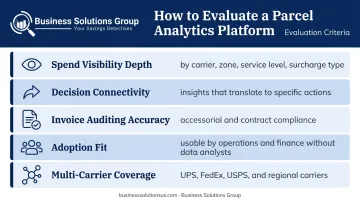
One mistake common in platform evaluations: selecting based on dashboard aesthetics or feature count rather than asking whether the tool changes what decisions get made. The most sophisticated reporting interface delivers no value if every insight requires a data analyst to extract, or if findings arrive after invoices are already paid and dispute windows have closed.
Where Advisory Services Add Value
Parcel analytics platforms surface data. Turning that data into contract leverage requires context — how your rates compare against the market, where carrier incentive structures create negotiating room, and what benchmark thresholds are realistic for your volume tier.
For businesses managing significant parcel spend, pairing an analytics platform with an advisory partner produces more actionable outcomes. Business Solutions Group's spend intelligence and carrier benchmarking services help shippers do exactly that. Their team includes former UPS and FedEx senior-level pricing analysts who interpret platform data against real contract terms and current market benchmarks. Core areas where they add value:
- Comparing your rates against market benchmarks for your volume tier
- Identifying where carrier incentive structures create negotiating room
- Validating contract compliance findings before dispute windows close
Business Solutions Group offers a complimentary savings analysis for shippers who want to understand where they stand.
Conclusion
The five platforms covered here don't all solve the same problem. Sifted and Enveyo are strongest for spend monitoring and contract leverage. Intelligent Audit and LateShipment.com focus on billing accuracy and cost recovery. EasyPost's Luma AI connects analytics to real-time carrier decisioning.
Choosing the wrong category for your current stage wastes both budget and adoption effort. A team sitting on unrecovered SLA refunds doesn't need a contract benchmarking tool first. And a shipper heading into carrier renegotiation needs more than automated refund claims.
Before evaluating any platform, identify your highest-leverage cost problem:
- Accessorial overcharges
- Carrier mix optimization
- Billing error recovery
- Contract renegotiation
Then confirm the platform integrates with your existing carrier programs and scales with your shipment volume.
If that selection process feels complex — or if your team lacks internal bandwidth to evaluate carriers and contract terms — Business Solutions Group offers parcel advisory services and proprietary spend intelligence software built specifically for shippers navigating these decisions.
Frequently Asked Questions
What does "parcel data received" mean?
"Parcel data received" is a carrier tracking status indicating the shipper has electronically transmitted shipment information to the carrier, but the physical package has not yet been scanned into the carrier's network. It does not confirm that the carrier has picked up the package.
What are the four types of analytics?
The four types are descriptive (what happened), diagnostic (why it happened), predictive (what's likely to happen), and prescriptive (what actions to take). The most effective parcel analytics platforms incorporate all four layers rather than limiting output to historical reporting.
What are the top three most used shipping carriers in the USA?
For commercial parcel programs, UPS, FedEx, and USPS are the three core national carriers. Each operates distinct rate structures, surcharge models, and accessorial frameworks, making multi-carrier analytics coverage essential for accurate cost control.
What is parcel spend management?
Parcel spend management is the practice of tracking, analyzing, and optimizing all costs associated with parcel shipping — including base rates, surcharges, accessorials, and dimensional weight fees. The goal is to identify savings opportunities and improve carrier contract terms through data-driven decisions.
How do parcel analytics platforms help with carrier contract negotiations?
These platforms provide benchmark data comparing a shipper's rates against market averages, flag where current contract terms are underperforming, and surface detailed usage patterns by zone, weight, and service level. That data gives shippers a concrete, evidence-based position when renegotiating carrier agreements.