The compounding effect is real. A 5.9% general rate increase (GRI), applied annually to an already inflated base rate, erodes whatever savings were negotiated at the original signing. Add expanding accessorial fee categories mid-agreement, and the effective rate a business pays three years in bears little resemblance to what they thought they agreed to.
None of this is inevitable. Parcel contract costs become expensive through poor preparation, passive renewal cycles, and a lack of visibility into how carrier pricing actually works. The businesses that consistently pay less aren't just lucky—they approach contracts differently.
This article covers where parcel costs accumulate, what drives them, and the specific strategies businesses can use to reduce spend across every phase of the contract lifecycle.
Key Takeaways
- Annual GRIs, surcharge proliferation, and automatic renewals compound parcel costs year over year
- Accessorial fees now represent 20–40% of total parcel spend for many shippers—often more impactful than base rate discounts
- The highest-leverage negotiation moment is before you sit across from a carrier, not during
- Renegotiation doesn't require waiting for contract expiration—specific trigger points justify reopening agreements mid-term
- Benchmark data and third-party expertise uncover savings that internal teams and carrier reps routinely miss
How Parcel Contract Costs Typically Build Up
Parcel costs don't usually spike — they drift upward, and that gradual movement is what makes them so damaging.
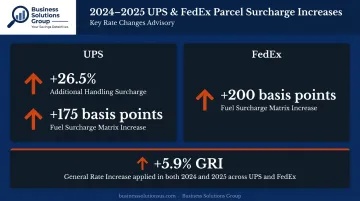
UPS and FedEx both implemented 5.9% GRIs in 2024 and again in 2025, applied to published list rates. For shippers operating on negotiated discounts off those published rates, the discount percentage stays the same while the base climbs. After two or three years of this, the effective rate a business pays looks nothing like what was modeled at signing.
GRIs aren't the only driver. Mid-agreement surcharge additions push costs further:
- UPS 2025 Additional Handling and Large Package surcharges increased over 26.5% on average
- From December 2023 to May 2024, UPS fuel surcharge matrices rose 175 basis points; FedEx rose 200 basis points
- Peak-season surcharges, residential delivery fees, and address correction charges layer on top without any cap in most standard contracts
Most businesses don't notice this until they run a shipping audit or benchmark their rates against the market. By then, months or years of avoidable overpayment have already occurred. The gap between what was negotiated and what's currently being charged sits in plain sight — and a structured contract review is typically what surfaces it.
Key Cost Drivers in Parcel Contracts
Understanding where costs originate is the prerequisite to reducing them. Three categories account for the majority of avoidable spend.
Volume Commitment Thresholds
Carriers structure minimum volume commitments to capture as much of a shipper's total spend as possible. The mechanics work against shippers in two ways: falling below the threshold triggers reduced discounts or penalty pricing, and committing to total business volume rather than realistic shipping volume creates built-in exposure.
When volume dips (seasonal fluctuation, a lost account, a supply chain disruption) the pricing penalty arrives automatically and silently.
Accessorial and Surcharge Fees
This is the fastest-growing cost category in parcel shipping. Surcharges now represent 20% to 40% of annual parcel spend for many shippers. The components:
- Residential delivery: UPS Ground residential surcharge at $5.50 per package; FedEx residential delivery at approximately $6.15 per package
- Fuel surcharges: Adjusted via matrix tables that carriers change throughout the year, independent of contract negotiations
- Dimensional weight (DIM): Chargeable weight is the greater of actual weight or DIM weight—carriers control the DIM divisor
- Peak surcharges: Seasonal fees layered on top of existing accessorials during high-volume periods
Most of these fees are uncapped in standard contracts. They can increase mid-agreement without triggering renegotiation rights.
DIM Pricing and Zone Distribution
Dimensional weight rules and zone distribution patterns are cost drivers that most shippers never fully model before signing. Carriers control the DIM divisor in their published rate guides. A shipper whose packages skew toward bulky-but-light SKUs can end up paying significantly more than their actual weight would suggest — without any obvious line item flagging the discrepancy.
Contract signing sets the cost ceiling for the entire agreement, making pre-negotiation the highest-leverage moment in the process.
Cost-Reduction Strategies for Parcel Contract Negotiation
Effective savings come from three categories: decisions made before negotiating, how the contract is managed after signing, and the competitive environment surrounding the carrier relationship.
Strategies That Change Pre-Negotiation Decisions
The most impactful reductions are secured before a shipper ever sits across from a carrier.
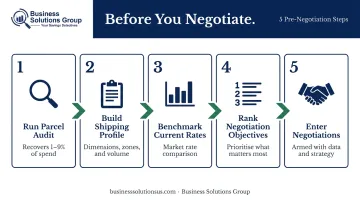
Run a comprehensive parcel audit first. Billing errors alone can account for 1% to 9% of a total shipping bill, and audits typically recover more than 3% of total spend. Beyond error recovery, the audit surfaces carrier performance failures that create negotiating leverage—late deliveries, damaged shipments, and unclaimed service guarantee credits.
Build a detailed shipping profile. Document package dimensions, weights, zone distribution, seasonal volume patterns, and service level requirements before entering any conversation. Carriers use this information to structure contracts in their favor. Shippers who understand it first can counter with precise demands rather than reacting to carrier-defined terms.
Benchmark current rates against market standards. Carriers won't volunteer information about what comparable shippers are paying for the same lanes and service levels. External benchmark data—or an analysis through a firm like Business Solutions Group, which compares client rates against proprietary market-rate databases—lets you identify where your current contract underperforms.
Rank your negotiation objectives before entering. Separate must-haves from nice-to-haves:
- Must-haves: Base rate discounts, accessorial fee caps, service guarantees, DIM divisor terms
- Nice-to-haves: Extended payment terms, reporting tools, dedicated account support
Without this ranking, shippers concede on high-impact terms to win low-value ones.
Strategies That Change Contract Management
Signing a contract doesn't end cost management—it begins it.
Negotiate explicit caps on accessorial charges. Uncapped residential delivery fees, DIM adjustments, and peak surcharges are among the fastest ways for total spend to exceed what was modeled at signing. Caps should be negotiated for each major accessorial category, not just for base rates.
Set realistic minimum volume commitments. Push to anchor minimums to actual shipping volumes, not total business volume. Negotiate graduated discount tiers so that volume fluctuations don't trigger cliff-edge pricing penalties. A shipper who misses a minimum by 8% shouldn't lose 25% of their discount structure.
Build service-level guarantees with defined remedies. Without specific language on what constitutes a failure and what credit is owed, carriers face no financial consequence for performance issues. Both UPS and FedEx require service guarantee claims within 15 days of the scheduled delivery date—a window most businesses miss entirely without a monitoring system in place.
Establish a regular contract review cadence. Quarterly or semi-annual reviews catch billing anomalies before they compound. Business Solutions Group's spend intelligence capabilities flag rate anomalies and surface savings opportunities on an ongoing basis—providing continuous oversight rather than a one-time post-signing check.
Strategies That Change the Context Around the Contract
Some of the most powerful cost levers aren't in the contract language. They're in the competitive environment surrounding it.
Use carrier competition as a negotiating tool. Get bids from competing carriers—regional and national—and present them to your current carrier. Carriers will often match or improve terms to retain business, but only when the shipper arrives with credible alternatives. One caution: don't reveal your total shipping volume to competing carriers during the RFP process, or you risk receiving full-capture offers structured to consolidate your spend under less favorable terms.
Time renegotiations around leverage points. Parcel carrier agreements are not rigid legal contracts. High-leverage triggers for mid-term renegotiation include:
- Annual GRI announcements (typically October–November)
- Meaningful volume growth that changes your spend tier
- A documented service failure pattern
- A new product line or fulfillment location that changes your shipping profile
Engage third-party advisory expertise. Carriers deploy internal pricing teams and external consultants during negotiations. Most shippers negotiate alone, relying on account reps who are compensated to retain margin for the carrier. A specialized advisor brings benchmark data, knowledge of discount programs carriers don't proactively offer, and experience with the contract terms shippers most commonly accept by default.
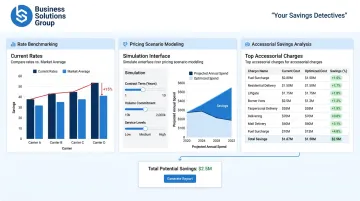
Business Solutions Group's carrier contract advisory services support negotiations across the full contract structure, not just base rates:
- Benchmarks client rates against proprietary market-rate databases
- Models proposed pricing scenarios before any terms are accepted
- Identifies accessorial and surcharge savings most shippers overlook
Clients have achieved savings in the 15–40% range through this process.
Conclusion
Parcel contract savings aren't found by cutting spend across the board. They come from identifying exactly where costs originate—whether in pre-negotiation blind spots, unmanaged surcharge growth, or the absence of competitive context around the carrier relationship.
Once those cost origins are clear, the next step is building the habits that keep savings intact. Businesses that pay consistently less treat contract optimization as a continuous process, not a one-time event at renewal. In practice, that means:
- Auditing shipping data before entering any negotiation
- Setting surcharge caps before signing, not after
- Monitoring actual invoiced costs against contracted rates on an ongoing basis
- Reopening carrier conversations when volume, mix, or market conditions shift—not just at renewal
The difference between a contract that erodes margin and one that protects it comes down to preparation and oversight. Carriers negotiate commercially. Shippers who approach the same conversation the same way consistently come out ahead.
Frequently Asked Questions
What are the 7 rules of negotiation?
The seven elements from Harvard's framework are: Relationship, Communication, Interests, Options, Legitimacy, BATNA, and Commitment. In parcel contract negotiation, Preparation (knowing your shipping profile and current rates) and BATNA (holding credible competing carrier bids) carry the most direct impact on outcomes.
What are the 5 P's of negotiation?
The 5 P's are Professionalism, Preparation, Patience, Persuasiveness, and Persistence. In parcel contracts, Preparation and Proof—meaning audit data, benchmark analysis, and documented carrier performance—drive the most significant savings.
When is the best time to renegotiate a parcel contract?
The strongest trigger points are annual GRI announcements, significant volume growth, documented service failures, and competitive bids that reveal substantially better rates. Shippers don't have to wait until a contract's end date—most parcel agreements can be reopened mid-term when circumstances justify it.
What should I review in my current parcel contract before entering negotiations?
Focus on five areas:
- Base rate discounts versus published rates
- Minimum volume thresholds and penalty structures
- Accessorial and surcharge fee tables
- Service level guarantee language and remedy provisions
- Clauses restricting RFP activity or carrier diversification
How much of my total shipping spend comes from surcharges and accessorial fees?
For many shippers, surcharges and accessorial fees represent 20% to 40% of total annual parcel spend. Negotiating caps on these fees—particularly residential delivery, DIM weight, and peak surcharges—often yields more savings than fighting for base rate reductions alone.
Is it worth using a third-party expert to negotiate my parcel contract?
Third-party advisors bring benchmark data, carrier discount program knowledge, and negotiating experience most internal teams don't have. They're especially valuable for shippers who haven't optimized their contracts recently or lack visibility into what comparable businesses are actually paying.