The problem rarely comes from a single bad decision. It compounds. A slightly oversized box here, an unchallenged address correction fee there, a carrier contract that hasn't been renegotiated in three years. None of it feels urgent until a margin review surfaces the cumulative damage.
What's worth understanding upfront: most parcel overspend isn't inherent to shipping. It stems from reactive carrier relationships, packaging specs that were set once and never revisited, and a lack of visibility into what the invoice actually contains. This article breaks down where costs originate and what businesses can do about each layer.
Key Takeaways
- Your invoice total is always higher than the label rate — fees stack on at every layer of the billing cycle
- Accessorial fees represent 20–35% of parcel spend and can reach 40% during peak periods
- FedEx and UPS have applied 5.9% General Rate Increases in each of the last three cycles — inaction on contracts means paying more every year
- The highest-impact savings happen before a shipment ever moves — upstream decisions drive downstream costs
- Sustained savings require ongoing monitoring, not a one-time fix
How Parcel Shipping Costs Typically Build Up
Most businesses look at their carrier invoice and see a shipping charge. What they're actually seeing is the output of five or six separate cost calculations stacked on top of each other.
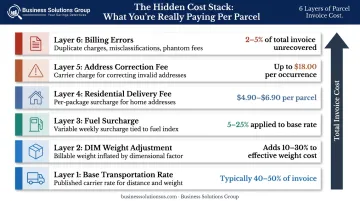
Here's how those layers typically accumulate per shipment:
- Base transportation rate — determined by service type, origin/destination zone, and billed weight
- Dimensional (DIM) weight adjustment — if the package is light but bulky, the carrier bills on volume, not actual weight
- Fuel surcharge — UPS Ground fuel surcharges currently run 21–24% depending on diesel price bands; FedEx Ground runs in a similar range
- Residential delivery fee — FedEx charges $6.45 and UPS charges $6.50 per residential Ground delivery
- Address correction fee — a single bad address costs $25.25–$25.50 with either major carrier
- Billing errors — up to 20% of shipping invoices contain errors, representing 1–9% of the total bill
At low volumes, these fees feel manageable. As order volume scales, the same per-shipment inefficiencies multiply into substantial budget pressure — often invisible until someone runs a formal invoice audit. Compounding this, carriers post these charges days or weeks after the shipment — by which point most businesses have already absorbed them as a fixed cost of doing business, missing the window to dispute or recover them.
Key Cost Drivers in Parcel Shipping
Dimensional Weight Pricing
DIM weight pricing is the single most misunderstood cost driver for businesses shipping light, bulky products. Both UPS and FedEx calculate billable weight using the formula: length × width × height ÷ 139 (for domestic U.S. shipments), with the result rounded up to the next whole pound. If that figure exceeds the actual weight, the carrier bills on DIM weight.
A box that weighs two pounds but measures 12" × 12" × 12" has a DIM weight of 12.5 lbs — meaning you're billed at more than six times the actual weight. Packaging optimization directly attacks this calculation.
General Rate Increases
FedEx and UPS have applied a 5.9% General Rate Increase (GRI) in each of the 2024, 2025, and 2026 rate cycles. The headline figure understates the real impact. Several compounding factors push actual cost increases well beyond 5.9%:
- Surcharge and accessorial fee hikes that don't follow the base-rate average
- DIM divisor adjustments that quietly expand billable weight
- Fuel surcharge index resets tied to carrier-favorable formulas
Businesses on outdated contracts absorb these increases every year with nothing to show for it.
Contract Terms and Benchmarking Gaps
GRI exposure compounds when contracts go unreviewed. Many businesses operate under default or lapsed pricing tiers, and without knowing what comparable-volume shippers pay, there's no leverage to negotiate. This gap often persists for years — even when the savings opportunity is significant.
Cost-Reduction Strategies for Parcel Shipping
Effective strategies vary by where the cost originates. Some savings come from decisions made before a package moves. Others come from tightening operational controls. And some require changing the structural context — geography, volume concentration, fulfillment infrastructure — that shapes the cost environment before a carrier ever prices a shipment.
Strategies That Change Decisions Before Shipment
Renegotiate carrier contracts using benchmark data. Most businesses ship under default or outdated pricing. Presenting carriers with objective comparisons of what similar-volume shippers pay creates real negotiating leverage — and even modest base-rate reductions compound across thousands of annual shipments. Business Solutions Group's carrier contract negotiation and benchmark analysis services are built specifically to surface this leverage, drawing on market-rate data to identify where a client's current contract diverges from what's available in the market.
Right-size packaging specifications. A packaging audit against actual order history — identifying the most common product combinations and standardizing box sizes accordingly — directly reduces DIM weight charges. For soft goods, switching from boxes to poly mailers or padded envelopes can eliminate a weight tier entirely.
Consider the math: a smaller 9"×9"×9" box saving $1.80 per package versus a larger alternative on the same lane — multiplied across 50,000 annual shipments — recovers $90,000 without touching a carrier contract.
Use prepaid and multiweight pricing options. Prepaid label programs from major carriers yield per-label discounts for businesses with consistent package weights and dimensions. Multiweight/hundredweight pricing — which typically must be negotiated into contracts — reduces per-package costs when multiple packages ship to the same address. Both require knowing your shipping profile well enough to commit.
Take control of inbound shipping. When vendors ship on their own carrier accounts, they often build inflated rates into the invoice. Issuing routing instructions that require vendors to ship on the buyer's negotiated account applies your contract rates to inbound volume — a cost reduction that requires no carrier negotiation at all.
Strategies That Improve Operational Control
Audit carrier invoices consistently. Carrier invoices regularly contain billing errors, misapplied surcharges, and incorrect fees. Consistent invoice auditing recovers 5–8% of total shipping spend, according to Shipware's audit benchmarks. Business Solutions Group employs former UPS and FedEx senior-level pricing analysts who understand carrier billing structures — and their spend intelligence software flags these discrepancies and recovers credits on the client's behalf.
Use multi-carrier shipping software and address verification. Automated rate-shopping tools compare carrier pricing in real time for each shipment's specific weight, dimensions, and destination — eliminating the default-to-one-carrier pattern that causes shippers to overpay on routes where a different carrier is cheaper. Address verification catches bad addresses before packages leave the facility, preventing the $25+ correction fees that add up fast for high-volume shippers.
Monitor surcharges and seasonal pricing changes proactively. Carriers adjust fuel surcharges weekly, introduce peak season surcharges in Q4, and modify residential delivery fees with annual rate changes. Businesses that track these shifts in advance can adjust packaging, routing, or carrier selection before absorbing the cost — not after.
Strategies That Change the Shipping Context
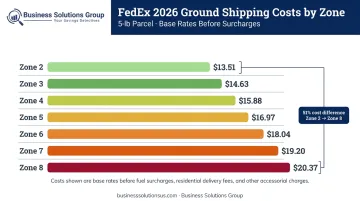
Reduce average shipping zone by repositioning inventory. Zone is one of the most direct determinants of parcel cost. FedEx 2026 list rates show a 5-lb Ground/Home Delivery parcel running from $13.51 in Zone 2 to $20.37 in Zone 8 — a 51% cost difference before fuel, residential, and other surcharges. Analyzing order destination data to identify geographic concentration can justify relocating inventory through a second fulfillment location, a 3PL network, or a regional warehouse partnership to reduce the average zone per order.
Consolidate shipping volume to strengthen negotiating position. Fragmented volume spread across multiple carriers weakens negotiating leverage with any single carrier. Consolidating volume — either through a primary carrier commitment or through a logistics provider that aggregates volume across clients — produces the scale needed to access deeper discount tiers that individual businesses can't reach independently.
Use hybrid shipping services for lightweight residential deliveries. UPS Ground Saver (formerly SurePost) and FedEx Ground Economy (formerly SmartPost) use USPS for last-mile residential delivery, reducing costs for lightweight packages where delivery speed isn't the priority. Both services handle packages up to 70 lbs with a maximum combined length and girth of 130 inches. The tradeoff is typically one additional business day in transit — a reasonable exchange for non-urgent residential shipments.
Conclusion
Reducing parcel shipping costs is an ongoing discipline, not a one-time fix. Carrier rates change annually, surcharges shift seasonally, and a business's own shipping profile evolves as product mix and customer geography change.
Businesses that keep shipping costs in check share one characteristic: they treat cost management as an ongoing practice backed by data, not a one-time response to a margin squeeze. In practice, that looks like:
- Auditing invoices regularly for billing errors and unexpected surcharges
- Revisiting carrier contracts before each GRI cycle, not after
- Tracking surcharge changes proactively so adjustments aren't reactive
If your current process is more reactive than that, the starting point is visibility — into what your invoices actually contain, what comparable shippers are paying, and where your packaging and zone profile is working against you. That's where the savings are waiting to be found.
Frequently Asked Questions
How can I reduce parcel shipping costs?
Start with the three highest-leverage areas: audit your carrier contract against market benchmarks to identify rate gaps, review packaging specs to eliminate unnecessary DIM weight charges, and implement multi-carrier rate shopping to stop defaulting to one carrier regardless of cost. Each targets a different cost layer, so improvements stack.
What is dimensional weight pricing and how does it affect my shipping costs?
DIM weight is calculated as length × width × height ÷ 139 (for U.S. domestic shipments with UPS and FedEx). If the result exceeds actual weight, you're billed at the higher DIM figure. For light but bulky products, this can inflate billable weight significantly — right-sizing packaging to reduce the calculated volume is the most direct fix.
How do I negotiate better carrier rates for parcel shipping?
Effective negotiation requires two things: your own shipping data (monthly volume, average weight, destination zone distribution) and benchmark intelligence showing what comparable shippers pay. Carriers respond to competitive alternatives and concrete volume commitments — without both, there's no leverage to move below default pricing tiers.
What hidden fees and surcharges should I watch for in parcel shipping?
The most commonly overlooked charges include fuel surcharges (currently 21–24% with UPS Ground), residential delivery fees ($6.45–$6.50 per package), address correction fees ($25.25–$25.50 per occurrence), large package surcharges, peak season surcharges, and delivery area surcharges for rural addresses. These stack on top of the base rate and can materially change total cost per shipment.
Should I use multiple carriers or consolidate with one to save money?
Both approaches have merit depending on your shipping profile. Consolidating volume with one carrier unlocks deeper discount tiers through volume commitments. Using multiple carriers strategically — routing specific weight classes, zones, or service types to the cheapest carrier — reduces costs for businesses with varied shipment characteristics. Running your shipment mix through a rate comparison analysis will show which model saves more for your specific profile.
When does it make sense to work with a logistics consultant to reduce shipping costs?
A logistics consultant adds clear value when you lack benchmark data to know whether your carrier rates are competitive, when invoice audits reveal systemic overcharges, or when shipping spend has grown to the point where even a small percentage reduction justifies expert analysis. Business Solutions Group provides carrier contract benchmarking, invoice auditing, and spend intelligence for businesses that need more than a carrier's default pricing to compete.