The gap between those two numbers is where margin erosion lives. A business shipping the same volume as three years ago is spending significantly more, not because of operational growth, but because of compounding rate increases, expanding surcharge menus, and contracts that were never revisited.
Parcel shipping doesn't become expensive by default. It becomes expensive because of poor contract terms, unaudited invoices, packaging choices that trigger dimensional weight charges, and fulfillment decisions that force long-zone shipments. Each of those is fixable.
This article covers how parcel costs accumulate, what drives them at the package level, and three distinct categories of strategies to reduce them.
Key Takeaways
- GRIs compound annually — flat volume doesn't mean flat spend
- Accessorial fees account for 20–35% of total parcel spend and often go uncontested
- Cost reduction strategies span procurement, operations, and network structure — each with distinct leverage points
- Invoice auditing and contract benchmarking consistently deliver the highest return on effort
- Zone distance is one of the largest cost multipliers — and one of the most addressable
How Parcel Shipping Costs Build Up
Most shippers don't experience a single large cost shock. The spend creeps upward through overlapping layers, none of which trigger an obvious alert.
Annual GRIs Compound Silently
Each year's GRI applies to the previous year's rates. A shipper who doesn't renegotiate after a 5.9% increase carries that year's rate as the new baseline into the next cycle. Over five years, that compounding produces the ~27% cumulative increase documented since 2021, before surcharges and package mix are even factored in.
Surcharges Expand Episodically
Carriers add or adjust fees with limited advance notice. Common additions include:
- Fuel surcharges
- Residential delivery fees
- Address correction charges
- Additional handling fees
- Oversized package premiums
These changes appear as new line items on invoices. Most shippers absorb them without review because reconciliation is manual, infrequent, or understaffed for the invoice volume.
Billing Errors Add a Hidden Layer
Carrier invoices contain errors more often than most shippers assume. Audit firms consistently cite 1–9% of total invoice value as recoverable through structured auditing — covering misclassified delivery types, unapplied discounts, duplicate charges, and incorrect rate application. Because carriers impose strict claim windows, unreviewed invoices mean unrecovered money.
Together, these three layers — compounding base rates, expanding surcharges, and unclaimed billing errors — explain why parcel spend rises even when shipment volume stays flat.
Key Cost Drivers for Parcel Shipping
Parcel costs don't come from a single source — they're the compounding result of carrier rate structures, shipment characteristics, and contract terms. Knowing which driver is hurting you most is where savings actually begin.
Carrier Rate Structure
Published base rates are the starting point, not the final cost. What actually determines the invoice is a combination of:
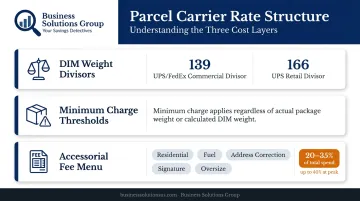
- DIM weight divisors — UPS and FedEx both use 139 as the divisor for commercial daily rates (UPS uses 166 for retail rates); packages are billed at whichever is greater, actual or dimensional weight
- Minimum charge thresholds — small packages may hit a minimum regardless of actual weight
- Accessorial fee menus — residential delivery, fuel, address correction, signature required, and oversize handling collectively make up 20–35% of parcel spend, reaching 40% during peak periods
Shipment Characteristics
The operational inputs — dimensions, weight, service level, delivery type — matter as much as the contract itself:
- A lightweight product in an oversized box gets billed at DIM weight, not actual weight
- A Zone 8 shipment (1,801+ miles) can cost more than 2x a Zone 2 shipment (under 150 miles) for the same package
- Residential delivery consistently costs more than commercial, and that surcharge applies regardless of negotiated base rate discounts
Contract Maturity and Negotiating Position
This is the most overlooked driver. Common signs a contract is costing more than it should:
- Signed during a period of low shipping volume or low negotiating leverage
- No renegotiation in two or more years
- Terms were accepted without benchmarking against market rates
- Discounts look strong on paper but apply to inflated base rates
The contract sets the cost floor. No amount of packaging optimization or service-level adjustments will overcome a below-market agreement.
Cost-Reduction Strategies for Parcel Shipping
Effective strategies differ based on whether costs stem from how shipping is procured, how it's managed day-to-day, or how the broader operational setup is structured. Most businesses have room to improve across all three.
Strategies That Change the Decisions Made Before a Package Moves
These approaches address the cost floor — the terms, packaging specs, and carrier relationships that determine what every shipment will cost before it's tendered.
Negotiate carrier contracts with data, not assumptions. Published rate cards are an opening position. Carriers expect negotiation, particularly from shippers with consistent volume. Bring 6–12 months of shipping data covering average weight, zone distribution, and service level mix. Push for discounts on base rates, surcharge caps, and DIM factor improvements — not just headline discount percentages that can mask unfavorable accessorial terms.
Don't waive Guaranteed Service Refunds. Carriers sometimes offer small rate concessions in exchange for waiving refund eligibility on service failures. For businesses shipping time-sensitive parcels, this trade-off almost always favors the carrier. Model the waiver against your own express volume and historical on-time performance before accepting it.
Add carriers to create competitive pressure. Single-carrier dependency eliminates negotiating leverage. Regional carriers have expanded coverage — Supply Chain Dive reports that alternative carrier volume grew 127% to 1.8 billion parcels in 2025. For local and zonal lanes, regionals are increasingly competitive. UPS's SMB program and comparable FedEx options also offer discounts that don't require enterprise-level volume commitments.
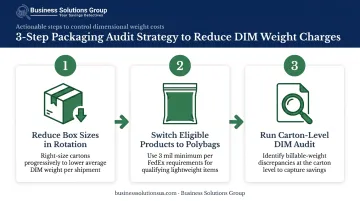
Audit packaging against DIM weight exposure. Carriers charge based on whichever is greater — actual weight or dimensional weight. Large boxes around lightweight products generate inflated charges. Practical fixes include:
- Reducing the number of box sizes in active rotation
- Switching eligible non-fragile products to polybags (minimum 3 mil thickness per FedEx guidelines)
- Running a carton-level audit to quantify how much current void fill is costing in DIM charges
Strategies That Improve Control Over Active Shipments
These approaches don't change the original decisions — they catch errors, surface patterns, and create accountability that prevents ongoing overspend.
Audit every invoice, not just samples. Billing errors are common: misclassified delivery types, unapplied contract discounts, duplicate line items, and incorrect surcharge tiers all appear across carrier invoices. Carriers have strict windows for claim filing, so delayed reviews mean unrecoverable losses.
Automated auditing tools flag discrepancies in real time and file claims systematically. That's a material improvement over periodic manual spot checks.
Benchmark rates against market peers. Most shippers don't know whether their contract terms are above or below market because they have no comparison point. Business Solutions Group uses proprietary spend intelligence tools to compare a shipper's rates, DIM factors, and accessorial levels against comparable businesses — giving procurement teams the evidence needed to negotiate from a position of data rather than assumption. Their parcel advisory engagements have delivered savings of 15–40%, with an average of 23.6%.
Map service levels against actual delivery requirements by lane. Shippers often default to expedited services out of habit, even where ground shipping would meet the customer's delivery window. Use zone-based transit data to identify lanes where a service level downgrade has no impact on delivery timing. The savings accumulate across every shipment on those lanes without any change to customer experience.
Know which accessorial fees hit your invoices most often. Fuel surcharges, residential delivery fees, address corrections, and oversize handling often account for a disproportionate share of total spend. Once you know which fees appear consistently, those specific surcharges become the highest-priority targets in the next contract negotiation — seeking caps, waivers, or reduced rates on charges that actually affect your business.
Strategies That Address the Operational Context Around Shipments
These approaches reduce cost by changing external factors — where inventory is positioned, how shipments are consolidated, and how the fulfillment network is structured.
Reduce average zone distance through distribution node placement. Every additional zone adds cost. A single West Coast origin shipping to customers in the Midwest and Southeast absorbs top-tier zone rates on a large share of orders. Adding a regional fulfillment node cuts average zone distance, lowers cost per order, and often makes ground delivery feasible where air was previously required.
Use zone skipping for high-density lanes. Zone skipping consolidates individual packages headed to the same region onto an LTL load, moves them to a carrier hub near the destination, and injects them into the local network for final-mile delivery at a lower zone tier. A Pitney Bowes comparison puts Zone 2 at roughly $8 and Zone 8 at $18 for the same package. That 2.25x gap is what zone skipping captures on high-volume lanes.
Let shipping data inform marketing and product decisions. Parcel cost varies by geography and SKU. Where customers are located and what they order determines cost-per-order as much as carrier rates do. Analyzing parcel cost by lane and product category creates a feedback loop: teams can align promotional decisions to lower-cost shipping profiles, making logistics data a direct input to planning — not just a cost report to manage after the fact.
Explore 3PL partnerships for aggregated rate access. The U.S. 3PL market reached $323.4 billion in 2025, reflecting the continued growth of outsourced logistics. 3PLs aggregate volume across multiple shippers to negotiate carrier rates that individual businesses — especially SMBs — can't achieve independently. Before committing, evaluate the fully loaded 3PL rate across these factors:
- Fees and markup structure
- Surcharge pass-through terms
- DIM weight rules applied
- Net rate vs. a direct carrier proposal
Conclusion
Reducing parcel shipping costs requires identifying where cost actually originates — a contract signed years ago under unfavorable terms, packaging that generates unnecessary DIM charges, invoices that are never challenged, or a fulfillment network that forces long-zone shipments. Addressing symptoms without understanding root causes produces temporary results at best.
That root-cause discipline matters because carriers will keep raising rates, introducing new surcharges, and expanding billing complexity. The businesses that control their shipping spend treat it as an ongoing management function — auditing invoices consistently, benchmarking contracts against current market data, and revisiting fulfillment strategy as volume patterns shift. Parcel spend isn't a fixed cost. It's a managed one.
Frequently Asked Questions
Is there a way to reduce shipping costs?
Yes — and the approach varies by operation. Carrier contract negotiation, packaging optimization, invoice auditing, and fulfillment network adjustments all contribute. A contract audit is usually the fastest place to find recoverable savings.
What are the most common hidden fees in parcel shipping?
Residential delivery surcharges, fuel surcharges, address correction fees, oversize package handling, and signature required fees are the most frequent offenders. These charges often appear on invoices without clear explanation, making consistent auditing the most reliable way to catch and contest them.
How do dimensional weight charges affect my parcel costs?
Carriers bill based on whichever is greater: actual weight or DIM weight (cubic inches ÷ 139 for most commercial shipments). Large, lightweight packages often get billed at rates far above their physical weight. Right-sizing packaging and switching eligible items to polybags reduces this directly.
Should small businesses try to negotiate carrier contracts?
Yes. UPS has publicly targeted growing SMB volume to 40% of its U.S. business, and regional carriers are increasingly open to lower-volume shippers. Even modest shipping volume carries real negotiating leverage when you bring consistent data to the table.
How often should I audit my carrier invoices?
Every invoice, not just periodic samples. Carriers have strict claim windows (typically 15–30 days), meaning delayed reviews result in unrecoverable losses. Automated or continuous auditing is the most effective approach for businesses shipping at any meaningful scale.
What is a General Rate Increase (GRI) and how does it affect my shipping costs?
A GRI is an annual across-the-board rate increase announced by major carriers each fall, effective in January. GRIs compound over time — even a shipper with flat volume still sees spend grow each year without renegotiation. Scheduling contract reviews to coincide with GRI announcements is standard practice for controlling this exposure.