FedEx and UPS have raised published rates by an average of 5.9% annually since 2022, producing a cumulative increase of roughly 24.6% over four years. And that figure only captures base rates. Surcharges — fuel, residential delivery, dimensional weight, delivery area fees — compound on top, quietly pushing your actual shipping spend well above the published increase.
The frustrating part: more than 50% of parcel shippers haven't conducted a full pricing negotiation in over a year, despite 75% believing their agreements could be improved. That gap is what carriers count on.
This guide covers exactly how to close it — how to build your data case, identify what to negotiate (most shippers miss the most valuable targets), and apply carrier-specific tactics for FedEx and UPS that produce lasting savings.
TL;DR — Key Takeaways
- Carrier rates are negotiable; your shipping data is your most powerful leverage tool
- Surcharges represent 20–40% of total parcel spend and are the most overlooked negotiation target
- FedEx and UPS use different contract structures, and the same negotiation approach won't work for both
- Start negotiations 90–120 days before contract expiry, never at the renewal deadline
- Signing the contract is step one; ongoing invoice auditing is what actually protects your negotiated rates
Why Your FedEx and UPS Rates Are Already Negotiable
Carriers publish "standard" rate cards, but that's the ceiling — not the floor. FedEx and UPS routinely offer volume-based discounts, surcharge caps, and incentive tiers to retain shipper relationships. Their reps are trained to close deals at the minimum discount necessary, not the maximum they can offer.
According to a Shipware survey, less than 7% of shippers believe they have best-in-class pricing — yet renegotiating strategically can save anywhere from 5% to 50% above current rates.
You Don't Need Fortune 500 Volume
Mid-market shippers often assume negotiating leverage is reserved for companies moving hundreds of thousands of packages monthly. It isn't. Carriers value consistency as much as volume.
A shipper with predictable monthly volume, stable package characteristics, and favorable delivery zones helps carriers optimize capacity on reliable lanes — that makes you worth keeping.
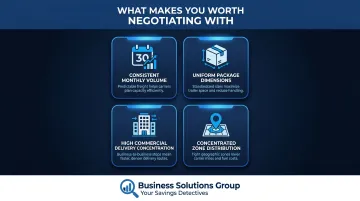
Carriers respond well to shippers who offer:
- Consistent monthly volume with low seasonal variance
- Uniform package dimensions and weights that are easy to route
- High commercial delivery concentration (fewer residential stops per route)
- Concentrated zone distribution (more local/regional, fewer cross-country shipments)
These characteristics show up in practice. Business Solutions Group, which manages over $3 billion in parcel spend, works with shippers ranging from 500 packages a month to 50,000 and beyond — and finds that most companies negotiating for the first time discover they've been overpaying by 15–30%.
Step 1: Build Your Shipping Profile — Your Negotiation Foundation
Before you contact your carrier, you need a data picture of your shipping operations that's at least as detailed as the one the carrier already has on you. Without it, you're negotiating blind while they're fully informed.
What Data to Compile (Last 12 Months)
Pull together the following from your carrier invoices:
- Monthly shipment volume by service level — Ground, Express, International
- Average package weight and dimensions — including DIM weight as billed vs. actual weight
- Zone distribution — which zones you ship to most frequently
- Residential vs. commercial delivery split
- Historical surcharges paid by category — fuel, residential, DAS/EDAS, additional handling
Why Zone and Residential Data Matter Most
These two factors drive a surprisingly large portion of your surcharge costs. Residential surcharges alone hit $6.45 per package (FedEx) and $6.50 (UPS) in 2026 — on top of base rates, on every residential delivery. Commercial deliveries don't incur this fee at all. For a shipper sending 5,000 residential packages monthly, that's over $32,000 in surcharges from a single fee category.
Zone distribution matters because carrier pricing is zone-based — your discount structure needs to reflect where you actually ship, not an average across all zones.
Finding the Gap Between Expected and Actual Costs
Analyze your invoices line by line to identify:
- DIM weight billing where actual weight is lower
- Minimum charge applications that override your discount
- Surcharges applied to shipment types that shouldn't carry them
- Missed service guarantee credits
At scale, this process spans thousands of invoices across dozens of fee categories — too much to review manually without missing something. Business Solutions Group's Parcel Spend Intelligence software automates the analysis, producing consolidated dashboards with over 40 actionable insights and drill-down capability to the shipment level. You walk into carrier negotiations with the same data clarity they have.
Step 2: Know What to Actually Negotiate — Beyond the Base Rate Discount
Most shippers focus on the headline discount and stop there. Carriers know this — which is why surcharges, the fees that compound on every single shipment, rarely get challenged at the table.
Accessorial fees represent 20–40% of total parcel shipping spend for most companies. During peak season or for poorly managed profiles, that figure can hit 50%. Negotiating only on base rates while ignoring surcharges means leaving the larger share of savings on the table.
The High-Impact Contract Terms to Target
DIM Divisor
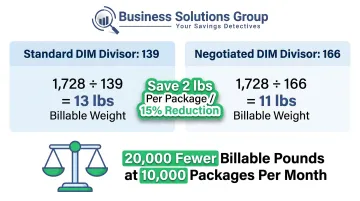
Both FedEx and UPS default to a DIM divisor of 139. Negotiating a higher divisor directly reduces billable weight on lightweight but bulky packages.
| DIM Divisor | Package: 12"×12"×12" (1,728 cu in) | Billable Weight |
|---|---|---|
| 139 (standard) | 1,728 ÷ 139 = 12.43 | 13 lbs |
| 166 (negotiated) | 1,728 ÷ 166 = 10.41 | 11 lbs |
That's 2 fewer billable pounds per package — a 15% reduction. At 10,000 packages monthly, you're eliminating 20,000 billable pounds from your invoice every month.
Fuel Surcharge Caps
As of May 2026, FedEx Ground fuel surcharge sits at 27.25% and UPS Ground at 27.75% of base rate — applied to every shipment, every week. These fluctuate with diesel prices and compound quickly. Negotiating a percentage cap or indexed maximum protects against volatility. FedEx tends to be particularly receptive to fuel cap negotiations given their pricing methodology.
Residential and Delivery Area Surcharges
If your delivery mix skews residential, this is your highest-priority target. DAS commercial fees run $4.30 per package (UPS 2025); DAS residential runs $6.15. Extended delivery area fees go higher. Negotiating caps or flat reductions on these fees cuts costs immediately and keeps cutting them on every future shipment.
Minimum Charge Reductions
Even with a strong base rate discount, minimum charge thresholds wipe out savings on lighter, shorter-zone packages. Negotiating the floor rate unlocks discounts across your full shipment profile — not just the heavier, longer-haul packages where your base rate discount is already working.
Revenue-Based Incentive Tier Brackets
Tiered discount structures are common in both FedEx and UPS contracts. Most shippers negotiate the discount percentage within a tier. The smarter move is to negotiate the bracket thresholds themselves. This matters most for businesses with seasonal volume swings, where a slow quarter can trigger a tier drop and eliminate discounts across the board.
Step 3: Carrier-Specific Tactics for FedEx and UPS
FedEx and UPS have meaningfully different contract architectures. Using the same playbook with both leaves money on the table.
FedEx Contract Specifics
FedEx typically structures base rate discounts with no defined expiration — but surcharge discounts carry a separate 1–3 year expiration date. Your fuel or residential surcharge discount can quietly lapse while your base rate discount remains intact. Shippers who don't track these dates revert to published surcharge rates without warning.
FedEx minimum charge reductions are expressed as a fixed dollar amount, not a percentage. As published rates increase year over year, the real value of that fixed reduction erodes — what looked like meaningful savings in year one becomes marginal by year three.
FedEx's revenue calculation for earned discounts (their incentive tier mechanism) is based on gross transportation charges only — accessorials and surcharges are excluded. This means a shift toward more residential deliveries won't affect your tier eligibility, but accessorial costs still need separate attention since they're not factored into tier standing.
UPS Contract Specifics
UPS tends to make both base rate discounts and surcharge discounts indefinite within the contract term, providing more structural stability than FedEx. Unlike FedEx's fixed-dollar minimum charge reduction, UPS expresses minimum charge reductions as a percentage. As published rates increase, your percentage discount grows in dollar value — a structurally more favorable position over a multi-year term.
The complexity with UPS is in the incentive tier structure. UPS includes gross charges plus residential surcharges and DAS/EDAS fees in its revenue calculation for tier determination. This makes UPS tiers more sensitive to shifts in your delivery geography: a move toward more residential or extended-area deliveries increases your tier-qualifying spend, but a shift away from those destinations can push you down a tier.
Industry guidance: negotiate tier bracket thresholds at no more than 85% of current attainment. This builds in a buffer against seasonal dips or optimization efforts that might inadvertently reduce gross spend and trigger a tier drop.
Worth flagging separately: UPS introduced a 2% surcharge for credit card payments in 2025, which can quietly negate 2% of savings negotiated elsewhere. Add payment method to your negotiation checklist if you're paying by card.
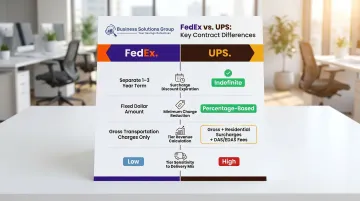
FedEx vs. UPS: Key Structural Differences at a Glance
| Contract Element | FedEx | UPS |
|---|---|---|
| Surcharge discount expiration | Separate 1–3 year term | Indefinite (within contract) |
| Minimum charge reduction | Fixed dollar amount | Percentage-based |
| Tier revenue calculation | Gross transportation charges only | Gross charges + residential surcharges + DAS/EDAS fees |
| Tier sensitivity to delivery mix | Low | High |
Step 4: Build Leverage, Time It Right, and Run a Competitive RFP
The Timing Rule
Begin negotiations 90–120 days before your current agreement ends. Waiting until the renewal deadline signals to your carrier rep that you're pressured — and removes your most important piece of leverage: the credible ability to walk away.
Early preparation shifts the dynamic entirely. You're shopping, not renewing.
Running a Formal RFP
A well-prepared RFP does two things: it generates a genuine competing bid, and it gives your preferred carrier's rep the internal justification to approve deeper discounts. Carrier reps don't unilaterally set pricing — they need business justification to take to their pricing team.
A parcel RFP should include:
- 12 months of historical shipment data (volume, weight, zones, service mix)
- Detailed accessorial charge profile by category
- Peak season volume projections
- Specific service level requirements
- Volume commitments and growth trajectory
- Competitive benchmarking data showing market-rate discounts for your profile
A structured RFP and negotiation process typically reduces shipping costs by 15–30% — a range Business Solutions Group consistently sees across parcel advisory engagements.
Carrier Diversification as Ongoing Leverage
Single-carrier dependency eliminates negotiating power permanently. Even a partial volume split — or a documented relationship with a regional carrier — sends a clear signal that alternatives are real and ready.
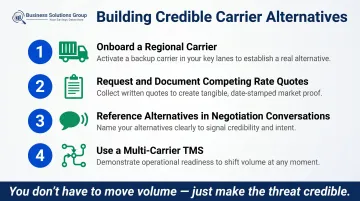
Moving volume isn't required to capture this leverage. Making the threat credible is what matters. Concrete ways to establish that credibility:
- Onboard a regional carrier for a defined lane or service type
- Request rate quotes from competing carriers and document them formally
- Reference alternative carrier relationships in negotiation conversations
- Use a TMS that supports multi-carrier routing to demonstrate operational readiness
With timing, a structured RFP, and documented carrier alternatives in place, you've built the foundation most shippers never bother to create — and that's exactly where the best discounts come from.
Common Mistakes That Undermine Your Position
Three mistakes that cost shippers the most:
- Accepting the first offer: Carrier reps always have room to go deeper. The initial proposal is a starting position — expect at least one or two rounds before rates firm up.
- Negotiating only for current services: Your shipping mix will shift. Lock in terms for services you anticipate using, not just what moves today.
- Signing multi-year agreements without rate review clauses: Longer terms unlock better initial rates, but they turn unfavorable quickly if your profile changes and no adjustment mechanism exists.
These mistakes share a common thread: they hand control back to the carrier. The contract clauses below can do the same.
Fine Print That Eliminates Your Leverage
Two contract clauses deserve specific attention:
- Right of first refusal: Before you can move volume to a competitor, you must give your incumbent carrier the chance to match that offer. In practice, this neutralizes any competitive RFP leverage you've built mid-term.
- Early termination fees: Structured to be substantial enough that switching becomes economically impractical — even when service performance has deteriorated.
These clauses are routinely buried in lengthy contract documents. Have an advisor flag them before you sign. Once you're locked in, they're difficult — and expensive — to undo.
The Customer-Facing Cost of Getting This Wrong
Passing shipping cost increases to customers isn't a neutral decision. 39% of online shoppers abandon carts when extra costs including shipping are too high, according to Baymard Institute's aggregate analysis. Every dollar saved through carrier negotiation is a dollar you don't have to pass downstream.
Managing Your Contract After the Handshake
A signed contract sets the terms — but billing errors, incorrectly applied surcharges, and missed service guarantee credits can quietly erode those terms over time.
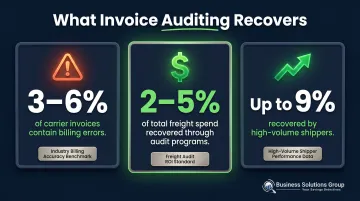
Between 3–6% of carrier invoices contain errors, with most originating in accessorial charges. Common issues include residential surcharge misapplication, unapplied contract discounts, and duplicate charges. Audit programs typically recover 2–5% of total freight spend, and parcel audit specialists working with high-volume shippers often recover up to 9%.
Setting up a systematic invoice auditing routine — or working with an auditing partner — catches discrepancies each billing cycle rather than after they compound for months. Business Solutions Group's carrier contract monitoring service verifies that negotiated discounts are applied correctly and handles carrier disputes directly. Clients typically see returns within the first billing cycle.
When to Reopen Negotiations Before Expiry
A signed contract isn't permanent. Watch for these triggers:
- Significant volume growth — you have more leverage than your current terms reflect
- Shift in service mix or delivery geography — your surcharge profile has changed
- New distribution center — zone distribution shifts, warranting new rate modeling
- Measurable carrier service performance decline — grounds to renegotiate or introduce competitive pressure
Carriers expect renewals at contract end. Shippers who track these signals can force the conversation sooner — often on more favorable terms.
Frequently Asked Questions
How do you negotiate shipping rates?
Build a detailed shipping profile (volume, weight, zones, surcharges) and benchmark it against what comparable shippers actually pay. Target base rates and accessorial fees, bring a competing bid, and start the process 90–120 days before your agreement expires.
What is the 80/20 rule in negotiations?
In carrier negotiations, 80% of your outcome comes from preparation: gathering shipping data, benchmarking rates, and defining clear goals. The conversation itself only accounts for about 20%. Shippers who skip the prep phase almost always accept suboptimal terms.
What is the 70/30 rule in negotiation?
The 70/30 principle suggests listening 70% of the time and speaking 30%. Asking your carrier rep to walk through their pricing logic, surcharge rationale, and discount structure often reveals flexibility you wouldn't discover by leading with demands.
What are the four golden rules of negotiation?
Applied to carrier contracts:
- Know your walk-away point before you start
- Never accept the first offer
- Negotiate the full package of terms, not just one line item
- Always be willing to walk away — carrier reps respond to credible alternatives, not desperation
What are the seven stages of negotiation in procurement?
Mapped to parcel contracts:
- Preparation — data analysis and benchmarking
- Opening — framing your position
- Testing — competitive RFP
- Proposing — specific concession requests
- Bargaining — back-and-forth on terms
- Closing — finalizing contract language
- Reviewing — ongoing invoice auditing and performance monitoring