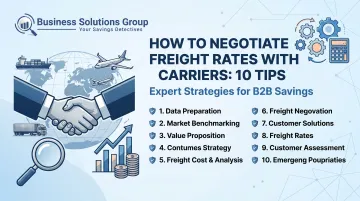
This guide is written for shippers and procurement teams — not carriers. The 10 tips below cover preparation, in-negotiation tactics, and contract management to help you secure better rates now and protect them over time.
Negotiating freight rates is a skill. It combines data literacy, negotiation strategy, and relationship management — all of which can be systematized once you know where to start.
Key Takeaways
- Audit freight spend by carrier, lane, mode, and shipment type before entering any negotiation
- Use market benchmarks and freight indexes to counter carrier pricing with evidence, not guesswork
- Leverage volume, multi-carrier bidding, and mode flexibility as your primary negotiation tools
- Negotiate fuel surcharge structures, payment terms, and service levels — not just the base rate
- Document every agreed term, review contracts for hidden fees, and build in scheduled rate reviews
Before You Negotiate: Build Your Data Foundation (Tips 1–3)
Tip 1: Audit Your Current Freight Spend
Start by pulling a complete picture of what you're actually paying — broken down by carrier, lane, freight mode, and shipment type. Most shippers are surprised by what that breakdown reveals.
This audit accomplishes two things: it shows you where costs are highest, and it reveals where you have leverage.
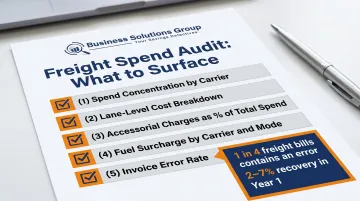
Key things your audit should surface:
- Spend concentration by carrier (which carriers represent the bulk of your freight budget)
- Lane-level cost breakdown (which origin-destination pairs are most expensive)
- Accessorial charges as a percentage of total spend
- Fuel surcharge amounts by carrier and mode
- Invoice error rate — roughly 1 in 4 freight bills contains an error, and freight audits typically recover 2% to 7% of total freight spend in the first year
High concentration with a single carrier can cut both ways. It gives you volume leverage when negotiating, but it also means you have limited competitive alternatives — which reduces your walk-away credibility.
Accessorial charges deserve particular attention. Fuel surcharges, liftgate fees, detention time, and reclassification charges add up without scrutiny. Many businesses overpay 10–15% due to unmanaged accessorials — charges that were either applied in error or accepted without scrutiny because they appeared in the fine print.
Business Solutions Group's freight audit process reviews every invoice line to flag incorrect weight classifications, duplicate billing, late delivery credits not applied, and accessorial fees added in error. Most clients find 10–30% in actionable savings through that initial review alone.
Tip 2: Research Market Rates and Industry Benchmarks
Without current market rate data, you have no way to evaluate whether a carrier's quote is competitive or inflated. You need lane-specific benchmarks for each freight type — LTL, FTL, intermodal, parcel — before any negotiation can be productive.
Useful benchmark sources include:
| Source | Best For |
|---|---|
| DAT RateView / DAT iQ | Truckload spot and contract rates by lane |
| Cass Freight Index | North American freight volume and expenditure trends |
| FreightWaves SONAR | Real-time multi-modal market intelligence |
| Freight consultants | Proprietary benchmark databases across modes |
Benchmarking also tells you where to focus. If your rates on three lanes are 8% above market but your other lanes are competitive, that's where you direct your negotiation energy first.
Companies that haven't independently benchmarked their contracts in the last 2–3 years are often overpaying by 15–30% relative to market rates — a gap that rarely surfaces from reading carrier communications alone.
Business Solutions Group's benchmark analysis compares client tariffs against proprietary market-rate intelligence, delivered through dashboards that drill down to shipment-level detail. The analysis is completed in 3–5 business days and provided at no cost.
Tip 3: Understand Every Cost Component — Not Just the Base Rate
The linehaul rate on a carrier quote is rarely the total cost. Shippers who compare carriers on base rate alone routinely make the wrong choice.
Cost components to account for before comparing quotes:
- Fuel surcharges — Fuel represents 20–30% of carrier operating expenses, and surcharges are recalculated weekly against DOE diesel price tables. LTL surcharges range from roughly 15% to 20%+ of linehaul depending on diesel prices
- Accessorial fees — Residential delivery, liftgate, inside delivery, notification/appointment scheduling, limited access delivery. Each adds cost that doesn't appear in the quoted rate
- Dimensional weight pricing — Parcel carriers price based on cubic size, not actual weight, which inflates costs for shipments near size thresholds
- Minimum charge thresholds — Many contracts contain minimum shipment charges that negate negotiated discounts on smaller parcels
- Peak-season surcharges — Applied during Q4 and other high-demand periods, often without advance notice
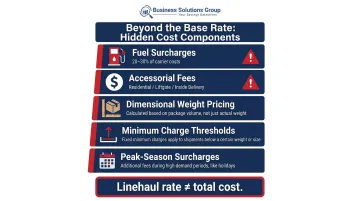
Before accepting any carrier proposal, ask for a full cost breakdown covering all surcharge schedules, accessorial rate tables, and minimum charge rules. That document is your actual comparison baseline, not the headline rate.
At the Table: Negotiation Tactics That Shift Leverage (Tips 4–7)
Tip 4: Use Volume and Shipping Consistency as Bargaining Power
Carriers price risk. A shipper who offers predictable, consistent volume over a defined period is a low-risk account worth discounting. A shipper who ships irregularly and unpredictably gets charged for that uncertainty.
The practical implication: commit to minimum volume thresholds or guaranteed lane frequency in exchange for rate reductions. Twelve months of historical shipping data — showing lane density, volume reliability, and forecast accuracy — removes a carrier's justification for risk premiums.
The case for this is concrete. A food producer replaced irregular LTL shipments with full truckloads and reduced transportation spend by 40% ($315,000) within six months. A foot care provider achieved 12.4% freight savings through pool distribution and multi-stop truckloads, cutting cost per pound from $0.46 to $0.39.
Smaller shippers aren't excluded from this leverage. Consolidating freight across product lines, business units, or locations — even across a portfolio of companies — creates aggregate volume that's more attractive to carriers than any single shipment size suggests.
Tip 5: Run Competitive Bids Across Multiple Carriers
Nothing creates negotiating leverage faster than genuine competition. A structured RFQ or mini-bid process — run across 3 to 5 carriers simultaneously — drives rates down without requiring confrontational tactics. Carriers negotiate harder when they know they're competing.
Best practices for a freight bid:
- Define lanes clearly — Include origin/destination pairs, freight characteristics, and volume expectations
- Standardize submissions — Require every carrier to provide base rates, fuel surcharge schedules, and accessorial tables in a consistent format
- Set a firm response deadline — This maintains momentum and signals seriousness
- Evaluate on total cost, not just rate — Factor in service reliability, transit times, and claims history alongside pricing
- Use results comparatively — Don't automatically award to the lowest bidder; use the spread to negotiate with preferred carriers
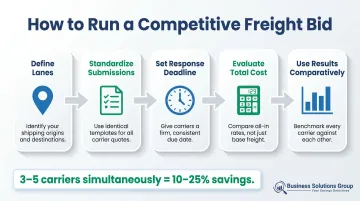
Managing this process manually across multiple carriers creates real coordination overhead. Business Solutions Group's eProcurement platform handles it end-to-end — from RFI qualification through live bidding — with side-by-side comparison tools and scenario modeling that keep the process moving across LTL, truckload, ocean, air, and rail.
Tip 6: Anchor Negotiations With Data, Not Assumptions
Whoever introduces the first specific number in a negotiation tends to influence where the final number lands. This is the anchoring effect — well-documented in behavioral economics — and it applies directly to freight rate discussions.
When a carrier presents an initial rate, a shipper with benchmark data can counter by referencing what comparable lanes are actually trading at in the market. That shifts the conversation from "take it or leave it" to a data-driven exchange with a rational reference point.
A practical example: a shipper might celebrate a 5% contract rate reduction while the spot market has dropped 12%. Without external benchmarks — DAT, Cass, or proprietary rate intelligence — that shipper doesn't know they've accepted an above-market deal.
Come prepared with specific lane-level data, present it early, and let the carrier respond to your reference point rather than the other way around.
Tip 7: Negotiate Beyond the Base Rate — Terms, Surcharges, and Service Levels
When a carrier won't move on linehaul rate, other levers often remain. Shippers who focus exclusively on the base rate leave real savings on the table.
Negotiable terms beyond the base rate:
- Fuel surcharge structure — Negotiate the calculation base price, floor, and cap to limit exposure during diesel price spikes. Carriers often accept surcharge modifications that shippers never think to request
- GRI mitigation clauses — Limit General Rate Increases to roughly 2% on specific lanes instead of absorbing a blanket 6% announcement
- Payment terms — Net-60 vs. net-30 affects your cash flow materially at scale
- Capacity commitments — Guaranteed lane capacity during peak season can be worth more than a rate discount
- Claims handling procedures — Defined timelines and resolution processes reduce dispute costs
- Service level agreements — Transit time guarantees and on-time performance standards with performance consequences
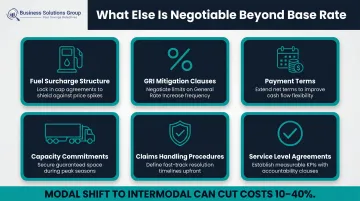
Shifting long-haul lanes from over-the-road to intermodal can cut costs by 10% to 40% compared to standard truckload. Consider this modal shift when carriers resist rate movement on price alone.
Know when to walk away. If a carrier's pricing is consistently out of line with market benchmarks and they won't engage, that position is only credible if alternatives are already lined up. That's precisely what the competitive bid process in Tip 5 makes possible.
Closing the Deal: Contracts, Terms, and Ongoing Rate Management (Tips 8–10)
Tip 8: Review Every Contract Clause Before Signing
Signed contracts lock in terms that are costly to contest later. What looks like a reasonable agreement at signing can become expensive once buried clauses activate.
Clauses to scrutinize before signing:
- Rate escalators — Automatic annual increases that trigger without renegotiation
- Fuel surcharge adjustment triggers — Are these fixed, floating, or capped?
- Minimum volume penalties — What happens if you fall short of committed volume?
- Dimensional billing rules — Can the carrier reclassify shipments mid-contract?
- Billing dispute windows — How long do you have to contest an invoice?
- Early termination clauses — What are the costs if you need to switch carriers?
- Liability caps — What is the carrier's maximum exposure on claims?
Contract rates are sometimes called "paper rates" because carriers don't always honor them when capacity tightens, pushing shippers into the spot market at higher prices. That exposure is exactly why clause-level review matters before you sign.
Business Solutions Group's contract review team — which includes former UPS and FedEx senior pricing analysts — examines agreements line by line. Their analysis frequently uncovers rebates, credits, and discounts that carriers applied incorrectly, translating directly into recoverable savings.
Tip 9: Choose the Right Contract Type for Your Business Model
Not every shipper benefits from the same contract structure. The three primary options each carry different risk profiles:
| Contract Type | Rate Stability | Flexibility | Best For |
|---|---|---|---|
| Long-term (1–2 years) | High | Low | High-volume, predictable shippers needing budget certainty |
| Spot/Short-term | Low | High | Seasonal or variable-volume shippers with flexible timelines |
| Index-linked | Medium | Medium | Shippers in volatile markets wanting market alignment without constant renegotiation |
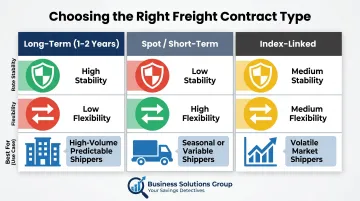
The 2020–2022 freight cycle illustrated the stakes. The truckload spot rate index moved from 93.4 to 178.1 — a near doubling — within that window. Shippers locked into long-term contracts during the peak paid above-market rates; those with spot exposure during the trough benefited. The lesson isn't that one structure always wins, but that matching your contract type to your volume predictability and risk tolerance matters.
Spot rates overtook contract rates during the 2025 holiday season and persisted into Q1 2026 — a signal that contract rates typically follow spot upward, making now a practical window to lock in multi-year agreements before that adjustment completes.
Tip 10: Schedule Regular Rate Reviews and Build Carrier Relationships Over Time
Securing a good rate at contract signing is the beginning, not the end. Freight markets shift, carrier capacity fluctuates, and the leverage balance between shipper and carrier changes continuously.
Build formal rate review cycles into every carrier relationship — quarterly scorecards with comprehensive annual reviews. These check-ins aren't optional in the current market.
Driver employment in long-distance trucking decreased year-over-year for 32 consecutive months as of late 2025, and FMCSA enforcement changes could push an additional 194,000 drivers out of the market. Capacity constraints like these drive rate increases that catch shippers off-guard when they're only reviewing contracts at renewal.
Beyond rate reviews, invest in the carrier relationship itself. Timely payment, clear volume communication, and reliable freight commitments earn preferential treatment when markets tighten — better capacity access, more flexible dispute resolution, and greater willingness to negotiate at renewal.
Business Solutions Group builds ongoing rate review cycles directly into client engagements: weekly or monthly savings reporting, quarterly business reviews, and continuous identification of new cost-saving opportunities. Transportation costs don't stay fixed — and your review cadence shouldn't either.
How Spend Intelligence and Expert Advisory Strengthen Your Position
For shippers managing multi-lane, multi-carrier freight programs, manual benchmarking quickly becomes unmanageable. Rate markets shift monthly. Surcharge tables update weekly. Carrier performance varies by lane. Tracking all of it manually while running a business is unrealistic.
Spend intelligence software and advisory partnerships address this directly. Business Solutions Group's platform aggregates freight data across all modes — parcel, LTL, FTL, air, ocean, rail — and delivers carrier performance scoring, rate anomaly identification, and negotiation-ready benchmarks through consolidated dashboards. The platform manages over $3 billion in parcel spend and has helped clients achieve more than $350 million in annual savings.
The advisory engagement follows a structured 8–10 week process: benchmark analysis, strategic planning, behind-the-scenes negotiation coaching, and final contract implementation. The model is performance-based — clients don't pay unless savings are delivered.
According to a 2024 3PL industry study, 84% of shippers and 97% of 3PLs agree there is a need for more advanced analytics capabilities in logistics relationships. Shippers who combine internal data literacy with an expert advisory partnership consistently outperform those who negotiate ad hoc, because they enter every carrier conversation with validated data and a clear strategy.
Frequently Asked Questions
How do you optimize shipping costs?
Audit current freight spend by carrier, lane, and mode first. Then benchmark rates against market data, consolidate volume where possible, negotiate surcharge structures alongside base rates, and schedule quarterly reviews to ensure rates stay aligned with market conditions.
How do you negotiate a service level agreement in freight?
Define transit time guarantees, on-time performance standards, claims handling timelines, and capacity commitments in writing. Tie measurable performance penalties or incentives to these terms — carriers take SLA commitments more seriously when there are financial consequences attached.
What are the four negotiation strategies?
Four common negotiation styles are competing (win-lose, positional), collaborating (win-win, interest-based), accommodating (concession-focused), and avoiding (walking away). In freight negotiations, collaborating works best on surcharge structures and service terms, while competing suits base rate discussions backed by benchmark data.
What are the 5 C's of negotiation?
Communicate, Calmness, Clarification, Collaborate, and Compromise. In freight negotiations, apply these by stating volume needs clearly, staying calm under pushback, pinning down ambiguous contract language, working with carriers on surcharge structures, and giving ground on secondary terms to protect base rate reductions.
What is the 70/30 rule in negotiation?
Spend 70% of the negotiation listening and 30% speaking. In freight contexts, this means asking carriers about their capacity constraints, lane priorities, and cost pressures before presenting your counter. Understanding what a carrier actually needs often reveals flexibility that a purely positional approach would never surface.