Most conversations about freight focus on tactics: audit your invoices, renegotiate contracts, consolidate loads. Those are valid. But the more important question is what actually changes inside your business when freight costs are brought under consistent control.
This article covers that ground — specifically how freight cost reduction affects profit margins, pricing flexibility, and your capacity to grow without logistics costs eating the upside.
Key Takeaways
- Freight savings translate almost directly into gross margin improvement — no incremental revenue required
- Lower logistics overhead creates pricing flexibility that competitors overpaying on freight don't have
- Unoptimized freight costs scale faster than revenue, creating a hidden ceiling on profitable growth
- 80% of shippers lack full visibility across regions and modes — most are making freight decisions without the full picture
- Locking in savings means ongoing monitoring — not a once-a-year review
What Is Freight Cost Reduction?
Freight cost reduction is the systematic process of identifying and eliminating unnecessary spend across every aspect of moving goods — transportation rates, fuel surcharges, accessorial fees, dimensional weight charges, handling costs, and administrative overhead.
It applies across all modes and business sizes:
- Small parcel shippers managing FedEx and UPS spend
- LTL and FTL shippers negotiating carrier contracts
- Importers managing ocean and air freight lanes
- Businesses shipping domestically, cross-border, or globally
What those categories share is a downstream effect that goes beyond the invoice. Lower freight costs translate directly into better margins, more competitive pricing, and a logistics cost structure that scales without eroding profitability.
Key Business Impacts of Reducing Freight Costs
The advantages below connect to financial and operational metrics that leadership actually tracks — and each one follows directly from bringing freight spend under control.
Stronger Profit Margins and Improved Cash Flow
Freight costs function as a silent tax on every unit shipped. Unlike overhead costs that are somewhat fixed, unoptimized freight charges grow with volume and compound with carrier rate increases. Reducing them translates almost dollar-for-dollar into improved gross margin — no new revenue needed.
Bain research on distribution and transportation costs found that these expenses typically represent 6–8% of revenue for product companies — and that structured optimization efforts have produced reductions of more than 20% in one case and 15% within 12 months in another, while maintaining 98% on-time delivery.
How that improvement gets realized in practice:
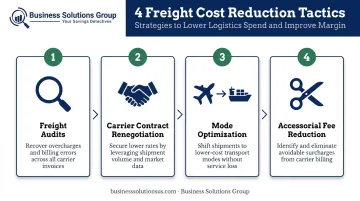
- Freight audits catch billing overcharges before they become sunk costs
- Carrier contract renegotiation replaces above-market rates using benchmark data
- Mode optimization shifts volume from air to ocean, or spot LTL to consolidated loads, where service requirements allow
- Accessorial fee reduction eliminates charges triggered by packaging errors, scheduling missteps, or incorrect freight class assignments
Margin improvement from cost reduction is also faster than margin improvement from revenue growth — and unlike a sales initiative, the savings don't require incremental headcount or marketing spend to sustain.
Lower freight spend on each shipment frees working capital that can be redeployed toward inventory investment, hiring, or capacity expansion rather than absorbed by logistics overhead.
KPIs impacted: gross profit margin, COGS, operating cash flow, cost-per-shipment, freight-as-a-percentage-of-revenue
Competitive Pricing Power and Market Positioning
When freight costs are high and uncontrolled, businesses face a binary choice: absorb the expense and compress margins, or pass it to customers and risk losing the deal. Neither option is attractive. Reducing freight costs breaks that trade-off.
With lower logistics overhead, a business can choose from options that competitors still overpaying on freight can't access:
- Reduce customer-facing prices to win volume in competitive bids
- Hold prices steady while banking higher margins per unit
- Offer free or flat-rate shipping as a differentiator — particularly in e-commerce and B2B distribution
- Price more aggressively across specific geographies or customer segments without sacrificing margin
In B2B markets, landed cost — the full cost to deliver a product to the customer — is a real factor in supplier selection. A peer-reviewed study on international supplier selection confirmed that total landed cost, including transportation, is a formal input in how purchasing managers evaluate and choose vendors. Businesses with lower delivered costs have a structural advantage in those decisions.
The strategic benefit extends beyond price competition. Companies with lower freight cost structures can pursue new markets, onboard lower-margin accounts, or respond to price pressure without immediately threatening profitability. That flexibility doesn't exist when freight spend is unmanaged.
KPIs impacted: win rate on competitive bids, average order value, landed cost per unit, customer acquisition cost, customer retention rate
Scalability and Supply Chain Resilience
Unmanaged freight spend scales linearly — or worse — with volume. Every new customer, new market, and new product line adds cost at the same inefficient rate, turning logistics into a genuine growth constraint.
Structural freight cost reduction breaks that relationship. When businesses establish volume-based carrier commitments, route optimization practices, and load consolidation strategies, they build a logistics infrastructure that absorbs growth without proportional cost increases.
Resilience operates through the same mechanism. Consider what happened to trucking costs in recent years: ATRI reported total marginal trucking costs hit $2.27/mile in 2023, up significantly from $1.855/mile in 2021. Businesses with diversified carrier bases, contracted capacity, and mode flexibility absorbed those increases with far less disruption than those relying on spot rates and single-carrier relationships.
What supply chain resilience actually requires:
- Carrier diversification eliminates single-carrier dependency that hands rate leverage to vendors
- Contracted capacity protects against spot market surges during peak seasons
- Spend visibility enables real-time monitoring that catches cost drift before it becomes structural
- Mode flexibility allows shifting between options when rates or capacity tighten
The visibility gap here is notable: Project44's survey of 200+ shippers found that only 20% had full visibility across all regions and modes. Businesses operating without that visibility aren't positioned to respond to disruptions — they're positioned to be surprised by them.
KPIs impacted: freight cost per unit at scale, on-time delivery rate, carrier diversification, cost variance during peak seasons
What Happens When Freight Costs Go Unmanaged
The consequences of ignoring freight spend management are rarely dramatic at first. They accumulate slowly and often get misdiagnosed.
Common patterns in unmanaged freight programs:
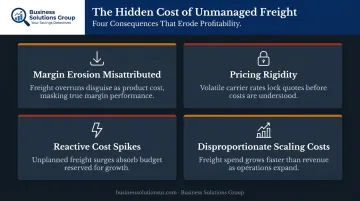
- Margin erosion gets misattributed to pricing or demand while freight inefficiency goes unaddressed — businesses adjust pricing strategy or cut headcount instead of fixing the real problem
- Inflated freight costs create pricing rigidity, making it impossible to respond to competitive pressure without accepting losses on bids you'd otherwise win
- Without spend monitoring, cost spikes force rushed carrier selections, premium rates, and last-minute mode shifts — each reactive decision costs more than a proactive one would have
- As volume grows, unoptimized freight costs scale disproportionately, and the constraint only becomes visible when it's hardest to fix
Underlying all four patterns is a visibility problem. Without cross-mode, cross-region insight into freight spend, billing errors persist unchallenged, above-market rates go undetected, and accessorial charges accumulate without review.
How to Get the Most Value from Freight Cost Reduction
Freight cost reduction delivers its highest return when it's treated as an ongoing management discipline — not a once-a-year contract review or a one-time audit project.
Three conditions that determine whether savings are sustained:
Freight spend data is reviewed continuously, not just at renewal. Businesses that monitor carrier performance, rate accuracy, and spend trends on an ongoing basis find more savings over time than those conducting annual reviews. Markets move. Carrier rates shift. Billing errors recur. Regular review catches these before they compound.
Findings get acted on. An audit that surfaces overcharges is only valuable if those overcharges get recovered and the root cause gets corrected. A benchmark analysis that shows above-market rates only matters if it drives a contract renegotiation. Savings opportunities that are documented but not implemented don't improve margins.
The right tools and expertise are in place. For businesses without internal freight intelligence infrastructure, a supply chain optimization advisor can accelerate both identification and implementation. Business Solutions Group works with shippers across parcel, LTL, FTL, ocean, air, and rail — handling both the benchmark analysis and the contract negotiation work required to turn findings into actual savings.
Businesses that build freight cost management into their regular operations — rather than revisiting it only when contracts expire — tend to recover more, renegotiate from a stronger position, and keep carrier billing errors from quietly eroding their margins.
Conclusion
Reducing freight costs does more than trim a line item. It improves gross margins directly, restores pricing flexibility that competitors with unmanaged freight spend don't have, and builds the logistics infrastructure needed to grow without cost blowout.
The gains compound. Better rate structures, smarter mode selection, and stronger carrier relationships each lower the cost baseline heading into the next growth period — and build the resilience that market disruptions routinely expose as the difference between businesses that absorb shocks and those that don't.
Freight is a strategic cost driver. The businesses that manage it that way don't just compete more effectively — they grow without the margin erosion that catches most companies off guard.
Frequently Asked Questions
What impacts freight costs?
The primary drivers are shipment weight and dimensions, distance, mode of transportation, fuel surcharges, accessorial fees, carrier capacity, and seasonal demand. Any of these can shift materially — fuel surcharges alone fluctuated by nearly $2/gallon between 2021 and 2024 — which is why active monitoring matters year-round, not just at contract renewal.
Why is it important to reduce costs?
Reducing freight costs directly improves profit margins, frees working capital, and creates pricing flexibility that high-freight-cost competitors don't have. On high-volume shipping programs, even a modest percentage reduction compounds into substantial annual savings at the business level.
How much can a business realistically save by reducing freight costs?
It varies by volume, shipping mix, and how optimized the current program is. Bain case examples documented reductions of 15% to more than 20% in distribution and transportation costs through structured optimization. Businesses that haven't conducted formal assessments often find more savings available than they expected.
Does reducing freight costs affect customer satisfaction?
Yes, indirectly. Lower freight overhead can fund faster shipping options, free shipping programs, or flat-rate pricing — all of which improve the customer experience. More consistent delivery performance, a natural byproduct of optimized logistics, reinforces that value further.
Can small businesses benefit from freight cost reduction strategies?
Yes. Shipment consolidation, packaging optimization, off-peak scheduling, and working with a freight advisor or 3PL are all accessible regardless of volume. At lower shipment counts, the percentage savings are often just as meaningful — sometimes more so — because every dollar recovered has a direct impact on margins.
What is the fastest way to start reducing freight costs?
Freight audits and carrier contract reviews are the fastest entry points. Audits surface billing errors and unauthorized charges that can be recovered immediately. Contract reviews compare current rates against market benchmarks and identify where renegotiation would deliver the most impact — typically without requiring any operational changes.