in Supply Chain Management](https://file-host.link/website/businesssolutionsus-mg3rtz/assets/blog-images/4c741258-a1be-49ae-8c99-64f0a67340b4/1779228309189699_3215b971da77437c94bfb0e95b8353e7/360.webp)
In that environment, gut feel and month-end reports aren't enough. By the time a problem surfaces in a static spreadsheet, costs have already compounded.
Business intelligence in supply chain management changes that dynamic. This article covers how BI functions as a practical operations tool—not just what it promises in theory—across three high-impact areas: real-time visibility, demand forecasting, and shipping cost reduction.
Key Takeaways
- BI turns raw supply chain data into decisions—covering procurement, logistics, inventory, and carrier spend
- Real-time visibility shortens the gap between a problem occurring and a response being made
- Inventory distortion cost global retailers $1.7 trillion in 2024—accurate forecasting directly attacks that number
- Without BI, shipping costs drift upward as rate increases go unchallenged and invoice errors go undetected
- Spend intelligence tools expose hidden losses across carrier contracts, freight lanes, and billing before they compound
What Is Business Intelligence in Supply Chain Management?
Supply chain BI is the process of collecting, integrating, and analyzing data from across the supply chain—suppliers, warehouses, carriers, and customers—to surface insights that improve decisions and outcomes.
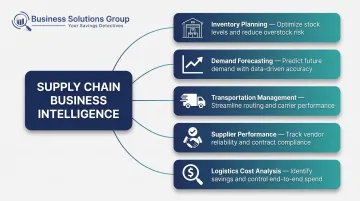
BI spans multiple operational functions rather than living in a single platform:
- Inventory planning — right-sizing stock levels based on demand signals
- Demand forecasting — predicting what's needed, where, and when
- Transportation management — tracking carrier performance and freight costs
- Supplier performance — monitoring lead times and reliability
- Logistics cost analysis — identifying where spend can be reduced or renegotiated
The goal is to shift supply chain management from reactive firefighting to proactive control: lower costs, stronger fill rates, and faster response when disruptions hit.
Key Advantages of Business Intelligence in Supply Chain Management
The advantages below focus on measurable, operational impact. Each maps directly to outcomes supply chain leaders are accountable for: cost, service levels, risk, and efficiency.
Advantage 1: Real-Time Visibility and Faster Decision-Making
Real-time visibility means monitoring what's happening across the supply chain—inventory levels, order status, supplier lead times, carrier performance—as it happens, not after the fact.
BI creates this advantage by aggregating data from ERP systems, warehouse management platforms, transportation management systems, and carrier feeds into unified dashboards. That eliminates the information lag that forces managers into reactive decisions.
Why it matters: McKinsey's Supply Chain 4.0 research found that digital supply chain capabilities can reduce supply chain costs by up to 30% and cut lost sales by up to 75% in certain operating contexts. Even as estimates, those numbers reflect what becomes possible when teams act on data in real time rather than waiting for weekly or monthly reports.
Consider a practical example: a carrier delay detected Tuesday afternoon can trigger a rerouting decision before a stockout occurs. The same delay discovered in a Friday report triggers an expedite fee and a customer complaint.
Gartner's 2025 supply chain guidance specifically urges leaders to prioritize advanced data visibility and scenario planning as a competitive differentiator amid ongoing global uncertainty.
KPIs most impacted:
- On-time delivery rate
- Order fill rate
- Lead time variability
- Inventory accuracy
- Exception rate (anomalies caught before escalation)
When it matters most: High-volume shipping environments, multi-node distribution networks, and peak demand periods—where a few hours of data latency translates directly into service failures.
Business Solutions Group's TMS platform supports this through real-time shipment tracking with pre-shipment, in-transit, and post-shipment visibility, automated exception alerts, and carrier performance monitoring across delays, incorrect deliveries, and cost variances.
Advantage 2: Demand Forecasting and Inventory Optimization
This advantage is the ability to predict how much of each product will be needed, where, and when—so organizations stock the right amount rather than over- or under-ordering.
Predictive models analyze historical sales data, seasonal trends, market signals, and promotional calendars to generate demand signals more accurate than static averages. Those signals feed directly into replenishment timing, safety stock calculations, and purchasing decisions.
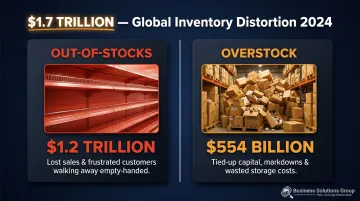
Why it matters: IHL Group estimates global inventory distortion at $1.7 trillion in 2024—$1.2 trillion from out-of-stocks and $554 billion from overstock. That's the direct financial cost of inaccurate forecasting. Excess inventory ties up working capital; stockouts lose sales and erode customer trust. Both happen simultaneously when demand signals are unreliable.
McKinsey's supply chain analytics research points to approximately 15% inventory reduction and 15–30% service-level improvement as achievable outcomes with well-implemented analytics programs.
KPIs most impacted:
- Inventory turnover rate
- Days of inventory on hand (DIOH)
- Stockout rate
- Carrying cost as a percentage of revenue
- Forecast accuracy percentage
When it matters most: Businesses with seasonal demand patterns, wide SKU breadth, or long supply lead times—where reactive purchasing is expensive and slow.
Business Solutions Group's Demand Planning Software uses over 250 complex algorithms to forecast demand, predict sales, and optimize inventory. The platform integrates with ERP systems and includes S&OP, inventory planning, and safety stock optimization tools—designed to replace the manual spreadsheet environments that make demand variability so costly.
Advantage 3: Shipping Cost Reduction and Spend Intelligence
This advantage is the ability to analyze where money is being spent across carriers, freight lanes, and procurement—and identify where costs can be reduced, renegotiated, or recovered.
Spend intelligence works by aggregating carrier invoice data, rate benchmarks, lane performance, and contract terms into a unified view. That visibility surfaces overcharges, underutilized discounts, and lanes where alternative carriers would reduce costs. The data becomes leverage in contract negotiations.
Why it matters: Most organizations have no benchmark to evaluate whether their carrier rates are competitive. Without that reference point, they accept rate increases passively and miss savings opportunities at contract renewal. Invoice errors compound the problem—studies estimate 15–25% of freight invoices contain billing mistakes, creating a steady, undetected drain on margins.
For businesses where freight is a significant cost line, even modest per-shipment savings aggregate into substantial annual reductions without requiring revenue growth.
Business Solutions Group's Parcel Spend Intelligence platform manages over $3 billion in parcel spend and has delivered more than $350 million in annual savings for clients. The platform produces more than 25 specific findings per engagement, covering billing overcharges, underutilized discounts, and rate structure optimization.
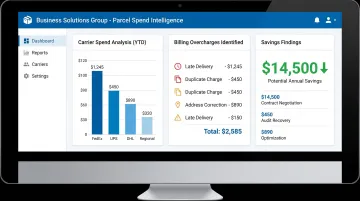
The engagement starts with a no-cost savings analysis completed within 48–72 hours. From there, BSG's team—which includes former UPS and FedEx senior-level pricing analysts—supports contract negotiations and runs weekly post-audits to catch ongoing billing errors. Clients keep 100% of recovered credits.
Most clients who haven't benchmarked their contracts in two to three years are overpaying by 15–30%.
KPIs most impacted:
- Cost per shipment
- Freight cost as a percentage of revenue
- Carrier on-time performance
- Contract compliance rate
- Savings realized through renegotiation
When it matters most: Small parcel and freight shippers operating at volume, where per-shipment savings compound into meaningful annual reductions—and where contract terms are typically accepted without benchmark validation.
What Happens When Business Intelligence Is Missing from Your Supply Chain
Without BI, supply chain teams operate on stale reports, tribal knowledge, and instinct. Problems are discovered after they've already become costly.
The consequences compound:
- Inventory imbalance — inaccurate forecasting creates simultaneous stockouts in some locations and overstock in others, driving lost sales and carrying cost waste
- Uncontrolled freight spend — without visibility into whether carrier rates are competitive or invoices are billed correctly, costs drift upward quarter over quarter
- Scalability ceiling — as order volumes grow or supplier networks expand, the absence of structured data makes complexity unmanageable, pushing error rates and operational costs higher
- Slow disruption response — without monitoring supplier performance and lead time variability, disruptions arrive without warning and recovery lags
These aren't isolated failures — they reinforce each other. Higher carrying costs reduce cash available for strategic investment. Reactive logistics decisions add expediting fees. Poor demand visibility generates markdown losses.
The result is a persistent drag on profitability that looks like bad luck but traces directly to missing data.
Gartner's survey data shows 73% of companies made supply chain network changes in the past two years, with 90% planning more. Organizations making those changes without BI are redesigning their networks blind.
How to Get the Most Value from Business Intelligence in Your Supply Chain
BI tools don't deliver results on their own. The value comes from how consistently insights are acted on.
Three conditions for high ROI:
- Clean, integrated data — BI is only as accurate as the data feeding it. ERP systems, WMS, TMS, and carrier billing platforms must be connected into a unified view
- Regular KPI cadence — dashboards reviewed ad hoc deliver a fraction of the value of dashboards reviewed on a structured weekly or monthly schedule
- Decision authority — teams must be empowered to act on what the data shows, not just report on it
The most effective implementations start with a specific, measurable problem—reducing freight spend, improving forecast accuracy, increasing inventory turns—rather than deploying a platform and waiting for insights to emerge. Solving a defined problem first creates early wins that build organizational confidence in the data.
In areas like carrier contract negotiation, internal data alone rarely tells the full story — market benchmarks and negotiation experience determine whether savings actually materialize. Business Solutions Group pairs its spend intelligence platform with advisory support: the software connects to ERP, WMS, and carrier billing sources, while the advisory team interprets findings, guides negotiations, and surfaces savings through ongoing post-audit analysis. That combination converts BI outputs into verified cost reductions.
For smaller shippers — those spending under $500,000 annually on parcel and freight — a full BI implementation may not be the right starting point. BSG's rate-shopping TMS offers a more direct path to savings, comparing carrier rates in real time across every shipment without requiring a broader analytics rollout.
Conclusion
Business intelligence in supply chain management comes down to one practical outcome: making better decisions faster than the problems find you. Real-time visibility, accurate forecasting, and spend intelligence aren't abstract capabilities — they're the levers that directly cut cost and lift service levels.
The advantages compound over time when applied consistently. A business that treats BI as an ongoing operational practice—not a one-time implementation—builds a structural cost advantage that grows as data accumulates and decisions improve. Visibility reduces expediting. Better forecasting reduces carrying costs. Spend intelligence reduces freight overpayment. Each improvement funds the next.
Companies that wait for problems to surface before acting pay a premium — in expediting fees, excess inventory, and missed service targets. The supply chain doesn't slow down for businesses that aren't watching it closely. BI is how you stay ahead of it.
Frequently Asked Questions
What is the role of business intelligence in the supply chain?
BI collects and analyzes data from across the supply chain to support faster, more accurate decisions—covering demand forecasting, inventory management, supplier performance, logistics, and cost control. Its core role is shifting supply chain management from reactive to proactive, so problems are prevented rather than discovered after costs have already compounded.
What are the 4 pillars of business intelligence?
The four foundational components are data collection and integration, analytical modeling, visualization and reporting, and performance monitoring. In a supply chain context, these translate to connecting operational systems, running descriptive through prescriptive analytics, presenting insights in dashboards teams can act on, and tracking KPIs consistently.
What is real-time tracking in the supply chain?
Real-time tracking is the continuous monitoring of inventory, shipments, and supplier activities as they happen—enabled by BI tools that aggregate live data from WMS, TMS, ERP, and carrier systems into a single operational view. It replaces end-of-day or end-of-week reporting with exception alerts and live status updates.
What are the 4 supply chain models?
The four commonly referenced models are continuous flow, fast chain, efficient chain, and agile (or custom-configured). BI supports each differently: efficiency-focused chains lean on cost and inventory analytics, while agile chains depend on real-time visibility and scenario planning to handle demand variability.
How does business intelligence help reduce supply chain costs?
BI reduces costs by identifying inefficiencies in carrier spend, surfacing overstock and carrying cost waste, optimizing procurement decisions, and providing the benchmark data needed to negotiate better contracts. Spend intelligence tools add a layer by detecting billing errors and quantifying how far current rates sit from market benchmarks.
What is the difference between supply chain analytics and business intelligence?
Supply chain analytics refers to the specific techniques applied to supply chain data—descriptive, diagnostic, predictive, and prescriptive methods. Business intelligence is the broader capability: the tools, dashboards, and data infrastructure that make those analytics accessible and actionable for the people making decisions day to day.