That's not a technology failure. That's a visibility failure, and it happens every day across companies of every size.
The deeper problem is what that failure costs — not in frustration, but in dollars. According to McKinsey, supply chain disruptions cost the average organization 45% of one year's profits over a decade. Yet only 25% of firms can identify and predict supply disruptions before they escalate, per Deloitte's 2023 CPO survey.
This article breaks down where visibility gaps are bleeding money — specific cost categories, where the gaps originate, how they undermine carrier negotiations, and what practical steps close them faster than you'd expect.
Key Takeaways
- Poor supply chain visibility generates direct P&L hits: OTIF penalties, detention fees, expedite premiums, and inventory write-offs
- The costliest visibility gaps are structural, hiding in disconnected systems and unmonitored supplier tiers
- Without centralized freight spend data, carrier contract negotiations default to guesswork
- Incremental visibility improvements recover costs quickly — no full technology overhaul required
What Poor Supply Chain Visibility Is Actually Costing You
Every visibility gap in your supply chain has a direct cost attached — fines, premiums, write-offs, and fees that erode margin before most teams even know there's a problem.
Retailer Penalties and Expedite Premiums
OTIF (on-time, in-full) compliance is non-negotiable with major retailers. Walmart's established standard requires suppliers to hit 98% OTIF, with penalties of 3% of COGS for non-compliant shipments, according to Supply Chain Dive. On a $2 million product line, that's $60,000 in fines per violation cycle — money that flows directly out of margin.
Nearly all OTIF penalties are preventable. When shippers have real-time PO status and carrier milestone data, exceptions surface early enough to fix. Without it, teams find out after the delivery window closes.
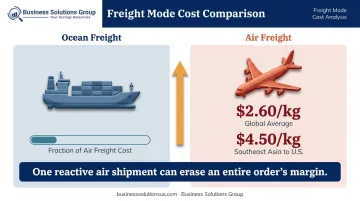
The expedite trap compounds the problem. When a late shipment is discovered too late for ground or ocean correction, the only option is air freight. Air cargo currently averages $2.60/kg globally, with Southeast Asia to U.S. routes running $4.50/kg (Xeneta, 2024). Ocean freight runs a fraction of that. One reactive air shipment can erase the margin on an entire order.
Detention, Accessorial, and Redelivery Charges
Detention fees accumulate whenever a carrier waits beyond the free-time window at a dock. This isn't rare — drivers experience detention at 39.3% of stops, costing the for-hire trucking industry $11.5 billion in lost revenue in 2023 (ATRI/PrePass, 2024).
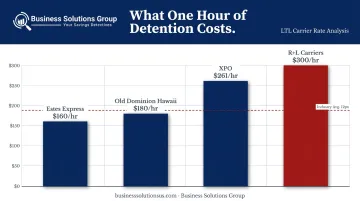
Published carrier tariffs show the hourly cost range for powered detention:
- Estes Express: ~$160/hour
- Old Dominion (Hawaii): ~$180/hour
- XPO: ~$261/hour
- R+L Carriers: ~$300/hour
These charges stem directly from poor dock appointment management and missing milestone data. Without a centralized view of arrival times and dock schedules, the same dock gets overbooked, drivers wait, and fees accumulate invisibly across hundreds of shipments.
Redelivery and missed-appointment charges run on the same root cause: missing milestone data means appointment windows slip, carriers show up to closed docks, and minimum-fee bills pile up. Across a high-volume operation, you'll miss these accessorial charges without centralized freight invoice data to surface them.
Inventory Write-offs and Spoilage
For temperature-sensitive shippers in food, pharma, and CPG, visibility gaps in cold chain monitoring have a direct write-off cost. IQVIA data shows vaccine wastage from transportation and storage failures reaches 7% to 25%, with 33% of storage and 38% of transportation instances exposing vaccines to out-of-range temperatures.
Without integrated lot-number tracking and real-time temperature logs across carriers, teams discover excursions only after delivery or QA rejection. At that point, the product is gone.
Operations with real-time sensor alerts can intervene mid-transit (rerouting, adjusting conditions, or flagging for accelerated delivery) and recover product that would otherwise be written off.
Where Visibility Gaps Hide in Plain Sight
Most companies assume their visibility problems are obvious. They're not. The most expensive gaps are structural — rooted in how data moves (or fails to) across disconnected systems and partners.
The numbers confirm this disconnect. IBM research found that 60% of supply chain leaders say their supply chains lack visibility, and 72% of suppliers who experienced a breakdown lacked full, real-time visibility. These aren't small or unsophisticated companies. The gaps exist because the systems that should be talking to each other simply aren't integrated.
Fragmented Data Across Internal Systems
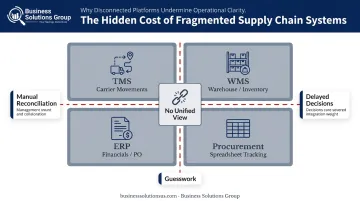
The typical enterprise runs supply chain operations across at least four disconnected platforms:
- TMS tracks carrier movements and freight status
- WMS holds inventory positions and warehouse activity
- ERP manages financials, POs, and invoicing
- Procurement often lives in spreadsheets or a standalone platform
Without integration, no single person has a unified view of cost, status, and performance simultaneously. Every cross-functional question requires manual reconciliation : pulling data from four systems, normalizing it, and hoping the numbers align.
When that reconciliation breaks down, mismatched carrier IDs, inconsistent location codes, and non-standardized product identifiers prevent automatic matching. A question as routine as "what did we pay for this lane last quarter?" can take hours to answer — and by the time it's answered, the decision it was meant to inform has already been made on guesswork.
Supplier and Partner Blind Spots
Upstream visibility gaps are equally costly. When suppliers don't share status updates in real time, shippers learn about production delays or compliance issues after the window to respond has closed. The BCI Supply Chain Resilience Report (2023) found that 26.4% of organizations didn't record, measure, or report on key supplier performance at all.
Downstream, the absence of in-transit telemetry creates what operations teams call "phantom inventory": goods technically in motion but unlocatable and unreliable for planning. The result is predictable. Stockouts occur when phantom inventory doesn't arrive on time. Overordering follows when planners pad safety buffers to compensate. Both behaviors add cost — and both stem from the same root cause: no reliable signal about what's actually happening in transit.
The Ripple Effect on Carrier Contracts and Freight Spend
Visibility gaps don't just generate operational costs. They destroy a company's ability to manage freight spend strategically.
Without clean, centralized spend data, businesses can't answer the questions that drive better contracts:
- Which lanes are we overpaying on relative to market rates?
- Which carrier relationships justify volume commitments?
- Where are contract terms being violated without consequence?
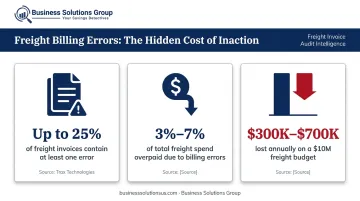
Benchmarking blind spots are expensive. Carrier contract negotiations require lane-level cost data, volume distribution, and service-level performance history. Without it, shippers accept whatever rates they're offered. Freight audit firms consistently report that 3% to 7% of total freight spend is overpaid due to billing errors (TransImpact; CTSI-Global estimates 3% to 5% of annual transportation spend is billed incorrectly). On a $10 million freight budget, that's $300,000 to $700,000 walking out the door annually — entirely recoverable with proper invoice auditing.
That invoice exposure compounds the benchmarking problem. Trax Technologies estimates up to 25% of freight invoices contain at least one error. Duplicate charges, misapplied accessorials, and contract non-compliance go undetected when there's no centralized auditing workflow. Each error is small. Across thousands of invoices, they add up to material overcharges that funded the carrier, not the shipper.
That's the gap Business Solutions Group's proprietary spend intelligence software addresses. Rather than leaving shippers to manually reconcile multi-carrier invoices across disparate systems, BSG aggregates freight spend data, surfaces billing discrepancies, and provides the benchmark analysis needed to enter carrier negotiations with documented, data-backed leverage.
The objective: turn freight spend from a passive cost center into an actively managed source of competitive advantage.
The Business Benefits When Visibility Improves
When visibility gaps close, operations shift from reactive fire-drills to proactive management. That shift has measurable financial value.
Operational and Financial Gains
Companies that pursue supply chain digitization can boost annual EBIT by 3.2% and annual revenue by 2.3%, according to ASCM citing McKinsey research. McKinsey's Supply Chain 4.0 analysis puts logistics cost reduction potential at up to 15% for organizations that implement integrated visibility approaches.
The mechanism is straightforward: true cost-to-serve clarity maps every accessorial charge, penalty, and overcharge back to a specific lane, carrier, or customer. That granularity turns vague margin erosion into an actionable target list:
- Identifies which carrier relationships are profitable versus quietly draining margin
- Pinpoints specific distribution centers or routes creating recurring delays
- Eliminates repeat firefighting by surfacing root causes, not just symptoms
Risk and Compliance Benefits
Better visibility shifts OTIF management from penalty-paying to exception management. With enough advance notice — days ahead rather than hours — teams can reroute, expedite selectively, or communicate proactively with retail partners before a compliance window closes.
Regulatory pressure adds another dimension. The FDA's FSMA Section 204 Food Traceability Rule requires covered entities to maintain Key Data Elements (KDEs) for Critical Tracking Events (CTEs) across the supply chain — harvesting, packing, shipping, receiving, and transformation. The FDA has proposed extending the original compliance date from January 20, 2026 to July 20, 2028, but the deadline is firm.
Companies with integrated visibility infrastructure can document CTEs automatically. Those without it face costly retrofitting under deadline pressure — a problem that grows harder to solve the longer it's deferred.
How to Start Improving Supply Chain Visibility Today
Improved visibility doesn't require a million-dollar technology overhaul on day one. The highest-impact path is incremental: prove value fast, then expand.
Three practical first steps:
Centralize all freight invoices into one auditable workflow. This single step immediately surfaces billing errors, duplicate charges, and accessorial patterns that are otherwise invisible. It's the fastest way to recover cash and creates the data foundation for everything that follows.
Build a focused dashboard for your highest-cost lane or most-penalized retailer relationship. Track dwell time, OTIF performance, and accessorial charges in one place. One focused view generates more actionable insight than ten incomplete ones.
Standardize product and carrier identifiers across systems. Mismatched IDs are the root cause of most manual reconciliation. Fixing them enables automatic data matching and eliminates the hours spent building spreadsheet bridges between TMS, WMS, and ERP.
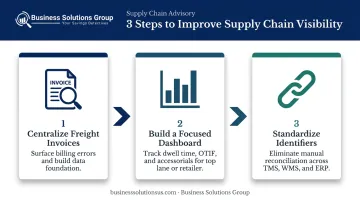
Each step builds on the last and generates measurable savings quickly enough to fund what comes next. Freight invoice centralization alone identifies enough overcharges to justify the effort within the first billing cycle.
For businesses that want an expert-led starting point, Business Solutions Group offers supply chain spend and visibility assessments that identify cost reduction opportunities before any full engagement begins. BSG's benchmarking phase takes about a week and delivers a data-backed savings analysis, giving leadership a clear picture of where charges are slipping through the cracks.
Frequently Asked Questions
How much supply chain visibility do you currently have?
Most companies have partial visibility at best — shipments are trackable within individual systems, but there's no integrated, real-time view across carriers, warehouses, and partners. If answering basic questions about shipment status, lane costs, or carrier performance requires pulling data from multiple systems manually, visibility is insufficient.
What is full cost visibility in the supply chain?
Full cost visibility means mapping every expense — freight charges, accessorial fees, OTIF penalties, detention charges, and inventory losses — back to its source (carrier, lane, customer, or product) in real time. That granularity shows exactly where to cut costs and where to invest.
What does supply chain visibility require?
Visibility depends on three things: integrated data from internal systems (TMS, WMS, ERP), real-time data sharing from external partners (carriers and suppliers), and the analytical tools to turn that combined data into decisions. Missing any one creates gaps that cost money.
What are the most common signs of poor supply chain visibility?
Key indicators include frequent OTIF penalties, unexplained accessorial charges, manually chasing shipment status updates, inability to explain cost variances by lane or carrier, and discovering inventory problems only after they've caused stockouts or write-offs.
How does poor supply chain visibility affect carrier contract negotiations?
Without aggregated freight spend data, shippers can't identify overpayments, compare lane rates against market benchmarks, or hold carriers to service-level commitments. Every contract renewal becomes a negotiation from weakness — recoverable savings left on the table.
What's the first step to improving supply chain visibility for a small or mid-size shipper?
Centralize all freight invoices into a single auditable system. This immediately surfaces billing errors, duplicate charges, and cost patterns — and builds the data foundation every subsequent visibility improvement depends on.