Introduction
Telecom costs rank among the largest — and most mismanaged — operational expenses for US businesses. According to Valicom, **78% of audited accounts contain billing errors**, and roughly 12% of telecom budgets are wasted on average. What makes this worse: vendor sources suggest most errors go undetected for 12 to 36 months, steadily inflating costs well before anyone flags them.
As telecom environments expand to include mobile fleets, VoIP, cloud services, and IoT devices, manual auditing simply can't keep pace. Spreadsheets miss things. Internal teams lack the bandwidth to catch every line-item discrepancy, and carriers aren't exactly incentivized to surface their own billing mistakes.
Telecom audit software built specifically for this problem automates invoice review, catches anomalies early, and shifts cost management from reactive to proactive. The result: fewer billing errors slipping through and more recoverable spend identified before it compounds.
This guide covers the top telecom audit software solutions in 2026, what each does well, how to evaluate them, and how to choose the right fit for your organization's size and complexity.
Key Takeaways
- Telecom billing errors affect the majority of organizations and often go undetected for over a year
- The global TEM market is projected to reach $11.55B by 2033, growing at 12.20% CAGR
- Leading platforms cover inventory, usage analytics, contract management, and AI anomaly detection — not just invoice auditing
- Top 2026 solutions include Tangoe, Calero, Brightfin, Sakon, and Asignet (formerly Cass TEM)
- The right tool depends on your line count, carrier complexity, and whether you need managed or self-serve capabilities
What Is Telecom Audit Software?
Telecom audit software is a specialized platform that reviews an organization's invoices, contracts, usage data, and assets to detect billing discrepancies, eliminate waste, and drive cost optimization.
According to Gartner's 2024 Market Guide for Telecom Expense Management Services, TEM services should deliver three core capabilities: cost optimization, asset inventory, and workflow automation. Most enterprise platforms in 2026 deliver all three in a single solution.
Core Functions
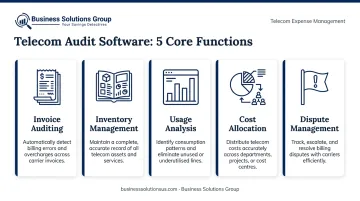
In practice, telecom audit software handles:
- Invoice auditing against contracted rates to catch overcharges, duplicate billing, and unauthorized charges
- Inventory management — a live catalog of every device, line, and service across the organization
- Usage analysis to flag idle lines, underused data plans, and services no longer matching actual consumption
- Cost allocation to assign telecom spend to the correct department, cost center, or project
- Dispute management — generating and tracking carrier dispute filings when billing errors are confirmed
Telecom Audit vs. TEM
A telecom audit is typically a one-time or periodic deep review of invoices and contracts. TEM (Telecom Expense Management), by contrast, is continuous — ongoing monitoring, management, and optimization of telecom spend. Most enterprise platforms in 2026 combine both. The distinction is practical: it affects how you engage a vendor, not which software category you're shopping in.
Top Telecom Audit Software Solutions in 2026
These platforms were evaluated on invoice auditing depth, inventory and asset management, integration capabilities, scalability, carrier support, and documented cost recovery outcomes. Here's how each platform stacks up.
Tangoe
Tangoe is one of the longest-standing names in enterprise telecom management. Its platform, Tangoe One, handles end-to-end invoice management, contract optimization, and automated dispute resolution across multi-carrier, multi-country environments.
What sets Tangoe apart is its ability to manage multi-currency, multi-country deployments within a single unified platform. For Fortune 500 telecom teams managing hundreds of carriers across multiple geographies, this depth of analytics is difficult to match. Tangoe was also recognized in the 2025 Gartner Market Guide for Managed Mobility Services, Global.
| Category | Details |
|---|---|
| Best For | Global enterprises with 1,000+ lines and complex international telecom environments |
| Key Features | Invoice auditing, automated dispute resolution, contract lifecycle management, multi-carrier analytics, usage reporting |
| Pricing Model | Enterprise subscription; contact Tangoe for current pricing |
Calero
Calero (formerly Calero-MDSL) is built for organizations managing large mobile device fleets. It combines telecom expense optimization with mobile device lifecycle management, covering everything from device provisioning and policy enforcement to wireless cost analysis.
Calero was named in Gartner's 2024 Magic Quadrant for SaaS Management Platforms and carries a 4.4 average rating across 41 reviews on Gartner Peer Insights. Its mobile lifecycle management tools go beyond what most general TEM platforms offer, making it a strong fit for enterprises with significant wireless spend or active BYOD programs.
| Category | Details |
|---|---|
| Best For | Enterprises with large mobile fleets, BYOD programs, or significant wireless spend |
| Key Features | Mobile device lifecycle management, usage analytics, invoice validation, wireless cost optimization, reporting dashboards |
| Pricing Model | Subscription-based; contact Calero for current pricing |
Brightfin
Brightfin expands the scope of traditional telecom auditing by unifying telecom, cloud, and SaaS expense management on a single platform. This is a practical advantage for organizations where the line between telecom and IT spend has blurred.
The platform is AI-native and integrates with ServiceNow, enabling finance and IT teams to track mobile plans, internet services, cloud infrastructure (AWS, Azure, Google Cloud), and software subscriptions from one interface.
Brightfin is listed in the Gartner TEM Market Guide and published a 2026 TEM Market Guide reference page — a useful data point for buyers benchmarking vendors against analyst-validated options.
| Category | Details |
|---|---|
| Best For | Companies managing both telecom and cloud/SaaS expenses who want unified IT spend visibility |
| Key Features | Telecom + cloud expense management, SaaS subscription tracking, vendor management, cost allocation, ServiceNow integration |
| Pricing Model | Subscription model; contact Brightfin for current pricing |
Sakon
Sakon offers a cloud-based TEM platform designed for mid-to-large enterprises that want modern audit capabilities without the implementation complexity of legacy enterprise systems. Its Telecom Cloud approach manages the full mobile ecosystem, from carrier plans and device workflows to wireless service optimization.
Sakon carries a 4.6 rating with 36 reviews on Gartner Peer Insights (updated October 2025), reflecting strong user satisfaction. Its reporting layer makes it accessible to non-specialists, which matters for organizations where telecom management isn't owned by a dedicated team.
| Category | Details |
|---|---|
| Best For | Mid-to-large enterprises seeking a modern, cloud-based TEM platform with strong analytics and reporting |
| Key Features | Cloud-based invoice auditing, analytics dashboard, contract management, multi-carrier support, wireless management |
| Pricing Model | Subscription-based; contact Sakon for current pricing |
Asignet (Formerly Cass TEM)
Cass Information Systems announced in April 2025 that it sold its Telecom Expense Management and Managed Mobility Services business to Asignet USA Inc. Any organization evaluating what was previously "Cass TEM" should verify current service delivery, platform continuity, and support structure directly with Asignet before committing.
The managed services model, where dedicated analysts handle invoice processing, auditing, payment, and optimization on behalf of the client, remains a viable option for organizations with high invoice volume and limited internal bandwidth. Confirm with Asignet whether this approach is being maintained post-acquisition.
| Category | Details |
|---|---|
| Best For | Organizations preferring fully outsourced telecom audit and payment management |
| Key Features | Managed invoice auditing and payment, expert analyst oversight, reporting (confirm current capabilities with Asignet) |
| Pricing Model | Managed service fees; contact Asignet for current engagement models |
How to Choose the Right Telecom Audit Software
Start With Your Evaluation Criteria
Gartner identifies three capabilities TEM services must deliver: cost optimization, asset inventory, and workflow automation. Use these as your baseline checklist — any platform that can't demonstrate all three clearly isn't enterprise-ready.
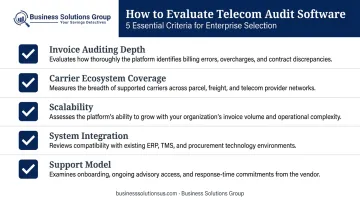
Beyond that baseline, evaluate:
- Invoice auditing depth — Does it reconcile each line against contract terms, or just flag totals?
- Carrier ecosystem coverage — Does the vendor have existing integrations with your specific carriers?
- Scalability — Can it handle your current line count and grow with you?
- Integration — Does it connect with your ERP, HRIS, or accounting systems?
- Support model — Is it self-serve software, a managed service, or a hybrid?
A Common Mistake to Avoid
Many organizations select TEM tools based on feature lists without validating whether the vendor has experience in their specific carrier ecosystem or industry vertical. A platform with excellent analytics is still underperforming if it doesn't have pre-built integrations for your primary carriers or lacks experience with your billing structures.
That vendor fit problem compounds when companies treat telecom audit software as a set-and-forget tool. The organizations that recover the most spend approach it as an active, ongoing discipline — revisiting contract terms, updating configurations, and acting on flagged exceptions consistently.
Where Advisory Support Adds Value
Even a well-configured platform can only audit what's in front of it. What it can't tell you is whether your carrier contracts are actually competitive relative to current market rates — that requires external benchmarking.
Advisory services fill that gap. Business Solutions Group offers carrier contract evaluation, benchmark analysis, and telecom spend optimization as part of its broader cost reduction work. For organizations unsure whether their contracts reflect fair market pricing, a no-cost savings analysis — typically completed within a few business days — can surface the discrepancies that software dashboards won't flag.
Conclusion
Telecom audit software in 2026 spans a wide range — from Tangoe's global enterprise platform to Sakon's modern cloud-based approach to the fully managed model now operating under Asignet. The right choice depends on your organization's line count, carrier complexity, internal resources, and whether telecom cost management is a continuous priority or a periodic exercise.
When evaluating options, don't optimize purely for features. Three criteria matter as much as any capability list:
- Ongoing support quality — responsive, knowledgeable teams that know your carrier environment
- Industry experience — vendors who've solved problems specific to your sector before
- Systems integration — clean connections to your existing financial and procurement tools
A feature-rich platform that doesn't match your operational model will consistently underperform regardless of how it benchmarks on paper.
Software alone only goes so far. For organizations that want expert-led contract benchmarking, carrier pricing analysis, and spend optimization alongside their tools, Business Solutions Group provides advisory and spend intelligence services designed to help US businesses uncover hidden cost reduction opportunities. Reach out at (949) 525-7677 or request a complimentary savings analysis at businesssolutionsus.com.
Frequently Asked Questions
What is telecom audit software and how does it work?
Telecom audit software automatically compares invoices, contracts, and usage data against agreed carrier terms to identify billing errors, unused services, and overpayments. It generates reports with prioritized savings recommendations and, in most platforms, can file carrier disputes automatically when errors are confirmed.
How much can a business save using telecom audit software?
Savings depend on organization size and billing complexity. Vendor benchmarks suggest companies can recover 10–30% of annual telecom spend through error identification, unused line elimination, and plan optimization — treat these as directional estimates, not guaranteed outcomes.
What is the difference between a telecom audit and TEM?
A telecom audit is a one-time or periodic review of invoices and contracts to surface errors and savings. TEM is an ongoing process that continuously monitors, manages, and optimizes telecom spend — often using software combined with managed services. Most enterprise platforms in 2026 combine both.
Is telecom audit software worth it for smaller businesses?
Smaller organizations with limited telecom complexity may find that a managed audit service or advisory engagement delivers better ROI than a full enterprise TEM platform. That changes once billing complexity, line count, or multi-location management raises the risk of undetected errors.
How often should a business conduct a telecom audit?
Most organizations benefit from continuous monthly invoice auditing, supplemented by deeper quarterly or annual reviews to reassess contracts and renegotiate carrier terms. One-off audits every two years risk missing savings windows, which are often limited to 90–180 days from the invoice date.
What features matter most in telecom audit software in 2026?
The most critical features are automated invoice-to-contract reconciliation, inventory and asset tracking, usage anomaly detection, cost allocation by department, and carrier dispute management. ERP and accounting integration is now expected by most enterprise buyers, and AI-driven anomaly detection is emerging as a real differentiator as telecom environments grow more complex.