Introduction
Telecom auditing firm Teligistics reports that 90% of business phone bills contain errors. For most organizations, telecom ranks among the third or fourth largest recurring monthly expenses — which means errors left unchecked aren't a minor annoyance, they're a steady, compounding drain on margins.
The problem rarely announces itself. There's no single invoice that looks obviously wrong. Instead, costs accumulate through layers of inaction:
- A line that never got cancelled after an employee left
- A contract that rolled over quietly at a higher rate
- A plan provisioned for peak usage that never materialized
Finance teams see the total and move on. Dissecting a telecom invoice — with its bundled charges, regulatory surcharges, and vague line items — takes time most teams simply don't have.
This guide walks through how telecom costs accumulate, which error categories consistently produce the largest overcharges, and the audit steps finance teams can use to recover dollars and prevent future billing drift. The result is a repeatable process — not just a one-time invoice review.
Key Takeaways
- Telecom billing errors are common, and most go undetected because invoices are deliberately complex
- Unused lines, expired contracts, and unmonitored usage erode margins gradually — often over months or years before anyone notices
- Effective cost reduction addresses three levers: upstream decisions, ongoing bill management, and market context
- Benchmark data matters — businesses negotiating without it almost always leave savings on the table
- A telecom audit is the starting point, not the solution — ongoing governance is what sustains savings
How Telecom Costs Typically Build Up
Telecom overspending compounds quietly — one overlooked line item at a time.
An expired contract auto-renews at old rates. A decommissioned office location keeps its circuits active. A former employee's mobile line stays on the account for months after offboarding. None of these events trigger an alert. They accumulate as line items in invoices that finance teams approve without scrutiny — and the dollar amounts grow accordingly.
The Math Adds Up Faster Than It Looks
According to Prelude Solutions, a single unused phone line costs $30 to $50 per month. That's $360 to $600 per year for one line. Most businesses carrying unused services aren't carrying one — they're carrying several, spread across voice, mobile, data, and internet services.
A Tangoe case study involving a global energy company found $40,000 per month in long-distance overage charges and inapplicable surcharges, plus an additional $32,000 recovered through circuit analysis — all from services that had been billing incorrectly for years without detection.
Why These Costs Stay Hidden
Those kinds of overcharges persist because telecom invoices are structurally difficult to audit. Each invoice typically combines:
- Base service charges
- Regulatory fees and USF contributions
- Equipment and installation amortization
- Usage-based overage charges
- Taxes and surcharges that vary by jurisdiction
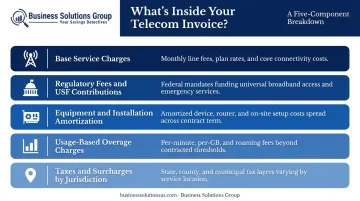
Most finance teams process these invoices for payment rather than scrutiny. Errors aren't corrected because they're never caught — and a line-by-line review is the only reliable way to surface what's actually being billed versus what should be.
Key Cost Drivers on Your Telecom Bill
Three forces shape most business telecom bills — and each one creates a different type of overpayment.
What Was Contracted
Every cost conversation starts upstream — at the moment services were selected and contracts were signed. Over-provisioning at this stage is common: businesses buy capacity for anticipated peak usage, then never fully utilize it. Paying for a bandwidth tier you rarely reach is a hidden cost baked into the contract from day one.
How Services Are Governed Over Time
Governance gaps are where most costs silently accumulate. Services added for a specific project, location, or employee rarely come with a built-in expiration date. Without a live inventory and an active deactivation process, unused assets just keep billing.
Common categories of telecom cost leakage include:
- Disconnected services that were never removed from billing
- Zero-use devices still generating monthly charges
- Recurring billing errors on active lines
- Metering database discrepancies that overstate usage
These aren't edge cases. They're recurring patterns that auditors find across industries.
What the Market Is Doing While Your Contract Sits Still
Telecom pricing drops steadily, but legacy contracts don't automatically adjust. TeleGeography's 2025 State of the Network report found that 10 GigE prices fell 13% compounded annually from Q2 2021 to Q2 2024, while 100 GigE port prices fell 15% over the same period. A business on a four-year contract signed in 2021 is likely paying rates that no longer reflect the market — and the carrier has no obligation to point that out.
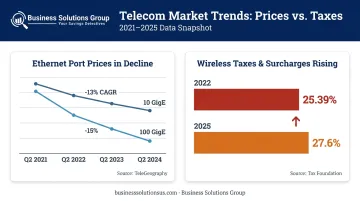
Surcharges add another layer of cost complexity. The Tax Foundation reports that wireless taxes, fees, and government surcharges reached 27.6% of the average wireless bill in 2025, up from 25.39% in 2022. Any thorough audit distinguishes legitimate pass-throughs from carrier-inflated line items.
Cost-Reduction Strategies for Your Telecom Bill
The most effective audits don't just look for billing errors. They address all three cost drivers: what decisions were made, how the bill is being managed, and what the market context actually allows. Here's how each layer works.
Strategies That Change Upstream Decisions
These approaches reduce cost by changing what gets contracted or activated in the first place.
Audit before every auto-renewal. Maintain a calendar of contract expiry dates and treat each one as a formal review trigger. Letting contracts roll over by default — even for services that are working fine — means accepting terms and rates that may no longer be competitive.
Right-size plans to actual usage. Pull consumption data for voice, data, and bandwidth across a 90-day window and compare it against provisioned capacity. Downgrade plans that are consistently over-provisioned. Paying for peak capacity that's rarely reached is a predictable and avoidable cost.
Consolidate vendors at procurement. Fewer carriers means simpler invoice management and concentrated spend — both of which improve your negotiating position at renewal time.
Require justification for every new service addition. Before activating any new line, device, or service, document the business need and set a defined review date. This prevents the gradual accumulation of services that were added for a short-term purpose and never removed.
Strategies That Change How the Bill Is Managed
These approaches close the gap between what's contracted and what's actually being billed.
Reconcile invoices against contracts monthly. Cross-check each invoice against contracted rates to catch incorrect rate applications, duplicate charges, and miscalculated taxes before they repeat across billing cycles. A one-month error is a nuisance. A twelve-month error is a recoverable loss.
Maintain a live telecom asset inventory. Every active line, device, and service should be in a register with an assigned owner. Build a deactivation trigger tied to employee departures, location closures, and service changes. Unused assets that stay active are a direct and preventable cost.
Set usage thresholds and alerts. Monitor consumption data to catch overages before they compound and to flag underutilized plans that could be downgraded. Most carriers won't alert you proactively when you're consistently under-utilizing a plan.
Formalize billing dispute recovery. Identifying an error and recovering from it are two different things. Without an internal protocol — including carrier submission, escalation paths, and credit tracking — errors get noticed but never resolved.
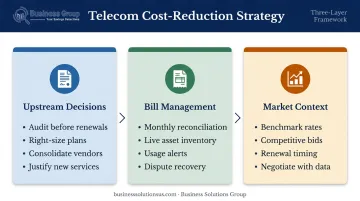
Strategies That Change the Market Context
These approaches address external factors: market pricing, vendor leverage, and competitive dynamics.
Benchmark contracted rates against current market pricing. Legacy contracts rarely keep pace with market rate erosion. TeleGeography's data on network pricing declines makes clear that businesses on multi-year contracts signed before 2022 are likely paying above-market rates for data and connectivity services — not because they made a bad deal, but because the market moved and the contract didn't.
Use competitive bids for negotiation leverage. You don't have to switch carriers to benefit from competitive quotes. Obtaining bids from two or three competing providers signals to your current carrier that you're an informed buyer. That alone is often enough to prompt improved pricing or terms without switching.
Time renegotiations 90 to 180 days before expiry. The window just before contract expiration is where you have the most leverage. Approaching carriers with 90 to 180 days of runway creates space for genuine negotiation. Waiting until 30 days out typically forces a rushed renewal on the carrier's terms.
Enter negotiations with benchmark data. Businesses that negotiate with market-validated data on comparable organizations' rates consistently outperform those that negotiate on instinct or historical invoices alone. Internal teams rarely have the market access or bandwidth to build that data position on their own. Business Solutions Group's benchmark analysis and spend intelligence tools give clients a documented, data-backed starting point — one that typically supports savings of 10 to 25 percent through service grooming and usage optimization.
Conclusion
Telecom overspending is a visibility and governance problem. The costs are real, but they're distributed across dozens of line items, billing cycles, and service categories in ways that don't surface without deliberate review. Businesses that conduct regular audits consistently uncover savings that had been building up unnoticed for months or years.
The audit itself is the starting point. What sustains savings is the discipline that follows:
- Track contract dates and renewal windows before carriers auto-renew at unfavorable terms
- Monitor usage patterns to catch idle lines and unused services
- Benchmark rates against current market pricing on a regular cadence
- Renegotiate with data in hand — not assumptions
An audit done once and forgotten produces a one-time result. An audit that becomes a recurring process produces compounding returns.
Frequently Asked Questions
What is included in a telecom audit?
A telecom audit typically covers invoice review, contract compliance verification, usage analysis across voice, data, and mobile services, identification of unused or redundant services, and billing error recovery. The output is a prioritized set of recommendations with quantified savings opportunities.
What does a telecom audit cost?
Pricing models vary: some firms charge on contingency (a percentage of identified savings), while others use flat or retainer fees. Ongoing telecom expense management is typically priced at 1% to 5% of aggregate spend, with rates decreasing as total spend increases.
How should I prepare for a telecom audit?
Gather all current invoices, locate active contracts with expiry dates, and compile a list of all telecom services and devices currently in use. Note any recent organizational changes — employee departures, office moves, or location closures — that may have created unused services still billing on the account.
How often should a business audit its telecom bills?
At minimum, annually. Businesses with large, multi-location, or rapidly changing telecom environments benefit from quarterly reviews. A review should always precede any contract renewal.
Can I conduct a telecom audit internally?
A basic self-audit is possible, but it commonly misses billing errors, tariff misapplications, and above-market contract rates. Expert auditors also bring benchmark data that internal teams rarely have access to, which is especially valuable during contract negotiations.
How long does a telecom audit take?
Timeline depends on scope: a small business audit may take days to a few weeks, while a multi-location enterprise audit can run several months. Most businesses begin seeing actionable findings within one to two billing cycles after completion.