The problem isn't a lack of awareness. It's that telecom lifecycle management is consistently treated as a back-office function rather than an operational discipline with direct cost and efficiency implications. Finance teams see the bills. IT teams field the service issues. But few organizations have the systematic processes in place to connect the two — and that gap is expensive.
This article covers what telecom lifecycle management actually involves, its three most impactful operational advantages, what goes wrong without it, and how to extract sustained value from it over time.
Key Takeaways
- Telecom lifecycle management covers services, assets, invoices, orders, and contracts across the full span from activation to retirement.
- Up to 20% of telecom invoices contain errors, yet most go unaudited and are paid in full.
- Its three highest-impact advantages are billing accuracy, proactive contract management, and structured change management.
- Value compounds over time: each clean inventory record and renegotiated contract makes the next cycle easier.
- Organizations that treat it as an ongoing discipline consistently outperform those that approach it as a one-time project.
What Is Telecom Lifecycle Management?
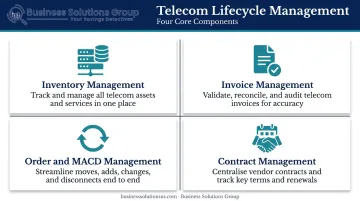
Telecom lifecycle management is the systematic, continuous process of overseeing all telecom services, assets, and vendor relationships from initial procurement through retirement. It covers four core functions:
- Inventory management — tracking every active service and asset across all locations and carriers
- Invoice management — validating billing against contracted rates and flagging discrepancies before payment
- Order and MACD management — handling service changes (Moves, Adds, Changes, Disconnects) accurately and ensuring they're reflected in the inventory
- Contract management — tracking terms, monitoring renewal windows, and benchmarking rates against the market
It applies most directly to mid-to-large enterprises managing multiple locations, several carrier accounts, and a mix of voice, data, network circuits, and mobility services — environments where manual tracking becomes unsustainable.
Telecom lifecycle management is not a software category or a one-time audit. It's the operational discipline that keeps telecom spend controlled, services aligned to actual business needs, and every line item justified — before it quietly erodes margin.
Key Advantages of Effective Telecom Lifecycle Management
Effective telecom lifecycle management produces measurable results across cost, contracts, and operations. These three advantages reflect what finance, IT, and procurement teams track — and what breaks down when the discipline is missing.
Full Cost Visibility and Billing Accuracy
One of the most immediate benefits of structured lifecycle management is gaining complete, granular visibility into what is being paid for — and whether those charges are accurate.
Lifecycle management creates this visibility by maintaining a verified inventory of all active services and cross-referencing it against incoming invoices. Billing errors, unauthorized charges, and duplicate line items can be flagged before payment rather than discovered months later after the money is already gone.
The scale of the problem makes this matter. According to the Crown Commercial Service's telecom audit white paper, Gartner estimated that up to 20% of telecom invoices contain errors — and 85% of large organization invoices are never audited internally. They're simply paid in full. For enterprises managing hundreds of invoice line items across multiple carriers, that combination produces significant annual overpayment that compounds silently.
The same Crown Commercial Service paper documents the real-world cost: in documented UK public sector cases, one organization identified £1 million in ceased services still being invoiced, while another recovered a £2 million overcharge over 18 months due to outdated tariffs — the kind of exposure that scales directly with invoice volume and carrier count.
KPIs this directly impacts:
- Telecom spend per location
- Invoice error rate
- Billing dispute recovery rate
- Cost per service unit
- AP processing time
Organizations with decentralized billing, multiple carrier accounts, or acquisition-driven growth face the highest exposure here — invoice reconciliation without a structured system is nearly impossible at scale. Business Solutions Group's spend intelligence software centralizes invoice data and surfaces anomalies automatically, replacing manual review with continuous oversight.
Proactive Contract Management and Carrier Benchmarking
Telecom contracts don't reward passivity. Without active management, they auto-renew on existing terms — often terms that made sense years ago but no longer reflect market rates.
Lifecycle management disciplines ensure vendor contracts are tracked, renewal windows are acted on strategically, and current pricing is benchmarked against market alternatives.
That means maintaining a forward-looking view of contract expiration dates, assessing current rates against competitive benchmarks, and building negotiating leverage before carriers hold the upper hand near the deadline.
The numbers behind this are compelling. Aberdeen Group research found that 57% of enterprises fail to compare their telecom contracts against pricing benchmarks, and that inefficient telecom cost management processes forfeit an average of 3% to 10% of spend. The Crown Commercial Service paper cites the Enterprise Technology Management Association reporting TEM savings as high as 15%, with future cost avoidance bringing that figure to 30%.
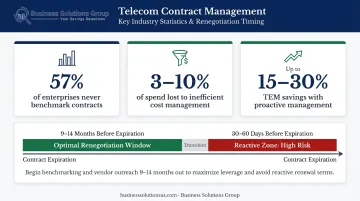
There's also a timing dimension most organizations miss. A structured renegotiation process should begin 9 to 14 months before contract expiration to allow a competitive RFP. Organizations that wait until the final 30 to 60 days — or discover the renewal after it's already happened — forfeit all of that leverage.
KPIs this directly impacts:
- Cost per circuit
- Contract renewal rate
- Carrier spend concentration
- Savings captured during renegotiation
- Vendor SLA compliance
For organizations managing large carrier portfolios, aging infrastructure contracts, or expanding vendor relationships, this gap is where the most recoverable spend sits. Business Solutions Group's benchmark analysis and carrier contract negotiation services are built specifically for this: ensuring clients enter every renewal cycle with market context and a clear negotiating position.
Operational Continuity During Service Changes
Telecom environments are never static. Employees move. Offices open and close. Technology migrations — POTS-to-VoIP, legacy WAN-to-SD-WAN — create bursts of service change activity that stress even well-run organizations.
Lifecycle management handles this through a structured MACD (Moves, Adds, Changes, Disconnects) process. That structure prevents the two most costly failure modes:
- Services billed after disconnection — cancelled lines and decommissioned circuits that keep generating charges because no one updated the inventory
- New services provisioned incorrectly — billing at tariff rates instead of contracted rates because the service change wasn't tracked through to the billing system
The first failure mode is more common than most organizations realize. The Crown Commercial Service paper lists unprocessed disconnected services as one of the most frequent invoice error categories, noting that cancellations can continue generating charges for several months after the intended stop-billing date. In a documented NHS Trust example, 27% of the mobile estate consisted of zero-use devices — still being carried on the books and billed.
The second failure mode creates operational risk beyond just cost. Poorly managed service changes lead to delayed installations, missed cut-over windows, and inventory records that no longer reflect reality — making future audits and troubleshooting significantly harder.
KPIs this directly impacts:
- MACD cycle time
- Billing accuracy post-change
- Number of zombie services (billed but inactive)
- Service installation completion rate
- Downtime incidents related to service changes
Organizations experiencing rapid growth, high employee turnover, real estate consolidation, or active technology migrations face the highest exposure here. The risk is not just financial — it's operational continuity.
What Happens When Telecom Lifecycle Management Is Ignored
Without a structured approach, telecom environments drift into inefficiency — and the financial consequences don't plateau. They compound.
The most common real-world outcomes:
- Overbilling goes undetected. Invoices are paid without validation. Billing errors and phantom charges accumulate unchallenged, often for months or years before anyone notices.
- Disconnected services keep billing. Without inventory reconciliation, terminated lines, cancelled circuits, and decommissioned devices continue generating charges long after they were supposed to stop.
- Contract auto-renewals lock in unfavorable terms. Without proactive tracking, contracts roll over at existing or increased rates. There's no benchmark, no renegotiation, no opportunity to switch carriers.
- MACD errors cascade. Service changes placed without proper process result in incorrect provisioning, new billing at tariff rates, and inventory records that no longer reflect reality — making every future audit harder.
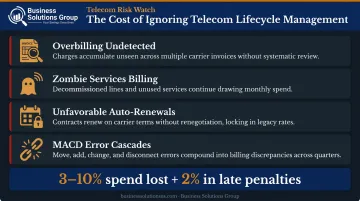
Aberdeen's research estimated that inefficient telecom cost management processes lose 3% to 10% of total spend — and late payment penalties alone account for another 2%. These losses aren't strategic trade-offs — they're the price of inattention, and they recur every billing cycle until someone intervenes.
How to Get the Most Value from Telecom Lifecycle Management
Lifecycle management delivers its full value only when applied consistently and treated as a continuous operational discipline. A one-time audit recovers past losses. An ongoing practice prevents future ones.
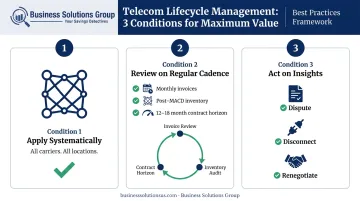
Three conditions define when it works best:
1. Apply it systematically — not selectively. Coverage needs to extend across all carrier accounts, service types, and locations. Organizations that manage their largest accounts carefully while leaving smaller ones untracked typically find that the smaller accounts are where the most persistent errors live.
2. Review on a regular cadence.
- Invoices validated monthly
- Inventory reconciled after every MACD
- Contracts reviewed on a rolling 12–18 month forward-looking horizon
3. Act on insights, not just document them. Identified billing errors need to be disputed. Unused services need to be disconnected. Contract benchmarking needs to lead to actual renegotiation. Organizations that generate reports but take no action capture none of the financial upside.
For teams that lack the carrier expertise, internal capacity, or technology to manage this effectively — particularly during growth periods or technology migrations — an advisory partner can accelerate results. Business Solutions Group brings contract negotiation support, spend intelligence analysis, and cost reduction strategies that help organizations move from identifying savings to capturing them.
Conclusion
Effective telecom lifecycle management delivers compounding value when practiced consistently. Billing accuracy eliminates waste, proactive contract management secures better terms, and structured change management keeps operations running without disruption.
Its advantages grow over time. Clean inventory records make the next audit faster. Well-negotiated contracts create a stronger baseline for renewals. Correctly processed MACDs reduce the risk of downstream billing and operational problems — and those gains stack.
The organizations that build this discipline now are better positioned to scale, manage costs, and adapt as their communications infrastructure continues to evolve. Treating telecom lifecycle management as an ongoing operational practice — not a one-time fix — is what separates organizations that consistently control costs from those that perpetually chase them.
Frequently Asked Questions
What is customer lifecycle management in telecom?
Customer lifecycle management in telecom refers to managing a customer's or enterprise's relationship with telecom services from initial provisioning through ongoing use, changes, and eventual retirement. The focus is on maintaining service quality, managing costs, and ensuring continuity at every stage of that relationship.
What is the lifecycle of network management?
Network management lifecycle spans planning, design, deployment, operation, optimization, and retirement. Each phase requires governance, documentation, and performance monitoring to keep the network aligned with business needs over time.
What are the main components of telecom lifecycle management?
The four core components are inventory management (tracking all active services), invoice management (validating billing accuracy), order and MACD management (handling service changes correctly), and contract management (tracking terms, benchmarking rates, and managing renewals).
How does telecom lifecycle management reduce costs?
It reduces costs by catching billing errors before payment, eliminating charges for unused or disconnected services, and enabling renegotiation of carrier contracts at competitive market rates, all without cutting necessary services.
What happens if telecom lifecycle management is neglected?
Neglected lifecycle management leads to unchecked billing errors, charges for decommissioned services, unfavorable auto-renewed contracts, and MACD errors that create cascading operational problems. These issues compound in both cost and complexity the longer they go unaddressed.
When should a business consider outsourcing telecom lifecycle management?
Outsourcing makes sense when internal teams lack the carrier expertise, bandwidth, or technology to manage multiple accounts and invoice volumes effectively. It's especially worth considering during growth periods, technology migrations, or after discovering significant unrecovered billing errors.