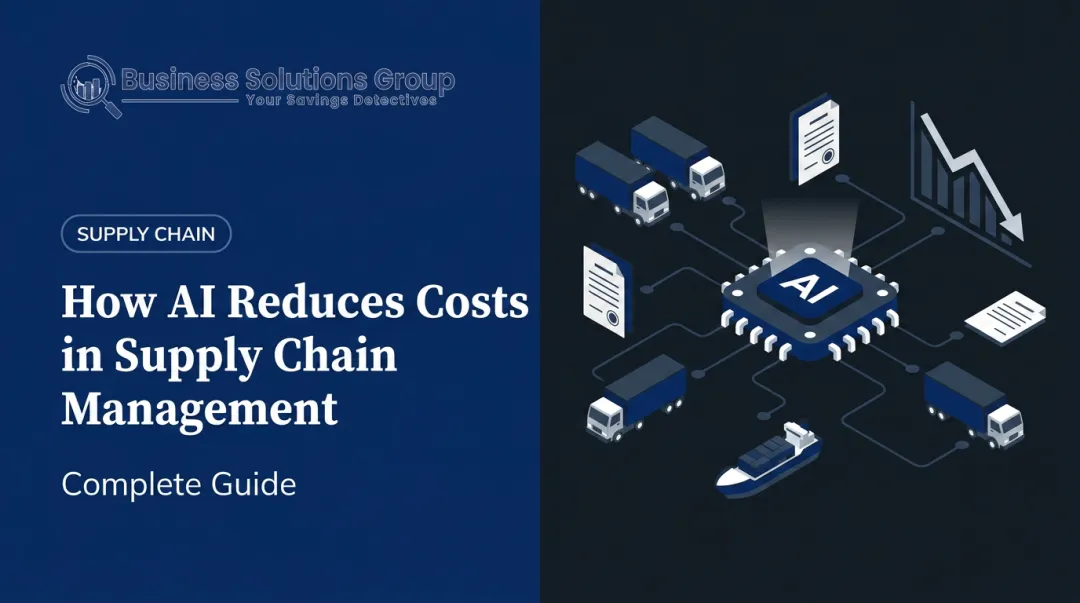
That's where AI in supply chain management changes the equation. Not because the technology is impressive, but because the outcomes are measurable: lower inventory carrying costs, reduced transportation spend, faster responses to disruptions. According to McKinsey, AI in distribution operations can reduce inventory by 20–30%, logistics costs by 5–20%, and procurement spend by 5–15%.
This article breaks down three specific advantages AI delivers — demand forecasting, transportation optimization, and real-time risk management — with a focus on what actually changes operationally, not just what AI promises in theory.
Key Takeaways
- AI reduces supply chain costs by improving forecast accuracy, optimizing transportation routing, and enabling proactive disruption response
- Inventory carrying costs and transportation spend are the two highest-impact targets for AI-driven optimization
- Operating on lagging data leads to overstock, stockouts, and unmanaged carrier spend — problems AI addresses at the source
- Sustained results come from embedding AI into everyday decisions, not treating it as a one-time project
- Advisory-led programs can accelerate results without requiring companies to build custom AI infrastructure
What Is AI in Supply Chain Management?
AI in supply chain management is the use of machine learning algorithms, predictive analytics, and automation to process supply chain data — across inventory, logistics, procurement, and demand — faster and more accurately than manual methods allow.
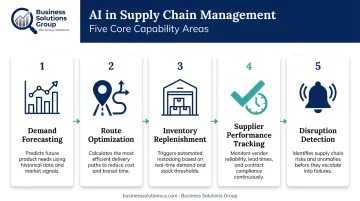
Rather than a single tool, it's a layer of intelligence applied across the entire chain:
- Demand forecasting — dynamic models that update as conditions change
- Route optimization — real-time routing decisions based on traffic, weather, and carrier data
- Inventory replenishment — automated reorder triggers based on actual demand signals
- Supplier performance tracking — continuous monitoring against expected lead times and quality
- Disruption detection — alerts triggered when something falls outside normal parameters
The practical objective is reducing costs, improving service levels, and catching small inefficiencies before they erode margins.
Key Advantages of AI in Supply Chain Management
The advantages below map directly to cost drivers and performance metrics supply chain leaders already track. They also compound — the more consistently AI is embedded in routine decisions, the stronger the return on that investment.
Advantage 1: Smarter Demand Forecasting and Inventory Optimization
Static reorder points and historical averages don't account for seasonality shifts, supplier lead time changes, or what happened three weeks ago in a competitor's market. AI replaces those static models with dynamic forecasting that continuously analyzes sales data, order patterns, and external variables to adjust inventory targets in real time.
The practical result: less overstock sitting in slow-moving lanes, fewer stockouts in high-velocity ones.
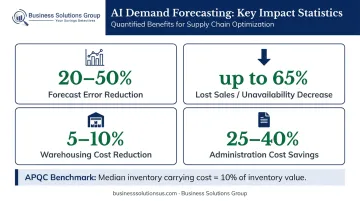
McKinsey research found that AI-driven forecasting can reduce forecast errors by 20–50%, translating into a decrease in lost sales and product unavailability of up to 65%, warehousing cost reductions of 5–10%, and administration cost savings of 25–40%. The median inventory carrying cost across 6,468 companies benchmarked by APQC sits at 10% of average inventory value — meaning every percentage point of improvement in inventory efficiency has a direct dollar impact.
KPIs directly affected:
- Inventory carrying costs
- Stockout rate and order fill rate
- Forecast accuracy (MAPE)
- Working capital tied up in stock
- Days of supply
When this matters most: Businesses with wide SKU ranges, seasonal demand swings, or multi-location distribution — where manual forecasting consistently lags actual demand patterns — see the highest impact. This is also where Business Solutions Group's demand planning software, which applies 280+ advanced forecasting algorithms, supports clients in moving from reactive replenishment to data-driven inventory planning.
Advantage 2: Transportation Cost Reduction and Route Optimization
Transportation is one of the largest controllable line items in any supply chain budget. U.S. business logistics costs reached $2.3 trillion in 2024, equal to 8.7% of national GDP. Even small efficiency gains add up fast when you're operating at volume.
AI optimizes transportation decisions by analyzing delivery locations, traffic patterns, weather conditions, load capacities, carrier performance history, and time windows simultaneously. It adjusts routing and load planning in real time rather than relying on static route tables or gut-feel carrier selections.
A less obvious benefit is often underutilized: AI-generated spend data gives shippers lane-by-lane cost visibility, which becomes direct leverage in carrier contract negotiations.
KPIs directly affected:
- Cost per shipment
- On-time delivery rate
- Trailer utilization
- Total transportation spend
- Carrier contract compliance
Highest impact for: Small parcel and freight shippers operating at scale, and any operation where carrier rates have been accepted as fixed rather than actively benchmarked. Business Solutions Group's spend intelligence platform manages over $3 billion in parcel spend and benchmarks carrier agreements down to 1/10th of a percent — surfacing the exact data needed to renegotiate from a position of evidence rather than assumption. Clients typically see 15–40% savings on small parcel spend, with an average of 23.6% year-to-date, and 20–25% on LTL.
Advantage 3: Real-Time Visibility and Proactive Risk Management
Supply chain disruptions are not rare events. Resilinc reported a 38% year-over-year increase in disruptions in 2024, with extreme weather events up 119% and geopolitical risk alerts up 123%.
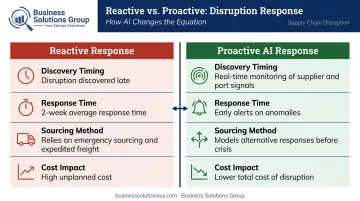
Most companies aren't positioned to respond quickly. McKinsey's 2024 supply chain survey found that companies take an average of two weeks to plan and execute a response after a disruption occurs. That two-week gap is where costs accumulate: expedited freight, emergency sourcing, lost customer orders.
AI changes the response posture from reactive to proactive. Real-time monitoring tools track supplier reliability metrics, port conditions, geopolitical signals, and demand anomalies continuously — triggering alerts when something deviates from expected parameters. More importantly, AI can model alternative responses (supplier substitution, rerouting, inventory redistribution) before a delay becomes a crisis.
KPIs directly affected:
- Supplier on-time performance
- Order exception rate
- Mean time to detect and respond to disruptions
- Customer service level
- Supply chain resilience score
Best fit for: Businesses with multi-tier supplier networks, those dependent on international shipping lanes, or operations that have experienced costly reactive responses and want to build a more resilient posture. Business Solutions Group's visibility tools provide real-time shipment tracking across all modes, predictive delay analytics, and automated exception alerts — giving teams the data to act before problems escalate.
What Happens When AI Is Missing from Your Supply Chain
Manual processes and outdated data create predictable, compounding cost problems — and most of them are invisible until they're expensive.
Here's what that looks like in practice:
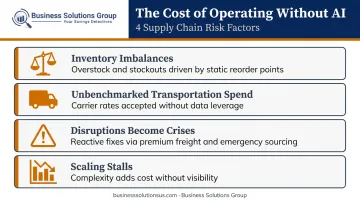
- Inventory imbalances persist. Static reorder points produce overstock in slow lanes and stockouts in fast ones. Carrying costs run at roughly 10% of inventory value (APQC benchmark), and every stockout triggers an expedited order that arrives late and costs more.
- Transportation spend goes unbenchmarked. Scattered volume means no negotiating leverage. Carrier rates get accepted rather than challenged, and route inefficiencies go undetected because there's no consolidated data to surface them.
- Disruptions become crises. A supplier delay or port disruption discovered after the fact requires premium freight and emergency sourcing — fixes that cost far more than a planned response.
- Scaling stalls. Without visibility into spend patterns and operational performance, it's hard to delegate decisions consistently or spot where complexity is adding cost rather than value.
Teams making inventory and routing decisions from last month's reports are working with information that no longer reflects current conditions — and that gap compounds with every decision made on stale data.
How to Get the Most Value from AI in Your Supply Chain
AI delivers the most value when it's applied to the areas with the highest cost exposure first. That means starting with an honest audit of where current processes are most manual, most reactive, or most disconnected from real-time data. For most businesses, the starting points are demand forecasting, transportation spend, and supply chain visibility.
Three practical principles for maximizing value:
- Start with your highest cost centers. Don't try to implement AI everywhere at once. Identify whether inventory carrying costs, carrier spend, or disruption response is generating the most waste — and address that first.
- Build review cycles into the process. AI insights only drive value when acted on consistently. Regular KPI reviews, clear ownership of outcomes, and a defined process for translating data into decisions separate organizations that see ROI from those that treat analytics as a reporting layer.
- Don't wait until you have perfect data. AI tools, and the advisory processes built around them, can work with imperfect data — the key is getting started and improving inputs over time.
These principles work regardless of where you start — but applying them is faster when you're not building the infrastructure from scratch.
For businesses that want faster results without building internal AI infrastructure, working with an advisory firm that brings both spend data and logistics expertise closes the gap between identifying savings and capturing them. Business Solutions Group's engagement model starts with a no-cost benchmark analysis — completed in 3–5 business days — that shows clients exactly where their carrier contracts, inventory costs, or logistics spend sit relative to market norms.
Most clients discover 10–30% in actionable savings before any commitment is made.
Frequently Asked Questions
How does AI in supply chain management reduce costs?
AI reduces costs by optimizing inventory levels (cutting carrying costs and stockouts), improving transportation routing (reducing fuel and carrier spend), and automating manual tasks that introduce delays and errors. Each of these areas compounds: fewer errors mean less rework, better routing means lower carrier spend, and tighter inventory means less capital tied up on shelves.
How does supply chain management help with cost reduction?
Strong supply chain management reduces costs through better supplier relationships, tighter procurement discipline, and cleaner coordination between inventory, logistics, and fulfillment teams. AI builds on this foundation by processing far more data — faster — than any manual workflow allows, turning good processes into consistently optimized ones.
What are the benefits of AI in supply chain management?
The core operational benefits are more accurate demand forecasting, lower transportation and inventory costs, real-time disruption detection, and faster decision-making across the chain. These advantages compound when AI is embedded in routine operations rather than applied selectively.
What are the biggest challenges of implementing AI in supply chain management?
The most common challenges are data quality issues, change management, and talent gaps. AI needs clean, integrated data to produce reliable outputs — and even when insights are good, teams often default to old habits. According to a McKinsey survey, 90% of companies reported lacking sufficient talent to meet their digitization goals.
How does AI improve demand forecasting in supply chains?
AI improves demand forecasting by analyzing a broader range of inputs — historical sales, seasonality, external disruptions, market trends — and continuously updating forecasts as conditions change, rather than relying on static historical averages that quickly drift from reality.
Can small and mid-sized businesses benefit from AI in supply chain management?
Yes. SMBs benefit most through AI-powered spend intelligence tools, demand forecasting software, and advisory-led programs that don't require building custom infrastructure. Business Solutions Group offers a benchmark analysis that identifies savings opportunities across parcel, freight, and inventory — useful for businesses that want a data-backed starting point before committing to broader changes.