Telecom service optimization is the process of auditing, renegotiating, and restructuring voice, data, and carrier services to eliminate waste and bring costs in line with actual business needs. It applies to businesses of all sizes, though the scale of opportunity grows with complexity.
This post covers the core strategies for telecom optimization, the benefits companies typically see, the hidden cost drains most organizations overlook, and a practical framework for getting started.
Key Takeaways
- Telecom optimization is a strategic, ongoing process — not a one-time cost-cutting exercise
- Billing errors, unused services, and above-market contract rates are the most common sources of waste
- Businesses should review contracts at least annually, and always 6–12 months before expiration
- Technology transitions — MPLS to SD-WAN, PBX to UCaaS — create savings opportunities and alignment risks
- Specialists provide market benchmarks and negotiation leverage most businesses can't build on their own
What Is Telecom Service Optimization?
Telecom service optimization is the ongoing evaluation of a company's entire telecommunications environment — carrier contracts, bandwidth provisioning, billing structures, and service configurations — to ensure costs are competitive and services match actual business requirements.
This differs from basic cost-cutting, which typically means canceling services or switching to a cheaper provider without any structured analysis. Telecom optimization is data-driven and systematic — built to produce lasting results, not quick fixes that unravel within a year.
Who Needs It Most
Mid-to-large businesses with multiple locations, distributed workforces, or complex carrier relationships carry the highest risk of telecom overspend. But smaller businesses with several carrier relationships or remote employees often find meaningful savings too — their contracts just tend to get less attention over time.
What Falls Under Telecom Optimization
The scope covers more than most people expect:
- Local and long-distance voice services
- Internet and data circuits (MPLS, DIA, broadband)
- Wireless and mobile plans
- Cloud-based communications (UCaaS, VoIP, SIP trunking)
- Managed network services such as SD-WAN and CCaaS
- Colocation and IoT connectivity
If the business receives an invoice for it from a carrier, it belongs in the optimization review.
Key Telecom Service Optimization Strategies
Effective telecom optimization is a sequence of targeted strategies applied across the service lifecycle — not a one-time fix.
Invoice Auditing and Billing Validation
Invoice auditing is typically the first and highest-impact step. Telecom bills are notoriously complex, and carriers make mistakes. A UK Crown Commercial Service audit white paper cited analyst estimates that up to 20% of telecom invoices contain errors and that 85% of large organizations' invoices are never internally audited — they're simply paid in full.
The same report documented a UK public-sector organization that recovered £2M (approximately $2.5M USD) in overcharges over 18 months because carriers failed to apply contracted tariffs correctly. Reviewing 12–36 months of invoices typically surfaces systematic errors that compound significantly over time.
Needs Assessment and Gap Analysis
A needs assessment maps what services employees actually require against what the company is currently paying for. The gaps — over-provisioned bandwidth, underused lines, mismatched service tiers — represent direct savings opportunities.
This process requires input from IT, finance, and operations. Each team sees a different slice of telecom usage, and the full picture only emerges when those perspectives are combined.
Carrier Benchmarking and Cost Analysis
Benchmarking compares current pricing against market rates for equivalent services. This is where the savings potential often surprises people — carrier pricing varies significantly by product, bandwidth, location, and contract age.
TeleGeography's WAN Cost Benchmark data illustrates this well: in one 2024 example, a 10 Mbps dedicated internet access circuit in Johannesburg was 60% cheaper than an equivalent MPLS connection. Without benchmarking, businesses renewing MPLS contracts have no way to know they're overpaying relative to available alternatives. Business Solutions Group brings proprietary spend intelligence and real-world pricing data to this analysis — surfacing gaps that internal teams, without broad market visibility, typically miss.
Contract Negotiation and Renewal Management
Benchmark data creates negotiating leverage. Armed with market comparisons, businesses can run an RFP process, present alternative bids to incumbent carriers, and negotiate meaningful rate reductions, improved SLAs, and better exit provisions.
The renewal window deserves particular attention:
- Maximum leverage exists when contracts expire — use it to push for better terms or switch providers
- Auto-renewals lock in stale pricing that hasn't kept pace with the market
- Even incumbent carriers will renegotiate when presented with competitive bids
Ongoing Account and Service Management
Optimization doesn't end at contract signing. Businesses need someone accountable for:
- Monitoring carrier performance against contracted SLAs
- Flagging upcoming renewal dates before leverage disappears
- Reviewing invoices for new errors and unauthorized charges
- Adjusting services as headcount, locations, or usage patterns change
Let this discipline lapse, and overspend creeps back in — often unnoticed until the next audit. Business Solutions Group's client success team handles this continuously, using spend intelligence software to catch new errors and flag savings opportunities before they're missed.
Top Benefits of Optimizing Your Telecom Services
Telecom optimization converts a passive cost center into a actively managed asset. The returns compound well past the first round of savings.
Significant Cost Reduction
Eliminating billing errors, disconnecting zombie services, right-sizing bandwidth, and renegotiating contracts each contribute to measurable savings. Business Solutions Group's telecom optimization work typically delivers savings in the range of 10–50%, depending on how long it's been since the last review and the complexity of the carrier environment.
The gains don't require changing carriers or disrupting operations. Many of the highest-return changes happen without touching the underlying services at all:
- Removing zero-use lines that have accumulated unnoticed
- Correcting misapplied discounts and rate errors
- Recovering billing credits owed under existing contracts
- Eliminating services tied to closed locations or consolidated offices
Improved Operational Efficiency
When services align with actual usage, the administrative burden shrinks. There are fewer invoices to reconcile, fewer carriers to manage, and less time spent chasing down billing discrepancies each month. For distributed or remote teams, the operational benefit is more direct: employees get the connectivity and communication tools they actually need, configured appropriately.
Better Technology Alignment
Regular telecom reviews surface technology mismatches that drain value over time. MPLS networks are a prime example — TeleGeography forecasts global MPLS revenue to fall from $130B in 2025 to $57B by 2030 as businesses shift to dedicated internet access, SD-WAN, and broadband alternatives. Companies still paying for MPLS at 2020 contract rates are likely overpaying for infrastructure that modern alternatives can replace at a fraction of the cost.
The same logic applies to legacy PBX systems relative to cloud-based UCaaS platforms, or POTS lines that haven't been reviewed since the last office consolidation.
Lower Vendor Lock-In and Carrier Risk
Optimization introduces flexibility. Better-negotiated contracts include meaningful exit provisions, service-level accountability, and in some cases, carrier diversification across critical sites. Businesses with single-carrier dependencies face disproportionate risk when that carrier underperforms — and have less negotiating leverage when renewal time arrives.
Increased Agility for Growth
Businesses with optimized, flexible telecom contracts scale more efficiently. Adding locations, expanding bandwidth, or onboarding remote employees doesn't require working around rigid legacy agreements. The telecom infrastructure adapts to the business rather than constraining it.
Common Telecom Cost Drains Businesses Overlook
Most businesses underestimate their telecom waste because the costs are distributed across complex invoices and long-standing contracts that rarely get scrutinized. A few patterns appear consistently:
- Zombie services — lines, accounts, or devices still billing for employees who left months or years ago. A regional NHS Trust audit found 27% of its mobile estate consisted of zero-use devices. A New Jersey state audit found more than 19,000 unused phone lines costing over $3.2M annually
- Auto-renewed contracts — agreements that roll over automatically at above-market rates because nobody flagged the renewal window
- Over-provisioned bandwidth — circuits sized for peak capacity years ago that now run well below their contracted levels
- Carrier billing errors — misapplied discounts, incorrect rate codes, and charges for services that were never activated or were disconnected months prior
- Legacy services — POTS lines, ISDN circuits, and early-generation MPLS connections maintained out of inertia rather than necessity
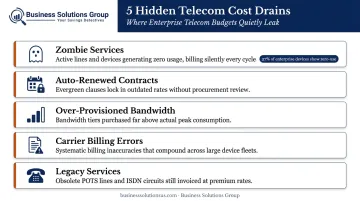
None of these drains look alarming on a single invoice. Spread across voice, data, wireless, and managed services — from multiple vendors, over multiple years — they routinely add up to six-figure annual overspend that goes undetected until someone audits the full picture.
How to Build a Telecom Optimization Plan
A structured plan moves through five phases:
- Inventory all current services, contracts, and invoices — AOTMP notes that accurate service and invoice inventories are the foundation of any TEM program, because costs can't be controlled without valid data
- Conduct a needs assessment — map contracted services to actual usage across IT, finance, and operations
- Benchmark current pricing — compare rates against market equivalents for each service category
- Prioritize and execute — start with quick wins (billing credits, zombie service removals) while pursuing longer-term contract renegotiations in parallel
- Establish a recurring review cadence — set renewal alerts, schedule annual audits, and assign ownership for ongoing monitoring
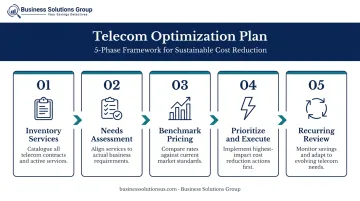
Before the plan begins, set measurable targets. Define a percentage reduction in telecom spend, specific SLA thresholds, or a dollar amount of billing credits to recover. Without these benchmarks upfront, there's no reliable way to gauge whether the effort moved the needle.
Why Work With a Telecom Optimization Consultant
Businesses can attempt telecom optimization internally. Most don't get far, because the process requires specialized knowledge of carrier pricing benchmarks, billing systems, and contract structures that most internal teams don't maintain.
A telecom optimization consultant brings:
- Market rate benchmarks — current pricing data across carriers, geographies, and service types
- Billing expertise — the ability to identify errors quickly, including the systematic ones carriers rarely flag voluntarily
- Negotiating experience — carriers negotiate enterprise contracts daily; most internal teams do it once every few years
- Accountability — someone responsible for following through on changes, not just identifying them
Business Solutions Group delivers this expertise as part of a broader cost optimization practice that also covers parcel, freight, and healthcare spend. Their performance-based model means clients keep 100% of recovered credits, and the firm earns only when savings are achieved — a structure that keeps incentives squarely focused on measurable, lasting outcomes.
That performance-based structure also makes the service accessible beyond large enterprises. Mid-sized businesses and smaller companies with multi-site or multi-vendor environments routinely find significant savings when a structured review is conducted — often because those contracts have gone the longest without scrutiny.
Frequently Asked Questions
What does a telecom consultant do?
A telecom consultant assesses a business's current telecom environment, identifies billing errors and service gaps, and negotiates with carriers on the client's behalf. They also provide ongoing guidance to ensure services remain cost-effective as business needs and market rates evolve.
What is telecom expense management (TEM)?
TEM is the process of tracking, managing, and optimizing all telecom-related expenses across voice, data, and wireless services. It typically involves invoice auditing, usage reporting, and contract management to control costs at every stage.
How often should businesses review their telecom contracts?
At least annually, and ideally 6–12 months before expiration. That window provides the most leverage for negotiation and prevents contracts from rolling over automatically at above-market rates.
What are the signs a business needs telecom optimization?
Common signals include:
- Invoices that are complex or inconsistent month-to-month
- Contracts that haven't been renegotiated in more than two years
- Employee complaints about connectivity or reliability
- No clear visibility into what services the business is actually paying for
What is the difference between telecom optimization and TEM?
TEM is primarily an ongoing operational discipline focused on tracking and managing costs. Telecom optimization is broader — it includes benchmarking, renegotiation, technology alignment, and restructuring services to drive long-term efficiency gains.
Can small businesses benefit from telecom service optimization?
Yes. Small and mid-sized businesses — especially those with multiple locations, remote employees, or several carrier relationships — often find proportionally significant savings. Their contracts tend to receive the least scrutiny, leaving the most room for recoverable savings.