Introduction
Few things frustrate shipping managers more than opening a UPS invoice and finding retroactive charges with no clear explanation. UPS shipping charge corrections (SCCs) are exactly that: billing adjustments applied after a shipment closes, often weeks later.
What makes them worse is the audit fee layer. When corrections are large enough and frequent enough, UPS adds a penalty on top of the correction itself. For businesses shipping at volume, this compounding effect chips away at margins on every invoice — until someone catches it.
This guide gives you a clear path forward: what SCCs are, what triggers them, how the audit fee is calculated using current 2026 UPS rates, and how to recover fees when UPS has made an error.
Key Takeaways
- UPS shipping charge corrections are retroactive billing adjustments triggered when manifested shipment data doesn't match what UPS verifies in transit.
- The audit fee applies when the average SCC exceeds $1.00 per corrected package per invoice week, billed at $1.65/package or 12% of total SCCs — whichever is greater.
- The most common triggers are incorrect weight, missing or inaccurate dimensions, and address classification errors.
- Audit fees do not apply to import shipments.
- Proactive data accuracy and systematic invoice auditing are the most effective ways to reduce SCC exposure.
What Are UPS Shipping Charge Corrections?
A UPS shipping charge correction is a retroactive billing adjustment applied when the shipment information entered at manifest — weight, dimensions, address type, service selection — does not match what UPS determines during processing or delivery.
Per UPS's own tariff documentation, UPS reserves the right to audit any package, shipment, or invoice to verify service selection, dimensions, weight, and charge applicability. Based on those audit results, UPS may increase, adjust, or assess additional charges.
SCCs vs. Accessorial Charges
These two charge types often appear on the same invoice, and the distinction matters:
- Accessorial charges are fees for specific handling conditions — residential delivery, address correction, additional handling, large package surcharge.
- SCCs are audit-driven corrections that adjust charges already submitted when UPS finds the original data was inaccurate.
In practice, the two overlap: if UPS remeasures a package and finds it qualifies for the Large Package Surcharge that wasn't declared at manifest, it applies the surcharge as a correction. Both can independently trigger the audit fee.
Timing and Visibility
SCCs appear on invoices after the shipment has already moved. UPS calculates and bills corrections based on the applicable invoice period, which makes them nearly impossible to anticipate without an active monitoring process. For businesses shipping hundreds of packages weekly, individual corrections can go unnoticed until they add up to a significant charge.
What Triggers a UPS Shipping Charge Correction?
Incorrect or Missing Package Weight
Weight corrections are among the most common SCCs. If the declared weight at manifest differs from what UPS measures, a correction is issued. Most arise from rounding errors or failure to include packaging weight at manifest.
Key rules from the 2026 UPS Rate & Service Guide:
- Round any fractional weight up to the next whole pound.
- Failing to enter any weight will trigger a correction — and potentially an Additional Handling surcharge if the package exceeds 50 lbs.
Dimensional Weight Discrepancies
UPS bills whichever is greater: actual weight or dimensional (DIM) weight. DIM weight is calculated as:
Length × Width × Height ÷ 139 (current domestic DIM divisor)
All dimensions are measured at the longest point and rounded up to the nearest whole inch — so a measurement of 1.1 inches is treated as 2 inches. If dimensions are missing or entered incorrectly at manifest, UPS remeasures and bills accordingly.
The highest-risk packages: large, lightweight items where the box volume far exceeds the item weight — clothing, foam products, electronics accessories.
Address and Delivery Classification Errors
Beyond dimensions and weight, the delivery address itself can trigger corrections. Two distinct types apply here:
- Residential reclassification: UPS applies a $6.50 Ground residential surcharge when it reclassifies a destination as residential. Home-based businesses are always classified as residential, regardless of how the shipper labels them.
- Address corrections: When a provided address is incomplete, unverifiable, or contains errors requiring UPS to locate the correct delivery point, UPS charges $25.25 per package for address correction.
Package Specification Violations
If oversized packages aren't declared at manifest, SCCs are issued post-delivery. Current thresholds:
| Condition | Surcharge |
|---|---|
| Longest side > 48 in, second-longest > 30 in, or length + girth > 105 in | Additional Handling |
| Length > 96 in or length + girth > 130 in | Large Package Surcharge |
| Weight > 110 lbs or cubic size > 17,280 cubic inches | Large Package Surcharge |
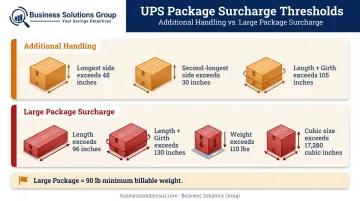
Note: When the Large Package Surcharge applies, the Additional Handling charge is not assessed. Large Packages carry a 90-pound minimum billable weight.
How the UPS Correction Audit Fee Is Calculated
The audit fee only applies when corrections cross a specific average-cost threshold — and UPS uses a two-part formula to determine what you owe.
The Trigger
The audit fee is assessed when the average SCC per corrected package in a given invoice week exceeds $1.00. Occasional small errors won't trigger it — but systemic patterns or high-value corrections will push you over that threshold quickly.
Once you know the trigger, the formula determines the actual charge.
The Formula
UPS charges whichever is greater:
- $1.65 per package subject to SCC during the invoice period, or
- 12% of total SCCs during that invoice period
These rates are from the 2026 UPS Daily Rates guide (updated May 10, 2026). An older structure — $5.00 threshold, $1.00/package, 6% — was the original 2018 formulation and is no longer in effect.
The three examples below show how these two calculations play out in practice — and which one UPS will apply.
Three Worked Examples
| Scenario | Packages | Total SCC | Avg/Package | Per-Package Calc | 12% Calc | Audit Fee |
|---|---|---|---|---|---|---|
| Per-package rate applies | 25 | $200 | $8.00 ✓ | 25 × $1.65 = $41.25 | 12% × $200 = $24.00 | $41.25 |
| Percentage rate applies | 5 | $250 | $50.00 ✓ | 5 × $1.65 = $8.25 | 12% × $250 = $30.00 | $30.00 |
| No audit fee | 50 | $40 | $0.80 ✗ | — | — | $0 |
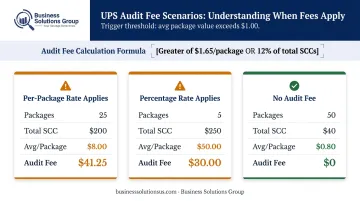
In the third scenario, corrections still apply to your invoice — the audit fee penalty simply doesn't trigger when the average falls below $1.00.
The fee is calculated per account number, and import shipments are excluded from this assessment entirely.
How to Avoid UPS Shipping Charge Corrections
Prevention costs nothing. Most SCCs trace directly to data entry errors that happen before the package ever leaves your dock.
Accurate Data Entry at Manifest
The single most effective control: enter verified dimensions, correct weight (rounded up), and proper address classification before tendering each shipment.
Practical steps:
- Weigh every package on a calibrated scale — don't estimate.
- Measure at the longest point of each dimension, round up to the nearest whole inch.
- Use UPS's Address Validation Street Level API to verify addresses against the USPS database before submitting.
- Flag all residential destinations, including home-based businesses.
Use UPS Shipping Tools Correctly
UPS WorldShip automatically calculates dimensional weight when correct dimensions are entered on the Details tab. For businesses shipping the same product configurations repeatedly, saved package profiles cut repeat-entry errors:
- WorldShip: Save reusable profiles with stored dimensions via Tools → Package Type Editor
- CampusShip: Enter dimensions in the Package Information section under Add Shipping Options for each shipment
Build an Internal QA Checkpoint
Don't rely on individual shippers to catch every error. A lightweight QA process prevents corrections before UPS ever flags them:
- Cross-check actual package weights against system entries before pickup.
- Flag package types historically prone to corrections — large/light ratio items, residential destinations, irregular shapes.
- Review outbound records weekly for patterns that indicate systemic data issues.
How to Audit and Recover Overcharged UPS Fees
Not every SCC is legitimate. UPS's automated measurement systems can misread dimensions or misclassify addresses — and shippers have the right to dispute charges they believe are incorrect.
The Dispute Process
UPS provides an online dispute process through the UPS Billing Center. To dispute a charge:
- Locate the charge on your invoice in the Billing Center.
- Click Dispute in the Actions menu.
- Submit supporting documentation — photos of the package with measurements, original address records, shipment confirmation data.
Critical deadline: Per the UPS Tariff, invoice adjustment requests must be submitted within 180 days of receiving the contested invoice. Missing this window constitutes agreement to pay the invoice amount and waives the right to challenge it.
Why Systematic Auditing Matters
For businesses shipping at volume, manual line-by-line review is impractical. A systematic audit approach catches what individual invoice reviews miss:
- Wrongful SCCs from measurement errors
- Duplicate charges
- Late delivery refund opportunities (UPS service guarantee claims)
- Audit fees applied to incorrectly billed corrections
The math supports the investment. According to Shipware's parcel invoice audit data, 1% to 5% of UPS invoices are eligible for refunds due to service guarantees alone — and high-volume shippers can recover 1% to 9% through comprehensive audit and refund recovery.
How Business Solutions Group Can Help
Systematic auditing requires more than a spreadsheet — it requires knowing what to look for and how to build a documented case that carriers will accept. Business Solutions Group's spend intelligence platform and advisory team are built specifically for that work.
Their capabilities include:
- Invoice-level audits to identify wrongful SCCs, duplicate charges, and missed service guarantee refunds
- Dispute filing with supporting documentation to substantiate each claim
- Carrier contract renegotiation to reduce base surcharge exposure long-term
- Former UPS and FedEx analysts who know how carrier billing systems apply — and misapply — corrections
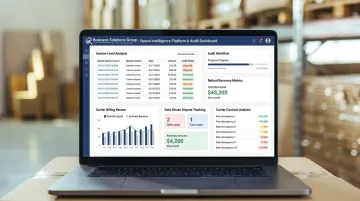
Their model is performance-based: clients receive 100% of recovered credits. For businesses that haven't had their UPS invoices professionally audited, Business Solutions Group offers a free savings analysis to identify what's recoverable.
Frequently Asked Questions
What is a UPS shipping charge correction?
A UPS shipping charge correction is a retroactive billing adjustment applied when shipment details entered at manifest — weight, dimensions, address — differ from what UPS verifies during or after transit. The correction results in additional charges billed during the applicable invoice period.
What is the UPS correction audit fee?
The UPS correction audit fee is a penalty assessed on top of SCCs when the average correction per package in a given invoice week exceeds $1.00. The fee is the greater of $1.65 per corrected package or 12% of total SCC revenue for that period, per 2026 UPS Daily Rates.
What triggers a UPS shipping charge correction?
The most common triggers are incorrect or missing package weight, inaccurate or omitted dimensions (leading to DIM weight recalculation), residential address misclassification, and incomplete or unverifiable delivery addresses requiring UPS correction.
Does the UPS audit fee apply to import shipments?
No. The UPS Shipping Charge Correction Audit Fee explicitly does not apply to import shipments. It is assessed only on domestic shipments subject to SCCs during a given invoice period.
How can I dispute a UPS shipping charge correction?
Log into the UPS Billing Center, locate the charge, and click Dispute in the Actions menu. Submit supporting documentation — package photos with measurements and address records. Requests must be filed within 180 days of the contested invoice date.
Can carrier contract negotiation help reduce UPS audit fee exposure?
Contract negotiation won't eliminate SCCs, but well-structured carrier agreements can reduce base surcharge rates and cap their financial impact. Benchmark analysis — comparing your current UPS rates against market standards — is the most effective starting point for identifying renegotiation opportunities.