According to the 2025 State of Logistics Report, U.S. business logistics costs reached $2.58 trillion in 2024 — equal to 8.8% of GDP — with transportation accounting for 64.4% of that total. For most businesses, freight isn't a minor operational expense. It's a major cost category that deserves the same scrutiny as labor or materials.
This guide breaks down every major freight charge category, identifies the hidden fees that quietly inflate invoices, and outlines specific actions you can take to reduce your total freight spend.
Key Takeaways
- Freight fees fall into three stages — origin, in-transit, and destination — with accessorial fees added when specific conditions apply.
- Demurrage, reweigh charges, and vendor freight markups are among the most avoidable fees on any invoice.
- Shipment weight, freight class, mode of transport, and seasonality are the primary cost drivers.
- Most freight charges — including base rates and fuel surcharges — are negotiable with the right data.
- A freight consulting partner can benchmark your spend against market rates and identify savings your internal team is missing.
What Are Freight Fees?
Freight fees are the total charges a business pays to move goods from origin to destination. That includes the base transportation cost, handling, documentation, and any additional services required en route.
These charges fall into three broad stages:
- Origin/pre-transit charges — booking fees, documentation, export customs
- In-transit charges — base rate, fuel surcharges, carrier-applied fees
- Destination charges — port fees, customs duties, terminal handling, last-mile delivery
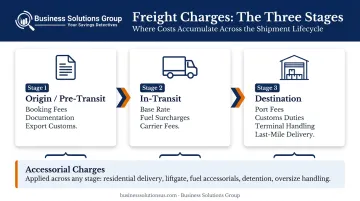
Accessorial charges are a separate category — and the one that most often catches shippers off guard. They're rarely quoted upfront, but they appear on the invoice whenever specific conditions arise: a residential delivery, a reweigh, a missed pickup window. Understanding they exist is the first step to disputing them.
The Most Common Freight Charges Explained
Base Freight Rates by Mode
The base rate is what you pay for the physical movement of goods. It varies significantly depending on the mode you're using:
| Mode | How It's Priced |
|---|---|
| LTL | Per hundredweight (CWT), based on NMFC freight class |
| FTL | Per mile — dry van spot rates are currently around $2.79–$2.82/mile including fuel |
| Ocean (FCL) | Per container — the Drewry World Container Index stood at $3,549 per 40ft container as of June 11, 2026 |
| Ocean (LCL) | Per cubic meter |
| Air freight | Actual or dimensional weight, whichever is greater — global yields averaged $2.65/kg in November 2025 |
| Parcel | Zone-based with dimensional weight as the billing standard |
Mode selection alone creates wide cost variance. Ocean freight typically runs $2–$4/kg with 30–40+ day transit times; air freight runs $5–$8/kg with 8–10 day transit. That tradeoff between cost and speed drives most mode decisions.
Standard Surcharges
Surcharges layer on top of the base rate and are applied across all modes:
- Fuel surcharges — indexed to diesel or jet fuel prices, expressed as a percentage of base rate. Carriers like ArcBest tie their fuel surcharge directly to the EIA National Average Diesel Fuel Index. In Q1 2026, ground fuel surcharges rose 26.7% even as diesel prices rose roughly 10% — surcharges don't always move in proportion to pump prices.
- Peak season surcharges — applied during high-demand periods, especially Q4. UPS peak surcharges for Large Packages ran as high as $107.00 per package in 2025.
- Security surcharges — cover regulatory compliance costs at ports and terminals.
- BAF/CAF — Bunker Adjustment Factor and Currency Adjustment Factor for ocean shipments, updated periodically by carriers like Maersk and Hapag-Lloyd.
Fuel surcharges are a recurring cost many shippers accept without review. Auditing them against actual fuel index movements regularly can surface real savings.
Destination and Port Fees
These charges apply on the receiving end and frequently catch importers off guard:
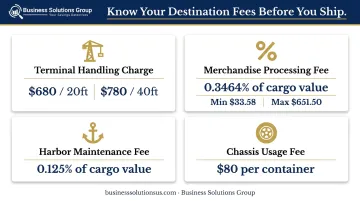
- Terminal Handling Charges (THC) — Maersk's Destination Handling Charge to the U.S. runs $680 per 20ft dry container and $780 per 40ft dry/HC container (effective March 2025)
- Merchandise Processing Fee (MPF) — 0.3464% of cargo value, minimum $33.58, maximum $651.50 for FY2026
- Harbor Maintenance Fee (HMF) — 0.125% of commercial cargo value
- Chassis usage fees — Hapag-Lloyd charges $80 per container for chassis usage at U.S. origins/destinations
Many of these fees are government-mandated and fixed. Knowing them in advance lets you calculate accurate landed costs — and avoid the budget overruns that derail procurement planning.
Documentation and Administrative Fees
Documentation fees cover the administrative side of a shipment:
- Bill of Lading issuance and booking confirmation fees
- Certificate of Origin charges
- ISF (Importer Security Filing) fees for U.S. imports
- Customs clearance fees
Manual booking transactions typically cost more than digital submissions. Using digital booking platforms reduces both administrative fees and the error rate that triggers additional charges downstream.
Hidden Freight Fees That Quietly Inflate Your Bill
Hidden Freight Fees That Inflate Your Bill Without Warning
Accessorial charges are the biggest source of invoice surprises. According to industry estimates, they can add 8%–15% to a standard freight invoice, and roughly 25%–40% of mid-market shipments include at least one accessorial beyond fuel.
Demurrage and Detention Fees
These two are frequently confused — and frequently expensive:
- Demurrage — charged when a container sits at a port beyond the free-time window (typically 4–7 days). Maersk recently updated its U.S. demurrage tariff, increasing import demurrage by $20–$40 per container depending on equipment and port, and reducing reefer free time to 2 working days at Miami and Port Everglades.
- Detention — charged when a container is held at a shipper or consignee's facility beyond the agreed window. ArcBest's LTL detention starts at $5/minute per vehicle after free time, with a $90 minimum.
Both fees escalate daily. Proper scheduling and early communication with carriers are all it takes to avoid them.
Reweigh and Reclassification Fees
If a shipment's declared weight or NMFC freight class doesn't match what the carrier finds on inspection, they'll reassign it — and charge you for the correction plus the rate difference.
Weigh and measure freight accurately before tendering — proactive measurement eliminates this risk entirely.
Accessorial Delivery Fees
Common delivery-side charges that appear when circumstances aren't communicated in advance:
- Lift-gate service — required when the delivery location has no loading dock
- Inside delivery — moving freight beyond the threshold into the facility
- Residential delivery surcharge — applied automatically to home addresses
- Limited-access delivery — schools, military bases, remote locations
- Advance notification fees — scheduling calls before delivery
- Redelivery fees — triggered when the first delivery attempt fails
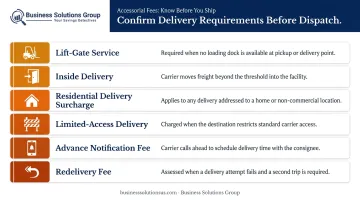
Confirming delivery requirements before dispatch eliminates most of these.
Vendor Freight Markups
Many vendors bundle freight into invoices as a flat "delivery fee" — with no visibility into the actual carrier cost underneath. These prepaid-and-add markups are rarely benchmarked against real rates, and the spread can be significant.
To close that gap:
- Isolate freight as a separate spend category in procurement
- Request itemized freight documentation from every vendor
- Compare carrier invoice totals against what you're being billed
Key Factors That Influence Freight Costs
Shipment Characteristics
- Weight and dimensions — carriers bill on actual or dimensional weight, whichever is higher. Packaging that reduces dimensional weight directly lowers your billable weight.
- Cargo type — hazardous materials, perishables, and oversized freight all command higher rates.
- Freight class (NMFC) — applies to LTL shipments. The NMFC system groups commodities into 18 classes, from Class 50 to Class 500, based on density, handling requirements, stowability, and liability. A lower class means lower cost per shipment — and misclassification is one of the most common triggers for carrier invoice disputes and unexpected charges.
External Market Factors
Shippers can't control these directly, but tracking them enables smarter budgeting and contract timing:
- Fuel price fluctuations (directly tied to surcharge levels)
- Seasonal demand spikes — Q4 routinely drives surcharge additions from major parcel carriers
- Port congestion — congestion events like those in 2021 pushed container spot rates to five times pre-pandemic levels
- Driver and capacity shortages in the trucking market
Proven Strategies to Reduce Your Freight Fees
Reducing freight costs takes more than negotiating lower rates. Operational discipline, data visibility, and strategic purchasing all have to work together.
Audit Your Freight Invoices Regularly
Invoice errors are common. Trimble reports that overcharges cost companies 2%–5% of annual transportation spend, and that digital audit processes can reduce time spent analyzing transport costs by 70%. Other freight audit sources put the error rate between 3% and 20% depending on methodology.
For each invoice, compare:
- The original carrier quote
- The Bill of Lading weight, class, and service level
- Contracted rates versus what was actually charged
- Any applied accessorials versus what was pre-agreed
Catching these discrepancies before payment is far more effective than recovering them afterward.
Consolidate Shipments and Optimize Freight Class
Combining smaller shipments into fewer, larger ones reduces per-unit freight cost and can shift a shipment into a more favorable NMFC class. ODW Logistics documented a consolidation program that produced 12.4% freight savings with shipments moving 1.2 days faster on average.
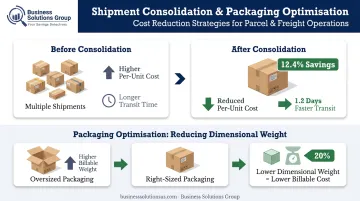
Packaging optimization matters too. Reducing dimensional weight through tighter packing lowers billable weight and avoids carrier dimensional weight adjustments.
Negotiate Freight Terms with Carriers and Vendors
Freight rates are negotiable — particularly when you can offer volume commitments or lane consistency. Two distinct negotiation tracks exist:
- Direct carrier contracts — for LTL and FTL, negotiate rate-per-CWT or per-mile discounts, fuel surcharge caps, and accessorial waivers based on your volume data
- Vendor agreements — push for "collect" freight terms or itemized freight billing to eliminate prepay-and-add markups that are invisible under a flat delivery fee
Benchmark Your Rates Against Market Standards
Without benchmark data, there's no way to know if you're overpaying. Start by pulling 12 months of invoices, then:
- Isolate freight as a standalone cost category (not bundled into COGS)
- Map charges by lane, mode, and service level
- Compare your rates against current market benchmarks for equivalent shipments
Business Solutions Group's freight advisory practice does this work for clients — using spend intelligence analysis and former UPS and FedEx pricing analysts to pinpoint where negotiation leverage exists. BSG has helped over 1,200 companies reduce shipping costs, with clients including Columbia Sportswear, ULTA Beauty, and Dexcom.
Time Shipments Strategically and Avoid Accessorial Triggers
Several cost-reduction moves require only planning discipline:
- Ship outside peak seasons where possible to avoid demand surcharges
- Schedule pickups and deliveries with enough buffer to avoid detention and demurrage
- Pre-confirm all delivery requirements (dock availability, hours, access restrictions) before dispatch
- Use digital documentation to minimize the administrative errors that cascade into additional fees
How a Freight Consultant Helps You Take Control of Costs
A freight consultant brings independent, data-driven analysis of your full freight spend. Internal teams often miss structural inefficiencies because they've become normalized — recurring billing errors, misaligned mode mix, underused contract terms, and lanes that haven't been benchmarked in years.
Identifying these gaps is where a good consultant earns their fee.
What a consulting engagement typically covers:
- Access to proprietary market rate benchmarks across modes and lanes
- Carrier contract negotiation support, including building the business case and conducting the actual negotiation
- Freight audit capabilities to catch billing errors before payment
- Analysis of accessorial charge patterns that reveal where operational changes can eliminate recurring fees

When evaluating a freight consultant, look for:
- Pricing model clarity — ask whether they charge a flat fee, retainer, or contingency (a percentage of documented savings). Contingency models reduce upfront risk; freight audit providers typically charge 25%–50% of identified savings under these arrangements.
- Benchmark access — can they show you what comparable shippers are actually paying on similar lanes?
- Track record — have they negotiated carrier contracts at scale, or do they only provide recommendations?
- Non-disruptive approach — will they require you to switch carriers or overhaul operations, or can they improve your current arrangements?
Business Solutions Group operates as a cost optimization advisory firm, not a freight broker. A broker earns revenue by arranging shipments; BSG earns fees by reducing what you pay for the shipments you're already running. The entry point is a free, no-obligation savings analysis — so clients see their potential savings before committing to anything.
Frequently Asked Questions
What is the average freight charge?
Freight costs vary widely by mode. U.S. dry van FTL spot rates currently run around $2.79–$2.82 per mile including fuel, while ocean rates on the Far East to U.S. West Coast lane ran $2,118–$2,645 per FEU in early 2026. LTL pricing has risen roughly 67.9% above its January 2018 baseline per the TD Cowen/AFS Freight Index — no single average covers all traffic.
What is freight consultation?
Freight consultation means working with a logistics expert who analyzes your shipping spend, benchmarks it against market rates, and develops strategies to cut cost. Unlike a freight broker, who earns revenue on individual shipments, a consultant's value is in improving the economics of your overall freight program.
What is a reasonable consulting fee?
Most freight audit and consulting providers work on contingency, charging 25%–50% of documented savings, so you only pay if savings are identified. Some offer flat project fees, which work better for defined-scope engagements like a one-time carrier contract review.
What are the most common hidden freight fees businesses overlook?
The four most frequently overlooked charges are:
- Demurrage and detention fees that escalate while waiting for attention
- Reweigh and reclassification charges triggered by inaccurate shipping data
- Vendor freight markups buried in flat delivery fees
- Fuel surcharges that stay elevated even when diesel prices fall
Are freight charges negotiable?
Most are. Base rates, fuel surcharge percentages, and accessorial fee structures are all negotiable — particularly when you have volume data and contract leverage. Vendor-applied freight fees are often the most negotiable category because vendors rarely expect pushback on line items labeled as "delivery fees."
What is the difference between a base freight rate and a surcharge?
The base rate covers the core cost of moving goods from origin to destination. Surcharges are additional fees layered on top to cover specific variables — fuel price volatility, peak season demand, security compliance costs, or destination-specific conditions. The base rate is relatively stable; surcharges are where invoice amounts fluctuate most unpredictably.