](https://file-host.link/website/businesssolutionsus-mg3rtz/assets/blog-images/3c1007d7-9821-43a4-b453-7b574ac5aa8a/1781615307172186_b578cc1f6032410689e53c9d29efa0e0/360.webp)
Introduction
Network traffic keeps climbing. Revenue per user keeps falling. For telecom operators, the math is getting harder to ignore.
McKinsey research puts the numbers in sharp relief: annual revenue growth in North America barely reached 1%, while Europe saw a 1% decline, with ROIC across both regions falling 10% to 15% between 2018 and 2022. Aggressive 5G and fiber capex cycles are compressing margins further, even as over-the-top competitors continue eroding legacy revenue streams.
What's less discussed is where much of that margin erosion actually originates: the business support layer. Outdated billing systems, fragmented product catalogs, manual revenue assurance processes, and reactive churn management all drain profitability in ways that increased network investment alone won't fix.
This post examines AI-driven BSS platforms as a direct lever for cost reduction and margin improvement: what they actually do, where the measurable ROI concentrates, and how operators can build a credible business case before committing to investment.
Key Takeaways
- AI-driven BSS addresses billing errors, revenue leakage, slow order management, and churn — problems network-side AI cannot solve
- Highest-ROI use cases: automated revenue assurance, intelligent churn management, dynamic offer optimization, and AI-assisted order management
- TM Forum research found average estimated revenue leakage of 1.9% of revenue — a direct, recoverable margin opportunity
- ROI arrives within 12–24 months when starting with a clearly scoped, KPI-tied use case
- Poor data quality and missing executive sponsorship sink more BSS deployments than poor technology choices
Why Telecom Margins Are Shrinking — and Why BSS Is the Overlooked Lever
The Macro Pressure Is Real
Bain's research identified a $28 billion free-cash-flow gap between major US telecom operators' projected trajectories and the levels needed to reach aspirational share prices by 2028. Inflation has added further pressure: personnel, energy, external services, leases, and capex represent roughly 60% of operator spending, and margin erosion of 3 to 5 percentage points over two years is a plausible scenario for operators who don't act structurally.
Bain's conclusion is pointed — incremental cost cuts won't close this gap. Operators need a more structural approach to efficiency — and that's where BSS becomes relevant.
What BSS Actually Is (and Why It Matters)
Business Support Systems (BSS) cover the commercial-facing layer of telecom operations:
- Billing and revenue management
- Product catalog management
- Customer relationship management (CRM)
- Order management and fulfillment
- Partner and wholesale management
- Revenue assurance
This is distinct from OSS (Operations Support Systems) — which handles network provisioning, fault management, and performance monitoring — and the two have very different cost profiles and improvement levers.
Where BSS Inefficiency Compounds
The telecom industry has invested heavily in network-layer AI. The BSS layer has received far less attention — and the consequences compound:
- Billing mismatches between OSS usage records and BSS invoices drive revenue leakage that often goes undetected for months
- Product catalog systems unable to handle complex multi-service bundles slow time-to-market and require manual configuration workarounds
- High cost-to-serve climbs when order fallout is handled manually and customer service stays reactive
- Churn signals missed until a customer calls to cancel — by then, retention efforts are already too late
Legacy BSS platforms weren't designed for modern converged, multi-channel, multi-service offers. Operators still running those systems are absorbing costs that better-architected platforms would eliminate.
What AI-Driven BSS Platforms Actually Do
The Core Architectural Shift
"AI-driven BSS" isn't a single product. It's a layer of intelligence applied across billing, product, order, and customer management domains. The shift is from static, rules-based systems toward platforms that learn from usage data, customer behavior signals, and network performance metrics, adapting in near real time.
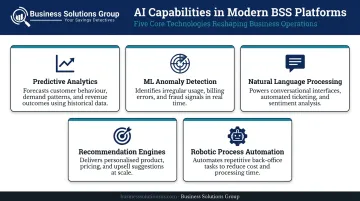
The key AI capabilities embedded in modern BSS platforms include:
- Predictive analytics for churn scoring and customer lifetime value modeling
- Machine learning anomaly detection for billing and revenue flow irregularities
- Natural language processing for customer service automation and agent assist
- Recommendation engines for personalized offer generation at the individual customer level
- Robotic process automation for order fulfillment and fallout resolution workflows
The Closed-Loop Between Network and Business Layer
The greatest margin value isn't created within BSS in isolation — it's created when AI-driven BSS integrates with OSS and network performance data to form a closed loop.
Consider a practical scenario: a customer experiences network degradation in their area. An integrated AI-BSS platform identifies the issue, cross-references the affected customer's churn risk score, and automatically triggers a proactive retention offer through their preferred channel.
A service credit is applied before the customer ever dials in a complaint. No human intervention. No cost-of-complaint absorbed.
This tight integration between network experience and commercial response is what separates AI-driven BSS from simple automation.
Handling the Legacy Constraint
Most operators cannot replace their BSS stack overnight. A practical dual-track model addresses this:
- Deploy AI agents on top of existing systems now — targeting specific high-value use cases like revenue assurance or churn prediction without requiring full platform replacement
- Use those agents to expose the specific bottlenecks in legacy systems, then prioritize modernization at those exact points
This avoids the paralysis of waiting for a clean-slate transformation that may be years away. AI agents within modern BSS platforms go beyond traditional automation because they can interpret context from multiple data sources and take bounded actions across domains. Rule-based systems break when conditions fall outside predefined parameters; AI agents don't.
Key Areas Where AI-BSS Drives Cost Reduction and Margin Improvement
The four use cases below represent where operators are seeing measurable returns in production deployments, not just pilots.
Automated Revenue Assurance and Billing Accuracy
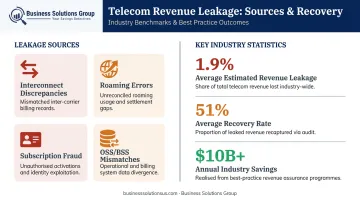
Revenue leakage is a structural problem across the industry. TM Forum's Revenue Assurance Survey found average estimated leakage of 1.9% of revenue, with measured leakage before recovery at 0.9% and average recovery rates of only 51%. The main leakage categories include:
- Interconnect billing discrepancies
- Roaming settlement errors
- Subscription fraud
- Mismatches between OSS usage records and BSS-generated invoices
AI-powered revenue assurance tools continuously monitor billing data flows in real time, using anomaly detection to flag discrepancies that rule-based systems miss. The business outcome: reduced leakage as a percentage of total revenue, fewer manual audit cycles, and faster detection of new fraud patterns. TM Forum estimates that business assurance best practices drive annual savings of over $10 billion in leakage reduction across the industry.
Intelligent Churn Prediction and Retention
AI-driven BSS platforms use behavioral signals — usage drop-off, billing anomalies, customer service interaction frequency, network experience scores — to identify at-risk customers 30 to 90 days before they churn. That early warning window is where retention economics are most favorable: a targeted offer to a high-risk customer costs a fraction of acquiring a replacement.
Outcomes across deployments include:
- McKinsey research found telecom advanced analytics can reduce churn by as much as 15%
- A European operator using CX analytics cut churn 40% within six months while customer satisfaction rose 15 points
- Integrated next-best-experience engines can reduce early-life churn by up to 30%
The best churn models don't just score risk — they recommend the optimal retention offer and channel, which prevents over-discounting and protects margin on the customers you retain.
Dynamic Offer Management and ARPU Optimization
Static product catalogs and uniform pricing leave revenue on the table. Customers with meaningfully different willingness to pay and usage patterns receive the same offer — and operators either under-capture revenue from high-value customers or over-invest in promotions for price-sensitive ones.
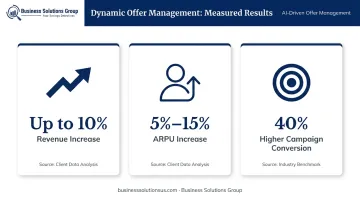
AI-driven BSS platforms address this by pulling real-time usage data, customer segmentation, and competitive signals to generate personalized offers and dynamic pricing recommendations. Measured results include:
- Analytics-driven customer value management can increase operator revenues by up to 10% and customer engagement by 20% to 30%, per McKinsey
- A leading European operator achieved 5% to 15% ARPU increase through generative AI-powered hyper-personalized upselling
- A European telco increased campaign conversion rates by 40% while reducing campaign costs
Beyond revenue lift, AI offer engines reduce promotional spend waste — targeting offers only to customers where incremental revenue is likely, rather than broad campaigns where most spend generates no uplift.
AI-Assisted Order Management and Cost-to-Serve Reduction
Order management — especially for enterprise and converged services — is a hidden cost center. TM Forum notes that order fallout rates in some environments reach 15% to 25%, requiring manual rework that consumes labor and damages customer experience.
AI-driven workflow automation and intelligent fallout management reduce both cycle times and processing costs. The customer service impact runs in parallel:
- A McKinsey-documented AI help-desk deployment reduced cost per call 35% and improved first-contact resolution 60%
- A Western European operator cut serving costs 35% by using predictive analytics to identify customers likely to call about resolvable faults and addressing them proactively
- A major European operator halved inbound calls related to service ticket management by digitizing repairs and technician tracking
Approximately 40% of fixed broadband technician appointments in one McKinsey CX example were booked without any human agent interaction — a direct cost-to-serve reduction with no service quality degradation.
Building the Business Case: What ROI Actually Looks Like
The Metrics That Matter
Before any AI-BSS investment, operators need clean baselines for these five metrics:
| Metric | Why It's in the Business Case |
|---|---|
| Revenue leakage as % of total revenue | Directly quantifies the recovery opportunity |
| Monthly churn rate and ARPU retention value | Ties retention improvement to P&L impact |
| Cost-per-interaction in customer service | Benchmarks the automation savings opportunity |
| ARPU from personalized vs. generic offers | Isolates the dynamic pricing uplift |
| Order fallout rate and rework labor cost | Sizes the order management efficiency gain |
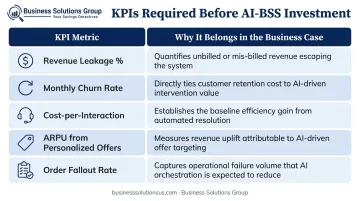
Without baseline KPIs established before go-live, the ROI case is not credible — and the AI deployment has no performance standard to meet.
Investment Context
Specific AI-BSS project cost and payback benchmarks are not widely published, but the market-level data frames the stakes clearly: Analysys Mason forecasts CSP OSS/BSS software and services spend reaching $80 billion by 2028, growing at 5.5% annually. McKinsey reports that roughly 50% of telecom operators are now capturing measurable impact from AI deployments, up from 25% a year prior, and 64% of surveyed C-suite executives are targeting 10% to 15% EBITDA improvement through AI scaling.
Smaller operators and MVNOs don't need to wait for a full BSS transformation. Modular, cloud-native AI tools targeting a single use case — revenue assurance or churn prediction — carry a fraction of the cost of a platform-wide overhaul, and the ROI logic holds at any operator size.
Where Independent Benchmark Analysis Adds Value
Those market figures establish the ceiling — but each operator's actual opportunity depends on where their cost structure sits relative to industry benchmarks. Before committing to technology investment, operators benefit from an independent assessment of where they deviate from peer benchmarks and what the addressable savings gap is. Business Solutions Group provides benchmark analysis and spend intelligence that helps organizations quantify that gap before a vendor selection process begins, grounding the business case in data rather than vendor projections.
Implementation Principles for AI-BSS Success
Data Readiness Comes First
AI-BSS tools are only as good as the data they consume. Customer records, usage data, billing records, and network performance data must be clean, integrated, and accessible before meaningful AI can be applied. Audit the data infrastructure before selecting technology.
Start Narrow, Prove Value, Then Scale
Operators who attempt to transform their entire BSS stack simultaneously consistently stall. The pattern that works: identify one high-value use case, deploy AI in a controlled and measurable way, demonstrate ROI, then use that proof point to fund the next initiative.
Revenue assurance is often the best starting point because:
- The leakage opportunity is directly quantifiable
- Data requirements are manageable relative to other use cases
- Results are visible within months, not years
Change Management Determines Whether Pilots Scale
AI-BSS transformation affects billing teams, customer operations staff, and marketing functions — all of whom must adapt their workflows. Resistance from these groups is one of the most common reasons deployments fail to scale beyond the pilot. Effective change management means:
- Early stakeholder involvement before deployment begins
- Role-level training that shows how AI augments rather than replaces judgment
- Transparent communication about what decisions AI makes versus escalates
Common Mistakes That Derail AI-BSS Investments
Buying Technology Without a Defined Problem
Vendors will present impressive AI capability demonstrations. Without a clearly defined use case, baseline KPIs, and executive ownership, even well-implemented tools become expensive data generators that no one acts on.
Work backwards from a specific margin or cost outcome, then select technology that addresses it.
Underestimating Integration Complexity
Most operators run multiple siloed billing platforms, CRM systems, and product catalogs that don't share clean data. AI models trained on fragmented inputs produce unreliable outputs, and that unreliability erodes confidence in the entire system quickly.
Conduct a data foundation audit before selecting any technology — it's the step that determines whether your AI investment delivers results or just noise.
Frequently Asked Questions
What is an AI-driven BSS platform in telecom?
BSS (Business Support Systems) is the business-facing layer that handles billing, CRM, order management, product catalog, and revenue assurance. AI-driven BSS adds predictive analytics, real-time anomaly detection, and personalization — reducing costs and improving revenue outcomes, not just automating what was already done manually.
How does AI in BSS reduce telecom operational costs?
AI targets cost at four points in the BSS stack:
- Automates billing and revenue assurance, cutting manual labor and leakage recovery time
- Reduces cost-per-interaction through AI-assisted and self-service customer channels
- Lowers order management fallout and rework costs
- Decreases churn-related revenue loss through earlier predictive intervention
What is revenue assurance in telecom, and how does AI improve it?
Revenue assurance identifies and recovers revenue lost to billing errors, fraud, and system discrepancies. AI improves it by continuously monitoring data flows in real time and detecting anomalies far faster than rule-based systems — which typically only catch discrepancy types they were explicitly programmed to find.
How long does it take to achieve ROI from an AI-BSS investment?
Well-scoped deployments in revenue assurance or churn prediction typically show measurable returns within 12 to 18 months. Full payback is often achieved in 18 to 30 months for mid-size operators, depending on use case complexity, data readiness, and scale.
Can smaller telecom operators benefit from AI-driven BSS platforms?
Yes. Smaller operators and MVNOs can deploy modular, cloud-native AI-BSS tools addressing a single use case rather than requiring full platform replacement. Revenue leakage recovery and churn reduction deliver measurable ROI at any scale — the starting investment is proportionally smaller, and so is the risk.
What is the difference between BSS and OSS in telecom?
BSS covers billing, customer management, and commercial operations. OSS covers network provisioning, fault management, and performance monitoring. AI is increasingly applied to both layers, but BSS improvements have a more direct and immediate impact on margin — because they affect revenue capture, customer retention, and cost-to-serve rather than network infrastructure.