Introduction
Gartner forecasts worldwide IT spending to reach $5.61 trillion in 2025, up 9.8% from the prior year. Yet a significant portion of that spend delivers no value — Flexera's 2024 State of ITAM Report found that even advanced IT asset management practitioners self-estimate wasting 22% of data-center software spend and 21% of IaaS/PaaS spend.
That waste rarely arrives as one bad decision. It accumulates. An unused license renews automatically. A cloud instance provisioned for a peak workload keeps running at 3 a.m. A vendor contract rolls over at last year's rates because no one benchmarked the market. Each decision looks defensible in isolation; together, they compound into chronic overspend.
IT infrastructure is inherently capital-intensive: hardware, software licenses, cloud services, vendor contracts, and network operations all carry real cost. But excess spend is largely driven by poor planning, fragmented procurement, and insufficient visibility into what's actually in use. The strategies below address all three — covering cloud rightsizing, license audits, vendor negotiation, and governance frameworks you can act on immediately.
Key Takeaways
- IT infrastructure costs accumulate through overprovisioning, idle resources, duplicate licenses, and auto-renewing contracts
- The biggest drivers are poor asset visibility, decentralized procurement, aging hardware, and cloud sprawl
- Effective reductions target the source — whether procurement decisions, operational gaps, or structural misalignment
- Cutting spend without understanding its source risks service degradation — optimization means eliminating waste, not just reducing budgets
- Sustained savings require ongoing governance, not one-time cleanups
How IT Infrastructure Costs Typically Build Up
IT cost accumulation follows two distinct patterns, and understanding both matters.
Slow compounding happens almost invisibly: unused SaaS licenses that auto-renew each year, cloud instances provisioned for anticipated peaks that run continuously at low utilization, or software subscriptions that outlive the team members who requested them. No single line item looks alarming. The aggregate does.
Episodic spikes are harder to ignore but harder to prevent reactively: emergency hardware replacements when aging equipment fails unexpectedly, unplanned cloud egress fees from workloads that weren't designed with data transfer costs in mind, or vendor contract renewals handled under time pressure without any market benchmarking.
What makes both patterns costly is that they tend to stay invisible until scale, audit, or financial pressure forces a look. Consider a few concrete examples of how this plays out:
- Shadow IT purchases made outside approved procurement channels that don't appear in any central inventory
- Zombie virtual machines — VMs decommissioned in theory but still running and consuming compute and storage costs
- Overlapping software subscriptions where two teams independently license tools that perform identical functions
According to Gartner, by 2027 roughly 75% of employees will acquire, modify, or create technology outside IT visibility — up from 41% in 2022. That trajectory means the shadow IT problem gets structurally worse without deliberate intervention.
Key Cost Drivers for IT Infrastructure
Overprovisioning
Organizations routinely provision compute, storage, and bandwidth based on projected peak demand rather than actual usage. The gap between what's provisioned and what's used is wider than most IT leaders realize.
The numbers bear this out:
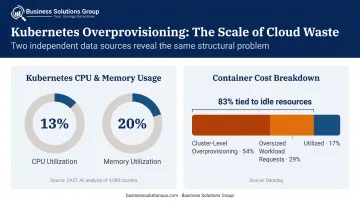
- CAST AI's analysis of ~4,000 Kubernetes clusters found organizations used only 13% of provisioned CPUs and 20% of provisioned memory on average
- Datadog's State of Cloud Costs report found 83% of container costs tied to idle resources — 54% from cluster-level overprovisioning, 29% from oversized workload requests
These are cloud-native environments, but the pattern extends to on-premises infrastructure. Teams specify hardware for worst-case scenarios, then operate well below that capacity day to day.
Decentralized Procurement
When different departments independently source IT tools, licenses, or services, the results are predictable:
- Duplicate purchases for tools that serve identical functions
- Spending that falls below volume discount thresholds
- Contracts negotiated without visibility into what the organization already has or what comparable pricing looks like
Fragmented procurement is an organizational problem at its core. Without a centralized purchasing function — or at minimum a unified view of what's being bought — redundancy accumulates by default.
Software and License Mismanagement
Zylo's 2024 SaaS Management Index — drawn from analysis of 30 million SaaS licenses and over $34 billion in SaaS spend — found that organizations utilized only 49% of provisioned SaaS licenses. The other 51% went unused, translating to an average of $18 million in annual license waste per organization. By 2025, that figure had risen to $21 million, up 14.2% year over year.
Inactive user accounts, over-licensed software tiers, and tools that outlive their original use case all contribute. Most of this waste persists not because organizations don't care, but because no one has clear visibility or ownership of the renewal cycle.
Deferred Hardware Lifecycle Decisions
Keeping servers, storage arrays, and networking equipment past their economic lifespan is a decision, not an inevitability. IDC's analysis notes that aging infrastructure becomes technical debt — costly to maintain, energy-inefficient, and increasingly exposed to unplanned failure risk.
The economics usually favor planned replacement over extended maintenance. Older hardware carries compounding costs:
- Higher power draw relative to modern equivalents
- Greater support resource requirements as components age
- Elevated failure probability leading to unplanned downtime
- Escalating vendor support fees once standard coverage lapses
Cost-Reduction Strategies for IT Infrastructure
Where costs originate determines which strategies will work. Some require changing decisions before infrastructure is acquired. Others require improving how active infrastructure is managed day to day. A third category addresses the broader organizational context.
Strategies That Change the Decision
These approaches reduce cost by intervening before capacity is committed to, contracts are signed, or licenses are renewed.
Standardize procurement before purchase. Define approved hardware configurations, preferred vendor tiers, and software standards in advance. Organizations without these guardrails pay a fragmentation premium — ad hoc purchasing consistently costs more than standardized purchasing, and the management overhead of non-standard assets compounds over time.
Benchmark before renewing vendor contracts. Many organizations renew at existing rates without knowing whether those rates still reflect market pricing. Researching comparable pricing and using benchmark data during negotiations can unlock meaningful savings — often without changing vendors at all. Business Solutions Group's spend intelligence and benchmark analysis capabilities give organizations the market context they need before entering contract negotiations — replacing guesswork with data.
Right-size before committing to capacity. Before purchasing additional on-premises hardware or cloud instances, analyze current utilization patterns. With CPU utilization running at 13% in some cloud-native environments, the case for adding capacity often looks very different once real usage data is on the table.
Audit licenses before renewal cycles. Rather than auto-renewing at current volumes, run a usage audit first. Identify inactive accounts, duplicate tools, and underused tiers — then renegotiate or eliminate. Given that roughly half of all provisioned SaaS licenses go unused, the audit consistently pays for itself.
Strategies That Change How Infrastructure Is Managed
These approaches eliminate waste that emerges not from poor initial decisions, but from inadequate operational discipline over time.
Implement continuous asset tracking. Without a current inventory of what hardware and software exists, what it costs, and when licenses or maintenance agreements expire, organizations inevitably pay for assets they no longer use and miss planned replacement windows that reduce emergency costs.
Automate routine maintenance tasks. Manual infrastructure operations are labor-intensive and error-prone. Automating patching, monitoring, and routine maintenance reduces operational overhead, catches issues before they escalate, and frees IT staff for higher-value work. A Forrester Total Economic Impact study of IBM Turbonomic reported a 471% three-year ROI from automated resource management — a vendor-commissioned figure, but consistent with the broader body of evidence on automation's operational payoff.
Create unified spend visibility. When IT, finance, and procurement each operate from separate data, cost anomalies go undetected and accountability erodes. Shared dashboards that connect these functions create the cross-functional visibility needed to catch overspend early and attribute it accurately.
Build formal decommissioning processes. Zombie servers, unattached storage volumes, forgotten cloud instances, and expired software accounts all carry ongoing cost. Without a structured decommissioning workflow, these accumulate silently. The fix isn't complex — it's procedural discipline applied consistently.
Strategies That Change the Broader Context
These approaches address workload placement, vendor relationships, and the alignment between IT planning and business demand.
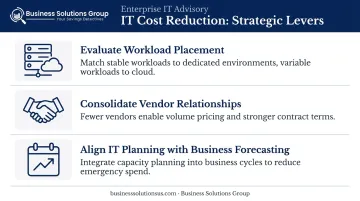
Three decisions at this level produce the most leverage:
- Evaluate workload placement deliberately. High-utilization, stable workloads often cost significantly less in dedicated or colocation environments than in public cloud, where the flexibility premium compounds at sustained throughput. Variable workloads benefit from cloud elasticity. Match each workload to the right environment.
- Consolidate vendor relationships. Distributing IT spend across many vendors fragments purchasing power. Fewer strategic relationships enable volume-based pricing, stronger contract terms, and less administrative overhead.
- Align IT planning with business forecasting. When IT operates on its own roadmap, disconnected from business demand signals, both over-provisioning and under-provisioning become more likely. Integrating capacity planning into business cycles reduces emergency costs and stranded capacity.
Conclusion
Reducing IT infrastructure costs is about one thing: identifying where costs originate, not just how large they are. Across-the-board cuts often trade immediate savings for downstream performance risk or emergency spend — the opposite of optimization.
The organizations that consistently reduce IT costs treat it as an ongoing practice: regular audits, cross-functional accountability, and procurement decisions grounded in market data rather than habit. Those that treat it as a one-time project find the savings erode as old patterns reassert themselves.
Building that kind of structured, repeatable approach is where Business Solutions Group focuses its work. The firm applies benchmark analysis, spend intelligence, and advisory services to surface hidden costs and support better procurement decisions across IT, telecom, and broader enterprise spend categories.
Frequently Asked Questions
What is an IT cost reduction framework?
An IT cost reduction framework is a structured process for identifying, analyzing, and eliminating unnecessary IT expenses. It typically involves a cross-functional team, a current-state audit, and a governance model — such as the FinOps Foundation's Inform, Optimize, and Operate cycle — that sustains savings over time rather than treating reduction as a one-time event.
How do you reduce IT infrastructure costs?
Start with visibility: audit current assets, utilization rates, and active licenses before making any changes. Then eliminate idle resources, standardize procurement, right-size capacity based on actual usage, consolidate vendors, and automate routine maintenance.
What are the biggest hidden costs in IT infrastructure?
The most common hidden costs are unused or auto-renewing SaaS licenses, idle cloud instances running at low or zero utilization, aging hardware maintained past its economic lifespan, shadow IT purchases made outside approved procurement channels, and cloud data egress or overage fees that accumulate without monitoring.
What is the difference between IT cost management and IT cost optimization?
IT cost management focuses on tracking, monitoring, and reporting spend to ensure budget adherence. IT cost optimization goes further — it actively implements strategies to reduce unnecessary spend and improve value delivered per dollar invested. In short: management tracks the numbers; optimization acts on them.
How do you measure ROI on IT cost optimization?
Track cost per workload, license utilization rates, reduction in unauthorized spend, and infrastructure utilization. Compare pre- and post-optimization baselines over 6 to 12 months to capture both direct savings and efficiency gains.
How often should IT infrastructure costs be reviewed?
Use monthly reviews to catch anomalies early, quarterly assessments to align infrastructure with current business needs, and annual audits for strategic decisions like vendor contracts and hardware refresh cycles. For cloud environments, the FinOps Foundation recommends weekly or monthly reviews given how quickly spend can shift.