The challenge is structural. Freight costs don't arrive as one visible number. They accumulate across base rates, fuel surcharges, accessorial fees, reclassification penalties, and mode mismatches — each category growing quietly until someone runs the numbers. By then, months of overpayment are already gone.
This checklist gives freight shippers and supply chain managers a structured approach for 2026: where freight cost originates, which decisions drive it up, and how to reduce it without sacrificing service levels. The framework covers three dimensions — procurement decisions, operational management, and structural context — because sustainable savings require all three.
Key Takeaways
- Freight costs compound across base rates, surcharges, mode mismatches, and unmanaged contracts — often pushing total spend well beyond initial estimates
- The highest-leverage reduction strategies address procurement decisions before a shipment is tendered, not after invoices arrive
- In 2026, tariff volatility and rising spot rates make contracted pricing and benchmark-driven negotiations essential — not optional
- Freight audits, load consolidation, mode optimization, and carrier diversification are among the fastest-to-implement actions on this checklist
How Freight Costs Typically Build Up
Most freight budgets don't blow up in one place. They leak slowly, across categories that individually seem minor but collectively represent significant avoidable spend.
The accumulation pattern looks like this:
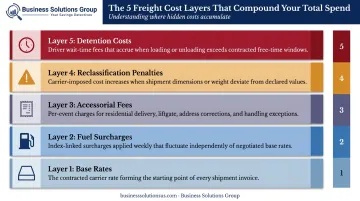
- Base rates set the floor — and a poorly negotiated rate means every surcharge above it multiplies from a higher starting point
- Fuel surcharges apply as a percentage or formula on top of base rates, meaning rate formula design matters as much as the rate itself
- Accessorial fees — detention, liftgate, redelivery, inside delivery — attach to individual shipments and rarely appear in upfront rate discussions
- Reclassification penalties hit when NMFC freight class on a bill of lading doesn't match the carrier's physical inspection, triggering invoice adjustments after the fact
- Detention costs alone caused $3.6 billion in direct expenses and $11.5 billion in lost productivity in 2023, according to ATRI research
Managing this reactively is where most businesses fall short. Across hundreds of shipments annually, the gap between what was paid and what should have been paid compounds into a recoverable loss — one that grows quietly until someone runs the numbers.
Companies without regular spend reviews routinely discover during a formal audit that they've been overpaying across multiple carriers and lanes simultaneously, often for years.
Key Cost Drivers for Freight in 2026
Understanding where cost comes from is a prerequisite for reducing it. Three categories drive the majority of avoidable freight spend.
Rate Structure and Market Conditions
The spot-versus-contract dynamic is particularly consequential right now. DAT reported spot van and reefer rates were nearly 9% higher year-over-year in December 2025, with contract van at $2.46/mile and contract reefer at $2.79/mile. Businesses defaulting to spot pricing under time pressure are absorbing that volatility with no capacity guarantee in return.
The EIA forecasts diesel at $3.40/gallon in 2026, which means fuel surcharge formula design — how the surcharge is calculated and capped — will continue to be a direct cost driver for any shipper with contracted carrier agreements.
Classification and Surcharge Accuracy
NMFC classification changes took effect July 19, 2025. Following those changes, U.S. LTL costs rose 7.3% year-over-year, with reclassification contributing to the muted carrier response. Shippers who haven't updated their classification practices since the 2025 NMFC revision are carrying unexamined exposure on every LTL tender.
Structural Network Inefficiencies
Even well-executed individual shipments can operate within a structurally expensive framework. Common network-level problems that rate negotiations alone can't fix include:
- Shipping from legacy warehouse locations no longer aligned with current customer geography
- Over-reliance on a single transportation mode
- Lack of carrier diversification, leaving little leverage at contract time
Cost-Reduction Strategies for Freight
Effective freight cost reduction falls into three categories: strategies that change the decisions made around procurement and planning, those that improve how active freight programs are managed, and those that address the structural context in which freight moves.
Strategies That Reduce Costs by Changing Decisions
These are the highest-leverage interventions because they define the cost ceiling before a single shipment is tendered.
Shift from spot market dependency to contracted rates. Businesses relying heavily on spot pricing absorb rate volatility with no service guarantee. Negotiating long-term carrier contracts with indexed fuel surcharge caps provides rate stability and priority capacity access — a meaningful advantage as 2026 lane conditions tighten.
Apply correct freight classification before tendering. The 2025 NMFC changes are now in effect. Operations teams need to assign accurate NMFC classifications and confirm dimensions before tendering LTL shipments. Reclassification fees are almost entirely avoidable with upfront accuracy — they're a documentation discipline problem, not a pricing problem.
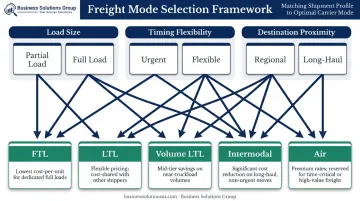
Right-size mode selection for every shipment. Defaulting to the same mode across all loads consistently wastes money. A time-flexible partial load dispatched as FTL, or a ground-eligible shipment sent by air because inventory wasn't managed, are both mode mismatches with direct cost consequences.
Build a decision framework that maps load size, timing flexibility, and destination proximity to the most cost-efficient mode for each scenario.
Negotiate from benchmark data, not intuition. Shippers who enter carrier negotiations without market benchmarks often accept rates that seem competitive but exceed best-in-class levels for their lanes and freight profile. Business Solutions Group's freight optimization advisory and eProcurement solutions provide shippers with spend intelligence and carrier benchmark data — securing contract terms that reflect actual market rates rather than the carrier's opening number.
Strategies That Reduce Costs by Changing How Freight Is Managed
Better procurement decisions don't eliminate cost leakage once shipments are in motion. These strategies address that gap.
Implement regular freight audits. Carrier invoices frequently contain duplicate charges, incorrectly applied rates, or negotiated discounts that were never actually applied. A systematic audit process — in-house or through a third party — recovers overpayments and surfaces recurring billing patterns that can be addressed at the next contract renewal.
Reduce accessorial charges through pre-shipment discipline. Detention, liftgate, redelivery, and inside delivery fees are largely avoidable. Establish a pre-shipment checklist confirming dock availability, freight readiness, accurate delivery information, and appointment confirmations before tendering every load.
The FMCSA documents detention occurring on roughly 1 in every 10 carrier stops — that frequency is a systems problem, not an isolated scheduling issue.
Consolidate LTL shipments into fuller loads. When multiple smaller shipments are heading to the same region within a close time window, consolidating them into a single FTL or volume LTL move reduces per-unit cost significantly. An EPA SmartWay case study documented a manufacturer cutting LTL volume from 75% to 27% of total shipments through consolidation — saving $800,000 in a single year.
Make consolidation a standard review step in shipment planning, not an ad hoc decision made only when the opportunity is obvious.
Use a TMS to track freight cost KPIs across lanes. Without visibility into cost-per-mile, freight bill accuracy, carrier performance, and lane-level spend, cost reduction is directionally blind. Business Solutions Group's TMS platform provides centralized real-time shipment tracking, API-powered carrier rate access, and dynamic pricing visibility — enabling proactive course corrections rather than reactive responses to invoices that have already been paid.
Strategies That Reduce Costs by Changing the Context Around Freight
In many cases, the surrounding setup is the true cost driver, not the individual shipment.
Optimize network design to reduce structural lane distance. Long-haul lanes that could be served by regional distribution, or shipments routed through warehouse locations no longer aligned with current customer geography, create freight costs that persist regardless of how well individual shipments are executed. Periodic network reviews against current shipping volume patterns identify consolidation or repositioning opportunities with lasting impact.
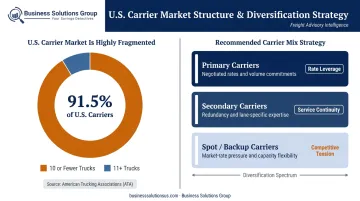
Diversify the carrier mix to maintain competitive tension. Over-reliance on one or two carriers removes negotiating leverage and creates service risk when those carriers face capacity constraints. The ATA reports that 91.5% of U.S. carriers operate 10 or fewer trucks — the market is fragmented and competitive. Maintaining a vetted panel of primary and backup carriers ensures neither rate complacency nor coverage gaps develop across high-volume lanes.
Address inventory and order management practices upstream. Expedited shipments, split orders, and last-minute load tenders are frequently symptoms of inventory planning or demand forecasting problems — not freight failures. Addressing safety stock levels, order batching policies, or supplier lead times removes the cost trigger entirely rather than managing around it with premium freight spend.
Engage advisory support for an end-to-end spend review. When internal resources lack the bandwidth or benchmark data to identify systemic savings across carrier contracts, network design, and procurement processes, a structured third-party review surfaces what internal teams consistently miss.
Business Solutions Group's supply chain optimization and spend intelligence solutions analyze freight, fuel, accessorials, surcharges, and contract terms across all modes — identifying savings that aren't visible from inside the current operation.
Conclusion
Reducing freight costs in 2026 starts with an honest diagnosis. The right strategy applied to the wrong cost driver produces effort without savings — too many shippers pour energy into rate negotiations when the real problem is network design, or run operational audits when the bigger issue is mode mismatch.
That diagnosis is also never finished. Carrier contracts expire. Market conditions shift — the current tariff environment and rising spot rates are a sharp reminder of that. Network realities change as customer geography evolves. Shippers who sustain the lowest freight costs treat this checklist as an ongoing operational standard, not an annual line item that surfaces only when budgets get tight.
Frequently Asked Questions
What is the KPI for freight cost?
Key freight cost KPIs include cost per shipment, cost per mile, freight cost as a percentage of revenue, freight bill accuracy rate, and accessorial charge ratio. APQC benchmarks median total transportation cost at $8.33 per $1,000 revenue across 1,456 companies — the right KPI to track depends on whether you're measuring rate efficiency, carrier performance, or overall spend control.
What are the most common hidden freight costs businesses overlook?
Accessorial charges — detention, liftgate, redelivery, and inside delivery — are the most frequently overlooked category. Freight reclassification penalties, fuel surcharge formula inefficiencies embedded in carrier contracts, and duplicate billing errors that go unrecovered without a formal audit process are the next tier of exposure — and none of them show up until a structured spend review is run.
How often should companies conduct a freight audit?
Businesses with significant shipping volume should audit at minimum quarterly. Companies with high invoice frequency or multiple active carriers benefit from ongoing automated audit processes that flag discrepancies in real time before payments are finalized.
Is LTL or FTL more cost-effective for reducing freight spend?
Neither is inherently cheaper. FTL offers lower cost per unit for full loads but is wasteful on partial loads; LTL is efficient for smaller shipments but carries higher per-pound rates. The goal is matching every load's volume and timing to the correct mode rather than defaulting to one across all scenarios.
What role does a TMS play in reducing freight costs?
A TMS centralizes visibility into freight spend, lane performance, and carrier billing accuracy — enabling data-driven decisions on carrier selection, route optimization, and load consolidation that manual processes can't replicate at scale. Without it, cost reduction stays reactive and inconsistent.
How can small businesses negotiate better freight rates without high shipping volumes?
Small businesses can strengthen their position by consolidating shipments to increase per-carrier volume, using market benchmark data to demonstrate rate awareness, and working with a 3PL or freight advisory firm that aggregates volume across multiple shippers — accessing carrier pricing tiers typically reserved for larger shippers.