The operational consequences go beyond line-item waste. MuleSoft's 2024 Connectivity Benchmark Report found that enterprises average 991 applications, only 28% of which are integrated — and 81% of IT leaders say data silos actively hinder their ability to operate effectively. Delayed reporting, inconsistent metrics across departments, and mounting engineering labor are the downstream effects.
The good news: data platform consolidation doesn't have to be expensive. Most cost problems trace back to poor procurement decisions and unchecked tool proliferation — not data management itself.
This article breaks down how fragmented data environments quietly inflate operational costs, identifies the specific drivers that make those costs compound, and maps out consolidation strategies across three categories: platform decisions, management practices, and environmental structure.
Key Takeaways
- Fragmented data environments generate compounding costs through unused licenses, integration labor, and reconciliation overhead
- Only 43% of organizations have complete visibility into their technology stack, meaning most don't know what they're paying for
- Cost reduction requires targeting the right layer: procurement decisions, active management practices, or architectural structure
- Governance-first consolidation produces more durable savings than tool-switching by establishing clear visibility into what data exists and what it costs
- Treating consolidation as an ongoing operational discipline, not a one-time project, sustains margin improvements over time
How Operational Costs Build Up in Fragmented Data Environments
Data-related operational costs rarely appear as a single budget line. They accumulate gradually — a new analytics tool approved here, a separate reporting dashboard spun up there — with each decision appearing reasonable in isolation.
Tool adoption at the team level rarely accounts for what's already running elsewhere. BetterCloud's 2025 State of SaaS report found organizations now average 106 SaaS applications.
MuleSoft's 2025 data puts enterprise application estates at an average of 897 systems, with 46% of organizations running over 1,000. Most of these systems were never designed to work together.
These costs stay invisible for a long time. Integration overhead, data reconciliation labor, and duplicate vendor contracts rarely surface in standard budget reviews. They tend to appear only when scale forces a full audit — or when an operational failure makes the gaps impossible to ignore.
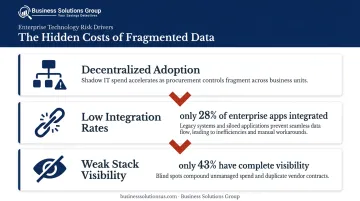
Three conditions accelerate cost accumulation:
- Decentralized adoption — teams independently procure tools to solve narrow problems without cross-functional visibility
- Low integration rates — with only 28% of enterprise apps integrated, data moving between systems requires manual effort or custom connectors
- Weak stack visibility — Flexera's 2025 State of ITAM found complete technology-stack visibility at just 43%, down from 47% the year prior
By the time fragmentation becomes visible, organizations are typically managing dozens of overlapping platforms with no authoritative data layer, no shared definitions, and no clear owner for the problem.
Key Cost Drivers Behind Data Platform Sprawl
Understanding where costs originate makes consolidation far more targeted. Four drivers account for the majority of inflated spend in fragmented environments.
Decentralized Procurement
When individual departments acquire tools independently, they create redundancy that multiplies licensing fees without proportional value. Shadow IT amplifies this: Zylo found that over 33% of applications originate outside formal IT procurement, and 65% of employee-expensed apps carry poor or low risk scores. The result is compounding spend with no central visibility to contain it.
Integration Labor
Every new platform added to a fragmented stack requires custom connectors, data mapping, and ongoing maintenance. According to MuleSoft's 2025 Connectivity Benchmark, developers already spend 39% of their time building and maintaining custom integrations — and 29% of projects are still delivered late. Those hours translate directly into labor costs that don't appear in any software line item.
Talent and Training Overhead
Fragmented environments force staff to context-switch across multiple tools, extend onboarding timelines, and limit the depth of expertise any individual can develop.
Knowledge workers using 16 or more applications report significantly more missed communications and incomplete tasks than peers in consolidated environments. This productivity drag rarely shows up in IT budgets — but it shows up in output.
Governance and Security Exposure
Siloed systems create inconsistent access controls, unclear data ownership, and incomplete audit trails. IBM's 2025 Cost of a Data Breach report put the global average breach cost at $4.44 million, and Verizon's 2024 DBIR found the human element involved in 68% of breaches. Fragmented access management leaves both risk categories harder to detect and more expensive to remediate.
Cost-Reduction Strategies Through Data Platform Consolidation
Effective consolidation depends on identifying where costs originate. The strategies below map to three distinct leverage points: the decisions made before platforms are adopted, the practices used to manage them while active, and the architectural conditions that make even well-managed platforms expensive.
Strategies That Reduce Costs by Changing Platform Decisions
These approaches address cost at the source — before redundancy is created.
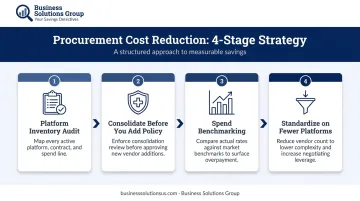
1. Conduct a full platform inventory and spend audit first. Before approving any new tool, organizations need a complete picture of what already exists, where platforms overlap, and what total cost of ownership looks like. With only 43% of organizations reporting complete technology-stack visibility, most are making procurement decisions without this foundation.
2. Adopt a "consolidate before you add" procurement policy. Require cross-functional review of existing tools whenever a new platform is requested. The question isn't whether the new tool solves the problem — it's whether an existing system can be extended instead. This policy shift alone can eliminate a large portion of redundant licenses.
3. Use spend intelligence benchmarking to evaluate contract competitiveness. Knowing what a platform costs isn't the same as knowing whether that cost is reasonable. Benchmarking technology and data platform spend against industry peers reveals overpriced or underused contracts before renewal — not after. For supply chain and logistics operations, where technology costs scale with transaction volume, this analysis pays off most at renewal cycles. Business Solutions Group's spend intelligence services are built around this type of benchmarking, helping clients identify where their spend diverges from market rates before those contracts auto-renew.
4. Standardize on fewer, broader platforms. Platforms that handle multiple functions — ingestion, transformation, governance, and visualization — eliminate the need for custom connectors between specialized tools. Reducing vendor count also simplifies renewal management and increases negotiating leverage.
Strategies That Reduce Costs by Improving How Platforms Are Managed
These approaches reduce cost without necessarily changing which platforms are in use.
1. Centralize data governance. When access controls, data quality rules, and ownership policies are enforced from a single framework, compliance remediation costs drop and reporting accuracy improves. Fragmented governance drives costs continuously, not just at the point of a compliance incident.
2. Implement usage monitoring to identify underutilization. With 51% of SaaS licenses going unused monthly, underused tools are the most immediate consolidation target. Regular license reviews that flag low-utilization platforms generate recurring savings — and build the evidence base for contract renegotiations.
3. Create a single operational data layer. A centralized repository or semantic layer eliminates the need for each team to maintain its own version of key metrics. When every department draws from the same source, data reconciliation labor drops and inter-departmental reporting disputes disappear.
4. Automate pipeline maintenance and scheduling. Manual data movement between systems is one of the most common hidden costs in fragmented environments. It rarely appears in IT budgets as a discrete line item, but it accumulates in engineering hours, delayed reporting, and error correction cycles.
Strategies That Reduce Costs by Restructuring the Data Environment
These approaches address the architectural conditions that make even well-run platforms expensive.
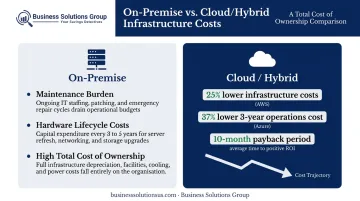
1. Migrate from on-premise to cloud or hybrid environments where appropriate. IDC's study on AWS adoption found 25% lower infrastructure costs and 50% lower five-year cost of operations, with a 10-month payback period. IDC's Azure study showed similar results: 37% lower three-year cost of operations and 16% lower infrastructure costs. For organizations still running legacy on-premise data infrastructure, the operational savings from eliminating hardware maintenance and lifecycle management are substantial.
2. Consolidate vendor relationships for contract leverage. Organizations managing 10 or more separate data tool contracts have limited bargaining power with any single vendor. Consolidating to fewer strategic relationships enables volume-based pricing, unified service agreements, and simplified renewal management — all without changing the underlying platforms.
3. Rationalize data storage by retiring legacy datasets. Storage costs grow with volume, and many organizations pay to maintain historical data in formats that can't be queried without additional tooling. A storage rationalization audit — identifying datasets with no active use case — typically reveals cost reduction opportunities that require no architectural changes, just decommissioning decisions.
4. Phase consolidation across business units. Organization-wide migrations attempted all at once carry high disruption risk. Phased rollouts let early workstreams generate measurable ROI before full investment is committed, create internal proof points that ease adoption resistance, and allow teams to refine the approach before scaling it.
Conclusion
Sustainable cost reduction through data platform consolidation depends on identifying where costs actually originate — in procurement decisions that create redundancy before it's noticed, in management practices that allow sprawl to persist, or in architectural conditions that make individual platforms more expensive than they need to be. Each root cause requires a different response.
The organizations that sustain margin improvements over time built regular platform reviews, spend benchmarking, and governance assessments into their operating rhythm — not as one-time projects, but as ongoing discipline.
Business Solutions Group works with logistics-heavy businesses across supply chain analytics, spend intelligence, and end-to-end cost reduction to support exactly that kind of continuous oversight. When technology spend is scaling alongside transaction volume, the cost of inaction compounds fast.
Frequently Asked Questions
What is data platform consolidation and how does it reduce operational costs?
Data platform consolidation is the process of reducing redundant or overlapping tools in a technology environment. Cost reduction comes from eliminating duplicate licenses, simplifying the integrations between systems, and cutting the labor required to reconcile data across disconnected platforms.
How much can businesses typically save by consolidating their data platforms?
Savings vary based on how fragmented the current environment is. McKinsey research found businesses can reduce application TCO by 15–20% and total IT costs by 8–10% annually, while IDC data shows 16–25% lower infrastructure costs with payback periods around 10 months.
What are the most common hidden costs of fragmented data environments?
The most common hidden costs are integration maintenance labor, manual data reconciliation time, training overhead across multiple tools, security and compliance exposure from inconsistent access controls, and delayed or inaccurate decision-making caused by inconsistent reporting.
How long does a data platform consolidation project typically take?
Timelines vary by scope. Phased approaches targeting high-waste areas — unused licenses, redundant integrations — can show measurable savings within 60–90 days, while full environment rationalization takes several months depending on total system count.
What should a business prioritize first when beginning a consolidation effort?
Start with a complete platform inventory and spend audit. Understanding what tools exist, what they cost, and where they overlap is the prerequisite for every consolidation decision. Without that visibility, consolidation efforts often create new inefficiencies rather than eliminating existing ones.
Can small and mid-sized businesses benefit from consolidation, or is it only relevant for large enterprises?
SMBs often see more immediate impact from consolidation. Tool sprawl represents a higher proportion of their total operating budget, and fewer legacy system dependencies make consolidation faster and less disruptive to execute than at enterprise scale.