Introduction
According to Gartner, worldwide IT spending is projected to reach $5.61 trillion in 2025 — a 9.8% increase from the previous year. Software spending alone is forecast at $1.247 trillion, up 14.2%. For most organizations, a significant portion of those budget increases absorb price hikes from existing vendors rather than funding new capability.
That gap between rising spend and realized value is where IT cost problems take root. Budget overruns accumulate quietly, margins compress, and leadership starts asking why IT investments aren't delivering proportional returns.
IT costs rarely spiral from a single bad decision. They accumulate across procurement choices, governance gaps, and operational habits — individually small, but collectively significant. A SaaS license here, an auto-renewed contract there, a cloud instance that never got deprovisioned.
This guide examines IT cost reduction from three practical angles: investment decisions and procurement strategy, active management of committed spend, and the organizational conditions that inflate costs independent of what the technology itself costs.
Key Takeaways
- IT cost waste compounds through unused licenses, auto-renewals, and unmanaged cloud consumption — not single large purchases
- 44% of SaaS licenses are wasted or underutilized, representing roughly $17M in annual waste for the average enterprise
- Cost optimization targets waste specifically — cost cutting targets spend indiscriminately, often eliminating capability alongside it
- Sustainable savings require continuous governance and cross-functional accountability, not a one-time audit
- Where you leak most depends on your organization — SaaS seats, cloud over-provisioning, and fragmented vendor contracts are the most common culprits
How IT Costs Typically Build Up
IT costs don't announce themselves. They layer in gradually — subscriptions auto-renew, licenses accumulate as headcount grows, legacy systems persist well past their useful life, and cloud resources get provisioned without corresponding deprovisioning.
The math on individual items seems harmless. One unused SaaS seat at $15/month is noise. But Zylo's research shows that enterprise organizations with 10,000+ employees spend over $224M on SaaS while utilizing only 50% of licenses — and that 51% of SaaS licenses go unused monthly. Scale changes the arithmetic entirely.
Three Patterns That Drive Accumulation
Three recurring patterns explain how costs slip past budget controls:
- Gradual drift: Applications bought for a specific project stay active long after it ends. User counts grow during hiring phases but rarely shrink when headcount stabilizes — and each renewal gets approved because the number looks the same as last year.
- Portfolio sprawl: Productiv data shows the average enterprise runs 342 SaaS applications, with 48% unmanaged by IT. When no single team has a complete view of what's running, duplication goes undetected and no one is accountable for eliminating it.
- Event-triggered spikes: Rapid headcount growth, mergers, or sudden technology mandates — AI adoption being the current example — generate purchasing decisions faster than governance can absorb them. Tools get deployed; the review never happens.
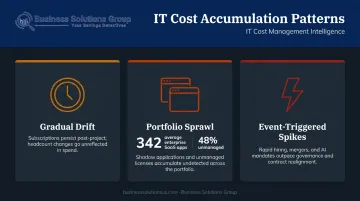
In each case, costs become embedded before anyone thinks to question them — which is exactly the problem a structured optimization process is designed to solve.
Key Cost Drivers for IT
Understanding where costs originate matters more than knowing that costs are high. The same dollar of overspend can come from very different sources, and the intervention that fixes one won't necessarily fix another.
Decentralized Purchasing
When business units buy tools independently of IT, spend fragments across dozens of budget lines and no single team sees the full picture. Zylo reports that IT directly controls only 26% of SaaS spending and manages only 16% of SaaS applications. The remainder flows through departmental budgets, expense cards, and procurement processes IT never touches.
The practical consequence: duplicate tools serving the same function, contracts that could have been consolidated at a discount, and renewal decisions made without usage data.
Over-Provisioning
Cloud environments make over-provisioning easy. Spinning up additional capacity takes seconds; the discipline to rightsize or deprovision it takes governance. Flexera's 2026 State of the Cloud report estimates 29% of IaaS and PaaS spend is wasted — and that AWS found only 47.1% of customers with Savings Plans coverage actively take rightsizing actions.
The same dynamic applies to software licenses. Seats purchased based on projected headcount often outpace actual adoption.
Poor Contract Governance
Renewal windows pass without review. Auto-renewal clauses activate at inflated rates. Minimum-commitment thresholds lock organizations into capacity levels they've outgrown or never reached.
Zylo found that 70% of SaaS application contracts were renewed in 2023 despite underutilization. Those renewals weren't deliberate decisions — they happened because no structured review process required utilization data before approval. Fixing this cost driver means building that process, not renegotiating with vendors.
Each of these three drivers shares a common thread:
- Decentralized purchasing hides spend before it can be managed
- Over-provisioning accumulates waste quietly in cloud and license budgets
- Weak contract governance converts inaction into recurring overspend
Addressing them in combination — not in isolation — is where sustained IT cost reduction actually happens.
IT Cost Reduction Strategies
The most effective strategies depend on where costs actually originate. Organizations that jump straight to cuts without diagnosing the source often eliminate value alongside waste, cutting programs that deliver results while leaving actual waste untouched.
The strategies below are organized by where they intervene: before spend is committed, while IT is actively in use, and in the organizational structures surrounding it.
Strategies That Reduce Costs by Changing Decisions
These approaches address costs at the point of commitment — before budget is locked in.
Conduct a full IT portfolio audit before approving new purchases. Catalog every active application, license, and infrastructure contract. Without this baseline, new spend layers on top of existing waste. Many organizations discover significant duplication only when an audit forces the inventory.
Apply benchmark analysis during vendor evaluation and renewal. Market pricing data changes constantly, and vendors rarely volunteer that your current rates are above market. Organizations that negotiate with benchmarked pricing intelligence consistently secure better terms than those working from the vendor's initial proposal. Business Solutions Group's Technology Optimization team reviews hundreds of technology agreements annually and maintains a library of comparable contract points specifically to close this information gap for clients across IT and telecom categories.
Shift procurement toward right-sized agreements. Committing to seat counts or capacity levels based on projected growth consistently overshoots. Negotiating flexible scaling terms (where commitments align to actual usage rather than forecasts) reduces the cost of getting projections wrong.
Evaluate build vs. buy vs. consolidate for every major technology decision. Before renewing a tool or procuring a new one, assess whether an existing platform in the portfolio already serves that function. Eliminating redundancy at the decision point costs nothing. Eliminating it after contracts are signed costs time and exit fees.
Strategies That Reduce Costs by Changing How IT Is Managed
These approaches address costs through improved control and visibility while IT is in active use.
Implement continuous spend monitoring. Periodic audits catch problems after the fact; continuous monitoring catches them before they compound. Only 3% of IT executives report having complete real-time visibility into SaaS apps, costs, and compliance status. The vast majority are managing spend retrospectively, if at all.
Establish license reclamation workflows. Identify inactive users, unassigned seats, and dormant applications on a recurring basis, then redeploy or eliminate them. This is one of the highest-ROI practices in IT cost management. Business Solutions Group's spend intelligence capabilities are designed to surface exactly this type of operational inefficiency, helping organizations identify where vendor spend doesn't correspond to actual usage.
Apply cost allocation practices. Showback and chargeback models make IT spend visible at the department level. When business units see how their tool usage translates into real dollars, consumption decisions become more deliberate.
The FinOps Foundation notes that proper shared-cost allocation ensures usage is reflected in financial plans. Gartner does caution, however, that chargeback models can become administratively complex if not designed with clear rules upfront.
Standardize IT procurement workflows. Uncontrolled purchasing creates shadow IT and fragmented contracts. A standardized intake and approval process ensures new tools are evaluated against existing capabilities before spend is approved.
Strategies That Reduce Costs by Changing the Context Around IT
These approaches address the organizational structures and technical environments that inflate costs regardless of individual purchasing decisions.
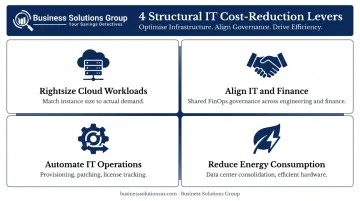
Four levers operate at this structural level:
Rightsize cloud workloads. In multi-cloud and hybrid environments, workloads often run on oversized instances or in high-cost regions by default. Matching instance type and size to actual demand reduces cloud costs without reducing capability. AWS, Google Cloud, and Azure all offer native recommendation tools, though acting on them requires a recurring review process.
Align IT and Finance under shared governance. Misalignment between IT's operational priorities and Finance's budget constraints is itself a cost driver. The FinOps framework defines cloud and technology cost governance as a collaborative discipline, requiring engineering, finance, and business teams to share data, metrics, and accountability. Organizations that implement this structure make better optimization decisions faster.
Automate repetitive IT operations. Manual provisioning, patch management, license tracking, and incident response all consume labor that automation handles at lower cost and higher consistency. Fewer manual steps also means fewer errors and fewer remediation cycles.
Treat energy consumption as a cost lever. The Lawrence Berkeley National Laboratory reported U.S. data centers consumed approximately 176 TWh in 2023 (roughly 4.4% of total U.S. electricity use), with projections reaching 325–580 TWh by 2028. Organizations consolidating physical infrastructure or adopting energy-efficient hardware reduce both carbon exposure and operational overhead simultaneously.
Conclusion
Reducing IT costs sustainably starts with locating where they originate — whether in procurement decisions made before spend is committed, management gaps that let waste compound invisibly, or organizational structures that create the conditions for cost drift. Cutting spend without that diagnosis risks eliminating the investments that actually drive performance.
IT cost optimization isn't a project with a finish line. It's a continuous discipline:
- Regular audits to surface waste before it compounds
- Benchmarked vendor negotiations to keep contracts competitive
- Real-time spend visibility so decisions are based on current data
- Cross-functional accountability between IT and Finance to close the gap between budgets and outcomes
Organizations that treat cost optimization as an ongoing practice build the capacity to reinvest savings where they matter — capability improvements, technology upgrades, and talent — rather than watching them disappear into the next budget cycle.
Frequently Asked Questions
What is cost optimization in IT?
IT cost optimization is the ongoing practice of evaluating and managing technology spend to eliminate waste while maintaining performance. Gartner defines it as reducing expenses while maximizing value and business outcomes — distinct from one-time cost-cutting because it's continuous and strategic.
What are the four pillars of cost optimization?
The four commonly cited pillars are right-sizing resources to match actual demand, eliminating waste from unused tools and licenses, improving governance and spend visibility, and reinvesting savings into value-generating initiatives. The labels vary by framework, but the underlying logic is consistent across most approaches.
What are the four types of IT costs?
Four cost types recur across most IT budgets: fixed costs (infrastructure, long-term contracts), variable costs (cloud usage, per-seat SaaS subscriptions), direct costs (licenses, hardware), and indirect costs (shadow IT, productivity loss from poor tool adoption). Indirect costs are the hardest to quantify and consistently the most underestimated.
What is the difference between IT cost optimization and IT cost reduction?
Cost reduction focuses on cutting spend quickly, sometimes at the expense of capability. Cost optimization takes a strategic view — targeting waste specifically, aligning spend to business outcomes, and preserving investments that drive performance. In practice, reduction is a tactic; optimization is the system that makes those reductions sustainable.
How do you build an IT cost optimization framework?
Start with a baseline: an IT audit that catalogs every application, license, and contract. Define business-aligned objectives, identify high-waste areas by category (SaaS, cloud, vendor contracts), implement prioritized reduction strategies, and establish a recurring governance cadence. Without that cadence, you have a one-time exercise, not a framework.