Introduction
Warehousing costs in the U.S. reached $211.1 billion in 2023, according to CSCMP/Kearney's 2024 State of Logistics report. That figure doesn't capture the full picture. Beneath it sit layer upon layer of costs that rarely show up as a single line item — space being paid for but not used, pickers spending more time walking than picking, inventory miscounts triggering emergency restocks, and workplace injuries inflating overtime and liability budgets.
These aren't unavoidable costs. They're the product of decisions: how storage is configured, how systems are managed, and how the facility is designed around them.
Automated storage — including AS/RS systems, vertical lift modules (VLMs), and goods-to-person technologies — creates a real opportunity to interrupt that pattern, but only when it's matched to the specific cost driver behind it. This article examines five ways that match works in practice, organized by where the cost actually originates: in the storage decision itself, in how systems are managed day-to-day, or in the surrounding facility design.
Key Takeaways
- Order picking alone can account for up to 55% of total warehouse operating expense — making it the highest-leverage target for automation
- High-density automated storage can recover up to 85% of floor space versus conventional racking
- Goods-to-person systems reduce picker travel time, which consumes roughly 50% of a manual picker's shift
- WMS integration turns automated storage into a live inventory tool; without it, the hardware delivers little beyond expensive shelving
- Cost reductions compound: early space and labor gains unlock downstream savings in carrying costs, error rates, and injury liability
How Warehouse Costs Build Up
Warehouse costs don't spike overnight. They accumulate steadily across labor, lease obligations, inventory carrying, and error-related rework — often untracked until a capacity crunch or budget audit forces a closer look.
The pattern is consistent across mid-size operations:
- Space inefficiency drives lease expansion as inventory grows into poorly utilized floor area
- Poor inventory visibility causes overstock and dead stock, which inflate carrying costs silently
- Manual picking compounds labor headcount year over year as order volumes grow
- Workplace injuries add hidden overhead through workers' compensation, absenteeism, and replacement staffing
These costs compound because they feed each other. Inefficient shelving forces workers into longer travel routes. Longer routes increase injury exposure. Injuries reduce throughput, which pushes overtime. Overtime raises cost per pick, which accelerates the case for more headcount — and the cycle continues.
For most operations, the three highest-cost processes — order picking, storage retrieval, and inventory reconciliation — are also the most manual. Automating these is where the cost curve starts to bend.
Key Cost Drivers in Warehouse Operations
Before selecting an automated storage system, it helps to understand which cost drivers actually dominate your operation.
Space and Footprint
Static shelving and conventional pallet racking consume floor space in two ways: the storage footprint itself, and the wide aisles required for forklift and manual picker access. Businesses paying per square foot for underutilized vertical space are absorbing a real, recurring cost — whether or not it appears as a line item.
With U.S. industrial asking rents averaging $10.13 per square foot as of Q4 2024 (Cushman & Wakefield), and $10.34 per square foot in Q1 2026 per JLL, the cost of underutilized vertical space compounds with every lease renewal.
Labor and Picking Time
Research from Erasmus University found that in manual warehouses, a typical picker spends:
- 50% of their time traveling between locations
- 15% searching for items
- 10% actually picking
- 20% on setup and administrative tasks
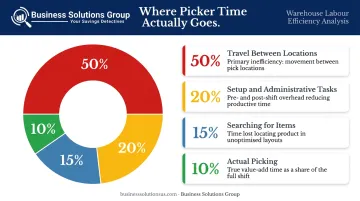
That breakdown means the majority of labor hours in a manual warehouse are spent moving and searching — not picking. Automation directly compresses those non-productive percentages.
Inventory Inaccuracy
DC Velocity reports that distribution centers lose nearly $400,000 annually from mispicks, with labor costs running $3 to $7 per error in cart-picking operations. Mispick costs extend well beyond the error itself: return shipping, reprocessing time, customer service handling, and reputational damage all compound the original loss.
Operation Type Matters
The relative weight of these drivers varies by facility:
- High-SKU-count operations: space density and picking accuracy dominate
- High-volume, low-SKU operations: throughput speed and labor efficiency are the primary pressure points
Matching the right automated storage approach to your operation's specific profile is what drives measurable cost reduction. Technology selection follows that diagnosis, not the other way around.
5 Ways Automated Storage Reduces Warehouse Costs
Cost reduction through automated storage depends on matching the right system to the right cost driver. The five strategies below are organized by whether they work through changing storage decisions, changing how those systems are managed, or changing the operational context around them.
Strategies That Change Storage Decisions
Way 1: Replace Static Shelving with High-Density Automated Storage
AS/RS systems, vertical lift modules, and automated carousels store inventory vertically — using ceiling height rather than floor area — and eliminate the wide aisle clearances that forklifts and manual pickers require. The result is a dramatically smaller footprint for the same inventory volume.
MHI's AS/RS Industry Group reports that AS/RS deployments can save up to 85% of floor space compared to conventional racking. At $10+ per square foot in most U.S. markets, reclaiming even a portion of that space delays or eliminates the need for facility expansion as inventory grows.
For operations approaching lease renewal or evaluating overflow space, the floor-space math can justify the capital investment on its own.
Way 2: Match Storage System Selection to SKU Velocity and Order Profile
Selecting an automated storage system without first profiling inventory velocity leads to one of two expensive outcomes: over-specification (paying for capacity that sits idle) or under-performance (throughput too slow for actual demand, requiring manual workarounds that undermine the business case).
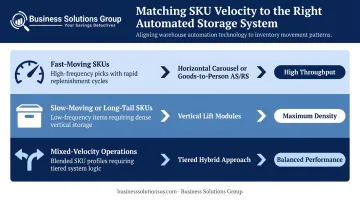
Profiling inventory by access frequency before specifying a system prevents both. The practical framework:
- Fast-moving SKUs benefit from horizontal carousel systems or goods-to-person AS/RS designed for high throughput
- Slow-moving or long-tail SKUs are well-suited to vertical lift modules that prioritize density over speed
- Mixed-velocity operations often benefit from a tiered approach — automated storage for fast movers, conventional racking for the long tail
Academic research from a 2017 Winter Simulation Conference paper found that ABC within-aisle storage with optimized routing produced travel times 42% lower than random storage. The upfront decision about which items go where — and in what system — shapes labor cost, energy consumption, and error rates across the system's entire lifespan.
Strategies That Change How Automated Storage Is Managed
Way 3: Integrate Automated Storage with a WMS to Cut Carrying Costs and Mis-Picks
An automated storage system without WMS integration functions as expensive shelving. The cost-reduction benefit comes from what integration enables: real-time stock visibility that prevents overstock, identifies slow-moving inventory before it becomes dead stock, and replaces manual cycle counts with automated, system-driven accuracy. MHI benchmarks AS/RS inventory accuracy at 99.99%.
For operations carrying significant inventory value, the carrying cost stakes are real. ISM reports that most companies target carrying costs between 20% and 30% of inventory value, covering capital, storage, insurance, handling, and obsolescence. Overstock driven by poor visibility pushes that figure higher without anyone noticing — until a write-off surfaces.
That diagnostic gap is where the cost case often goes undetected. Business Solutions Group's supply chain analytics and spend intelligence services help operations teams identify where inventory carrying costs are being underreported — and where to target WMS-integrated automated storage first.
Way 4: Deploy Goods-to-Person Picking at the Storage Interface
In a traditional warehouse, workers go to the inventory. In a goods-to-person setup, the inventory comes to the worker — delivered automatically to a stationary pick station by the automated storage system.
Travel consumes roughly 50% of a manual picker's time. Goods-to-person eliminates most of that — the remaining time is spent actually picking.
After implementing Exotec Skypod AS/RS, Ariat achieved a 10x increase in picking rate, reached more than 1,650 lines per hour with seven employees, and moved 80% of its picking labor staff to other value-added work. That's a restructuring of how labor hours are allocated, not a marginal efficiency tweak.
Beyond throughput, goods-to-person reduces ergonomic strain. The U.S. DOL OIG reports a 2021 warehouse injury and illness rate of 5.5 per 100 employees — more than double the 2.7 rate across all industries — with 47% of injuries attributed to overexertion and musculoskeletal disorders. Removing the bending, reaching, and overhead lifting from the picking process reduces that exposure, and with it the workers' compensation, absenteeism, and overtime costs that follow.
Strategies That Change the Context Around Automated Storage
Way 5: Redesign Layout and Material Flow Around Automated Storage
In many facilities, the storage system isn't the primary cost driver — the surrounding setup is. Aisle configurations designed for forklift access, staging zones placed far from dock doors, and inbound/outbound flow paths that cross each other all add internal transportation distance that multiplies across thousands of daily movements.
When layout is redesigned around the automated storage system's input/output points, goods travel shorter distances internally. Forklift usage drops. Fuel and maintenance costs fall. Zone-based lighting and HVAC controls — activated only where automated systems are operating — reduce energy draw across the facility.
Lawrence Berkeley National Laboratory research found average 31% occupancy-control lighting savings in warehouse installations. HVAC accounts for roughly 15% of electricity use in warehouses, and zone controls that deliver heating and cooling only where needed compound those savings further.
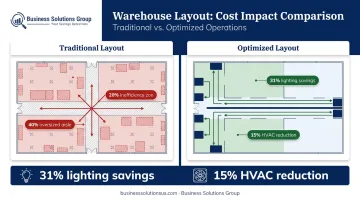
Contextual redesign delivers cost savings that storage technology alone cannot generate. A well-selected AS/RS installed into a poorly configured facility will underperform its cost case. The same system in a layout built around it performs considerably better.
Conclusion
Reducing warehouse costs through automated storage starts with an accurate diagnosis: is the cost coming from the storage decision, from how the system is managed, or from the facility design surrounding it? Applying automation without that clarity produces capital expenditure without meaningful return.
Lasting cost reductions treat automated storage as part of a broader operational strategy. Operations that continuously benchmark SKU profiles, track carrying costs, and align storage configurations to evolving throughput demands keep compounding their gains — rather than losing ground as conditions shift.
Business Solutions Group helps operations teams build this kind of structured, evidence-based approach. Through spend intelligence analysis, supply chain benchmarking, and ongoing advisory support, the goal is cost reductions that are measurable, sustainable, and tied to the right drivers from the start.
Frequently Asked Questions
What is an automated storage and retrieval system (AS/RS) in a warehouse?
AS/RS is a category of automated storage technology — including vertical lift modules, horizontal carousels, and robotic shuttle systems — that stores and retrieves inventory with minimal human movement. These systems reduce both floor-space requirements and the labor time associated with manual retrieval.
How much can automated storage reduce warehouse labor costs?
Results vary by operation. Ariat's Exotec Skypod implementation increased picking rates 10x and redeployed 80% of picking staff to other tasks. Kardex cites productivity gains of 200% to 600%, though treat vendor figures as directional rather than universal benchmarks.
What is the typical ROI timeline for an automated storage system?
Savings in labor, space, and error-reduction typically compound within one to three years. Vendor survey data suggests many VLM implementations reach payback in under 18 months, though independent benchmarks for this figure are limited.
Can small or mid-size warehouses benefit from automated storage?
Yes. Modular VLMs and standalone AS/RS units are scalable to smaller operations. Vendor data indicates more than half of automated warehouse users operate with 24 employees or fewer, and roughly one in four manage with 10 or fewer — confirming these systems are viable well below enterprise scale.
How does automated storage improve inventory accuracy?
Automated storage systems control access to specific compartments during retrieval, which prevents the mis-picks common in open-shelf environments. When integrated with WMS software, they provide real-time stock counts that reduce discrepancies and replace labor-intensive manual cycle counts.
What is the difference between a vertical lift module and traditional pallet racking?
Traditional pallet racking requires wide aisles and forklift access, consuming significant floor area. A vertical lift module stores items in enclosed trays that use ceiling height, delivering them automatically to a single access point. The result is a smaller footprint, no forklift requirement at the storage interface, and faster retrieval with less labor.