These numbers don't appear on a single invoice line. They accumulate quietly — through outdated carrier agreements, unreviewed accessorial schedules, and reactive shipping decisions made under time pressure rather than strategy.
The good news: most excess logistics spend is not inevitable. It's the byproduct of poor decisions, insufficient visibility, and a reactive posture toward cost management. Shippers who treat logistics as a managed discipline rather than a fixed expense consistently find material savings — without sacrificing service levels.
This article covers seven strategies organized around where cost actually originates: decisions made before execution, management practices during active operations, and the operational context surrounding your logistics network.
Key Takeaways
- Logistics costs accumulate through surcharges, billing errors, and poor planning — small leaks that add up faster than a single large expense
- Carrier contracts, unaudited invoices, DIM weight penalties, and misaligned inventory placement are the biggest cost drivers
- Sustainable savings require targeting root causes — not applying across-the-board cuts
- Combining spend visibility tools with expert advisory support accelerates and sustains results
- Each of the seven strategies targets a specific cost driver — giving you a concrete starting point regardless of where your margins are leaking
How Logistics Costs Build Up
Most shippers don't lose money on a single bad decision. They lose it gradually, across multiple cost layers that each look small in isolation.
The typical cost stack includes:
- Base transportation rates that increase annually via GRIs
- Dimensional (DIM) weight charges — FedEx bills whichever is greater, actual or dimensional weight, with a 40-lb minimum billable weight for packages triggering Additional Handling - Dimension fees
- Accessorial surcharges that escalate independently of base rates (UPS Additional Handling - Weight increased to $46.50–$58.75 per zone in the 2026 rate cycle)
- Fuel surcharges that rose 26% year over year in 2026 while diesel itself rose only 4.7%
- Freight invoice errors, which occur in up to 10% of freight bills
That compounding effect is what shippers consistently underestimate. A shipper absorbing a 5.9% GRI, a 13% surcharge increase, and 10% invoice error exposure simultaneously faces a cost burden far larger than any single line item suggests. Most don't recognize the full exposure until a financial audit forces the numbers into view — by which point significant margin has already eroded.
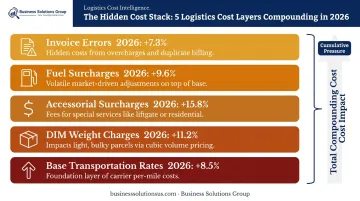
Each of the seven strategies below targets a specific layer in this cost stack.
Key Cost Drivers in Logistics
Logistics costs don't rise for one reason — they rise for three distinct reasons, and which one dominates determines which strategy will actually move the needle.
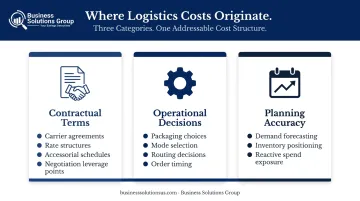
Cost drivers fall into three categories:
Contractual terms: Carrier agreements, rate structures, accessorial fee schedules, and minimum charge thresholds lock in at signing. As your shipping profile changes, those terms stay the same — and the gap between what you agreed to and what the market offers quietly widens.
Operational decisions: Packaging specs, mode selection, routing logic, and order timing each add cost at the shipment level. Multiply a poor default choice across thousands of shipments and the compounding effect becomes significant fast.
Planning accuracy: When demand forecasts are off and inventory is mispositioned, teams resort to reactive purchasing. That means expedited shipments, spot rates, and premium fees — costs that disciplined planning eliminates entirely.
The right intervention depends on which driver dominates. A company paying 40% above market on its carrier contract has a fundamentally different problem than one hemorrhaging costs through last-minute expedited shipments. Each of the seven strategies ahead maps to one of these three categories — identifying your primary driver first will tell you where to start.
Cost-Reduction Strategies for Logistics
The seven strategies below are organized by the type of change they require — process adjustments, contract renegotiations, and technology adoption — so you can prioritize based on where your logistics spend is actually leaking.
Strategies That Change Decisions
Strategy 1: Audit Carrier Contracts and Renegotiate Using Benchmark Data
Many businesses operate under carrier agreements signed two or three years ago, often auto-renewed without review. In that time, shipping profiles change, carrier pricing structures shift, and market rates move — leaving shippers paying rates that no longer reflect their volume or their leverage.
The gap between what a shipper pays and what they should pay isn't always visible from the invoice. It requires benchmarking current rates against actual market rates for equivalent shipping profiles across:
- Base rates and discount structures
- Accessorial fee schedules
- DIM weight thresholds
- Minimum charge structures
That benchmarking data creates negotiating leverage. Carriers respond to evidence-based proposals showing a specific gap between current terms and competitive rates. Without data, renegotiation attempts lack credibility and typically yield minimal results.
AFMS-published case studies illustrate the scale of what's available: one automobile manufacturer achieved $2.8M in annual parcel savings, while another recovered $15M in additional annual savings across parcel and air freight. Results vary by volume and contract terms, but the pattern is consistent — companies that benchmark before negotiating capture savings that reactive renegotiation misses.
Business Solutions Group's carrier contract advisory service covers this end-to-end — from benchmarking current rates against the market to structuring the negotiation for parcel and freight shippers.
Strategy 2: Consolidate Shipments and Optimize Procurement Decisions
Fragmented purchasing is one of the most consistent cost amplifiers in logistics. Multiple small shipments, uncoordinated order timing, and split carrier usage all inflate per-unit transportation costs — often without any service benefit to justify them.
Common consolidation opportunities include:
- Converting LTL freight to full truckloads once volume justifies it
- Aligning order cycles across purchasing categories to batch shipments
- Standardizing carrier selection to build volume concentration with fewer partners
- Using eProcurement tools to enforce buying rules that prevent uncoordinated spot purchasing
Business Solutions Group's Global RFP eProcurement platform supports this by placing carriers into competitive, structured bidding environments across all modes — LTL, truckload, ocean, air, and rail. Standardizing procurement decisions through a single platform reduces both carrier costs and the administrative overhead of managing fragmented carrier relationships.
Strategy 3: Right-Size Packaging to Eliminate Dimensional Weight Penalties
DIM weight pricing means carriers charge based on package volume rather than actual weight — whichever is higher. For lightweight products shipped in oversized boxes, this creates a direct, preventable cost.
FedEx's 2026 Service Guide applies a 90-lb minimum billable weight to packages classified as Oversize or Ground Unauthorized. A five-pound product in a large box can be billed at 90 lbs. That math compounds fast across volume.
The fix: audit packaging specifications against actual product dimensions and switch to right-sized formats. Flat-pack configurations, custom inserts that eliminate void fill, and smaller box sizes reduce DIM charges and, as a secondary benefit, lower storage costs.

The upfront investment in packaging redesign typically pays back within months for shippers moving more than a few hundred packages per week.
Strategies That Change How Logistics Is Managed
Strategy 4: Automate Freight Invoice Auditing to Recover Overcharges
Carrier invoices are complex — rate tables, accessorial fee schedules, fuel surcharge indices, and service guarantee credits all interact. Errors are common and rarely caught without systematic review.
Research published by SupplyChainBrain puts the freight bill error rate at up to 10%, with freight bill auditors typically recovering 1% to 5% of total transportation costs. A comprehensive audit can save 2% to 5% of transportation spend.
The most common error categories include:
- Duplicate charges across billing cycles
- Missed service guarantee credits for late deliveries
- Incorrect accessorial fees applied to shipments
- Rate mismatches between contracted terms and billed amounts
Manual invoice review doesn't scale past a certain volume. Automated freight audit processes flag discrepancies across every invoice — not just a sample — enabling recovery of overcharges and building billing accuracy data that prevents repeat errors.
Business Solutions Group provides freight audit and recovery across parcel, LTL, FTL, air, ocean, rail, and 3PL modes. Clients retain 100% of recovered credits under a performance-based model, meaning the service pays for itself.
Strategy 5: Improve Demand Forecasting to Eliminate Reactive Shipping Costs
Poor forecasting creates two compounding cost problems. Excess inventory drives up holding and storage costs. Stockouts force last-minute expedited shipments at premium rates.
The rate differential matters. UPS 2026 Daily Rates show a 10-lb Ground shipment to Zone 8 at $148.91. The same package via UPS Next Day Air Early runs $231.67. When a stockout forces an upgrade to air, that premium appears on every shipment until inventory is restabilized.
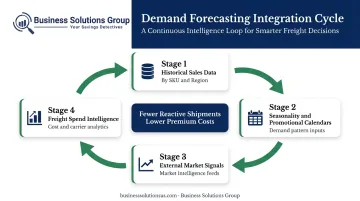
Effective forecasting integrates:
- Historical sales patterns by SKU and region
- Seasonality and promotional calendars
- External market signals that affect demand timing
- Actual carrier and freight spend data to identify recurring reactive patterns
The practical goal is reducing how often unplanned shipments default to premium service levels. Spend intelligence platforms that surface recurring reactive spend patterns give operations teams the lead time to intervene at the planning stage. That's a fundamentally different outcome than scrambling at execution.
Strategies That Change the Operational Context
Strategy 6: Optimize Warehouse Placement and Inventory Positioning
Carrier zone pricing creates a direct relationship between warehouse location and transportation cost. Shipping from a single central location to customers spread across the country means most shipments travel through high-zone lanes — and pay accordingly.
The numbers tell the story: UPS 2026 Daily Rates price a 10-lb Ground shipment at $40.77 for Zone 2 and $148.91 for Zone 8. A distributed inventory strategy that shifts more shipments into lower zones directly reduces transportation spend per unit.
A project44 analysis illustrates the opportunity: 3,000 packages shipped from Georgia to California cost $30,000 through standard routing. Zone-skipping the same volume cut cost to $24,000 and reduced transit from 4-5 days to 3 days. The savings came entirely from reducing the zone distance traveled.
Business Solutions Group's warehouse location analysis uses shipping data to identify demand geography and recommend fulfillment positioning that reduces average zone distance across the shipment mix.
Strategy 7: Use Multimodal Transportation and Route Optimization
Defaulting to a single carrier or transportation mode — particularly air or express parcel — for shipments that don't require that service level is a structural cost problem. The pattern repeats on every shipment until mode selection is redesigned around actual shipment characteristics.
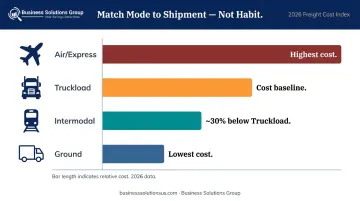
Matching mode to urgency, weight, distance, and cost sensitivity rather than habit captures significant savings:
- Ground vs. air: The rate gap shown above makes mode selection one of the highest-leverage decisions per shipment
- Intermodal vs. truckload: According to InTek's summary of the JOC Q1 2026 Intermodal Savings Index, intermodal spot rates ran 30.6% below truckload, with the traditional historical average at 16-19%
- Regional carriers: On localized delivery lanes, regional carriers often offer better rates than national carriers — but require systematic carrier evaluation to find
Route optimization tools reduce empty miles (which ATRI's 2024 operational cost analysis placed at 16.7% of average trucking miles, at an average operating cost of $2.260 per mile), improve load utilization, and make mode selection systematic rather than habitual.
Conclusion
Reducing logistics costs isn't about cutting spend broadly — it's about identifying where cost originates and applying the right intervention to each root cause. A carrier contract problem needs benchmarking and renegotiation. An invoice accuracy problem needs systematic auditing. A reactive shipping pattern needs better forecasting upstream.
None of these are one-time fixes. Carrier rate cycles renew annually, shipping profiles shift as businesses grow, and invoice errors recur without ongoing review. Sustained savings require the same structured attention as any other operational function.
Companies that pair expert advisory support with spend intelligence tools catch inefficiencies earlier, negotiate from a stronger position, and hold onto savings longer across rate cycles.
Business Solutions Group works with parcel and freight shippers through benchmark analysis, carrier contract negotiation, freight audit recovery, and spend intelligence — built for organizations that want to manage logistics costs as a continuous practice, not a crisis response.
Frequently Asked Questions
How to reduce costs in logistics?
Start by identifying where spend originates — carrier contract terms, invoice errors, DIM weight penalties, or reactive shipping triggered by poor forecasting. Apply targeted strategies to each area rather than making uniform cuts, which tend to reduce service quality without addressing the underlying cost driver.
What is the logistics audit process?
A logistics audit is a structured review of carrier contracts, freight invoices, transportation routes, warehouse operations, and inventory positioning. It identifies billing errors, inefficiencies, and contract gaps that represent recoverable savings, and is typically conducted before and after renegotiation cycles.
What are the biggest hidden logistics costs businesses overlook?
The most commonly overlooked costs are accessorial fees, dimensional weight surcharges on oversized packaging, auto-renewed carrier rate increases, duplicate invoice charges, and expedited freight premiums triggered by poor demand forecasting. Each appears small individually but adds up fast at scale.
How much can a business save by renegotiating carrier contracts?
Published case studies show savings can be material — AFMS examples include $2.8M and $15M in annual savings from parcel contract renegotiation alone. The actual range for any business depends on current contract terms, shipping volume, and the benchmark data used against market rates.
What is dimensional weight pricing and how does it affect shipping costs?
DIM weight pricing charges based on package volume rather than actual weight, whichever is higher. A bulky but lightweight package gets billed at its volumetric equivalent, not its scale weight. Right-sizing packaging is the most direct way to reduce this cost without changing carrier relationships.
When should a business work with a logistics cost reduction consultant?
Consulting support delivers the most value when a business lacks visibility into its full logistics spend, is running contracts that haven't been reviewed in over a year, or has grown in shipping volume without revisiting carrier terms. Outside expertise and benchmark data surface savings that internal teams are unlikely to identify on their own.