Telehealth is often framed as a convenience perk. The stronger case is the business one: lower claims costs, fewer lost workdays, better retention, and a benefits package that signals genuine investment in employee wellbeing. According to SHRM's 2025 Employee Benefits Survey, 93% of employers now offer telehealth or telemedicine — which means companies without it aren't just missing a perk, they're falling behind a clear market standard.
This article breaks down exactly what telehealth delivers — on the employer's balance sheet and in employees' day-to-day experience — and how to make sure it actually pays off.
Key Takeaways
- Telehealth lets employees consult licensed providers by phone or video, eliminating travel time and clinic wait times
- Employers gain through lower ER utilization, reduced absenteeism, and a more competitive benefits package
- Mental health services become far more accessible — no scheduling friction, no in-person stigma, no missed half-days
- Most employers already offer telehealth — companies without it face a growing gap in benefits competitiveness
- Adoption drives ROI — employees must know the benefit exists and when to reach for it over an ER visit
What Is Telehealth?
The Health Resources & Services Administration defines telehealth as the use of electronic information and telecommunication technologies to support long-distance clinical care, patient education, health administration, and public health.
For employers and employees, that translates to one thing: a licensed medical professional reachable by video or phone, no clinic visit required.
What It Covers
Telehealth is broader than most people assume. Common use cases include:
- Same-day consultations for colds, infections, and minor injuries
- Prescription renewals and medication management
- Behavioral health therapy and counseling
- Chronic condition check-ins and follow-up care
- Specialist referrals and routine preventive screenings
Telehealth is a delivery model, not a separate healthcare system. It works alongside existing insurance and benefits plans, giving employees quicker access to care they're already covered for.
Key Benefits of Telehealth for Employers and Employees
The advantages below fall into three categories: financial wins for employers, quality-of-life gains for employees, and outcomes that benefit both. Each is tied to metrics decision-makers actually track — cost per claim, days lost, retention rates, and satisfaction scores.
Reduced Healthcare Costs for the Organization
The cost argument for telehealth starts with care setting. When employees can't easily access a provider, minor issues escalate. They end up in urgent care or the emergency department — settings that are dramatically more expensive than a virtual visit.
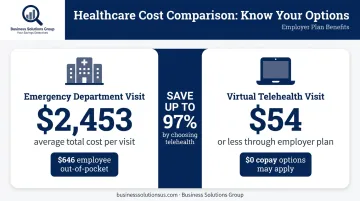
The numbers are significant. KFF data shows the average emergency department visit costs $2,453, with privately insured employees paying $646 out of pocket on average. Compare that to a virtual visit, which UnitedHealthcare states typically runs $54 or less through an employer-sponsored plan. That cost difference, multiplied across a workforce where even a small share of ER visits get redirected, adds up quickly.
The access barrier makes this worse. Research from the Integrated Benefits Institute found that 58% of employed individuals delayed necessary care due to cost or insurance barriers, and 42% delayed because an appointment simply wasn't available. Delayed care doesn't make health problems cheaper — it makes them more expensive when they eventually surface.
KPIs impacted:
- Healthcare spend per employee
- ER and urgent care utilization rates
- Insurance claims frequency
- Employee out-of-pocket costs
When this matters most: Peak illness seasons, workforces with hourly or shift workers who can't take half-days, and geographically dispersed teams where nearby providers are scarce.
Telehealth's cost impact depends on whether virtual visits substitute for in-person care or add new utilization on top of it. Research from JAMA Network Open studying 3.04 million insured adults found high telehealth adoption was not associated with statistically significant spending increases — but savings aren't automatic. Cost reduction follows when employees actively redirect care away from higher-cost settings.
Lower Absenteeism and Stronger Workforce Continuity
The traditional care pathway doesn't just cost money — it costs hours. It's genuinely disruptive to a workday. Call to schedule. Wait several days for an appointment. Commute to the clinic. Wait in the waiting room. Return home. For a straightforward illness, that process routinely consumes a half-day or more.
Telehealth collapses that to 20-30 minutes — often completed before the workday starts or during a lunch break. Employees get diagnosed, get a prescription started, and stay at work.
IBI research estimated poor health costs US employers $575 billion annually and 1.5 billion lost workdays. Peer-reviewed employer-cost research put the annual per-person cost of presenteeism — working while unwell, at reduced capacity — at $3,055, versus $520 for absenteeism. Presenteeism alone accounts for nearly two-thirds of total health-related workforce costs in that analysis.
Faster access to care addresses both. An employee who gets diagnosed and treated on day one recovers faster than one who waits four days for an appointment.
KPIs impacted:
- Absenteeism rate and average sick days per employee
- Presenteeism (working while ill, at reduced output)
- Last-minute coverage gaps
- Manager time spent managing unexpected absences
When this matters most: Customer-facing roles, production environments, small teams where one absence strains capacity, and remote workers who may delay care simply because local providers aren't accessible.
Broader Employee Well-being, Mental Health Access, and Retention
Telehealth's scope now routinely includes behavioral health — therapy, counseling, and psychiatric consultations. This matters because the logistics of in-person mental health care have historically been a genuine barrier: long wait times for appointments, limited provider availability, and the stigma of visibly scheduling mental health visits through employer HR channels.
Virtual access removes most of those friction points. The business case for doing so is strong.
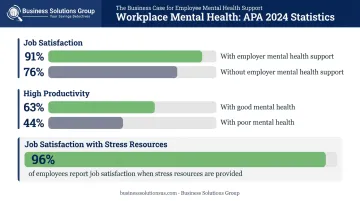
The APA's 2024 Work in America Survey found:
- 91% of workers whose employer offers mental health support reported job satisfaction, versus 76% without it
- 63% of workers with good or excellent mental health rated their productivity as high, compared to 44% of those with fair or poor mental health
- Workers with sufficient employer resources to manage stress reported 96% job satisfaction
Employees who feel genuinely supported — not just handed a benefits brochure — stay longer and perform better.
With 93% of employers now offering telehealth, candidates compare benefits packages at this level of detail. Mental health coverage via telehealth has moved from differentiator to expectation, particularly for younger workers who default to digital-first services.
KPIs impacted:
- Voluntary turnover rate
- Employee Net Promoter Score (eNPS) and engagement scores
- Mental health-related leave frequency
- Time-to-fill for open roles
When this matters most: High-burnout industries, companies scaling quickly in competitive talent markets, and remote or hybrid workforces with limited access to on-site support resources.
What Happens When Telehealth Isn't Part of Your Benefits Package
Skipping telehealth doesn't leave your benefits package neutral — it creates compounding risk across costs, talent, and operations.
When access is difficult, employees let symptoms worsen. Minor infections become more complex. Manageable chronic conditions go unmanaged. The result is higher-severity claims, longer recovery times, and more expensive interventions — all hitting the employer's healthcare spend directly.
The competitive gap is real, too. When 93% of employers already offer telehealth, a company without it doesn't look neutral — it looks behind the curve. That shows up in offer comparisons, candidate conversations, and exit interview feedback. Benefits are increasingly part of the talent story, not an afterthought.
Without easy access to care, employees also make a different choice: they come to work unwell rather than navigate the friction of booking an appointment. The downstream effects compound quickly:
- Illnesses spread across teams
- Absences become harder to predict and schedule around
- Coverage gaps hit operations at the worst times
This connects directly to presenteeism — employees showing up but working at reduced capacity while unwell. That pattern already costs employers an estimated $3,055 per person per year. Removing access barriers is one of the most direct levers available to address it.
How to Get the Most Value from Telehealth
Telehealth only delivers ROI when employees actually use it. That requires more than a line item in an enrollment document.
Drive adoption through active communication:
- Brief managers on when telehealth is the right first step
- Send onboarding guides when employees join and at annual enrollment
- Reference telehealth in routine benefits communications — not just once a year
- Make it clear what's covered, what it costs, and how to access it
Telehealth works best when it connects to the rest of your benefits structure rather than sitting apart from it. Shared medical records, clear referral pathways, and coordination between virtual and in-person providers ensure consultations lead to continuity of care rather than dead ends.
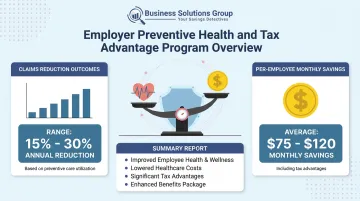
Budget is often the sticking point when employers want to expand benefits. Business Solutions Group's healthcare cost review is designed to address that directly. Their Employer Preventive Health and Tax Advantage Program (available for companies with 25 or more employees) includes telemedicine access as a core component, integrating with existing plans without requiring a carrier change.
The program targets reductions in employee claims of 30-70% by addressing underlying cost drivers rather than just renegotiating premiums. Clients typically see $100-$300+ in savings per employee per month — funds that can be redirected toward stronger benefits across the board.
The assessment starts with a no-cost benchmark analysis, typically completed within 3-5 business days.
Conclusion
Telehealth creates measurable value on both sides of the employment relationship. For employers: lower ER utilization, reduced absenteeism, and a benefits package that competes in a market where talent compares options carefully. For employees: faster access to care, less workday disruption, and mental health support that's actually reachable.
These advantages compound. An employee who gets prompt care stays healthier, stays longer, and performs better. An employer who builds that experience into their benefits package gets both outcomes: a more resilient workforce and a stronger recruiting position.
Telehealth has moved well past pandemic-era necessity. With 93% of employers now offering it, it's a standard component of competitive benefits — and a direct lever for reducing healthcare costs that erode margins year over year.
Frequently Asked Questions
What are the benefits of telemedicine for employers?
Telehealth cuts employer costs by shifting care away from expensive ER and urgent care visits, reduces absenteeism by making care faster and less disruptive, and strengthens benefits packages that support retention. As employee health improves, claims costs follow.
How does telehealth help reduce employee absenteeism?
Telehealth eliminates the scheduling friction of traditional care — same-day virtual appointments mean faster diagnosis and treatment, often without significant time away from work. A condition that would have required a half-day out gets resolved in a 20-30 minute video call.
Does telehealth cover mental health services for employees?
Most employer-grade telehealth platforms include therapy, counseling, and in some cases psychiatric consultations, accessible by video or phone. This removes the scheduling and stigma barriers that long kept employees from seeking mental health care through in-person channels.
Can telehealth replace traditional in-person doctor visits for employees?
Telehealth complements rather than replaces in-person care. It's well-suited for non-emergency consultations, prescription management, follow-ups, and mental health sessions. Complex diagnostics, physical exams, and acute emergencies still require clinic or hospital visits.
How much does it cost for an employer to offer telehealth benefits?
Vendor-reported pricing typically ranges from roughly $5-$15 per employee per month, though costs vary by provider and workforce size. Programs like Business Solutions Group's Employer Preventive Health and Tax Advantage Program bundle telehealth access into a broader cost-reduction structure, where savings on claims and payroll taxes generally offset program costs within the first plan year in many cases.
How do employers measure the ROI of a telehealth program?
Track claims frequency, average cost per medical episode, sick days, ER utilization, and telehealth adoption rates before and after implementation. Year-over-year healthcare spend per employee gives the clearest read on whether virtual care is genuinely substituting for higher-cost settings.