Introduction
Healthcare costs keep climbing. According to Mercer's 2025 survey, employer-sponsored health benefits now average $17,496 per employee annually — up 6% from the prior year, with another 6.7% projected for 2026. Those costs aren't just financial. The 2024 APA Work in America Survey found 29% of workers reported lack of motivation or energy, and 25% reported emotional exhaustion.
Employers are caught between rising plan costs and a workforce that increasingly needs mental health support, flexible access, and faster care.
Telehealth technology addresses all three. HHS/HRSA defines it as the use of electronic and telecommunications technologies to support remote clinical care, health education, monitoring, and administration. It's no longer a pandemic-era workaround.
SHRM reports that 91% of employers offered telehealth in 2024. The question has shifted from "should we offer it?" to "how do we make it work?"
This guide covers how telehealth functions, what it treats, the benefits it delivers for both employees and employers, how to integrate it into your benefits plan, and how to drive real employee adoption.
Key Takeaways
- Telehealth gives employees on-demand access to physicians, mental health providers, and specialists via video, phone, or app.
- It covers primary care, urgent care, mental health, chronic disease management, and preventive wellness.
- Employers benefit from reduced absenteeism, lower ER utilization, and improved workforce productivity.
- Successful integration depends on vendor vetting, health plan alignment, ERISA compliance review, and clear employee communication.
- All telehealth platforms handling employee health data must meet HIPAA federal standards.
What Is Telehealth Technology and How Does It Work?
Telehealth is the broader umbrella. It encompasses remote clinical care, health education, patient monitoring, and administrative health services. Telemedicine is the narrower subset — specifically the clinical diagnosis and treatment delivered remotely between a provider and patient.
For employers building a benefits program, that distinction matters. A robust telehealth benefit goes well beyond video doctor calls — and understanding the underlying technology helps you evaluate what a program actually delivers.
Core Technologies
Modern telehealth platforms run on a combination of:
- Video conferencing software for live synchronous visits
- HIPAA-compliant mobile apps for scheduling, messaging, and prescription management
- Electronic health record (EHR) integration for continuity of care
- Wearable remote monitoring devices that transmit biometric data like blood pressure, heart rate, and glucose levels
- Secure patient portals for asynchronous communication and document sharing
AI-assisted diagnostic tools and 5G connectivity are also expanding real-time data transmission from wearables, particularly for remote patient monitoring programs.
Four Delivery Modes
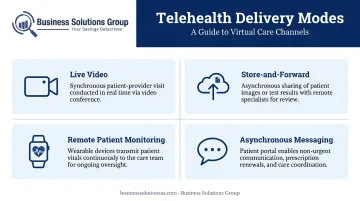
| Mode | How It Works |
|---|---|
| Live video | Synchronous visit between patient and provider |
| Store-and-forward | Medical images or test results shared asynchronously with a specialist |
| Remote patient monitoring (RPM) | Wearables track vitals and send data to the care team |
| Asynchronous messaging | Patient portals handle non-urgent questions, prescription renewals, and lab follow-ups |
Employees only need a smartphone, tablet, or computer with a stable internet connection — no commute, no waiting room, and no half-day out of the office.
Key Benefits of Telehealth for Employees and Employers
Key Benefits of Telehealth for Employees and Employers
Employee Benefits
KFF found that roughly 1 in 5 adults under 65 faced non-cost logistical barriers to care — including work schedules, transportation, or difficulty finding an in-network provider. Telehealth removes most of those friction points for working parents, remote employees, and workers in rural or underserved areas.
One important caveat: CDC data shows telemedicine use in 2022 was 34.2% in large metro areas versus 19.6% in noncore rural areas. Employers with dispersed workforces should confirm their vendor's network coverage and assess broadband access before rollout.
Across three high-impact areas, the employee-side benefits are well-documented:
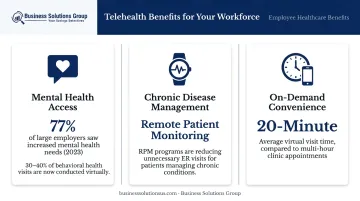
- Mental health access: Business Group on Health reported 77% of large employers saw increased employee mental health needs in 2023, up from 44% the prior year. Telehealth platforms with licensed therapists and psychiatrists reduce both logistical and stigma-related barriers to care. Roughly 30–40% of behavioral health visits now happen virtually.
- Chronic disease management: Employees managing diabetes, hypertension, or asthma can combine remote monitoring devices with scheduled virtual check-ins to catch complications earlier — reducing ER visits and long-term claims costs.
- On-demand convenience: A 20-minute virtual visit fits around a work schedule in ways a clinic appointment rarely does, especially for employees without paid sick leave or reliable transportation.
Employer Benefits
Those employee-side gains translate directly into measurable business outcomes.
Faster care access reduces absenteeism in a straightforward way: fewer untreated conditions lead to fewer prolonged absences and less presenteeism. No single verified benchmark captures exact telehealth-attributable absenteeism reductions, but the directional evidence is consistent across utilization studies.
On talent, the numbers are harder to ignore. Mercer's Health on Demand 2023 survey found that 92% of workers consider it important to work for an employer that genuinely cares about their health and well-being. In a tight hiring market, modern benefits like telehealth signal that commitment in a concrete, visible way — not just in a handbook.
What Conditions Can Telehealth Address for Your Workforce?
Telehealth covers a wide clinical range, but it has real limits. Employers who communicate those boundaries clearly will set the right expectations from day one.
Common Treatable Conditions
Urgent and primary care:
- Cold and flu symptoms, respiratory infections
- Pink eye, rashes, and skin conditions
- Urinary tract infections
- Migraines and headaches
- Allergies and nausea
- COVID-19 evaluation and post-visit follow-ups
- Medication management and prescription renewals
Expanded care categories:
- Behavioral health: anxiety, depression, stress management, addiction counseling, one-on-one and group therapy
- Chronic condition management: diabetes, hypertension, heart disease, HIV monitoring via RPM
- Preventive wellness: nutrition coaching, weight management, smoking cessation
- Post-procedure follow-up visits
What Telehealth Cannot Replace
Conditions requiring physical examination, imaging, lab work, or emergency intervention must be handled in person. The American Academy of Family Physicians notes that telemedicine appropriateness should follow the standard of care, meaning the clinical need — not administrative convenience — should drive the decision.
That distinction matters for how you present this benefit. When employees understand telehealth as an accessible first point of contact rather than a full substitute for in-person care, they use it more appropriately and experience fewer gaps in treatment.
How to Choose and Integrate a Telehealth Program Into Your Benefits Plan
Step 1: Assess Employee Needs and Plan Structure
Start with your workforce composition — remote vs. on-site, age distribution, top health claims, geographic spread. Identify gaps in current healthcare access and determine whether telehealth will be layered onto your existing group health plan or offered as a standalone benefit.
If telehealth is offered to all employees regardless of health plan enrollment, it may be classified as a separate group health plan under ERISA, with its own compliance obligations. The safer approach: limit access to employees already enrolled in your group health plan. Confirm this with your legal or benefits counsel before launch.
Step 2: Evaluate Vendor Capabilities
Schedule demos and assess each platform against these criteria:
- Ease of use for non-technical employees
- Mobile app quality: scheduling, video quality, prescription management
- Provider network breadth, including coverage for remote or traveling employees
- HIPAA compliance, end-to-end encryption, and secure data storage
- Integration with your existing health plan and EHR systems
- Behavioral health access alongside primary care
Business Group on Health found that 70% of large employers worry about siloed care experiences, and 46% cite lack of integration between vendors as a top concern. Prioritize platforms that connect to your existing plan, not just add another portal.
Step 3: Confirm Insurance and Billing Alignment
Verify that the telehealth benefit integrates cleanly with your group health carrier's reimbursement model. State parity laws matter here — NCSL reported in late 2024 that 43 states and DC had telehealth private insurance laws, with 22 states requiring equal reimbursement for telehealth versus in-person visits. Check your state's current status before finalizing cost-sharing structures.
Step 4: Apply Cost Benchmarking to Vendor Negotiations
Telehealth vendor contracts vary widely in pricing, feature bundles, and utilization fee structures. Employers often pay for capabilities their workforce won't use. The same procurement discipline that works in logistics and technology spend applies here:
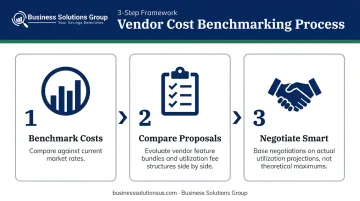
- Benchmark costs against current market rates
- Compare vendor proposals side-by-side on feature bundles and utilization fees
- Negotiate based on actual utilization projections, not theoretical maximums
Business Solutions Group applies this benchmarking and contract analysis approach across vendor categories, including benefits procurement, to help employers select cost-effective platforms without sacrificing coverage quality.
Step 5: Build a Rollout and Communication Plan
Adoption depends on awareness. Build a structured onboarding plan including:
- Employee FAQs covering what telehealth covers, how to log in, and cost-sharing
- Live demos or video tutorials at open enrollment
- A designated private space at the office for employees who want to use the service during work hours
- Reminders timed to high-need moments: flu season, benefits renewal, stress awareness campaigns
Step 6: Meet Compliance and Privacy Requirements
All telehealth platforms used in a benefits context must be HIPAA-compliant. HHS states that covered entities using technologies that create, receive, maintain, or transmit electronic protected health information (ePHI) are subject to HIPAA requirements; COVID-era enforcement discretion ended in 2023.
Your vendor agreements and internal policies should address:
- Require business associate agreements (BAAs) with all telehealth vendors
- Confirm end-to-end encryption and access rights management
- Understand whether your group health plan or the vendor is the covered entity for data governance purposes
Driving Employee Adoption and Engagement
Availability and utilization are two different things. SHRM's 2024 benefits communication research described employer communication efforts as "underwhelming," with digital tools like benefits apps, virtual meetings, and video messaging significantly underused.
Tactics That Work
- Promote at open enrollment and throughout the year — not just once. Seasonal reminders during flu season or mental health awareness month maintain visibility.
- Share real employee stories — anonymized testimonials from colleagues address the common concern that telehealth feels impersonal.
- Give employees time to use it — allow dedicated work-time access and provide a private space on-site.
- Segment your messaging by employee needs:
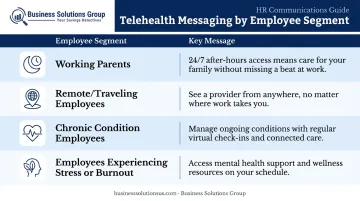
| Employee Segment | Key Message |
|---|---|
| Working parents | 24/7 after-hours access for sick kids or late-night concerns |
| Remote/traveling employees | In-network care from anywhere, no location barriers |
| Employees with chronic conditions | Ongoing RPM tools and scheduled virtual check-ins |
| Employees experiencing stress or burnout | Private, on-demand mental health access with no waitlist |
SHRM recommends gathering utilization statistics and employee feedback within 6 to 8 weeks of launch. Early data lets you adjust messaging before low utilization becomes a pattern.
That measurement effort fits within a broader engagement model. Business Group on Health identifies five levers for health engagement: communication, culture, experience, solution design, and incentives. An open enrollment email addresses only one. Sustained adoption requires reinforcing telehealth across all five — making it visible, accessible, and normal year-round.
Frequently Asked Questions
What technologies are commonly used in telehealth?
The main technologies include video conferencing platforms, HIPAA-compliant mobile apps, wearable remote monitoring devices, EHR systems, and secure patient portals. AI-assisted diagnostic tools and 5G connectivity are increasingly enabling real-time data transmission, particularly for wearable monitoring devices.
What conditions can be treated via telehealth?
Common treatable conditions include cold and flu, pink eye, UTIs, rashes, migraines, allergies, anxiety, depression, diabetes management, and post-visit follow-ups. Conditions requiring physical examination, imaging, lab work, or emergency intervention should always be handled in person.
Can telehealth prescribe controlled substances like oxycodone?
Under the Ryan Haight Act, telehealth providers generally cannot prescribe Schedule II controlled substances without an in-person evaluation. A temporary DEA/HHS extension permits some controlled substance prescribing via telemedicine through December 31, 2026, with specific conditions — so employers should avoid implying unrestricted prescribing in their benefits materials.
Is telehealth covered by employer health insurance?
Many group health plans now include telehealth coverage. In 22 states, parity laws require insurers to reimburse telehealth at the same rate as in-person visits. Employers should verify coverage details with their carrier and ensure employees understand their specific cost-sharing responsibilities.
How does telehealth reduce healthcare costs for employers?
Telehealth reduces costs by decreasing unnecessary ER visits, cutting absenteeism tied to in-person appointments, enabling earlier intervention for chronic conditions, and reducing administrative claims overhead. Employers should track their own claims data to confirm actual program impact.
What should employers look for when selecting a telehealth vendor?
Prioritize HIPAA compliance, ease of use, mobile functionality, provider network breadth, integration with your existing health plan, transparent pricing, and behavioral health services. Avoid platforms that don't connect with your existing care model — a disconnected experience reduces adoption and value.