The business case is real. A study of 40,000 Cigna beneficiaries found that virtual care users had 17% lower total costs and a 36% net reduction in emergency department visits compared to non-users. With the average ER visit costing employers $2,453, deflecting even a fraction of those visits adds up fast.
But picking the wrong platform — one with poor utilization, limited behavioral health access, or no integration with your existing health plan — wastes that spend entirely. This guide covers the top telehealth platforms built for employer health plans, along with the evaluation criteria HR and benefits leaders should use when comparing them.
Key Takeaways
- Employer-grade telehealth requires eligibility integration, multi-state provider coverage, and HR-facing utilization reporting
- Top platforms include Teladoc Health, MDLive (Evernorth), Amwell, Included Health, and Hinge Health
- Evaluate platforms on HIPAA compliance, behavioral health depth, and PEPM pricing transparency — these determine real-world fit
- Platforms that combine telehealth with care navigation (like Included Health) can reduce total cost of care, not just visit costs
- Treat telehealth as a cost-containment strategy, not a checkbox benefit, to achieve measurable ROI
Telehealth and Employer Health Plans: What You Need to Know
In an employer benefits context, telehealth means giving employees access to licensed clinicians remotely — covering primary care, behavioral health, and specialty services — as part of their sponsored health plan. It's not a standalone app; it's an integrated care channel.
The KFF 2025 Employer Health Benefits Survey found that 30% of firms with 50+ workers now contract for virtual primary care services beyond what's embedded in their standard health plan. Among employers with 5,000+ employees, 45% offered virtual primary care. Adoption has grown, but utilization often lags — Mercer data shows utilization plateaued around 9% or lower among large employers before 2020, even when the benefit was offered.
That gap between offering and using is where employers lose money. A telehealth benefit no one accesses doesn't deflect ER visits or reduce absenteeism. The platforms below are built to close that gap. To do it effectively, they share three core attributes:
- Enterprise-grade infrastructure that supports plan-wide deployment
- Provider networks scaled for large, distributed workforces
- Reporting tools that give HR teams measurable utilization data
Top Telehealth Platforms for Employer Health Plans
The platforms listed here were selected based on employer market presence, breadth of virtual care services, HIPAA compliance, benefits integration capabilities, and documented employee utilization outcomes.
Teladoc Health
Teladoc operates as a global leader in whole-person virtual care, with more than 50% of Fortune 500 employers partnering with the platform. Its scope extends well beyond urgent care — Teladoc covers primary care, behavioral health, chronic condition management through its Livongo acquisition, and expert medical second opinions, all under one employer contract.
For HR and benefits teams, the enterprise infrastructure matters as much as the clinical breadth. Teladoc supports eligibility file management, dedicated account management, and employer-specific utilization dashboards. Its Livongo platform (now Livongo by Teladoc Health) addresses diabetes, hypertension, weight management, and diabetes prevention with smart device monitoring and coaching. One diabetes management case study documents a 4.6x ROI for employers using the program.
| Category | Details |
|---|---|
| Key Features | Whole-person care (primary, behavioral, chronic); Livongo for diabetes/hypertension; 24/7 on-demand access; multi-state provider network; employer utilization dashboards |
| Pricing Model | PEPM or per-visit; typically bundled into employer health plan contracts — confirm current pricing directly with Teladoc |
| Best For | Mid-to-large employers seeking a single platform covering physical health, mental health, and chronic condition management |
MDLive (Evernorth / Cigna)
MDLive operates under Evernorth, Cigna's health services division, following a 2021 acquisition. It serves 62 million individuals through health plans and employers and has generated $2.7 billion in documented client cost savings since 2019.
The platform covers urgent care, primary care, behavioral health, and dermatology. Its behavioral health network includes more than 1,400 psychiatrists and licensed therapists across all 50 states, with first therapy sessions available in as little as five days. Employers get access through mobile app, web browser, or call center — a practical advantage for reaching workforces that aren't entirely tech-forward.
Outcome data is strong: 80% of patients treated for anxiety or depression showed improved clinical scores after just three sessions, and the platform reports a member NPS of 74 with 93% client retention.
| Category | Details |
|---|---|
| Key Features | Urgent/primary care, behavioral health, dermatology; call center access option; eligibility integration via Cigna/Evernorth; HIPAA-compliant end-to-end encryption |
| Pricing Model | PEPM or per-visit; often embedded in Cigna/Evernorth plan benefits; standalone employer contracts available |
| Best For | Employers prioritizing behavioral health access and those already using Cigna/Evernorth as their health plan carrier |
Amwell
Amwell's enterprise platform — built around its Converge architecture — focuses on configurable, hybrid care delivery that connects virtual and in-person visits. Rather than offering a pre-packaged telehealth product, Amwell gives employers and health systems an open-architecture platform to build a custom-branded virtual care experience.
Its API-based integrations with EHRs and benefits administration systems make it well-suited for self-insured employers who need deep system connectivity. The platform covers urgent care, primary care, behavioral health, and specialty telehealth. For organizations with existing health system partnerships, Amwell's hybrid care model enables continuity between virtual visits and in-person follow-up care — something most standalone telehealth products can't support.
| Category | Details |
|---|---|
| Key Features | Converge open-architecture platform; white-label employer branding; urgent care, behavioral health, specialty telehealth; API-based EHR and benefits admin integrations; HIPAA-compliant |
| Pricing Model | Enterprise licensing and PEPM; pricing varies by configuration and contract scope — contact Amwell directly for employer quotes |
| Best For | Self-insured or larger employers wanting a configurable, white-labeled platform with deep system integrations |
Included Health
Included Health was formed through the 2021 merger of Grand Rounds and Doctor On Demand, combining clinical navigation with virtual care in a way no pure-play telehealth vendor does. Employees can see a virtual doctor, but they can also get help finding the right in-network specialist, understanding their benefits, and resolving billing issues — through dedicated care guides.
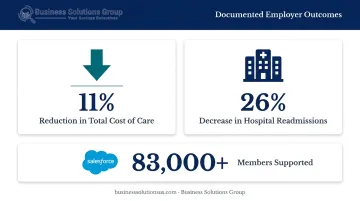
The navigation layer translates into measurable employer results. For one large employer, Included Health's virtual primary care delivered an **11% reduction in total cost of care** and a 26% decrease in hospital readmissions. Salesforce uses the platform to support more than 83,000 members.
Employers with complex benefits structures, or high rates of employees who struggle to navigate their benefits, will find this combination difficult to replicate with a standalone telehealth vendor.
| Category | Details |
|---|---|
| Key Features | Primary and behavioral telehealth; dedicated care guides for benefits navigation; specialist matching and referral support; employer analytics dashboard; HIPAA-compliant |
| Pricing Model | PEPM model; scales with employer size and service tier; typically positioned as a premium benefits layer |
| Best For | Employers with complex benefits structures who want to combine telehealth with guided navigation to reduce inappropriate utilization |
Hinge Health
Hinge Health addresses musculoskeletal (MSK) conditions — back pain, knee pain, hip, neck, and shoulder issues — which the Business Group on Health's 2025 Employer Health Care Strategy Survey identified as one of the top two cost drivers for large employers alongside cancer.
The platform delivers virtual physical therapy through sensor-guided exercise sessions using 3D motion tracking, supported by licensed physical therapists and health coaches. An analysis across 136 employers found $2,387 lower total MSK claims per participant versus a control group, with a 2.4x ROI.
The platform also reports a 68% average reduction in reported pain among participants. Employers with physically demanding workforces, or those carrying high orthopedic surgery rates, will find Hinge addresses a cost driver that most general telehealth platforms don't touch.
| Category | Details |
|---|---|
| Key Features | Digital PT for 9+ MSK conditions; 3D motion-tracked exercise guidance; FDA-cleared wearable (Enso) for pain relief; virtual PT and coaching; surgical avoidance program; employer outcomes reporting |
| Pricing Model | PEPM based on enrolled employees; typically offered as a point solution alongside core health plans |
| Best For | Employers with physically demanding workforces or high MSK-related claims seeking to reduce orthopedic surgery rates and disability costs |
How to Evaluate Telehealth Platforms for Your Health Plan
Choosing a telehealth platform for an employer plan is fundamentally different from picking a consumer health app. The most common mistakes HR leaders make:
- Prioritizing brand name over utilization data — a well-known platform with poor adoption rates delivers no ROI
- Underweighting behavioral health — mental health and substance use conditions are among the top drivers of absenteeism and disability claims
- Overlooking integration requirements — a platform that doesn't connect to your existing benefits admin system creates administrative burden and eligibility errors
- Skipping the workforce demographics check — a mobile-only platform may not reach older or less tech-savvy employees
The Evaluation Framework That Works
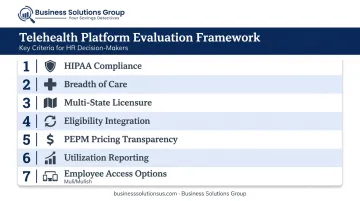
When comparing platforms, assess each vendor across these dimensions:
- HIPAA compliance: All platforms must comply with HIPAA Rules; require a signed Business Associate Agreement (BAA). HHS provides clear guidance on telehealth technology requirements
- Breadth of care: Does the platform cover primary care, behavioral health, and specialty areas relevant to your workforce?
- Multi-state provider licensure: Critical for distributed or remote workforces.
- Eligibility file integration: Can it sync with your HR or benefits admin system without manual workarounds?
- PEPM pricing transparency: Understand what's bundled versus billed separately.
- Utilization reporting: Employer-facing dashboards showing visit volume, cost deflection, and engagement rates.
- Employee access options: Mobile app, web browser, and phone/call center access ensures broader workforce reach.
Employers that treat telehealth as a strategic cost tool see better outcomes than those treating it as a passive benefit offering. Platforms with strong utilization support — proactive member outreach, seamless enrollment, multi-channel access — consistently outperform those that make care available without actively driving adoption.
Conclusion
The best telehealth platform for your health plan isn't the biggest vendor or the one with the most name recognition. It's the one that fits your workforce demographics, integrates with your existing plan structure, and has documented utilization and cost-deflection outcomes to back it up.
Before signing a multi-year contract, request employer-specific case studies and utilization benchmarks from each vendor. Pilot with measurable KPIs. Behavioral health coverage, multi-state provider access, and HR-facing reporting should be non-negotiable in any final vendor decision.
Telehealth is one piece of a larger benefits cost puzzle. For employers looking to reduce total benefits spend — not just individual line items — Business Solutions Group works with organizations to identify cost reduction opportunities across their full operational and benefits structure. Contact BSG to learn how a cost optimization review can lower your benefits overhead and improve your bottom line.
Frequently Asked Questions
What is the most used telehealth platform?
Teladoc Health is the largest telehealth platform globally by employer market reach, with partnerships covering more than 50% of Fortune 500 employers. For employer health plans specifically, it remains the most widely adopted option by plan size and utilization volume.
What platforms can be used for telehealth?
Employer-focused platforms include Teladoc, MDLive, Amwell, Included Health, and Hinge Health. For clinical settings, HIPAA-compliant video tools like Zoom for Healthcare and Doxy.me are also used. The right choice depends on whether the use case is individual care, employer benefits, or health system delivery.
How do employers add telehealth to their health plan?
Employers can contract directly with a telehealth vendor as a point solution, embed telehealth through their health plan carrier (such as MDLive through Cigna/Evernorth), or integrate a platform through a benefits administrator. Eligibility file sharing and a clear employee communication plan are essential for successful adoption.
What should employers look for in a telehealth provider?
Key criteria to evaluate:
- HIPAA compliance and multi-state provider coverage
- Behavioral health access alongside primary care
- Transparent PEPM pricing with no hidden fees
- Integration with existing health plan or HR systems
- Employer-facing utilization reporting dashboards
Is telehealth covered under employer health insurance?
Many employer-sponsored health plans now include telehealth — either embedded in the plan design or as a supplemental offering. Coverage specifics, including copays, visit limits, and eligible services, vary by plan design and carrier.
How much does telehealth cost for employers?
Employer telehealth platforms are priced on a per-employee-per-month (PEPM) basis. Costs vary by platform, scope of services, and employer size. Request direct quotes from vendors and factor in cost deflection savings — reduced ER visits and urgent care avoidance — when calculating total ROI.