Telehealth has been in the benefits conversation for years, but its value is increasingly measurable: lower claims costs, fewer missed workdays, stronger mental health support, and a more competitive benefits package. The real question isn't whether telehealth works — it's whether your organization is using it strategically.
This article breaks down the specific operational advantages of telehealth for employers and employees, what happens without it, and how to extract maximum ROI from your telehealth investment.
Key Takeaways
- Telehealth visits cost significantly less than urgent care or ER alternatives, cutting benefits spend directly
- Faster access to care reduces both absenteeism and presenteeism, keeping workforce capacity more predictable
- Mental health access via telehealth removes the biggest barriers to care: cost, scheduling friction, and stigma
- 90% of organizations already offer telehealth — employers without it are falling behind
- ROI depends on active promotion, not just availability
What Is Telehealth as an Employee Benefit?
Telehealth is the delivery of healthcare services through digital communication tools — video calls, phone consultations, and secure messaging — that allow employees to connect with providers without visiting a clinic. As a benefit, it functions as a first-access layer that reduces friction and channels employees toward the right level of care faster.
In most employer benefits contexts, telehealth covers:
- Primary care: Same-day virtual visits for common illnesses, medication questions, and routine follow-ups
- Mental health therapy: Video or phone sessions with therapists and counselors
- Urgent care: Acute but non-emergency conditions that would otherwise mean an ER trip
- Chronic condition management: Regular check-ins for ongoing conditions like diabetes or hypertension
- Specialty consultations: Dermatology, nutrition, and other specialist access where local availability is limited
Telehealth doesn't replace all in-person care. For most everyday health needs, though, it removes the barriers that delay it: travel time, scheduling bottlenecks, and half-day absences that push employees to put off care until a minor issue becomes a costly one.
Key Advantages of Telehealth for Employers and Employees
The advantages below map to outcomes employers actually track: healthcare spend, productivity, absenteeism, and talent metrics.
Advantage 1: Lower Healthcare Costs for Employers and Employees
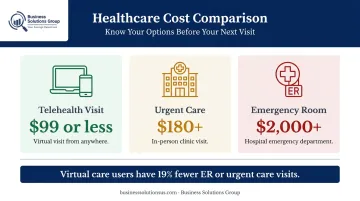
The cost difference between telehealth and traditional care settings is significant. According to UnitedHealthcare's member pricing, virtual primary care visits run $99 or less, compared to an urgent care average of $180 — and ER visits run more than $2,000 above that. Cigna's internal data found that non-urgent virtual visits averaged $93 less than in-person equivalents, with virtual urgent care saving $141 per visit.
That gap compounds across a workforce of any meaningful size. The core mechanism is diversion: employees who can access same-day virtual care are far less likely to let minor conditions escalate into expensive ER visits.
Why ER diversion matters:
High ER utilization for non-emergency conditions is one of the most preventable cost drivers in employer health plans. CMS identifies telehealth as a proven tool for reducing unnecessary emergency department visits by providing 24/7 access as an alternative entry point. Cigna's analysis reinforced this, finding that patients using virtual providers had 19% fewer ER or urgent care visits.
KPIs this moves:
- Healthcare claims cost per employee
- ER visit frequency
- Urgent care utilization rate
- Total benefits spend as a percentage of payroll
When it matters most: Cost savings amplify during high-utilization periods — flu season, open enrollment surges — and for distributed or hourly workforces where scheduling constraints make ER visits more common by default.
Advantage 2: Reduced Absenteeism and Improved Workforce Productivity
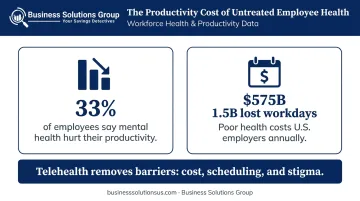
One of the most direct operational benefits of telehealth is time. A virtual appointment during a lunch break eliminates the half-day absence that a traditional in-person visit often requires. The broader productivity math is substantial. The Integrated Benefits Institute estimated that poor employee health cost U.S. employers $575 billion and 1.5 billion days of lost productivity in a single year — including 978 million absence days and 540 million presenteeism days. For every $1 employers spend on healthcare benefits, they absorb an additional $0.61 in illness-related absence, disability, and reduced work output.
Telehealth addresses both sides of that equation:
- Absenteeism: Faster access to diagnosis and treatment shortens the time between symptom onset and recovery. Conditions managed early don't become extended sick leaves.
- Presenteeism: Employees who can quickly consult a provider during a break are more likely to get appropriate treatment than to push through symptoms untreated for days.
Mental health is a major driver of both absenteeism and presenteeism — and often the hardest condition for employees to address on their own. The 2024 NAMI Workplace Mental Health Poll found that 33% of employees noticed their productivity suffer because of mental health, and 36% said work demands damaged their mental health. Telehealth removes most of the barriers that prevent employees from getting help, including scheduling friction, stigma, and cost.
KPIs this moves:
- Unplanned absenteeism rate
- Employee sick day usage
- Presenteeism index
- Productivity output per team
When it matters most: For small-to-mid-sized businesses, one employee's extended absence creates disproportionate disruption. For shift-based or client-facing roles, coverage gaps directly affect service delivery and revenue.
Advantage 3: Talent Attraction, Retention, and Mental Health Support
Today's workforce treats benefits quality as a decision factor, not a perk. According to the EBRI/Greenwald 2024 Workplace Wellness Survey, 72% of workers identify health insurance as a top factor when deciding whether to stay at or leave a job.
Benefits satisfaction also correlates with engagement: 67% of workers who used employer-offered benefits education were satisfied with their package, versus 45% of those who didn't.
Telehealth strengthens retention by closing the access gap for mental health care. NAMI data shows that 52% of adults with mood disorders cite treatment cost as a barrier and 84% cite stigma. Accessing therapy from home, outside business hours, removes both obstacles without requiring employees to walk into a visible clinical setting.
The competitive signal matters too. 90% of organizations offered telehealth benefits in 2023, per SHRM. Employers without it are no longer neutral — they stand out negatively in benefits benchmarking comparisons that candidates increasingly review before accepting offers.
When it matters most: High-stress industries, remote-heavy teams, and organizations competing for skilled workers in tight labor markets — where a single differentiating benefit can tip a candidate's decision.
KPIs this moves:
- Employee turnover rate
- Benefits satisfaction score
- Mental health claim utilization
- Offer acceptance rate
What Happens When Telehealth Is Missing from Your Benefits Package
Without telehealth, employees default to more expensive, less timely care options. ER visits for non-emergency conditions drive up claims costs. Minor issues that could be addressed in a 15-minute virtual visit instead become half-day urgent care trips or ignored problems that worsen over time.
The consequences extend well beyond claims spend:
- Talent retention: The Aflac 2025–2026 WorkForces Report found that 25% of employees said improvements to their benefits package would make them more likely to stay with their employer. A benefits gap signals that an organization isn't keeping pace with workforce expectations.
- Care inequity: For remote, hourly, or geographically constrained employees, the absence of telehealth creates unequal access to care. That inequity erodes trust and morale in ways that show up directly in turnover data.
- Competitive positioning: 90% of employers already offer telehealth, with 30% now offering advanced virtual primary care contracts (KFF 2025). The bar keeps rising.
Organizations without telehealth aren't just missing a benefit — they're behind a standard most competitors already meet.
How to Get the Most Value from Telehealth Benefits
Telehealth produces the strongest ROI when employees actually use it. That requires more than adding it to the benefits summary during open enrollment.
Maximize utilization through active communication:
- Announce telehealth access at onboarding, not just enrollment season
- Send seasonal reminders — flu season, back-to-school — with clear instructions on how to connect
- Include real-cost comparisons: "$0–$99 virtual visit vs. $180+ urgent care" is a compelling message
- Host brief platform demos so employees are familiar with the tool before they need it in a stressful moment
The platform itself shapes whether employees ever log in. A telehealth solution should be:
- Mobile-friendly and intuitive across tech comfort levels
- HIPAA-compliant (required for any telehealth arrangement offered as part of a group health plan)
- Integrated with existing health plan coverage so employees aren't navigating a separate billing system
- Vetted with employee demos before full rollout
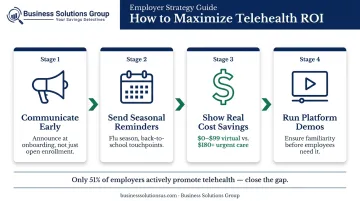
KFF 2021 data found that only 51% of employers that covered telehealth did additional promotion of those benefits to workers. That gap between availability and awareness is where ROI leaks out.
Closing that gap starts with measurement: benchmark current utilization, identify cost drivers, and restructure the program around outcomes. Business Solutions Group applies the same data-driven benchmarking used in supply chain optimization to healthcare benefits strategy — helping employers control benefits spend rather than absorb it as fixed overhead.
Conclusion
The advantages of telehealth compound when the benefit is used consistently. Lower claims costs reduce the per-employee expense of health coverage. Faster access to care keeps absences shorter and less frequent. Mental health support improves retention in the roles that matter most. Together, these gains make a measurable difference to both workforce health and the cost of maintaining it.
Sustaining those results takes ongoing promotion, vendor accountability, and integration with the broader benefits strategy. Employers who actively manage telehealth as part of their benefits program — rather than setting it and forgetting it — are the ones who capture the full return.
Frequently Asked Questions
What are the positive benefits of telehealth?
Telehealth improves healthcare access, reduces costs for both employers and employees, shortens time to treatment, and supports mental health by removing scheduling and cost barriers. For employers, the measurable outcomes include lower claims costs, reduced absenteeism, and stronger retention.
What are two advantages of employers offering healthcare benefits to employees?
Robust benefits — including telehealth — directly improve employee retention and reduce absenteeism. Both outcomes translate into lower operational costs and a more stable, engaged workforce .
What is the Telehealth Benefit Expansion for Workers Act?
H.R. 824, introduced in the 118th Congress, would allow employers to offer stand-alone telehealth benefits to all employees as excepted benefits — expanding access beyond standard group health plan coverage. As of mid-2026, the bill has not become law, so employers should monitor its progress as it could affect how standalone telehealth benefits are structured.
How does telehealth reduce healthcare costs for employers?
Telehealth diverts non-emergency care away from expensive ER and urgent care settings, lowers claims frequency, and enables early intervention before minor conditions escalate. Virtual visits cost significantly less than in-person alternatives at every level of care.
Does telehealth improve employee productivity?
Yes. By enabling faster access to care and reducing the time employees spend away from work for appointments, telehealth directly reduces both absenteeism (missed days) and presenteeism (working while too unwell to be effective).
How can employers encourage employees to use telehealth services?
Communicate clearly at onboarding and throughout the year, send seasonal reminders, and show employees the cost difference between virtual and in-person visits. Make telehealth easy to find through mobile-friendly tools integrated with existing coverage, and run brief platform demos before employees need them.